Paper I — Q4
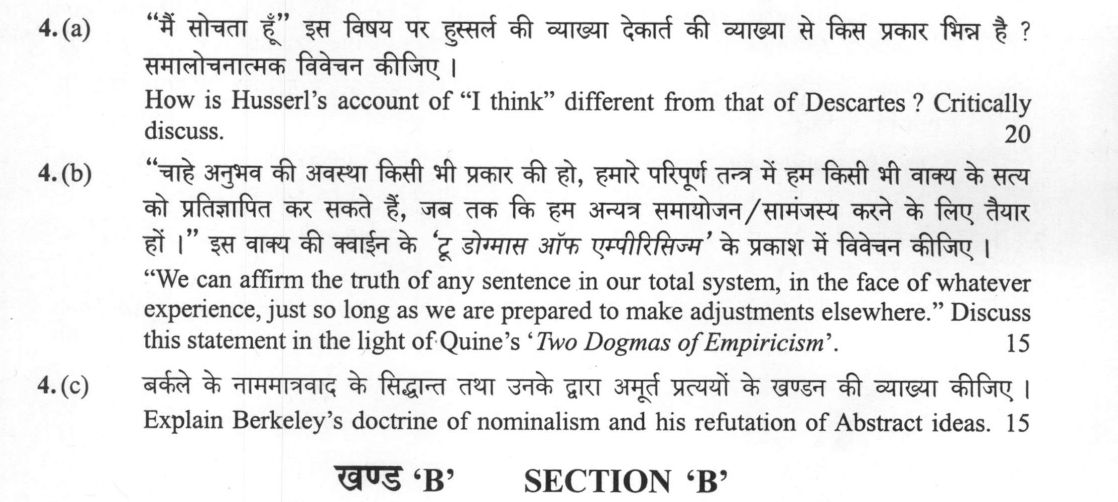
(a) How is Husserl's account of "I think" different from that of Descartes ? Critically discuss. 20 (b) "We can affirm the truth…
How is Husserl's account of "I think" different from that of Descartes ? Critically discuss. 20 marks
"We can affirm the truth of any sentence in our total system, in the face of whatever experience, just so long as we are prepared to make adjustments elsewhere." Discuss this statement in the light of Quine's 'Two Dogmas of Empiricism'. 15 marks
Explain Berkeley's doctrine of nominalism and his refutation of Abstract ideas. 15 marks
हिंदी में प्रश्न पढ़ें
"मैं सोचता हूँ" इस विषय पर हुसर्ल की व्याख्या देकार्त की व्याख्या से किस प्रकार भिन्न है ? समालोचनात्मक विवेचन कीजिए । 20
"चाहे अनुभव की अवस्था किसी भी प्रकार की हो, हमारे परिपूर्ण तंत्र में हम किसी भी वाक्य के सत्य को प्रतिज्ञापित कर सकते हैं, जब तक कि हम अन्यत्र समायोजन/सामंजस्य करने के लिए तैयार हैं ।" इस वाक्य की क्वाइन के 'टू डॉग्मास ऑफ एम्पीरिसिज्म' के प्रकाश में विवेचन कीजिए । 15
बर्कले के नाममात्रवाद के सिद्धांत तथा उनके द्वारा अमूर्त प्रत्ययों के खण्डन की व्याख्या कीजिए । 15
Model answer
Written by UPSC Answer Check against this question's marking rubric, to the expected length. UPSC does not publish answers for Mains — this is one way to score well, not an official key.
Modern epistemology is characterized by successive shifts in grounding subjectivity, linguistic meaning, and the external world, evolving from Cartesian foundationalism to intentional phenomenology, holistic pragmatism, and idealist nominalism.
Husserl versus Descartes: The Transformation of the "I Think"
Descartes arrives at the cogito (ego cogito, ergo sum) through radical methodical doubt, identifying the self as a substantial, thinking entity (res cogitans) separate from the extended world (res extensa). This renders the Cartesian self an isolated, self-evident substance, establishing certainty from which the existence of God and the external world must be deductively reconstructed.
Edmund Husserl fundamentally transforms this "I think" through his phenomenological method. Rather than doubting existence, Husserl applies the epoché (phenomenological reduction), bracketing the natural attitude to examine pure consciousness. For Husserl, consciousness is never an empty, self-contained substance; it is essentially intentional—always consciousness-of something. The "I think" is thus not a static entity but an intentional act structured by the correlation between noesis (the subjective act of meaning-bestowal) and noema (the objective meaning-correlate as intended).
Critically, early formulations of Husserl’s transcendental reduction risked falling back into Cartesian solipsism, as the ego remained the sole source of meaning constitution. However, Husserl successfully departs from Cartesian dualism by demonstrating that the ego is intrinsically world-directed. In his later philosophy, Husserl resolves the solipsistic dilemma through the theory of transcendental intersubjectivity—where the alter-ego is recognized through appresentation—and by grounding all meaning in the pre-predicative Lifeworld (Lebenswelt). Thus, Husserl replaces Descartes' metaphysical, isolated substance with an intentional, intersubjectively constituted field of meaning.
Quine's Holism: The Web of Belief and the Two Dogmas
In Two Dogmas of Empiricism, W.V.O. Quine rejects both the analytic-synthetic distinction and verificationist reductionism championed by Rudolf Carnap. Carnap maintained that individual synthetic statements could be isolated and verified against distinct sensory experiences. Quine contends instead that our statements about the external world face the tribunal of sense experience not individually, but only as a corporate body.
This establishes Quine's "web of belief" or confirmation holism. The total system of science is a man-made fabric impinging on experience only along the edges (the periphery). If an recalcitrant experience conflicts with the system, equilibrium can be restored by re-evaluating statements anywhere within the network. Peripheral, empirical observations are readily revised, whereas core principles—such as the laws of logic and mathematics—are heavily insulated. Nevertheless, no statement is immune to revision, nor is any statement entirely immune to recalcitrant experience if we make sufficiently radical adjustments elsewhere in the web.
This holistic view entails the underdetermination of theory by evidence and ontological relativity. While coherentist in structure, Quine’s radical holism avoids pure idealism by retaining the empirical periphery, transforming traditional foundational empiricism into a pragmatic, fallibilist naturalism.
Berkeley's Nominalism and the Rejection of Abstract Ideas
George Berkeley’s nominalism is intrinsically bound to his immaterialist thesis that esse est percipi (to be is to be perceived). Berkeley asserts that only particular, determinate ideas and the minds perceiving them can exist; an idea cannot exist unperceived, nor can it possess indeterminate properties.
Accordingly, Berkeley mounts a decisive critique against John Locke's doctrine of abstract general ideas. Locke argued that the mind forms a general idea of a triangle by abstracting away specific characteristics, creating an idea that is "neither oblique nor rectangle, neither equilateral, equicrural, nor scalenon, but all and none of these at once." Berkeley demonstrates that such an idea is logically impossible and psychologically unrepresentable; one cannot imagine a triangle that has no determinate shape or size. For Berkeley, generality belongs exclusively to language and signs: a general idea is simply a particular idea made to represent a class of other particular ideas based on resemblance.
To avoid complete skepticism regarding non-sensory knowledge, Berkeley introduces the doctrine of "notions," which accounts for our knowledge of minds, mental operations, and relations without admitting abstract ideas. Berkeley thereby preserves an uncompromising conceptual nominalism, purging empiricism of unobservable material and abstract entities.
Conclusion
These three frameworks articulate distinct responses to the crisis of representation: Husserl dynamically bridges subject and object through intentional phenomenology, Quine dissolves foundational certainty into holistic pragmatism, and Berkeley purges abstract ontology in favour of radical empirical particularism.
What "Critically discuss" is asking you to do
Lay the issue out from more than one side — how it arose, what is claimed for it, what is held against it, and where it now stands. UPSC attaches discuss to broad topics with several live dimensions, so coverage of the dimensions earns more than the strength of your opinion. “Critically” is not a section added at the end: name the yardstick you are judging by — the evidence, the stated objective, a constitutional principle, a rival explanation — and let a verdict close each part of the body. Where the question quotes a claim, that verdict must land on the claim itself, accepted, qualified or rejected, and not on the theme in general.
Structure that answers it
Set the issue up → the case as it is made → the case against → the dimension both sides leave out → where the balance now lies
Where marks are lost
Merits in one paragraph, demerits in the next, and a conclusion calling for a balanced and holistic approach. That is a survey with the judgement left out and it holds the answer in the middle band. The opposite error is reading “critically” as permission to attack — and with the odd pairings, critically describe or critically explain, the exposition still carries most of the marks, the judgement being a layer on it rather than a substitute for it.
How this answer will be evaluated
Approach
Framework: UPSC Philosophy Paper 1. (a) discuss: intro > 3-4 dimensions > example > balanced close | (b) discuss: intro > 3-4 dimensions > example > balanced close | (c) explain: definition/context > points in order > small example > short close Full marks: Precise technical vocabulary, clear reconstruction of arguments, strong counter-arguments, and balanced evaluation.
Key points expected
- Descartes' cogito as foundation of substance dualism
- Husserl's ego as transcendental pole of intentionality
- Distinction between 'I think' and 'I am'
- Role of phenomenological reduction (epoché) in Husserl
- Definition of the 'Two Dogmas' (analytic/synthetic, reductionism)
- Explanation of the 'web of belief' metaphor
- Quine's argument against the analytic-synthetic distinction
- Implications for the nature of empirical knowledge
Evaluation rubric
Each sub-part is marked on its own, against the marks and word limit printed on the paper.
- (a) Compare Husserl's phenomenological ego with Descartes' cogito, highlighting the shift from substance to act. 20 marks
discuss— intro → 3-4 dimensions → example → balanced close
Must cover
- Descartes' cogito as foundation of substance dualism
- Husserl's ego as transcendental pole of intentionality
- Distinction between 'I think' and 'I am'
- Role of phenomenological reduction (epoché) in Husserl
Loses marks
- Biographical details of Descartes or Husserl
- Treating Husserl as a simple empiricist
Earns more
- Reference to Husserl's 'Cartesian Meditations'
- Mention of 'noema' and 'noesis' structure
- Critique of Husserl's 'solipsism' objection
Extra mark
- Use of Greek terms: noesis, noema, epoché
- (b) Explain Quine's rejection of the analytic-synthetic distinction and the dogma of reductionism. 15 marks
discuss— intro → 3-4 dimensions → example → balanced close
Must cover
- Definition of the 'Two Dogmas' (analytic/synthetic, reductionism)
- Explanation of the 'web of belief' metaphor
- Quine's argument against the analytic-synthetic distinction
- Implications for the nature of empirical knowledge
Loses marks
- Confusing Quine with logical positivism
- Failing to define the 'dogmas' clearly
Earns more
- Reference to 'confirmation holism'
- Mention of 'underdetermination of theory by data'
Extra mark
- Reference to Quine's 'Ontological Relativity'
- (c) Detail Berkeley's rejection of abstract ideas and his nominalist view of universals. 15 marks
explain— definition/context → points in order → small example → short close
Must cover
- Berkeley's argument against the 'abstract triangle'
- The 'impossibility' of separating qualities from objects
- Nominalism: universals as names, not real entities
- Connection to his idealism (esse est percipi)
Loses marks
- Confusing Berkeley's nominalism with Locke's
- Failing to link nominalism to his anti-realist metaphysics
Earns more
- Reference to 'Principles of Human Knowledge'
- Mention of 'particulars' vs 'universals'
Extra mark
- Reference to 'Three Dialogues between Hylas and Philonous'
Practice this exact question
Write your answer and it is marked point by point against the model answer above — what you covered, what you missed, what you got wrong.
Evaluate my answer →More from Philosophy 2025 Paper I
- Q1 Answer the following questions in about 150 words each : 10×5=50 (a) "Ideas are timeless…
- Q2 (a) What are the basic tenets of Rationalism ? How does Descartes build a system of Philo…
- Q3 (a) "We should look not to an ideal language which derives its meaning from facts and has…
- Q4 (a) How is Husserl's account of "I think" different from that of Descartes ? Critically d…
- Q5 Answer the following questions in about 150 words each : 10×5=50 (a) Explain the ground o…
- Q6 (a) Present a detailed account of Gautama's definition of Perception. 20 (b) How is Brahm…
- Q7 (a) Why does Śaṃkara consider Sāṃkhya Philosophy as his chief opponent (pradhāna malla) ?…