Paper I — Q7
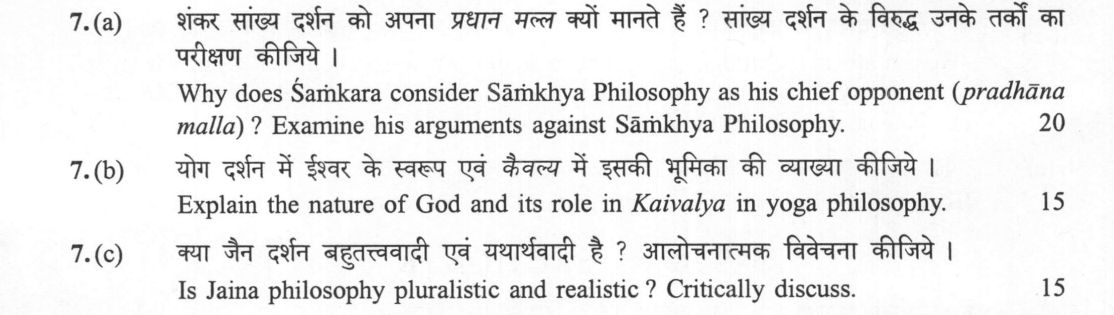
(a) Why does Śaṃkara consider Sāṃkhya Philosophy as his chief opponent (pradhāna malla) ? Examine his arguments against Sāṃkhya…
Why does Śaṃkara consider Sāṃkhya Philosophy as his chief opponent (pradhāna malla) ? Examine his arguments against Sāṃkhya Philosophy. 20 marks
Explain the nature of God and its role in Kaivalya in yoga philosophy. 15 marks
Is Jaina philosophy pluralistic and realistic ? Critically discuss. 15 marks
हिंदी में प्रश्न पढ़ें
शंकर सांख्य दर्शन को अपना प्रधान मल्ल क्यों मानते हैं ? सांख्य दर्शन के विरुद्ध उनके तर्कों का परीक्षण कीजिए । 20
योग दर्शन में ईश्वर के स्वरूप एवं कैवल्य में इसकी भूमिका की व्याख्या कीजिए । 15
क्या जैन दर्शन बहुतत्ववादी एवं यथार्थवादी है ? आलोचनात्मक विवेचना कीजिए । 15
Model answer
Written by UPSC Answer Check against this question's marking rubric, to the expected length. UPSC does not publish answers for Mains — this is one way to score well, not an official key.
These systems are best read as competing answers to the same problem: what is ultimately real, how liberation is possible, and how truth must be stated.
Śaṃkara and Sāṃkhya Śaṃkara calls Sāṃkhya his chief opponent because of its structural proximity to Advaita. Both are jñāna-yoga systems that accept mokṣa, renunciation and the transcendence of duḥkha, yet Sāṃkhya makes prakṛti, not Brahman, the ultimate material ground. This makes it the most dangerous rival: it offers a plausible path to liberation while denying the non-dual identity of jīva and Brahman. In the Brahmasūtra-bhāṣya, especially II.2.1–10, Śaṃkara does not reject satkāryavāda as such; he rejects Sāṃkhya’s parināmavāda, the claim that the world is a real transformation of prakṛti. For Śaṃkara, if prakṛti were an independent cause, Brahman would become unnecessary; if Brahman is the only reality, prakṛti is only an apparent manifestation. If prakṛti is insentient, it cannot be the efficient cause of a conscious, purposeful universe. Teleology cannot arise from an unconscious cause, and an insentient substance cannot generate intelligence. If puruṣa is pure witness, how can it be affected by prakṛti? Real contact is impossible for consciousness, while mere dependence gives no agency. Śaṃkara also presses the Sāṃkhya problem of how one prakṛti can respond to many puruṣas without an intelligent controller. Thus the Sāṃkhya account of puruṣa-prakṛti interaction is either unintelligible or collapses into a hidden cause. Scripturally, dualism conflicts with jīva-brahma-aikya: the Upaniṣads teach recognition of one’s identity with Brahman, not separation from a material principle. Hence Sāṃkhya is the pradhāna malla because it shares Advaita’s soteriology but contests its metaphysical foundation.
Īśvara and kaivalya in Yoga In Pātañjala Yoga, Īśvara is not a creator or world-governor. He is a viśeṣa-puruṣa, a special puruṣa not dependent on the created and untouched by kleshas, karma, vipāka and latent impressions. He is eternal consciousness, distinct from ordinary puruṣas and from prakṛti. In Yoga-sūtra I.23–29, īśvara-praṇidhāna is presented as a means: Īśvara is the object of devotion, the model yogin and the omniscient teacher. His role in kaivalya is not to grant liberation directly. Through devotion and concentration, the practitioner’s citta-vṛttis are stilled and klesha-karma-vipāka-śayyāpahāra occurs, enabling samādhi. Kaivalya is the isolation of puruṣa in its own svabhāva, the complete cessation of citta-vṛttis and return to intrinsic consciousness. Īśvara is the witness of all, but not the doer; his bhakti is not theistic salvation but a yogic aid. Īśvara therefore functions as a support and exemplar, not as a soteriological agent.
Jaina pluralism and realism Jaina philosophy is pluralistic because anekāntavāda rejects ekānta, the claim that one standpoint exhausts reality. Reality has many aspects, and different nayas disclose different determinations. Syādvāda and saptabhaṅgī-nyāya express this by predicating existence, non-existence, both, and indescribability conditionally, thereby avoiding absolutism. It is also realist: jīva and ajīva are accepted as independently real categories, and sat is defined as utpāda-vyaya-dhrauvya-yuktaṃ sat, that is, existence involving production, destruction and permanence. Reality is not merely a mental construction; it has a permanent essence amid pariṇāma. The critical question is whether this realism is robust. Jaina epistemology is perspectival, since every statement is conditioned by a naya; this can appear constructivist. Yet syādvāda is not subjectivism: it claims multiple determinations of an objective reality, and saptabhaṅgī aims at completeness rather than denial. This pluralism is not relativism, because the seven-fold formula is meant to capture the full ontological status of an entity, not to deny it. Thus Jaina thought is pluralistic and realist, but a qualified, perspectival realism.
Together, these debates shaped classical Indian epistemology and metaphysics. Śaṃkara’s critique sharpened the distinction between real transformation and apparent manifestation; Yoga’s Īśvara showed devotion as a discipline within a realist metaphysics; and Jaina pluralism expanded truth beyond monistic assertion.
What "Critically examine" is asking you to do
Test the proposition the question puts to you and return a finding on how far it holds. Examine stems carry a claim, or ask whether something has happened, and expect evidence weighed both ways before the extent is stated — often with remedial measures attached. “Critically” is not a section added at the end: name the yardstick you are judging by — the evidence, the stated objective, a constitutional principle, a rival explanation — and let a verdict close each part of the body. Where the question quotes a claim, that verdict must land on the claim itself, accepted, qualified or rejected, and not on the theme in general.
Structure that answers it
Restate the claim as the question frames it → evidence that supports it → evidence that undercuts it → the conditions under which it holds → verdict on how far it stands
Where marks are lost
Merits in one paragraph, demerits in the next, and a conclusion calling for a balanced and holistic approach. That is a survey with the judgement left out and it holds the answer in the middle band. The opposite error is reading “critically” as permission to attack — and with the odd pairings, critically describe or critically explain, the exposition still carries most of the marks, the judgement being a layer on it rather than a substitute for it.
How this answer will be evaluated
Approach
Framework: UPSC Philosophy Paper 1. (a) examine: intro > how/why with reasoning > evidence > conclusion | (b) explain: definition/context > points in order > small example > short close | (c) discuss: intro > 3-4 dimensions > example > balanced close Full marks: Precise Sanskrit terminology, clear reconstruction of arguments, and strong critical evaluation.
Key points expected
- Define 'pradhāna malla' and Śaṃkara's specific objection to Sāṃkhya.
- Reconstruct the argument against the independent status of Prakṛti.
- Explain the critique of the Sāṃkhya theory of evolution (Vikāra-vāda).
- Contrast Sāṃkhya's dualism with Śaṃkara's non-dualism (Advaita).
- Define Īśvara as the 'Puruṣa' free from Klesas (afflictions).
- Distinguish Īśvara from the general Puruṣa (Puruṣa-vyāvṛtti).
- Explain Īśvara's role as a means (upāya) for the practitioner.
- Clarify that Īśvara is not the cause of Kaivalya itself.
Evaluation rubric
Each sub-part is marked on its own, against the marks and word limit printed on the paper.
- (a) Reconstruct Śaṃkara's critique of Sāṃkhya as the primary opponent (pradhāna malla). 20 marks
examine— intro → how/why with reasoning → evidence → conclusion
Must cover
- Define 'pradhāna malla' and Śaṃkara's specific objection to Sāṃkhya.
- Reconstruct the argument against the independent status of Prakṛti.
- Explain the critique of the Sāṃkhya theory of evolution (Vikāra-vāda).
- Contrast Sāṃkhya's dualism with Śaṃkara's non-dualism (Advaita).
Loses marks
- Biographical details of Śaṃkara or Kapila.
- Vague paraphrase of Sāṃkhya without specific refutation.
- Confusing Sāṃkhya with Yoga or Nyāya arguments.
Earns more
- Mention the 'Sāṃkhya Kārikā' as the primary text refuted.
- Use precise Sanskrit terms: Prakṛti, Puruṣa, Tattvas, Ahaṃkāra.
- Reference the 'Brahma Sūtra Bhaṣya' or 'Upadeśa Sāhasrī'.
Extra mark
- Cite specific verses from the Brahma Sūtra Bhaṣya.
- Mention the 'Sāṃkhya Kārikā' verses refuted by Śaṃkara.
- (b) Define the nature of Īśvara and its specific function in achieving Kaivalya. 15 marks
explain— definition/context → points in order → small example → short close
Must cover
- Define Īśvara as the 'Puruṣa' free from Klesas (afflictions).
- Distinguish Īśvara from the general Puruṣa (Puruṣa-vyāvṛtti).
- Explain Īśvara's role as a means (upāya) for the practitioner.
- Clarify that Īśvara is not the cause of Kaivalya itself.
Loses marks
- Describing Īśvara as a creator God (Sāṃkhya view).
- Confusing Yoga with Vedānta concepts of Brahman.
- Ignoring the technical definition of Kaivalya.
Earns more
- Reference the 'Yoga Sūtra' (1.23-1.26).
- Use terms: Klesas, Vṛtti, Citta, Kaivalya.
- Mention the concept of 'Īśvara-praṇidhāna'.
Extra mark
- Cite specific Yoga Sūtras (1.23-1.26).
- Mention the 'Om' mantra as the symbol of Īśvara.
- (c) Evaluate the pluralistic and realistic nature of Jaina metaphysics. 15 marks
discuss— intro → 3-4 dimensions → example → balanced close
Must cover
- Define Jaina pluralism (Jiva/Dravya categories).
- Explain the theory of Anekāntavāda (many-sidedness).
- Discuss the theory of Syādvāda (conditional predication).
- Critique the 'realism' of the Jaina view of the soul.
Loses marks
- Treating Jaina philosophy as purely monistic.
- Ignoring the epistemological aspect (Syādvāda).
- Vague generalities without specific Jaina terminology.
Earns more
- Use terms: Dravya, Guṇa, Paryāya, Anekāntavāda.
- Reference the 'Tattvārtha Sūtra' or 'Nayācāra'.
- Mention the 'Saptabhaṅgī' (seven-fold predication).
Extra mark
- Cite specific 'Nayas' (standpoints) like 'Dravya-naya'.
- Mention the 'Saptabhaṅgī' (seven-fold predication) explicitly.
Practice this exact question
Write your answer and it is marked point by point against the model answer above — what you covered, what you missed, what you got wrong.
Evaluate my answer →More from Philosophy 2025 Paper I
- Q4 (a) How is Husserl's account of "I think" different from that of Descartes ? Critically d…
- Q5 Answer the following questions in about 150 words each : 10×5=50 (a) Explain the ground o…
- Q6 (a) Present a detailed account of Gautama's definition of Perception. 20 (b) How is Brahm…
- Q7 (a) Why does Śaṃkara consider Sāṃkhya Philosophy as his chief opponent (pradhāna malla) ?…
- Q8 (a) Discuss the idea of Bimba-pratibimbavāda as presented in Vedanta philosophy along wit…