Paper II — Q1
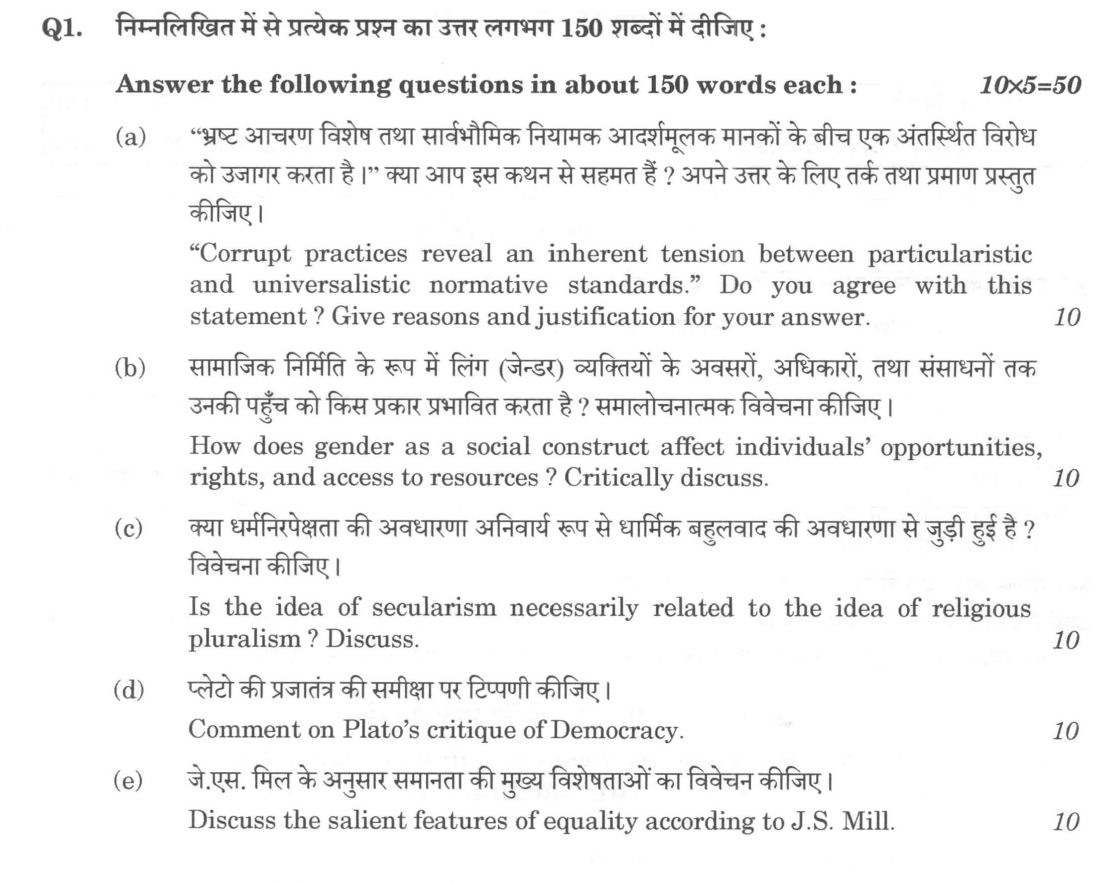
Answer the following questions in about 150 words each: (a) "Corrupt practices reveal an inherent tension between…
Answer the following questions in about 150 words each:
"Corrupt practices reveal an inherent tension between particularistic and universalistic normative standards." Do you agree with this statement ? Give reasons and justification for your answer. 10 marks
How does gender as a social construct affect individuals' opportunities, rights, and access to resources ? Critically discuss. 10 marks
Is the idea of secularism necessarily related to the idea of religious pluralism ? Discuss. 10 marks
Comment on Plato's critique of Democracy. 10 marks
Discuss the salient features of equality according to J.S. Mill. 10 marks
हिंदी में प्रश्न पढ़ें
निम्नलिखित में से प्रत्येक प्रश्न का उत्तर लगभग 150 शब्दों में दीजिए :
"भ्रष्ट आचरण विशेष तथा सार्वभौमिक नियामक आदर्शमूलक मानकों के बीच एक अंतर्निहित विरोध को उजागर करता है।" क्या आप इस कथन से सहमत हैं ? अपने उत्तर के लिए तर्क तथा प्रमाण प्रस्तुत कीजिए। (10 अंक)
सामाजिक निर्मिति के रूप में लिंग (जेंडर) व्यक्तियों के अवसरों, अधिकारों, तथा संसाधनों तक उनकी पहुँच को किस प्रकार प्रभावित करता है ? समालोचनात्मक विवेचना कीजिए। (10 अंक)
क्या धर्मनिरपेक्षता की अवधारणा अनिवार्य रूप से धार्मिक बहुलवाद की अवधारणा से जुड़ी हुई है ? विवेचना कीजिए। (10 अंक)
प्लेटो की प्रजातंत्र की समीक्षा पर टिप्पणी कीजिए। (10 अंक)
जे.एस. मिल के अनुसार समानता की मुख्य विशेषताओं का विवेचन कीजिए। (10 अंक)
Model answer
Written by UPSC Answer Check against this question's marking rubric, to the 150-word length. UPSC does not publish answers for Mains — this is one way to score well, not an official key.
(a) Particularistic vs Universalistic Standards in Corruption
Corruption fundamentally emerges from a clash between particularistic norms—obligations grounded in personal loyalty, kinship, caste, and local community—and universalistic standards, which demand impartial adherence to the rule of law, Kantian categorical duty, and Rawlsian fairness. In particularistic moral frameworks, assisting one’s kin or community through nepotism or patronage is perceived as a moral duty. However, modern public administration demands universalism, where public offices are held in trust and decisions must be strictly blind to personal affiliations.
This tension was recognized early by Kautilya in the Arthashastra, where he noted the difficulty of preventing public servants from diverting state resources toward personal and clan networks. In contemporary India, corrupt acts such as clientelism and preferential contract allotment reflect this moral dissonance, where familial or community loyalty overrides institutional ethics. Resolving this conflict, as highlighted by the Second Administrative Reforms Commission, necessitates not merely punitive measures, but institutionalizing a robust ethical infrastructure that firmly establishes the supremacy of universal public duty over particularistic loyalties.
(b) Gender as a Social Construct
Gender operates as a socially and culturally enforced hierarchy distinct from biological sex. As Simone de Beauvoir asserted, "One is not born, but rather becomes, a woman," a view extended by Judith Butler’s theory of gender performativity, which posits that gender is continually produced through repetitive social acts and disciplinary norms.
This construct critically impairs individuals' opportunities, rights, and access to resources. In the sphere of opportunities, gendered division of labour naturalizes unpaid care work and restricts women to secondary, low-wage sectors, suppressing female labour force participation. Regarding rights, patriarchal norms have historically compromised women’s bodily autonomy and equal inheritance, necessitating legislative correctives like the Hindu Succession (Amendment) Act, 2005. Access to resources is similarly skewed; son meta-preference generates systemic disparities in nutrition, higher education, and healthcare. While welfare legislations like the Maternity Benefit Amendment Act attempt to mitigate these disadvantages, fully dismantling gender inequality requires challenging the deeply embedded normative beliefs that structure institutional practices.
(c) Secularism and Religious Pluralism
Secularism and religious pluralism are analytically distinct yet normatively intertwined concepts. Religious pluralism is both an empirical fact—the coexistence of diverse faiths—and a normative endorsement of peaceful, equal coexistence. Secularism, by contrast, denotes a political doctrine concerning the appropriate relationship between the state and religion.
The two concepts do not always co-occur identically. Under French laïcité, secularism is defined as strict separation and the privatization of religion, which can sometimes constrain public pluralistic expressions, such as the wearing of religious symbols. Conversely, Indian secularism, conceptualized as Sarva Dharma Sambhava (equal respect for all religions) and articulated by Rajeev Bhargava as "principled distance," is inherently designed to accommodate deep religious pluralism. Here, the state may intervene to reform oppressive practices (such as untouchability under Article 17) while extending equal protection and subsidies across communities (Articles 25–30). As Charles Taylor observes in multicultural theory, secularism in diverse societies must evolve beyond mere institutional wall-building to actively protect and foster pluralistic coexistence.
(d) Plato's Critique of Democracy
In Books VIII and IX of the Republic, Plato offers a foundational critique of democracy, characterizing it as a degenerated regime that prioritizes unbridled liberty over virtue and order. Plato's primary objection rests on his critique of democratic equality: it distributes a sort of equality to unequals and equals alike, employing mechanical numerical equality rather than proportional justice based on merit and wisdom.
Plato illustrates this through the "Ship of State" analogy, where the shipowner (the populace) is easily duped by mutinous, unqualified sailors (demagogues), while the true navigator—the philosopher possessing genuine epistemic knowledge—is dismissed as a useless stargazer. Furthermore, Plato argues that the "democratic man" lacks an internal hierarchy of the soul, treating all desires, base and noble, with equal standing. While modern democratic theory rejects Plato's authoritarian paternalism and values democratic self-correction, his critique remains profoundly relevant as a warning against populism, majoritarian passion, and the erosion of expert knowledge by demagoguery.
(e) Salient Features of Equality according to J.S. Mill
J.S. Mill’s conception of equality represents a significant departure from Jeremy Bentham’s quantitative utilitarianism. While Bentham maintained that "each is to count for one, and nobody for more than one," treating all pleasures as qualitatively equal, Mill introduced a qualitative distinction, linking equality directly to human flourishing, intellectual development, and individuality.
For Mill, equality is anchored in the Harm Principle articulated in On Liberty, which guarantees equal negative freedom to all rational adults to pursue their own good, provided they do not harm others. In The Subjection of Women, Mill advanced a radical egalitarian stance for his era, arguing that the legal and social subordination of women was a relic of the past and a major hindrance to human development. He demanded equal political rights, women's suffrage, and equal access to education and employment. Unlike radical socialist models, Mill championed equality of opportunity, legal status, and moral agency rather than absolute equality of outcome, cautioning against the "tyranny of the majority" suppressing individual eccentricity.
What "Discuss" is asking you to do
Lay the issue out from more than one side — how it arose, what is claimed for it, what is held against it, and where it now stands. UPSC attaches discuss to broad topics with several live dimensions, so coverage of the dimensions earns more than the strength of your opinion.
Structure that answers it
Set the issue up → the case as it is made → the case against → the dimension both sides leave out → where the balance now lies
Where marks are lost
Listing facts with no thread between them, or arguing one side throughout and calling it a discussion.
How this answer will be evaluated
Approach
Framework: UPSC Mains Philosophy Paper II. (a) justify: claim > 3-4 reasons > evidence > conclusion | (b) critique: the claim > its strengths > its weaknesses > your judgment | (c) discuss: intro > 3-4 dimensions > example > balanced close | (d) comment: context > arguments both sides > judgment > close | (e) discuss: intro > 3-4 dimensions > example > balanced close Full marks: Precise definitions, strong arguments, concrete examples, balanced judgment
Key points expected
- Define particularistic vs universalistic normative standards
- Explain how corruption prioritizes particularistic loyalty
- Identify the inherent tension in the conflict
- Provide a concrete example of the tension
- Define gender as a social construct
- Analyze impact on opportunities (e.g., education, jobs)
- Analyze impact on rights and resource access
- Provide a critical evaluation of the construct
Evaluation rubric
Each sub-part is marked on its own, against the marks and word limit printed on the paper.
- (a) Justify the claim that corruption reveals tension between particularistic and universalistic standards. 10 marks · 150 words
justify— claim → 3-4 reasons → evidence → conclusion
Must cover
- Define particularistic vs universalistic normative standards
- Explain how corruption prioritizes particularistic loyalty
- Identify the inherent tension in the conflict
- Provide a concrete example of the tension
Loses marks
- Vague definition of corruption
- Ignoring the 'normative standards' aspect
- Biographical details of anti-corruption activists
Earns more
- Reference to Merton's anomie
- Reference to Rawls' justice as fairness
- Distinction between 'gift' and 'bribe'
Extra mark
- Reference to specific Indian corruption case
- Reference to specific anti-corruption statute
- (b) Critically discuss how gender as a social construct affects opportunities, rights, and resources. 10 marks · 150 words
critique— the claim → its strengths → its weaknesses → your judgment
Must cover
- Define gender as a social construct
- Analyze impact on opportunities (e.g., education, jobs)
- Analyze impact on rights and resource access
- Provide a critical evaluation of the construct
Loses marks
- Treating gender as purely biological
- Ignoring the 'social construct' aspect
- Generalizing without specific examples
Earns more
- Reference to Simone de Beauvoir
- Reference to Judith Butler
- Distinction between sex and gender
Extra mark
- Reference to specific gender equality law
- Reference to specific gender gap statistic
- (c) Discuss the relationship between secularism and religious pluralism. 10 marks · 150 words
discuss— intro → 3-4 dimensions → example → balanced close
Must cover
- Define secularism in a political context
- Define religious pluralism
- Analyze the necessary relationship between the two
- Provide a balanced conclusion on their interplay
Loses marks
- Equating secularism with atheism
- Ignoring the 'necessarily related' aspect
- Vague definitions of key terms
Earns more
- Reference to Indian model of secularism
- Reference to Western model of secularism
- Distinction between state and religion
Extra mark
- Reference to specific constitutional provision
- Reference to specific court judgment
- (d) Comment on Plato's critique of Democracy. 10 marks · 150 words
comment— context → arguments both sides → judgment → close
Must cover
- Identify Plato's main arguments against democracy
- Explain the 'ship of state' analogy
- Discuss the concept of 'mob rule'
- Provide a balanced judgment on his critique
Loses marks
- Biographical details of Plato
- Ignoring the 'critique' aspect
- Vague paraphrase of Plato's arguments
Earns more
- Reference to 'The Republic'
- Reference to 'The Statesman'
- Distinction between democracy and oligarchy
Extra mark
- Reference to specific modern democratic failure
- Reference to specific modern democratic success
- (e) Discuss the salient features of equality according to J.S. Mill. 10 marks · 150 words
discuss— intro → 3-4 dimensions → example → balanced close
Must cover
- Define Mill's concept of equality
- Explain the role of utility in his theory
- Discuss the 'harm principle' in relation to equality
- Provide a balanced conclusion on his theory
Loses marks
- Biographical details of Mill
- Ignoring the 'salient features' aspect
- Vague paraphrase of Mill's arguments
Earns more
- Reference to 'On Liberty'
- Reference to 'Utilitarianism'
- Distinction between formal and substantive equality
Extra mark
- Reference to specific modern equality law
- Reference to specific modern equality case
Practice this exact question
Write your answer and it is marked point by point against the model answer above — what you covered, what you missed, what you got wrong.
Evaluate my answer →More from Philosophy 2025 Paper II
- Q1 Answer the following questions in about 150 words each: (a) "Corrupt practices reveal an…
- Q2 (a) Present a detailed account of the debate between Gandhi and Ambedkar on the issue of…
- Q3 (a) Can one's right to life be absolute ? Answer with reference to the idea of Capital Pu…
- Q4 (a) How are both equality and liberty inadequate as social and political ideals without j…