Paper II — Q7
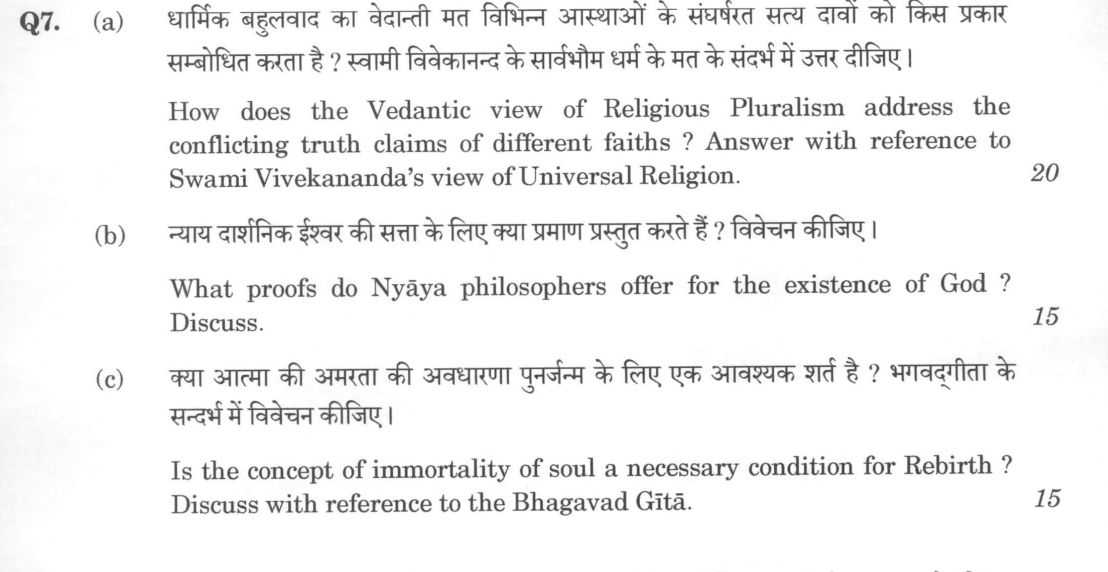
(a) How does the Vedantic view of Religious Pluralism address the conflicting truth claims of different faiths ? Answer with…
How does the Vedantic view of Religious Pluralism address the conflicting truth claims of different faiths ? Answer with reference to Swami Vivekananda's view of Universal Religion. 20 marks
What proofs do Nyāya philosophers offer for the existence of God ? Discuss. 15 marks
Is the concept of immortality of soul a necessary condition for Rebirth ? Discuss with reference to the Bhagavad Gītā. 15 marks
हिंदी में प्रश्न पढ़ें
धार्मिक बहुलवाद का वेदान्ती मत विभिन्न आस्थाओं के संघर्षरत सत्य दावों को किस प्रकार सम्बोधित करता है ? स्वामी विवेकानन्द के सार्वभौम धर्म के मत के सन्दर्भ में उत्तर दीजिए। (20 अंक)
न्याय दार्शनिक ईश्वर की सत्ता के लिए क्या प्रमाण प्रस्तुत करते हैं ? विवेचन कीजिए। (15 अंक)
क्या आत्मा की अमरता की अवधारणा पुनर्जन्म के लिए एक आवश्यक शर्त है ? भगवद्गीता के सन्दर्भ में विवेचन कीजिए। (15 अंक)
Model answer
Written by UPSC Answer Check against this question's marking rubric, to the expected length. UPSC does not publish answers for Mains — this is one way to score well, not an official key.
Vedantic pluralism and Vivekananda Vedanta addresses conflicting truth claims by separating the ultimate from the empirical. In Advaita, Brahman is one non-dual reality, and the individual self is identical with it; religions differ in names, forms, rituals, deities, and institutions, but point to the same ground. Vivekananda’s Universal Religion is not a new dogma, but the recognition that every genuine religion aims at realizing divinity in the self. He distinguishes the essential core—spiritual realization, ethics, devotion, knowledge, selfless action—from non-essential accretions such as ritualism, caste prejudice, sectarian exclusivism, and institutional power. Conflicting claims are handled through ekam sat vipra bahudha vadanti: one truth is spoken of in many ways. The four Yogas—karma, bhakti, jnana, raja—are not rival systems but complementary paths adapted to temperaments. This makes Vivekananda’s pluralism ontological rather than merely tolerant: if all souls are Atman, no faith can monopolize salvation. He rejects proselytization and religious imperialism, urging respect for all religions as expressions of the same divine reality. A difficulty is that historical and moral conflicts may be reduced to provisional differences, but the view still provides a Vedantic basis for coexistence.
Nyāya proofs Udayana’s Nyāyakusumāñjali gives five formal proofs for Īśvara: from the world as effect (kāryāt), from its combination/arrangement (āyojanāt), from its support (dhṛtyādeḥ), from its dissolution/destruction (padāt), and from its being cognized (pratyayataḥ). The first argues that the world is an effect and needs an efficient cause; the second that ordered combination cannot arise from inert matter; the third that continued existence needs a sustainer; the fourth that dissolution needs a conscious agent; and the fifth that being known points to an ultimate knower. Udayana infers Īśvara as nimitta-kāraṇa: the world is an *apurva*-like result not explicable by unconscious pradhāna or atoms. Pradhāna lacks intention, knowledge, and will, so it cannot produce, arrange, maintain, dissolve, or cognize the world. Related Nyāya discussions of adṛṣṭa and śabda support the same conclusion, but the formal five are these worldly arguments. Thus God is inferred from experience and logic, not merely revealed; this makes Nyāya a theistic rationalism, not a mere article of faith.
Gita, immortality and rebirth In the Gita, rebirth (dehāntara-prāpti) is the change of bodies (2.13, 2.22), while the self is avināśi, unborn, indestructible, and eternal (2.20-25). Immortality is logically prior to rebirth: if the self perishes with the body, there is no subject to migrate, and Carvaka denial of the soul thus denies transmigration. But immortality alone is not sufficient. The Gita ties rebirth to karma, desire, and ignorance; the bound jiva transmigrates according to karma, while the liberated jivanmukta remains immortal but free from further birth. Thus immortality is a necessary condition, not a sufficient one. Buddhism’s anātmavada shows that some traditions posit rebirth without a permanent soul, but within Gita’s metaphysics, rebirth presupposes an enduring atman plus karmic bondage. The Gita therefore separates survival from transmigration: the soul’s permanence makes rebirth possible; karma makes it actual. This also answers the objection that an immortal soul might simply persist without changing bodies: persistence is not the same as saṃsāric return. Hence the Gita’s rebirth is not mere survival but morally conditioned renewal, and immortality is its metaphysical precondition.
Taken together, these positions show a distinctive Indian pluralism. Vivekananda’s universalism grounds religious coexistence in one Atman-Brahman; Nyāya supplies rational inference for a conscious creator; and the Gita links eternal selfhood with karmic bondage and liberation. The result is not a single system but a coherent family of views: truth is one, paths are many, God can be reasoned, and rebirth depends on both immortality and moral causation.
What "Discuss" is asking you to do
Lay the issue out from more than one side — how it arose, what is claimed for it, what is held against it, and where it now stands. UPSC attaches discuss to broad topics with several live dimensions, so coverage of the dimensions earns more than the strength of your opinion.
Structure that answers it
Set the issue up → the case as it is made → the case against → the dimension both sides leave out → where the balance now lies
Where marks are lost
Listing facts with no thread between them, or arguing one side throughout and calling it a discussion.
How this answer will be evaluated
Approach
Framework: Vedantic Pluralism, Nyāya Epistemology, Bhagavad Gītā Soteriology. (a) explain: definition/context > points in order > small example > short close | (b) discuss: intro > 3-4 dimensions > example > balanced close | (c) discuss: intro > 3-4 dimensions > example > balanced close Full marks: Precise technical vocabulary, strong argument reconstruction, clear evaluation, specific references
Key points expected
- Define Vedantic view of religious pluralism
- Address conflicting truth claims of different faiths
- Reference Swami Vivekananda's Universal Religion
- Explain the mechanism of resolution
- Identify Nyāya philosophers' proofs
- Present the arguments logically
- Discuss the validity of these proofs
- Use precise technical vocabulary
Evaluation rubric
Each sub-part is marked on its own, against the marks and word limit printed on the paper.
- (a) Explain how Vedantic pluralism resolves truth conflicts via Vivekananda's Universal Religion. 20 marks
explain— definition/context → points in order → small example → short close
Must cover
- Define Vedantic view of religious pluralism
- Address conflicting truth claims of different faiths
- Reference Swami Vivekananda's Universal Religion
- Explain the mechanism of resolution
Loses marks
- Biography of Vivekananda
- Vague paraphrase of Vedanta
- Ignoring the conflict aspect
Earns more
- Use Sanskrit terms like Advaita, Brahman
- Cite specific Vivekananda quotes or concepts
- Contrast with exclusivist views
- Provide concrete examples of faiths
Extra mark
- Reference specific Vedantic texts
- Mention specific Vivekananda lectures
- (b) Discuss Nyāya proofs for God's existence. 15 marks
discuss— intro → 3-4 dimensions → example → balanced close
Must cover
- Identify Nyāya philosophers' proofs
- Present the arguments logically
- Discuss the validity of these proofs
- Use precise technical vocabulary
Loses marks
- Biography of Nyāya philosophers
- Vague paraphrase of arguments
- Ignoring the discussion aspect
Earns more
- Use Sanskrit terms like Pramana, Ishvara
- Reconstruct arguments step-by-step
- Present strongest counter-arguments
- Evaluate the proofs critically
Extra mark
- Reference specific Nyāya texts
- Mention specific Nyāya philosophers
- (c) Discuss if soul immortality is necessary for Rebirth per Bhagavad Gītā. 15 marks
discuss— intro → 3-4 dimensions → example → balanced close
Must cover
- Define immortality of soul
- Define Rebirth in Gītā context
- Analyze the necessity relationship
- Reference specific Bhagavad Gītā verses
Loses marks
- Biography of Gītā characters
- Vague paraphrase of Gītā
- Ignoring the necessity aspect
Earns more
- Use Sanskrit terms like Atman, Punarjanma
- Cite specific Gītā chapters/verses
- Present arguments for and against necessity
- Evaluate the Gītā's position
Extra mark
- Reference specific Gītā commentaries
- Mention specific Gītā characters
Practice this exact question
Write your answer and it is marked point by point against the model answer above — what you covered, what you missed, what you got wrong.
Evaluate my answer →More from Philosophy 2025 Paper II
- Q4 (a) How are both equality and liberty inadequate as social and political ideals without j…
- Q5 Answer the following questions in about 150 words each: (a) Discuss Cārvāka's critique of…
- Q6 (a) Present an account of Design argument to prove the existence of God along with its cr…
- Q7 (a) How does the Vedantic view of Religious Pluralism address the conflicting truth claim…
- Q8 (a) Evaluate the nature and object of Religious Experience as explained by Radhakrishnan…