Paper II — Q3
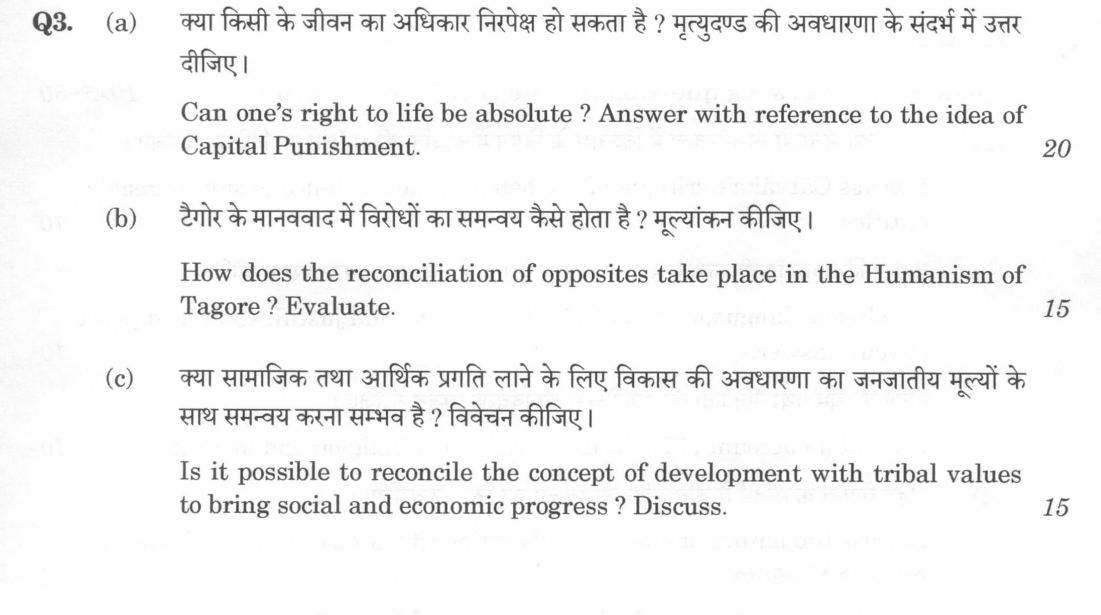
(a) Can one's right to life be absolute ? Answer with reference to the idea of Capital Punishment. (20 marks) (b) How does the…
Can one's right to life be absolute ? Answer with reference to the idea of Capital Punishment. 20 marks
How does the reconciliation of opposites take place in the Humanism of Tagore ? Evaluate. 15 marks
Is it possible to reconcile the concept of development with tribal values to bring social and economic progress ? Discuss. 15 marks
हिंदी में प्रश्न पढ़ें
क्या किसी के जीवन का अधिकार निरपेक्ष हो सकता है ? मृत्युदंड की अवधारणा के संदर्भ में उत्तर दीजिए। (20 अंक)
टैगोर के मानववाद में विरोधों का समन्वय कैसे होता है ? मूल्यांकन कीजिए। (15 अंक)
क्या सामाजिक तथा आर्थिक प्रगति लाने के लिए विकास की अवधारणा का जनजातीय मूल्यों के साथ समन्वय करना संभव है ? विवेचन कीजिए। (15 अंक)
Model answer
Written by UPSC Answer Check against this question's marking rubric, to the expected length. UPSC does not publish answers for Mains — this is one way to score well, not an official key.
The right to life is not self-evidently absolute: if absolute, no state could lawfully take life; if qualified, it may be restricted by due process and constitutional morality. Retentionists defend capital punishment on retributive grounds: the murderer forfeits life and justice requires proportionate punishment. Kant’s categorical imperative treats persons as ends, which abolitionists read as a ban on killing, while retentionists invoke his retributive idea of state responsibility. Bentham’s utilitarian calculus asks whether death deters, incapacitates, or serves the greatest good; if it does not, it is wasteful cruelty. Abolitionists stress human dignity, error, arbitrariness, and Amnesty International’s data showing no credible evidence that the death penalty deters murder more than life imprisonment. Retentionists argue that for the most heinous crimes, life imprisonment fails to express societal condemnation. Indian constitutional morality under Article 21 permits deprivation of life only by fair procedure established by law; Bachan Singh v. State of Punjab upheld death penalty for murder, and Machhi Singh v. State of Punjab confined it to the “rarest of rare” cases by examining manner, anti-social circumstances, magnitude, and reformation. This doctrine is a compromise: it preserves the right to life as a qualified right while limiting state power. Thus an absolute right to life is philosophically defensible but constitutionally contested; capital punishment tests whether dignity can be reconciled with retribution.
Tagore’s humanism reconciles opposites by treating the individual not as an isolated liberal atom but as a “surplus man” who rises above mere biological and material existence through creativity, culture, and spiritual aspiration. In Sadhana and The Religion of Man, he presents human life as a dialectical synthesis: freedom is not licence but self-realisation within order; tradition is not fossilised custom but a living source of modern renewal; the individual is not opposed to the universal but finds identity in the larger life of humanity. His humanism is relational: the self is formed in community, nature, and moral responsibility, so that personal freedom and social harmony are not contradictions but mutually completing. Evaluated against Western liberal humanism, Tagore’s position is distinctive. Liberal humanism often centres rational autonomy, individual rights, and material progress; Tagore critiques this as narrow when it becomes nationalism, industrial exploitation, or the worship of power. He also critiques nationalism as a false universal that divides humanity. Yet his humanism is not anti-modern; it seeks to modernise without losing spiritual depth, synthesising East and West by drawing on Vedantic, Buddhist, and Sufi insights while accepting science, reason, and universal human dignity. Thus his reconciliation is not a vague compromise but a moral vision in which opposites are held together in a larger human unity.
Tribal value systems—communitarian land tenure, sacred ecology, and oral knowledge—often conflict with mainstream development metrics that equate progress with GDP growth, industrialisation, and market integration. Yet reconciliation is possible when development is understood as capability and dignity, not merely output. Panchayats (Extension to Scheduled Areas) Act, 1996 and the Forest Rights Act, 2006 provide institutional mechanisms: PESA empowers Gram Sabhas in scheduled areas to plan, manage, and protect local resources; FRA recognises forest dwellers’ rights over forest land and community forest resources. Kerala’s tribal sub-plan, Jharkhand’s MGNREGA tribal participation, and the Niyamgiri movement show different forms of reconciliation: planning around tribal livelihoods, wage work that strengthens community assets, and Gram Sabha consent that limits extractive mining. The critique of development-induced displacement remains central: dams, mines, and industrial corridors have dispossessed tribes and destroyed ecological knowledge. A viable way forward is development that is participatory, ecologically sensitive, and constitutionally grounded, allowing tribal values to shape progress rather than be erased by it.
What "Discuss" is asking you to do
Lay the issue out from more than one side — how it arose, what is claimed for it, what is held against it, and where it now stands. UPSC attaches discuss to broad topics with several live dimensions, so coverage of the dimensions earns more than the strength of your opinion.
Structure that answers it
Set the issue up → the case as it is made → the case against → the dimension both sides leave out → where the balance now lies
Where marks are lost
Listing facts with no thread between them, or arguing one side throughout and calling it a discussion.
How this answer will be evaluated
Approach
Framework: UPSC Philosophy Paper II. (a) comment: context > arguments both sides > judgment > close | (b) evaluate: criteria > evidence > balanced judgment | (c) discuss: intro > 3-4 dimensions > example > balanced close Full marks: Precise reconstruction of arguments, strong counter-arguments, and specific references to laws/texts.
Key points expected
- Define the 'right to life' (Article 21) and its scope.
- Present the strongest argument for capital punishment (deterrence/retribution).
- Present the strongest argument against (infallibility/human rights).
- Provide a reasoned judgment on whether the right is absolute.
- Identify specific 'opposites' (e.g., East-West, Individual-Universal).
- Explain the mechanism of reconciliation (e.g., 'unity in diversity').
- Provide textual or conceptual evidence from Tagore's works.
- Offer a balanced judgment on the validity of this synthesis.
Evaluation rubric
Each sub-part is marked on its own, against the marks and word limit printed on the paper.
- (a) Contextualize the debate on the absoluteness of the right to life using capital punishment as the primary case study. 20 marks
comment— context → arguments both sides → judgment → close
Must cover
- Define the 'right to life' (Article 21) and its scope.
- Present the strongest argument for capital punishment (deterrence/retribution).
- Present the strongest argument against (infallibility/human rights).
- Provide a reasoned judgment on whether the right is absolute.
Loses marks
- Biographical details of legal scholars.
- Vague moralizing without legal/philosophical argumentation.
Earns more
- Reference to specific Indian Supreme Court judgments (e.g., Bachan Singh).
- Distinction between 'right to life' and 'right to live'.
- Mention of the 'rarest of rare' doctrine.
Extra mark
- Citation of specific international covenants (ICCPR).
- (b) Assess the mechanism of reconciling opposites in Tagore's Humanism using specific criteria and evidence. 15 marks
evaluate— criteria → evidence → balanced judgment
Must cover
- Identify specific 'opposites' (e.g., East-West, Individual-Universal).
- Explain the mechanism of reconciliation (e.g., 'unity in diversity').
- Provide textual or conceptual evidence from Tagore's works.
- Offer a balanced judgment on the validity of this synthesis.
Loses marks
- Generalized praise of Tagore without philosophical analysis.
- Confusing 'Humanism' with 'Nationalism'.
Earns more
- Use of specific Tagore terminology (e.g., 'Sahitya', 'Sahitya').
- Reference to specific works (e.g., 'Gitanjali', 'Nationalism').
Extra mark
- Comparison with Western humanist thinkers (e.g., Marx, Nietzsche).
- (c) Examine the compatibility of development concepts with tribal values for social and economic progress. 15 marks
discuss— intro → 3-4 dimensions → example → balanced close
Must cover
- Define 'development' in the context of tribal areas.
- Identify key 'tribal values' (e.g., community, ecology).
- Analyze points of conflict and points of convergence.
- Conclude on the possibility of reconciliation.
Loses marks
- Romanticizing tribal life without addressing economic realities.
- Ignoring the 'social' aspect of progress.
Earns more
- Reference to specific tribal communities (e.g., Gond, Santhal).
- Mention of specific policies (e.g., PESA Act).
Extra mark
- Citation of specific developmental projects (e.g., Narmada Valley).
Practice this exact question
Write your answer and it is marked point by point against the model answer above — what you covered, what you missed, what you got wrong.
Evaluate my answer →More from Philosophy 2025 Paper II
- Q1 Answer the following questions in about 150 words each: (a) "Corrupt practices reveal an…
- Q2 (a) Present a detailed account of the debate between Gandhi and Ambedkar on the issue of…
- Q3 (a) Can one's right to life be absolute ? Answer with reference to the idea of Capital Pu…
- Q4 (a) How are both equality and liberty inadequate as social and political ideals without j…
- Q5 Answer the following questions in about 150 words each: (a) Discuss Cārvāka's critique of…
- Q6 (a) Present an account of Design argument to prove the existence of God along with its cr…