Paper II — Q2
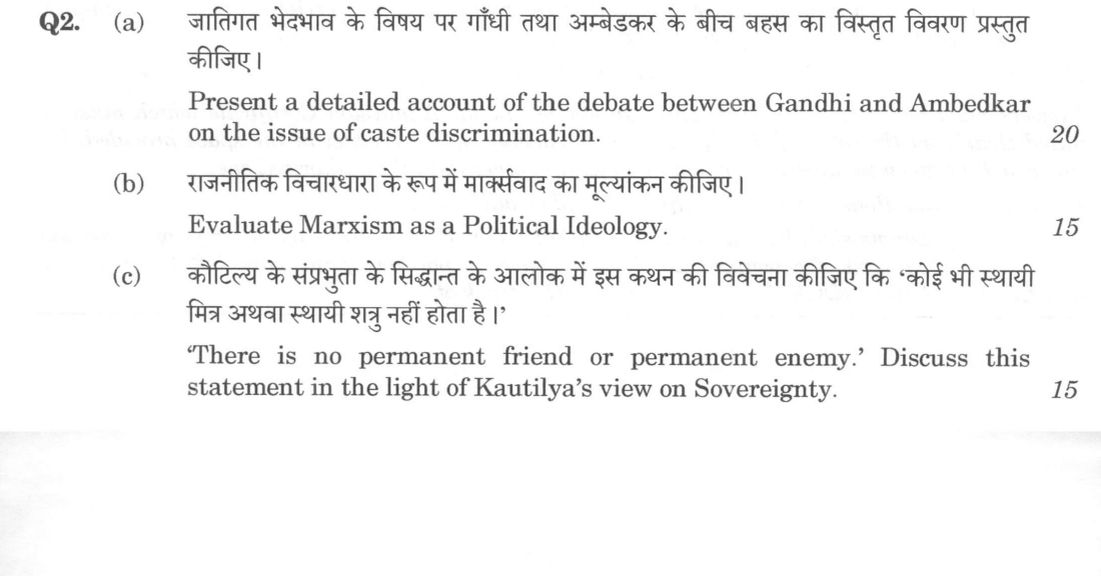
(a) Present a detailed account of the debate between Gandhi and Ambedkar on the issue of caste discrimination. (20 marks) (b)…
Present a detailed account of the debate between Gandhi and Ambedkar on the issue of caste discrimination. 20 marks
Evaluate Marxism as a Political Ideology. 15 marks
'There is no permanent friend or permanent enemy.' Discuss this statement in the light of Kautilya's view on Sovereignty. 15 marks
हिंदी में प्रश्न पढ़ें
जातिगत भेदभाव के विषय पर गांधी तथा अंबेडकर के बीच बहस का विस्तृत विवरण प्रस्तुत कीजिए। (20 अंक)
राजनीतिक विचारधारा के रूप में मार्क्सवाद का मूल्यांकन कीजिए। (15 अंक)
कौटिल्य के संप्रभुता के सिद्धांत के आलोक में इस कथन की विवेचना कीजिए कि 'कोई भी स्थायी मित्र अथवा स्थायी शत्रु नहीं होता है।' (15 अंक)
Model answer
Written by UPSC Answer Check against this question's marking rubric, to the expected length. UPSC does not publish answers for Mains — this is one way to score well, not an official key.
Political philosophy negotiates human emancipation, power, and statecraft through competing normative and realistic paradigms.
The Gandhi-Ambedkar Debate on Caste Discrimination
The discourse between M.K. Gandhi and B.R. Ambedkar represents a fundamental divergence over the nature, origin, and remedy of caste oppression. Ambedkar diagnosed caste as an institutionalized system of graded inequality sanctified by Hindu scriptures, demanding its total destruction in Annihilation of Caste (1936) and offering a scathing critique in What Congress and Gandhi Have Done to the Untouchables. Conversely, Gandhi defended an idealized Varnashrama Dharma as a non-hierarchical, hereditary division of labour, while fiercely condemning untouchability as an excrescence via his Harijan campaign and writings in Young India.
Their ideological divide reached a political climax during the Round Table Conferences over separate electorates for Depressed Classes. Gandhi’s fast unto death culminated in the Poona Pact (1932), substituting separate electorates with reserved seats within a joint electorate to prevent fracturing the Hindu community.
Philosophically, Gandhi’s organic model rested on moral-religious reform, trusteeship, and hriday parivartan (change of heart) through decentralized village swaraj. Ambedkar, rooted in liberal-constitutional individualism and Enlightenment rationality, rejected moral appeals to the oppressor, arguing that socio-political emancipation requires state intervention, legal-constitutional rights, and the structural annihilation of the caste hierarchy.
Evaluation of Marxism as a Political Ideology
Marxism conceptualizes historical development through dialectical materialism, framing history as a succession of class struggles culminating in a proletarian revolution and the ultimate withering away of the state. Evaluated against its emancipatory standard—the end of human alienation and exploitation—Marxism presents profound contradictions.
Historically, Marxism succeeded in mobilizing anti-imperialist resistance and accelerating rapid industrialization in the Soviet Union and China. However, it failed in practice by producing bureaucratic totalitarianism, economic stagnation, suppression of individual liberties, and an ecological blindspot rooted in productivism.
In India, Marxist orthodoxy faced unique challenges. M.N. Roy transitioned from Leninist Marxism to 'Radical Humanism', rejecting economic determinism. The communist movement split between CPI(M)'s parliamentary engagement and revolutionary insurrectionism. Crucially, the Ambedkar-Marx debate highlighted Marxism's inadequacy in India: by reducing all subjugation to an economic base, it failed to see that caste is not merely a division of labour, but a division of labourers.
Verdict: While Marxism remains an indispensable diagnostic tool for critiquing capitalist exploitation, it fails as a viable totalizing ideology due to its deterministic neglect of socio-cultural stratification, democratic pluralism, and individual moral autonomy.
Kautilya on Sovereignty and Realpolitik
Kautilya’s Arthashastra defines sovereignty through internal authority (danda) and external diplomatic autonomy. The dictum 'there is no permanent friend or permanent enemy' encapsulates Kautilya's ruthless realism, wherein state survival and prosperity (raison d'état) override moral considerations.
Kautilya formalizes external sovereignty through the Rajamandala (Circle of States), positing that geopolitical proximity determines alignment: a neighbouring state is a natural enemy (ari), while the state bordering the enemy is a natural ally (mitra). To navigate this dynamic, the sovereign (Vijigishu) employs the Shadgunya (six-fold policy): sandhi (peace), vigraha (war), asana (neutrality), yana (marching), samshraya (seeking refuge), and dvaidhibhava (duplicity).
Alliances are temporary instruments of national interest. This mirrors Niccolò Machiavelli’s The Prince and Hans Morgenthau’s classical realism, asserting that power balances dictate interstate relations.
Conclusion
These philosophical streams directly underpin contemporary India. The Gandhi-Ambedkar dialectic achieved synthesis in the Indian Constitution, fusing moral uplift with structural rights (Articles 14–17); Marxism shaped India’s early redistributive welfarism despite limited parliamentary reach; and Kautilyan realism remains the guiding doctrine behind India’s strategic autonomy and multi-aligned foreign policy.
What "Evaluate" is asking you to do
Judge how well something has performed against the standard it set for itself — its stated aim, mandate or promise — and commit to a verdict. Name the yardstick before you judge; an unanchored judgement reads as opinion.
Structure that answers it
Name the yardstick — stated aim, mandate or benchmark → performance against it → shortfall against it → why the gap exists → verdict
Where marks are lost
Presenting both sides and then declining to decide, or delivering a verdict against a standard you never stated, which makes it look arbitrary.
How this answer will be evaluated
Approach
Framework: UPSC Mains Philosophy Paper II. (a) account for: state the phenomenon > the causes in order of weight > conclusion | (b) evaluate: criteria > evidence > balanced judgment | (c) discuss: intro > 3-4 dimensions > example > balanced close Full marks: Precise reconstruction of arguments, specific terminology, balanced evaluation, and clear linkage to the question's core concepts.
Key points expected
- Gandhi's view: caste as moral failing, not structural
- Ambedkar's view: caste as structural hierarchy and exploitation
- Specific points of contention (e.g., Harijan vs. Dalit, separate electorates)
- The role of the Constitution in resolving the debate
- Core tenets: historical materialism, class struggle, surplus value
- Strengths: critique of capitalism, focus on structural inequality
- Weaknesses: economic determinism, authoritarian tendencies, failure in practice
- Balanced judgment on its relevance today
Evaluation rubric
Each sub-part is marked on its own, against the marks and word limit printed on the paper.
- (a) Detailed reconstruction of the Gandhi-Ambedkar debate on caste discrimination. 20 marks
account for— state the phenomenon → the causes in order of weight → conclusion
Must cover
- Gandhi's view: caste as moral failing, not structural
- Ambedkar's view: caste as structural hierarchy and exploitation
- Specific points of contention (e.g., Harijan vs. Dalit, separate electorates)
- The role of the Constitution in resolving the debate
Loses marks
- Biographical details of Gandhi or Ambedkar
- Vague generalities without specific points of debate
- Failing to distinguish their core philosophical differences
Earns more
- Reference to the Poona Pact (1932)
- Mention of the 'Annihilation of Caste' pamphlet
- Distinction between 'Harijan' and 'Dalit' terminology
- Reference to the 'Poona Pact' or 'Constitutional safeguards'
Extra mark
- Citing specific dates of the Poona Pact
- Mentioning the 'Poona Pact' or 'Constitutional safeguards'
- (b) Critical assessment of Marxism as a political ideology. 15 marks
evaluate— criteria → evidence → balanced judgment
Must cover
- Core tenets: historical materialism, class struggle, surplus value
- Strengths: critique of capitalism, focus on structural inequality
- Weaknesses: economic determinism, authoritarian tendencies, failure in practice
- Balanced judgment on its relevance today
Loses marks
- Summarizing Marx's life instead of his ideas
- Presenting only strengths or only weaknesses
- Vague statements without specific Marxist terminology
Earns more
- Reference to 'Historical Materialism' or 'Dialectical Materialism'
- Mention of 'Surplus Value' or 'Bourgeoisie/Proletariat'
- Critique of 'Economic Determinism'
- Reference to 'State' or 'Dictatorship of the Proletariat'
Extra mark
- Citing specific Marxist texts (e.g., 'Communist Manifesto')
- Mentioning specific Marxist thinkers (e.g., Lenin, Mao)
- (c) Analysis of 'no permanent friend/enemy' via Kautilya's sovereignty. 15 marks
discuss— intro → 3-4 dimensions → example → balanced close
Must cover
- Kautilya's concept of 'Mandala' theory (concentric circles)
- The 'Mitra' (friend) and 'Shatru' (enemy) dynamic
- Sovereignty as the ultimate goal (Svabhav) of the state
- Pragmatism over ideology in foreign policy
Loses marks
- General discussion of international relations without Kautilya
- Failing to link the quote to Kautilya's specific theory
- Vague statements about 'friendship' or 'enmity' without political context
Earns more
- Reference to 'Mandala' theory or 'Mitra-Shatru' dynamic
- Mention of 'Svabhav' (nature) or 'Svabhav' (sovereignty)
- Reference to 'Arthashastra' or 'Kautilya'
- Discussion of 'Pragmatism' or 'Realpolitik'
Extra mark
- Citing specific examples from the 'Arthashastra'
- Mentioning specific Kautilyan terms (e.g., 'Mandala', 'Mitra', 'Shatru')
Practice this exact question
Write your answer and it is marked point by point against the model answer above — what you covered, what you missed, what you got wrong.
Evaluate my answer →More from Philosophy 2025 Paper II
- Q1 Answer the following questions in about 150 words each: (a) "Corrupt practices reveal an…
- Q2 (a) Present a detailed account of the debate between Gandhi and Ambedkar on the issue of…
- Q3 (a) Can one's right to life be absolute ? Answer with reference to the idea of Capital Pu…
- Q4 (a) How are both equality and liberty inadequate as social and political ideals without j…
- Q5 Answer the following questions in about 150 words each: (a) Discuss Cārvāka's critique of…