Paper II — Q5
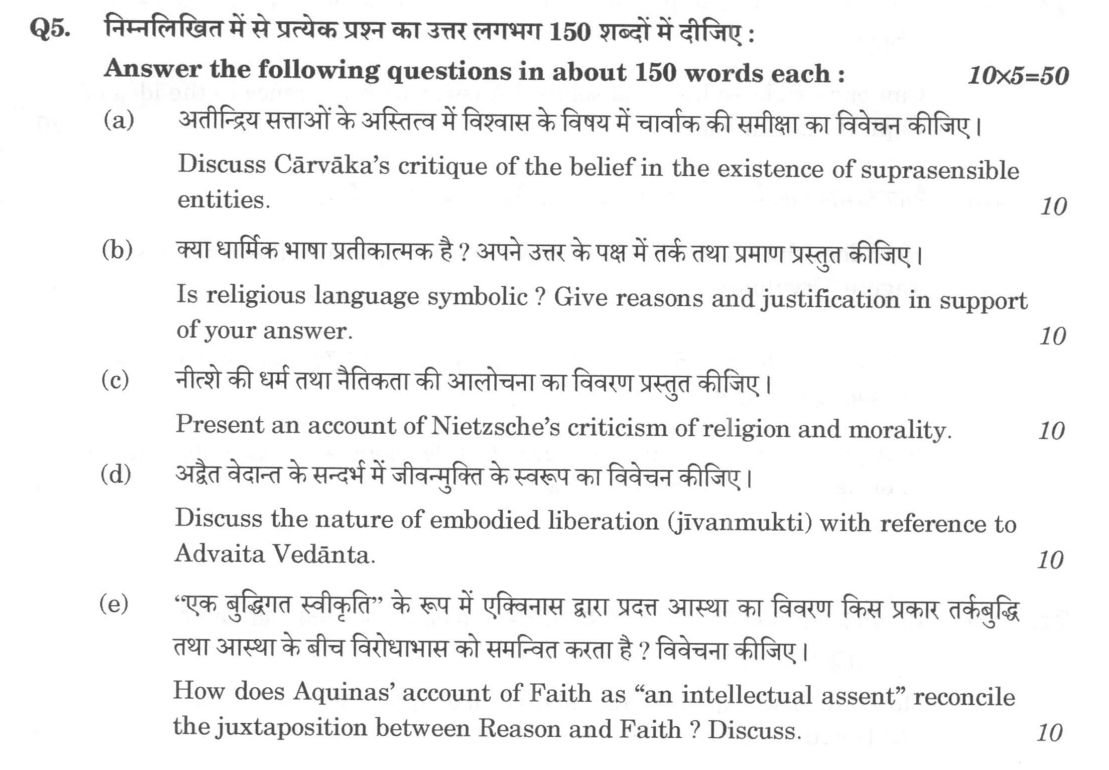
Answer the following questions in about 150 words each: (a) Discuss Cārvāka's critique of the belief in the existence of…
Answer the following questions in about 150 words each:
Discuss Cārvāka's critique of the belief in the existence of suprasensible entities. 10 marks
Is religious language symbolic ? Give reasons and justification in support of your answer. 10 marks
Present an account of Nietzsche's criticism of religion and morality. 10 marks
Discuss the nature of embodied liberation (jivanmukti) with reference to Advaita Vedānta. 10 marks
How does Aquinas' account of Faith as "an intellectual assent" reconcile the juxtaposition between Reason and Faith ? Discuss. 10 marks
हिंदी में प्रश्न पढ़ें
निम्नलिखित में से प्रत्येक प्रश्न का उत्तर लगभग 150 शब्दों में दीजिए :
अतीन्द्रिय सत्ताओं के अस्तित्व में विश्वास के विषय में चार्वाक की समीक्षा का विवेचन कीजिए। (10 अंक)
क्या धार्मिक भाषा प्रतीकात्मक है ? अपने उत्तर के पक्ष में तर्क तथा प्रमाण प्रस्तुत कीजिए। (10 अंक)
नीत्शे की धर्म तथा नैतिकता की आलोचना का विवरण प्रस्तुत कीजिए। (10 अंक)
अद्वैत वेदान्त के संदर्भ में जीवन्मुक्ति के स्वरूप का विवेचन कीजिए। (10 अंक)
"एक बुद्धिगत स्वीकृति" के रूप में एक्विनास द्वारा प्रदत्त आस्था का विवरण किस प्रकार तर्कबुद्धि तथा आस्था के बीच विरोधाभास को समन्वित करता है ? विवेचना कीजिए। (10 अंक)
Model answer
Written by UPSC Answer Check against this question's marking rubric, to the 150-word length. UPSC does not publish answers for Mains — this is one way to score well, not an official key.
(a) Cārvāka’s critique of suprasensible entities rests on a narrow epistemology. It accepts only pratyakṣa, direct perception, as valid knowledge and rejects śabda/āgama as pramāṇa because Vedic testimony cannot be verified by sense experience. It also treats anumāna as fallible: inference may produce anavasthā, an infinite regress of reasons, or cakraka, circularity, and therefore cannot establish dharma, heaven, soul or God. For Cārvāka, suprasensible claims are unobservable and hence not credible; the only reliable aim is bhuñjita, enjoying what is present, because pleasure and pain are perceptible. This critique is epistemologically radical: it denies that reason or revelation can bridge the gap between the sensible and the suprasensible, though it risks reducing ethics to immediate experience. It thus challenges the authority of śruti and the metaphysical assumptions of dharmaśāstra, while leaving little basis for moral obligations beyond perceptible consequences. Its strength is clarity; its weakness is exclusion of insight.
(b) Whether religious language is symbolic depends on what it is taken to do. Tillich argues that religious symbols are not literal descriptions but vehicles of meaning: they point beyond themselves to ultimate reality, disclose the heart, and are open, penetrable and non-exclusive. This avoids the literalist error of treating God as an object among objects, but critics say it may make doctrine non-cognitive or unverifiable. Braithwaite offers a non-cognitive view: religious statements are not factual claims but expressions of a way of life, commitments and responses to God. Aquinas, by contrast, defends analogical predication: terms such as good, wise and living are applied to God neither univocally nor purely metaphorically, but according to a real relation between Creator and creature. Against literal verificationism, which demands empirical testability, these accounts preserve the truth-claim of religion by reinterpreting its mode of reference: symbolically, existentially or analogically, rather than as straightforward factual assertion.
(c) Nietzsche’s criticism of religion and morality is genealogical: he asks not whether moral truths are valid, but how they arose. In On the Genealogy of Morality, he argues that Christian slave morality inverted the noble values of strength, honour and self-affirmation, replacing them with humility, pity and obedience. Its driving force is ressentiment: the weak, unable to act, reinterpret their powerlessness as virtue and condemn the strong as evil. The “death of God” intensifies this crisis, because the loss of the Christian metaphysical foundation exposes the arbitrariness of moral values and threatens nihilism. Nietzsche therefore calls for a transvaluation of values, a move beyond good and evil in which life, creativity and the will to power are affirmed rather than denied. His critique is powerful in exposing the psychological and historical roots of morality, but it risks making moral evaluation itself a matter of power and taste and not reason.
(d) In Advaita Vedānta, jīvanmukti is liberation while embodied. It is jñāna-niṣṭhā: the removal of avidyā through knowledge of the identity of ātman and Brahman. The jīvanmukta remains in the body because prārabdha-karma, the karma already bearing fruit, continues to sustain the present life, but no new saṃchita-karma is created and the sense of individual agency ceases. This differs from videhamukti, where the body is finally relinquished. The contrast with other schools is nuanced. Dvaita, while accepting release from fresh bondage, stresses eternal difference and graded liberation in divine service rather than non-dual identity. Viśiṣṭādvaita also accepts a form of jīvanmukti: the liberated soul may remain embodied until prārabdha-karma is exhausted, yet its final beatitude is union with and service to God, not impersonal identity. Thus jīvanmukti is not mere survival but the lived experience of freedom. It shows that embodiment is not the obstacle; ignorance is the true barrier.
(e) For Aquinas, faith is not blind acceptance but an intellectual assent, assensus, to revealed truths, given by the will under grace. In the Summa Theologiae, he classifies faith as a theological virtue rather than an intellectual virtue, though it resides in the intellect and is directed toward truth. This allows him to reconcile reason and faith: truths knowable by natural reason, such as God’s existence, may also be revealed, forming a twofold truth that is not contradictory but complementary. Theology is subalternated to reason in the sense that it uses rational argument, logic and natural philosophy, yet it is guided by revealed principles. Faith therefore does not oppose reason; it extends it. The formula fides quaerens intellectum captures the movement: faith seeks understanding, and reason illuminates what faith accepts. The result is a harmonious order: reason prepares for, supports and deepens faith, while faith opens to truths beyond unaided demonstration.
What "Discuss" is asking you to do
Lay the issue out from more than one side — how it arose, what is claimed for it, what is held against it, and where it now stands. UPSC attaches discuss to broad topics with several live dimensions, so coverage of the dimensions earns more than the strength of your opinion.
Structure that answers it
Set the issue up → the case as it is made → the case against → the dimension both sides leave out → where the balance now lies
Where marks are lost
Listing facts with no thread between them, or arguing one side throughout and calling it a discussion.
How this answer will be evaluated
Approach
Framework: Philosophy Paper II: Reconstruct > Objection > Evaluation. (a) discuss: intro > 3-4 dimensions > example > balanced close | (b) explain: definition/context > points in order > small example > short close | (c) explain: definition/context > points in order > small example > short close | (d) discuss: intro > 3-4 dimensions > example > balanced close | (e) discuss: intro > 3-4 dimensions > example > balanced close Full marks: Precise technical vocabulary, strong counter-arguments, concrete examples.
Key points expected
- Cārvāka: pratyakṣa, anumāna, śabda, suprasensible
- Religious language: symbolic, literal, numinous, apophatic
- Nietzsche: slave morality, master morality, ressentiment, God is dead
- Advaita: jivanmukti, videhamukti, mokṣa, karma
- Aquinas: faith, reason, juxtaposition, reconciliation
Evaluation rubric
Each sub-part is marked on its own, against the marks and word limit printed on the paper.
- (a) Reconstruct Cārvāka's epistemological rejection of suprasensible entities. 10 marks · 150 words
discuss— intro → 3-4 dimensions → example → balanced close
Must cover
- Limit pramāṇa to pratyakṣa (perception)
- Reject anumāna (inference) for suprasensible
- Reject śabda (scripture) as authority
- Identify specific entities (Ātman, Devar)
Loses marks
- Biographical details of Cārvāka
- Confusing with Buddhist 'Pudgalavāda'
Earns more
- Mention 'anupalabdhi' (non-apprehension)
- Reference 'Lokāyata' or 'Bāulaka' texts
- Critique of 'anumāna' circularity
- Materialist ontology (Pṛthvī, Āpas, Tejas, Vāyu)
Extra mark
- Cite specific verse from 'Cārvāka Sūtra'
- (b) Justify the symbolic nature of religious language. 10 marks · 150 words
explain— definition/context → points in order → small example → short close
Must cover
- Define 'symbolic' (Rudolf Otto/C.S. Lewis)
- Contrast with 'literal' or 'propositional'
- Explain 'numinous' or 'mysterium tremendum'
- Address 'apophatic' (negative) theology
Loses marks
- Treating religion as mere 'myth'
- Ignoring 'literalist' counter-arguments
Earns more
- Reference 'The Language of God' (Lewis)
- Mention 'mystical' vs 'rational' language
- Discuss 'metaphor' in religious context
- Reference 'via negativa'
Extra mark
- Cite specific example from 'Mysticism' literature
- (c) Account for Nietzsche's critique of religion and morality. 10 marks · 150 words
explain— definition/context → points in order → small example → short close
Must cover
- Define 'slave morality' (Sklaavemoralität)
- Define 'master morality' (Herrn-moralität)
- Explain 'ressentiment' (resentment)
- Critique of 'God is dead' (Gott ist tot)
Loses marks
- Confusing with 'nihilism' as a goal
- Ignoring 'revaluation of values'
Earns more
- Reference 'Genealogy of Morals'
- Mention 'will to power' (Wille zur Macht)
- Discuss 'Übermensch' (Overman)
- Critique of 'herd instinct'
Extra mark
- Cite specific aphorism from 'Thus Spoke Zarathustra'
- (d) Discuss the nature of embodied liberation (jivanmukti). 10 marks · 150 words
discuss— intro → 3-4 dimensions → example → balanced close
Must cover
- Define 'jivanmukti' (liberation while living)
- Contrast with 'videhamukti' (liberation after death)
- Explain 'mokṣa' (liberation) in Advaita
- Address 'karma' (action) in jivanmukti
Loses marks
- Confusing with 'sāṃkhya' liberation
- Ignoring 'jñāna' (knowledge) as means
Earns more
- Reference 'Brahman' (Absolute) and 'Ātman' (Self)
- Mention 'adhyāsa' (superimposition)
- Discuss 'sādhana' (practice) for jivanmukti
- Reference 'Gītā' or 'Upaniṣads'
Extra mark
- Cite specific verse from 'Māṇḍūkya Upaniṣad'
- (e) Discuss Aquinas' reconciliation of Reason and Faith. 10 marks · 150 words
discuss— intro → 3-4 dimensions → example → balanced close
Must cover
- Define 'faith' (fides) as 'intellectual assent'
- Explain 'reason' (ratio) and 'faith' (fides) relationship
- Address 'juxtaposition' of Reason and Faith
- Explain 'reconciliation' in Aquinas' view
Loses marks
- Confusing with 'fideism'
- Ignoring 'natural theology'
Earns more
- Reference 'Summa Theologiae'
- Mention 'gratia' (grace) and 'natura' (nature)
- Discuss 'analogia entis' (analogy of being)
- Reference 'five ways' (quinque viae)
Extra mark
- Cite specific article from 'Summa Theologiae'
Practice this exact question
Write your answer and it is marked point by point against the model answer above — what you covered, what you missed, what you got wrong.
Evaluate my answer →More from Philosophy 2025 Paper II
- Q2 (a) Present a detailed account of the debate between Gandhi and Ambedkar on the issue of…
- Q3 (a) Can one's right to life be absolute ? Answer with reference to the idea of Capital Pu…
- Q4 (a) How are both equality and liberty inadequate as social and political ideals without j…
- Q5 Answer the following questions in about 150 words each: (a) Discuss Cārvāka's critique of…
- Q6 (a) Present an account of Design argument to prove the existence of God along with its cr…
- Q7 (a) How does the Vedantic view of Religious Pluralism address the conflicting truth claim…
- Q8 (a) Evaluate the nature and object of Religious Experience as explained by Radhakrishnan…