Paper II — Q4
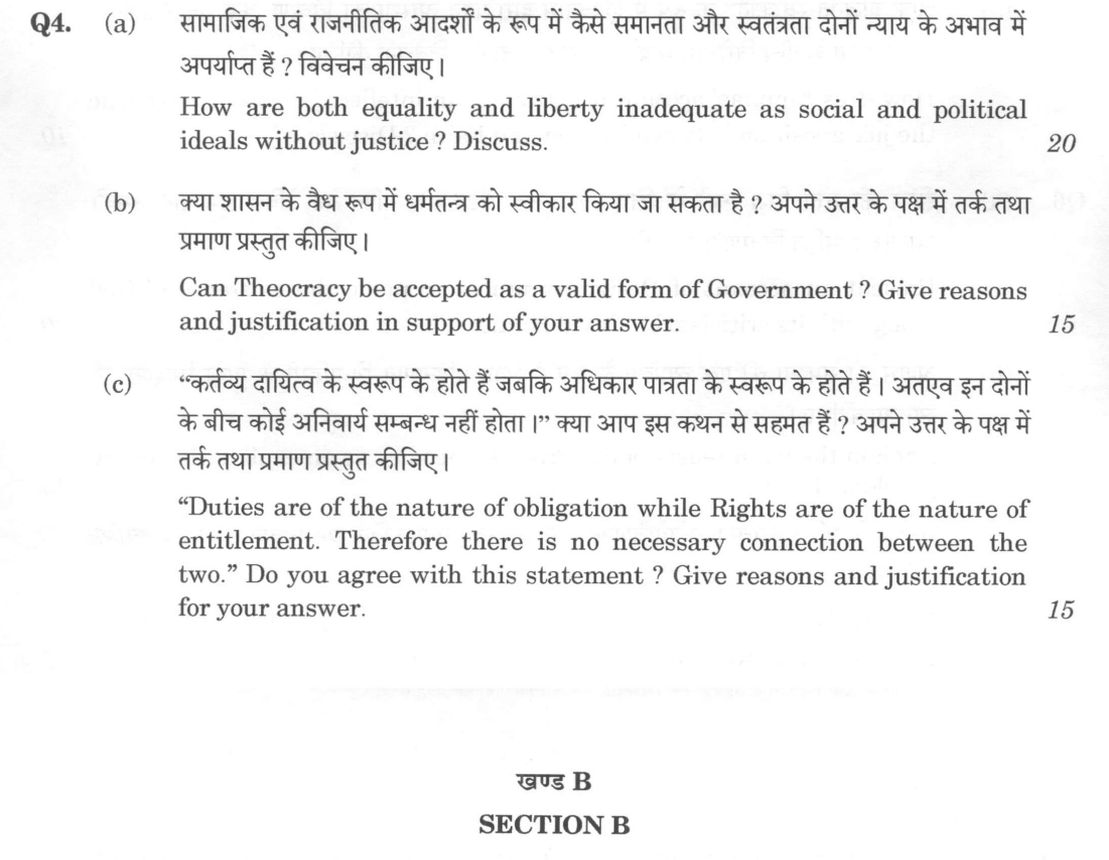
(a) How are both equality and liberty inadequate as social and political ideals without justice ? Discuss. (20 marks) (b) Can…
How are both equality and liberty inadequate as social and political ideals without justice ? Discuss. 20 marks
Can Theocracy be accepted as a valid form of Government ? Give reasons and justification in support of your answer. 15 marks
"Duties are of the nature of obligation while Rights are of the nature of entitlement. Therefore there is no necessary connection between the two." Do you agree with this statement ? Give reasons and justification for your answer. 15 marks
हिंदी में प्रश्न पढ़ें
सामाजिक एवं राजनीतिक आदर्शों के रूप में कैसे समानता और स्वतंत्रता दोनों न्याय के अभाव में अपर्याप्त हैं ? विवेचन कीजिए। (20 अंक)
क्या शासन के वैध रूप में धर्मतंत्र को स्वीकार किया जा सकता है ? अपने उत्तर के पक्ष में तर्क तथा प्रमाण प्रस्तुत कीजिए। (15 अंक)
"कर्तव्य दायित्व के स्वरूप के होते हैं जबकि अधिकार पात्रता के स्वरूप के होते हैं। अतएव इन दोनों के बीच कोई अनिवार्य संबंध नहीं होता।" क्या आप इस कथन से सहमत हैं ? अपने उत्तर के पक्ष में तर्क तथा प्रमाण प्रस्तुत कीजिए। (15 अंक)
Model answer
Written by UPSC Answer Check against this question's marking rubric, to the expected length. UPSC does not publish answers for Mains — this is one way to score well, not an official key.
A legitimate social and political order relies on the coherent integration of foundational ideals such as liberty, equality, rights, and legitimate authority. When examined in isolation, these concepts reveal structural inadequacies that require justice, normative reciprocity, and institutional legitimacy to resolve.
Inadequacy of Liberty and Equality without Justice
Pursued in isolation, liberty and equality often generate severe social distortions. Negative liberty without equality degenerates into unbridled license (as Rousseau warned) and perpetuates structural inequalities, allowing powerful actors to monopolize resources and produce the "paradox of tolerance," where unchecked freedom extinguishes freedom itself. Conversely, formal equality pursued without liberty risks authoritarian "leveling down" (Harrison), suppressing individual distinctiveness and agency to enforce mechanical uniformity.
Justice provides the necessary mediating framework and "qualifying condition" (Ronald Dworkin) that harmonizes these competing ideals. In John Rawls’s theory of justice as fairness, the lexical priority of basic equal liberties is balanced with the Difference Principle, ensuring that inequalities are justified only if they benefit the least advantaged. Amartya Sen’s capability approach further demonstrates that neither formal negative liberty nor mere equality of resources suffices; justice demands the substantive expansion of human capabilities, translating abstract freedoms into real opportunities to lead a valuable life.
Validity of Theocracy as a Form of Government
The strongest defense of theocracy rests on the premise that sovereignty belongs to divine authority, providing unchanging moral laws that transcend human fallibility and preserve communal identity through a unified conception of the good.
However, from the standpoint of modern political philosophy, theocracy cannot be accepted as a valid form of governance because it fails the core criteria of political legitimacy: popular consent, public reason, and value pluralism. As John Locke established in A Letter Concerning Toleration, the state cannot legitimately enforce internal religious conscience through coercive power. In diverse societies, a theocracy precludes what John Rawls termed an "overlapping consensus," disenfranchising minority traditions and non-believers.
Reflecting these insights, the Indian constitutional experience (Articles 25–28) rejects theocratic governance in favor of principled secularism. As thinkers like Bhikhu Parekh and classical philosophers like Madhava have argued, limiting the role of religion in statecraft is essential to preserve public reasoning and uphold the dignity of every individual within a pluralistic body politic.
The Correlativity of Rights and Duties
While duties are deontological obligations demanding performance and rights are normative entitlements conferring claims, the thesis that there is "no necessary connection" between them is conceptually and practically flawed.
Wesley Hohfeld’s analytical jurisprudence demonstrates that rights and duties are strictly correlative: an individual’s claim-right necessarily implies a corresponding duty upon others or the state to respect or facilitate that claim. Without an enforceable duty, a right remains an empty abstraction, as Jeremy Bentham observed.
The asymmetry objection—that "imperfect duties" (such as charity or general benevolence) do not correspond to specific rights-holders—does not sever this essential link. In a modern political community, imperfect moral duties are systematically translated into institutional rights (such as socioeconomic welfare entitlements). In Indian constitutional morality, this organic connection is reflected in the symbiotic relationship between Fundamental Rights (Part III) and Fundamental Duties (Part IVA). Rights without duties foster civic decay, while duties without rights result in authoritarian subjugation.
Way Forward
A viable political architecture cannot treat liberty, equality, rights, and duties as isolated, adversarial absolutes. Instead, a sustainable polity requires an overarching architecture of justice—grounded in secular constitutionalism, substantive capabilities, and the mutual interdependence of entitlements and obligations—to preserve individual freedom alongside the common good.
What "Discuss" is asking you to do
Lay the issue out from more than one side — how it arose, what is claimed for it, what is held against it, and where it now stands. UPSC attaches discuss to broad topics with several live dimensions, so coverage of the dimensions earns more than the strength of your opinion.
Structure that answers it
Set the issue up → the case as it is made → the case against → the dimension both sides leave out → where the balance now lies
Where marks are lost
Listing facts with no thread between them, or arguing one side throughout and calling it a discussion.
How this answer will be evaluated
Approach
(a) discuss: intro > 3-4 dimensions > example > balanced close | (b) justify: claim > 3-4 reasons > evidence > conclusion | (c) comment: context > arguments both sides > judgment > close Full marks: Precise definitions, strong arguments, clear counter-arguments, and a well-reasoned conclusion.
Key points expected
- Define justice as the unifying principle of social/political order
- Analyze equality without justice (e.g., formal vs substantive)
- Analyze liberty without justice (e.g., anarchy or tyranny)
- Synthesize how justice provides the normative limit to both
- Define Theocracy and its core features
- Present arguments in support (e.g., moral authority, stability)
- Present arguments against (e.g., secularism, individual liberty)
- Provide a reasoned judgment on its validity
Evaluation rubric
Each sub-part is marked on its own, against the marks and word limit printed on the paper.
- (a) Demonstrate the logical dependence of equality and liberty on justice. 20 marks
discuss— intro → 3-4 dimensions → example → balanced close
Must cover
- Define justice as the unifying principle of social/political order
- Analyze equality without justice (e.g., formal vs substantive)
- Analyze liberty without justice (e.g., anarchy or tyranny)
- Synthesize how justice provides the normative limit to both
Loses marks
- Treating equality and liberty as independent of justice
- Vague definitions without political application
- Biographical details of philosophers instead of argument
Earns more
- Reference to Rawls' 'Justice as Fairness'
- Distinction between negative and positive liberty
- Reference to Amartya Sen's 'Capability Approach'
- Concrete example of legal equality failing without social justice
Extra mark
- Reference to Aristotle's 'Distributive Justice'
- Reference to John Stuart Mill's 'Harm Principle'
- (b) Evaluate the validity of Theocracy as a form of government. 15 marks
justify— claim → 3-4 reasons → evidence → conclusion
Must cover
- Define Theocracy and its core features
- Present arguments in support (e.g., moral authority, stability)
- Present arguments against (e.g., secularism, individual liberty)
- Provide a reasoned judgment on its validity
Loses marks
- Defining Theocracy as merely 'religious rule' without analysis
- Ignoring the conflict with modern democratic values
- Biographical details of religious leaders
Earns more
- Comparison with secular democracy
- Reference to historical examples (e.g., Iran, Vatican)
- Discussion of the separation of church and state
- Analysis of the source of political legitimacy
Extra mark
- Reference to John Locke's 'Letter Concerning Toleration'
- Reference to the Indian Constitution's secularism
- (c) Critique the claim that rights and duties are unconnected. 15 marks
comment— context → arguments both sides → judgment → close
Must cover
- Define rights as entitlements and duties as obligations
- Analyze the 'correlative' view (rights imply duties)
- Analyze the 'independent' view (rights exist without duties)
- Provide a balanced judgment on the 'necessary connection'
Loses marks
- Treating rights and duties as identical
- Ignoring the legal and moral distinction
- Vague generalities without specific examples
Earns more
- Reference to Hohfeld's 'Fundamental Legal Conceptions'
- Distinction between positive and negative rights
- Reference to the Indian Constitution (Fundamental Rights vs Duties)
- Concrete example of a right without a corresponding duty
Extra mark
- Reference to John Rawls' 'Theory of Justice'
- Reference to Immanuel Kant's 'Categorical Imperative'
Practice this exact question
Write your answer and it is marked point by point against the model answer above — what you covered, what you missed, what you got wrong.
Evaluate my answer →More from Philosophy 2025 Paper II
- Q1 Answer the following questions in about 150 words each: (a) "Corrupt practices reveal an…
- Q2 (a) Present a detailed account of the debate between Gandhi and Ambedkar on the issue of…
- Q3 (a) Can one's right to life be absolute ? Answer with reference to the idea of Capital Pu…
- Q4 (a) How are both equality and liberty inadequate as social and political ideals without j…
- Q5 Answer the following questions in about 150 words each: (a) Discuss Cārvāka's critique of…
- Q6 (a) Present an account of Design argument to prove the existence of God along with its cr…
- Q7 (a) How does the Vedantic view of Religious Pluralism address the conflicting truth claim…