Paper II — Q6
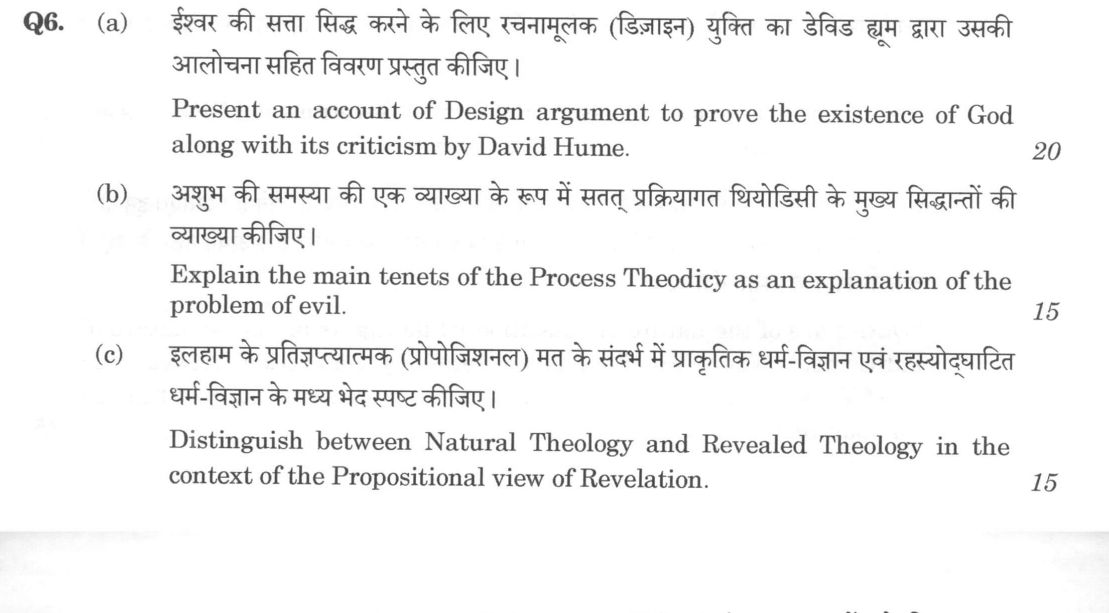
(a) Present an account of Design argument to prove the existence of God along with its criticism by David Hume. (20 marks) (b)…
Present an account of Design argument to prove the existence of God along with its criticism by David Hume. 20 marks
Explain the main tenets of the Process Theodicy as an explanation of the problem of evil. 15 marks
Distinguish between Natural Theology and Revealed Theology in the context of the Propositional view of Revelation. 15 marks
हिंदी में प्रश्न पढ़ें
ईश्वर की सत्ता सिद्ध करने के लिए रचनामूलक (डिजाइन) युक्ति का डेविड ह्यूम द्वारा उसकी आलोचना सहित विवरण प्रस्तुत कीजिए। (20 अंक)
अशुभ की समस्या की एक व्याख्या के रूप में सतत् प्रक्रियागत थियोडिसी के मुख्य सिद्धान्तों की व्याख्या कीजिए। (15 अंक)
इल्हाम के प्रतिज्ञाप्यात्मक (प्रोपोजिशनल) मत के संदर्भ में प्राकृतिक धर्म-विज्ञान एवं रहस्योद्घाटित धर्म-विज्ञान के मध्य भेद स्पष्ट कीजिए। (15 अंक)
Model answer
Written by UPSC Answer Check against this question's marking rubric, to the expected length. UPSC does not publish answers for Mains — this is one way to score well, not an official key.
The rational justification of religious belief rests on an interconnected matrix concerning God’s existence, the coherence of divine attributes amidst evil, and the epistemic modes through which ultimate reality is known.
The Design Argument and Hume’s Critique
The teleological argument infers an intelligent creator from the observed order, intricacy, and adaptation in nature. In its classical analogical form, William Paley compares the universe to a watch: just as the intricate coordination of gears toward an end necessitates an intelligent watchmaker, the vastly superior mechanical complexity of nature necessitates an omnipotent designer. Richard Swinburne updates this into a probabilistic, inductive argument: given the cosmic fine-tuning and temporal regularities of the universe, theism provides the simplest and most probable cumulative explanation for cosmic order. This resembles the classical Nyāya inference (anumāna) where the cosmos, possessing the character of an effect (kāryatva), implies an intelligent agent (kartā).
In Dialogues Concerning Natural Religion, David Hume systematically dismantles the argument. First, he challenges the analogy: the universe is unique, organic, and vast; comparing it to a human-made mechanical artifact is a weak analogy (non sequitur). Second, finite and flawed effects cannot warrant an infinite, perfect cause; the argument fails to rule out multiple, imperfect, or infant designers. Third, the Epicurean hypothesis demonstrates that given finite matter and infinite time, particles randomly organizing into temporary states of apparent order is statistically inevitable without teleology. Finally, the prevalence of suffering and dysteleology undermines the inference of a morally perfect, benevolent deity.
Process Theodicy
Hume’s critique of classical omnipotence directly motivates Process Theodicy, formulated by Alfred North Whitehead and Charles Hartshorne. Process theology reconstructs theism on a dipolar model: God possesses an eternal, immutable Primordial nature (providing the conceptual lure of possibilities) and a temporal, dynamic Consequent nature (absorbing and suffering alongside the actualized world).
Rather than creating ex nihilo and wielding coercive omnipotence, God exercises persuasive power. Creation consists of dynamic "actual occasions" endowed with genuine indeterminacy and freedom. Evil is not an illusion—as in Advaita Vedānta’s *māyāvāda*—nor a divinely ordained instrument, but the inevitable metaphysical byproduct of creaturely freedom and cosmic novelty. Because God cannot unilaterally coerce finite entities without annihilating their self-creative agency, God cannot simply prevent evil. By divesting God of coercive omnipotence, Process Theodicy evades Hume’s dilemma: God is wholly benevolent and shares in worldly suffering, but is structurally incapable of preventing discordant actualizations.
Natural Theology vs. Revealed Theology in Propositional Revelation
The Propositional view of revelation, championed by theologians like B.B. Warfield and Carl Henry, conceptualizes revelation not merely as divine presence, but as the communication of objective, intelligible truth-claims and cognitive propositions in scripture.
Within this framework, Natural Theology and Revealed Theology are distinct in their epistemic foundations. Natural Theology operates via unaided human reason and empirical observation, attempting to establish divine attributes through rational demonstrations like cosmological and teleological arguments. In contrast, Revealed Theology derives its truths strictly from divine self-disclosure in scripture, demanding faith and cognitive assent to divine authority (śabda-pramāṇa or Nyāya’s īśvaravāṇī).
While Karl Barth rejected Natural Theology entirely as a human attempt at self-justification, propositionalists maintain that while Natural Theology renders humanity without excuse, it remains incomplete without the special, inerrant propositions of Revealed Theology. However, this distinction risks collapsing: if human reason requires the normative grid of divine propositions to correctly interpret natural order, Natural Theology ultimately becomes subordinate to Revealed authority.
These debates demonstrate that natural proofs invite foundational empirical critiques, compelling revisions of classical divine attributes, while the cognitive validity of theological truth rests on resolving the epistemic boundary between reason and revelation.
What "Explain" is asking you to do
Make the working of something clear — what sets it off, what follows from what, and what it produces. Explain is the Commission's mechanism word: it dominates the technical papers and the “explain why” stems, where the marks sit in the causal chain and not in the label.
Structure that answers it
State what it is → the initiating condition → the chain of cause, step by step → an instance where it plays out → what the chain produces
Where marks are lost
Describing what something looks like instead of why it works that way. Naming the stages without linking them reads as description too.
How this answer will be evaluated
Approach
Framework: UPSC Philosophy Paper II. (a) account for: state the phenomenon > the causes in order of weight > conclusion | (b) explain: definition/context > points in order > small example > short close | (c) compare: paired headings or table > key differences > significance > conclusion Full marks: Precise technical vocabulary, clear reconstruction of arguments, and specific engagement with named philosophers (Hume, Whitehead).
Key points expected
- Reconstruct the Teleological argument (Paley's watchmaker analogy)
- Identify Hume's 'fork' (induction vs. analogy)
- Detail Hume's 'Five Dialogues' objections (e.g., finite to infinite)
- Evaluate the argument's validity post-Hume
- Define 'Process Theology' (Whitehead/Hartshorne)
- Explain 'Dipolar' God (Primordial vs. Consequent nature)
- Explain 'Persuasion' vs 'Coercion' in divine action
- Link 'Evil' to 'Creativity' and 'Becoming'
Evaluation rubric
Each sub-part is marked on its own, against the marks and word limit printed on the paper.
- (a) Reconstruct the Design argument and detail Hume's specific objections. 20 marks
account for— state the phenomenon → the causes in order of weight → conclusion
Must cover
- Reconstruct the Teleological argument (Paley's watchmaker analogy)
- Identify Hume's 'fork' (induction vs. analogy)
- Detail Hume's 'Five Dialogues' objections (e.g., finite to infinite)
- Evaluate the argument's validity post-Hume
Loses marks
- Biographical details of Hume or Paley
- Vague paraphrase of 'design' without technical terms
- Confusing Design argument with Cosmological argument
Earns more
- Mention Paley's 'Natural Theology'
- Reference 'Dialogues Concerning Natural Religion'
- Distinguish 'a priori' vs 'a posteriori' design claims
- Mention the 'Argument from Contingency' as a contrast
Extra mark
- Cite specific 'Five Dialogues' character (e.g., Philo)
- Reference the 'Infinite Regress' objection
- (b) Define Process Theodicy and its solution to the problem of evil. 15 marks
explain— definition/context → points in order → small example → short close
Must cover
- Define 'Process Theology' (Whitehead/Hartshorne)
- Explain 'Dipolar' God (Primordial vs. Consequent nature)
- Explain 'Persuasion' vs 'Coercion' in divine action
- Link 'Evil' to 'Creativity' and 'Becoming'
Loses marks
- Confusing 'Process' with 'Open Theism'
- Vague 'God is love' without technical mechanism
- Ignoring the 'Problem of Evil' context
Earns more
- Mention 'Dipolar Theism'
- Reference 'Whitehead's 'Process and Reality'
- Contrast with 'Classical Theism' (omnipotence)
- Mention 'Suffering' as 'Solicitude'
Extra mark
- Cite 'Hartshorne's' specific terminology
- Reference 'The Problem of Evil' in 'Process' terms
- (c) Distinguish Natural and Revealed Theology via Propositional view. 15 marks
compare— paired headings or table → key differences → significance → conclusion
Must cover
- Define 'Propositional View' of Revelation
- Define 'Natural Theology' (Reason/Creation)
- Define 'Revealed Theology' (Scripture/Word)
- Contrast 'Epistemic' sources (Reason vs. Faith)
Loses marks
- Confusing 'Propositional' with 'Experiential' view
- Vague 'God speaks' without 'Propositional' definition
- Ignoring the 'Distinction' requirement
Earns more
- Mention 'Aquinas' on Natural Theology
- Reference 'Special' vs 'General' Revelation
- Mention 'Inerrancy' in Propositional view
- Contrast 'Immanent' vs 'Transcendent' knowledge
Extra mark
- Cite 'Plantinga' on 'Warrant' in Revelation
- Reference 'Calvin's' 'Sensus Divinitatis'
Practice this exact question
Write your answer and it is marked point by point against the model answer above — what you covered, what you missed, what you got wrong.
Evaluate my answer →More from Philosophy 2025 Paper II
- Q3 (a) Can one's right to life be absolute ? Answer with reference to the idea of Capital Pu…
- Q4 (a) How are both equality and liberty inadequate as social and political ideals without j…
- Q5 Answer the following questions in about 150 words each: (a) Discuss Cārvāka's critique of…
- Q6 (a) Present an account of Design argument to prove the existence of God along with its cr…
- Q7 (a) How does the Vedantic view of Religious Pluralism address the conflicting truth claim…
- Q8 (a) Evaluate the nature and object of Religious Experience as explained by Radhakrishnan…