Paper I — Q1
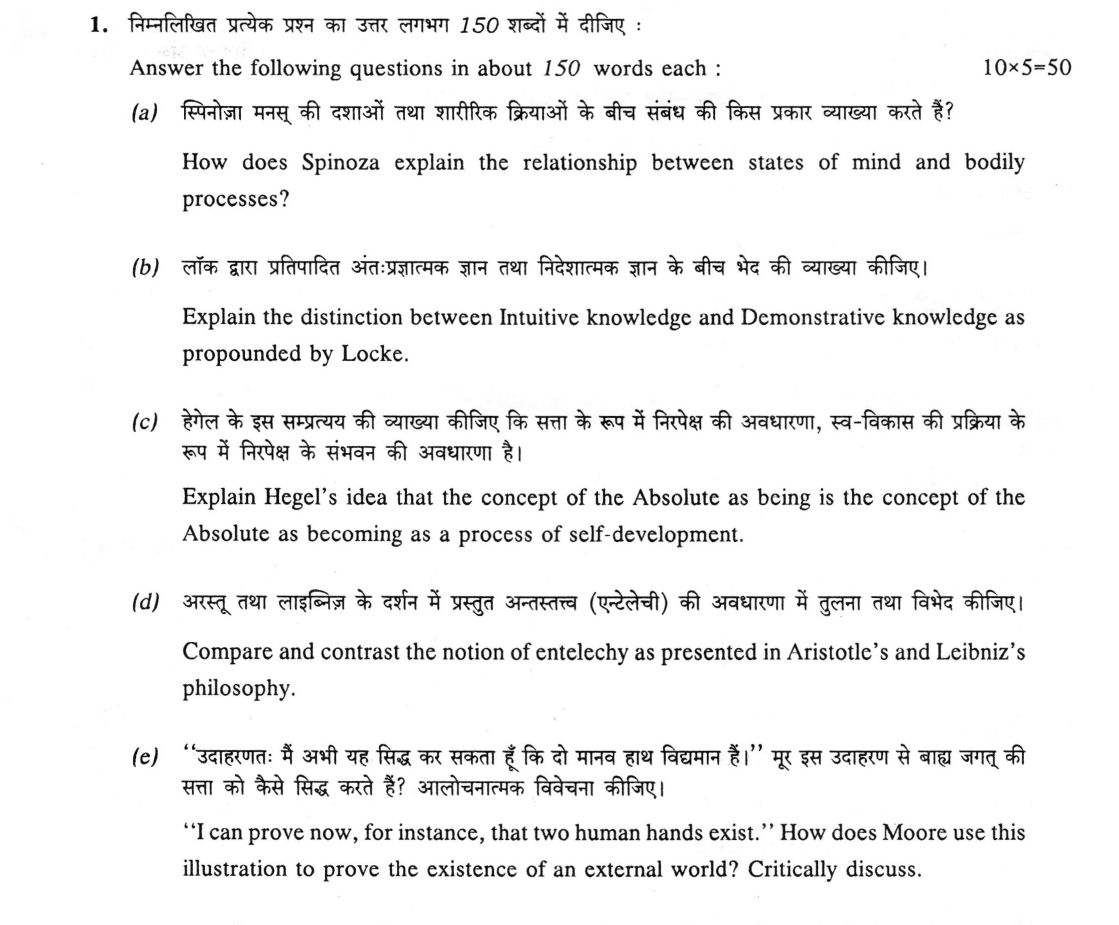
(a) How does Spinoza explain the relationship between states of mind and bodily processes? (10 marks) (b) Explain the…
Answer the following questions in about 150 words each :
How does Spinoza explain the relationship between states of mind and bodily processes? 10 marks
Explain the distinction between Intuitive knowledge and Demonstrative knowledge as propounded by Locke. 10 marks
Explain Hegel's idea that the concept of the Absolute as being is the concept of the Absolute as becoming as a process of self-development. 10 marks
Compare and contrast the notion of entelechy as presented in Aristotle's and Leibniz's philosophy. 10 marks
‘‘I can prove now, for instance, that two human hands exist.’’ How does Moore use this illustration to prove the existence of an external world? Critically discuss. 10 marks
हिंदी में प्रश्न पढ़ें
निम्नलिखित प्रत्येक प्रश्न का उत्तर लगभग 150 शब्दों में दीजिए :
स्पिनोज़ा मन की दशाओं तथा शारीरिक क्रियाओं के बीच संबंध की किस प्रकार व्याख्या करते हैं? (10 अंक)
लॉक द्वारा प्रतिपादित अंत:प्रज्ञात्मक ज्ञान तथा निदर्शनात्मक ज्ञान के बीच भेद की व्याख्या कीजिए। (10 अंक)
हेगेल के इस सम्प्रत्यय की व्याख्या कीजिए कि सत्ता के रूप में निरपेक्ष की अवधारणा, स्व-विकास की प्रक्रिया के रूप में निरपेक्ष के संभवन की अवधारणा है। (10 अंक)
अरस्तू तथा लाइब्निज़ के दर्शन में प्रस्तुत अन्तस्तत्त्व (एन्टेलेची) की अवधारणा में तुलना तथा विभेद कीजिए। (10 अंक)
‘‘उदाहरणत: मैं अभी यह सिद्ध कर सकता हूँ कि दो मानव हाथ विद्यमान हैं।’’ मूर इस उदाहरण से बाह्य जगत् की सत्ता को कैसे सिद्ध करते हैं? आलोचनात्मक विवेचना कीजिए। (10 अंक)
Model answer
Drafted with AI by UPSC Answer Check against this question's marking rubric, to the 150-word length. UPSC does not publish answers for Mains — this is one way to score well, not an official key. How we build rubrics and answers.
(a) Spinoza on mind and body
In the Ethics (1677) there is only one substance, Deus sive Natura, possessing infinite attributes, of which we know two: Thought (cogitatio) and Extension (extensio). Mind and body are therefore not two interacting substances, as Descartes held, but one and the same thing conceived now under Thought, now under Extension.
II P7: "the order and connection of ideas is the same as the order and connection of things." II P12–13: the object of the idea constituting the human mind is the body, so nothing happens in the body that the mind does not perceive, and the more capable the body, the more the mind perceives. III P2: the body cannot determine the mind to think, nor the mind the body to move. Mental and bodily states correspond without interacting, being one causal order under two attributes; hence no pineal gland and no divine intervention (Malebranche) is needed. The mind is active when it has adequate ideas and passive when it has inadequate ones, and the conatus of the body is equally the striving of the mind.
(b) Locke: intuitive and demonstrative knowledge
In Book IV of the Essay Concerning Human Understanding (1690), Locke defines knowledge as "the perception of the connexion of and agreement, or disagreement and repugnancy, of any of our ideas."
Intuitive knowledge perceives the agreement or disagreement immediately, by the ideas themselves, without any intervening idea: that white is not black, that a circle is not a triangle, that three are more than two. It is irresistible, "like bright sunshine", and is the ground of all certainty.
Demonstrative knowledge perceives the agreement only through intervening ideas, called proofs, as in showing that the three angles of a triangle equal two right angles; Locke also claims demonstrative knowledge of God's existence (IV.x). It is certain but less clear: every step must itself be intuitive, so a demonstration is a chain of intuitions; it is preceded by doubt, needs pains and attention, and depends on memory across long deductions, which makes it liable to error. Below both stands sensitive knowledge of particular external existents.
(c) Hegel: the Absolute as Being and as Becoming
For Hegel each basic category of the Logic is a definition of the Absolute; the first is "the Absolute is Being" (Encyclopaedia Logic §86). Pure Being (Sein), lacking all determination, is empty; in thinking it we think nothing, so it is indistinguishable from Nothing (Nichts), yet each passes over into the other. The truth of both is this passing-over, Becoming (Werden), the first concrete thought, which settles into Determinate Being (Dasein).
The movement is logical, not temporal: Being, rigorously thought, already is Becoming. So the Absolute cannot be a static substance or Schelling's undifferentiated identity, "the night in which all cows are black". The Preface to the Phenomenology of Spirit calls it "Substance and equally Subject": "the True is the whole", which is essentially a result. Through Aufhebung (cancelling, preserving, raising) it moves from an sich through für sich to an und für sich: the Idea (Logic) externalises itself as Nature and returns to itself as Spirit, culminating in art, religion and philosophy.
(d) Entelechy in Aristotle and Leibniz
Entelecheia (en + telos + echein, "having its end within") is Aristotle's term for actuality as against potentiality (dynamis). In De Anima II.1 (412a27) the soul is "the first entelechy of a natural body having life potentially": the form (eidos) that organises matter (hyle) into a living being and is at once its formal and final cause. First entelechy is a capacity possessed (knowledge had); second entelechy is its exercise (knowledge used).
Leibniz, in the Monadology (1714) §18, calls all simple substances "entelechies" because they have in them a certain perfection and a self-sufficiency that makes them sources of their own internal actions. He revives substantial forms and active force (vis viva) against Descartes' mechanism.
Comparison: both use entelechy to make reality teleological and self-active rather than merely mechanical. Contrast: Aristotle's entelechy is the form of a particular body and cannot exist apart from it; Leibniz's are infinitely many immaterial, windowless monads (§7) that unfold their perceptions through appetition (§15) and are coordinated not by interaction but by pre-established harmony.
(e) Moore's proof of an external world
In "Proof of an External World" (British Academy lecture, 1939), Moore answers Kant's complaint that it is a "scandal to philosophy" that the existence of things outside us must be accepted on faith. He argues: "Here is one hand, and here is another; therefore at least two external objects exist", hands being "things to be met with in space". The proof is rigorous, he says, because the premiss differs from the conclusion, the premiss is known and not merely believed, and the conclusion follows from it.
Critically: first, the sceptic replies that Moore begs the question (petitio principii), since knowing "here is a hand" presupposes knowing that one is not dreaming; Moore concedes he cannot prove his premiss, yet insists he knows it. Second, Wittgenstein's On Certainty treats "here is a hand" as a hinge proposition, a framework certainty, so Moore misuses "I know". In reply, the "Moorean shift" (cf. "A Defence of Common Sense", 1925) holds that such certainties outweigh any sceptical premiss. The proof thus shifts the burden of proof to the sceptic rather than refuting him.
How this answer will be evaluated
Evaluation rubric
Each sub-part is marked on its own, against the marks and word limit printed on the paper.
- (a) Explain (state and make intelligible, with textual grounding) Spinoza's account of the mind-body relation, i.e. how mental states and bodily processes are related in the Ethics. 'How does he explain' requires the doctrine of one substance with two known attributes plus the parallelism/identity thesis, not a mere description of dualism. 10 marks · 150 words
Must cover
- Spinoza, Ethics (Ethica, 1677)
- Deus sive Natura; one substance, infinite attributes
- Attributes of Thought (cogitatio) and Extension (extensio)
- Ethics II P7 - ordo et connexio idearum idem est ac ordo et connexio rerum
- Ethics II P13 - the mind is the idea of the body
- Ethics III P2 - mind and body cannot determine each other
- Parallelism / dual-aspect identity (not interactionism)
- Conatus; adequate vs inadequate ideas; activity and passivity
- Descartes' interactionism and the pineal gland, rejected
Loses marks
- Presenting Spinoza as an occasionalist (that is Malebranche) or as a pre-established harmony theorist (that is Leibniz); Spinoza's is parallelism grounded in substantial identity, not in divine intervention or a pre-arranged fit.
- Saying mind and body are two substances or two parallel series of DIFFERENT things - they are one and the same thing under two attributes.
- Allowing mind-body causal interaction somewhere in the answer, which contradicts Ethics III P2.
- Writing a general essay on Spinoza's substance, attributes and modes without ever reaching the mind-body question asked.
- Attributing the phrase 'God or Nature' to Descartes, or the parallelism proposition to the wrong Part of the Ethics.
Earns more
- Ethics II P13: the human mind is the idea of the human body; the more capable the body, the more the mind perceives
- (b) Explain the DISTINCTION Locke draws between intuitive and demonstrative knowledge in Essay Concerning Human Understanding Book IV. The answer must first give Locke's definition of knowledge, then contrast the two degrees on immediacy, certainty, role of intervening ideas and liability to error, with Locke's own examples. 10 marks · 150 words
Must cover
- John Locke, An Essay Concerning Human Understanding (1690), Book IV, chapters i-ii
- Knowledge = perception of the agreement or disagreement of ideas
- Intuitive knowledge: immediate, no intervening idea; white is not black; a circle is not a triangle; three are more than two
- Demonstrative knowledge: intervening ideas / proofs; angles of a triangle equal two right angles; existence of God
- Every step of a demonstration must be intuitive
- Role of memory and attention in demonstration; liability to error
- Sensitive knowledge as the third and least certain degree
Loses marks
- Confusing Locke's degrees with Descartes' clear and distinct ideas or with Hume's relations of ideas / matters of fact - the question is about Locke's own IV.ii scheme.
- Calling intuitive knowledge 'innate' - Locke's Book I attacks innate ideas; intuition is a mode of perceiving relations between acquired ideas.
- Omitting that demonstration is a chain of intuitions, which is the hinge of the distinction.
- Giving no example, or inventing examples not in Locke; the examiner expects Locke's own illustrations.
- Spending the answer on sensitive knowledge or on primary/secondary qualities, which are not what is asked.
Earns more
- Each step of a demonstration must itself be intuitive, so demonstration presupposes intuition; demonstration needs memory, attention and is preceded by doubt, hence less clear and more error-prone
- (c) Explain Hegel's thesis that the Absolute conceived as Being is thereby the Absolute as Becoming, i.e. as a process of self-development. The answer must work through the opening of the Science of Logic (Being-Nothing-Becoming) and then show how this licenses the claim that the Absolute is Subject and a self-developing whole. 10 marks · 150 words
Must cover
- Science of Logic (Wissenschaft der Logik): Being (Sein) - Nothing (Nichts) - Becoming (Werden) - Determinate Being (Dasein)
- Phenomenology of Spirit, Preface: the True as Substance and equally as Subject; the True is the whole
- Aufhebung / sublation
- an sich - fuer sich - an und fuer sich
- Logic - Nature - Spirit triad; absolute spirit as art, religion, philosophy
- Absolute idealism (contrast with Schelling's undifferentiated Absolute and Spinoza's static substance)
Loses marks
- Presenting the dialectic as a mechanical thesis-antithesis-synthesis formula and attributing that vocabulary to Hegel himself; Hegel scarcely uses it.
- Treating Becoming as a later stage that the Absolute 'enters', instead of showing that Being, rigorously thought, already collapses into Becoming.
- Confusing Aufhebung with mere cancellation; the preservation and elevation are essential.
- Substituting Heraclitean flux or Bergson's duration for Hegel's logical Becoming.
- Filling the 150 words with Hegel's philosophy of history or the master-slave dialectic, neither of which is asked for.
Earns more
- Dialectic and Aufhebung (sublation: cancel, preserve, raise); movement an sich - fuer sich - an und fuer sich
- The concrete shape of self-development: Idea (Logic) - self-externalisation as Nature - return to itself as Spirit (subjective, objective, absolute: art, religion, philosophy)
- (d) Compare AND contrast entelechy in Aristotle and in Leibniz. Both halves are required: the shared teleological, anti-mechanistic role of the notion, and the sharp differences in what bears it (form of a body vs simple substance/monad), its relation to matter, and the causal framework (immanent final causality vs pre-established harmony). 10 marks · 150 words
Must cover
- entelecheia (en + telos + echein); dynamis and energeia
- Aristotle, De Anima II.1 412a27 - soul as first actuality of a natural body having life potentially
- Hylomorphism: form (eidos/morphe) and matter (hyle); the four causes; internal final cause
- Leibniz, Monadology (1714) paragraph 18 - monads as Entelechies
- Monadology 7 (windowless monads), 15 (appetition as the tendency from one perception to another)
- Pre-established harmony; complete individual concept; revival of substantial forms and vis viva against Descartes
Loses marks
- Treating entelechy as a vital 'life-force' in the manner of Driesch's vitalism and reading that back into Aristotle or Leibniz.
- Equating Aristotelian entelecheia with Platonic Form - Aristotle's point is precisely that form is immanent, not separate.
- Offering only comparison or only contrast when the directive demands both.
- Saying monads causally interact; Leibniz's monads are windowless and coordinated only by pre-established harmony.
- Forgetting the first/second entelechy distinction, which is Aristotle's most citable use of the term.
Earns more
- Contrast: Aristotle's entelechy is the form of a particular material body and cannot exist without it, whereas Leibniz's entelechies are infinitely many simple substances unfolding their complete individual concepts under pre-established harmony, not real interaction; Leibniz revives substantial forms/vis viva against Cartesian mechanism
- (e) Two tasks. First, reconstruct Moore's proof of an external world using the two-hands illustration, including his three conditions for a rigorous proof. Second, 'critically discuss' - state at least two serious objections (question-begging; Wittgenstein's On Certainty) and Moore's or a Moorean reply. 10 marks · 150 words
Must cover
- G. E. Moore, 'Proof of an External World' (British Academy lecture, 1939)
- Kant, Critique of Pure Reason B xxxix note - the 'scandal to philosophy'
- 'Here is one hand ... and here is another'; things to be met with in space
- Moore's three conditions for a rigorous proof
- Moore's inability to prove the premiss / the dream argument
- 'A Defence of Common Sense' (1925); the Moorean shift
- Wittgenstein, On Certainty - hinge propositions
- Petitio principii / begging the question
Loses marks
- Confusing this argument with 'Moore's paradox' ('It is raining but I do not believe it is raining'), which is a different point entirely.
- Confusing it with Moore's 'Refutation of Idealism' (1903) and the attack on esse is percipi - related but not the same argument.
- Presenting only the proof and skipping the critical discussion, when the directive is 'critically discuss'.
- Claiming Moore proved his premisses; he explicitly says he cannot, and that is where the philosophical interest lies.
- Attributing the hinge-proposition criticism to Russell or Ayer rather than to Wittgenstein's On Certainty.
Earns more
- Moore's admission that he cannot prove the premiss (cannot prove he is not dreaming) yet claims to know it; the Moorean shift and 'A Defence of Common Sense' (1925)
- Wittgenstein's On Certainty: 'here is a hand' is a hinge/framework proposition, not an item of knowledge; Moore misapplies 'I know'
What "Explain" is asking you to do
Make the working of something clear — what sets it off, what follows from what, and what it produces. Explain is the Commission's mechanism word: it dominates the technical papers and the “explain why” stems, where the marks sit in the causal chain and not in the label.
Structure that answers it
State what it is → the initiating condition → the chain of cause, step by step → an instance where it plays out → what the chain produces
Where marks are lost
Describing what something looks like instead of why it works that way. Naming the stages without linking them reads as description too.
Practice this exact question
Write your answer and it is marked point by point against the model answer above — what you covered, what you missed, what you got wrong.
Evaluate my answer →More from Philosophy 2026 Paper I
- Q1 Answer the following questions in about 150 words each : (a) How does Spinoza explain the…
- Q2 (a) What, according to Aristotle, is the fundamental problem of metaphysics? Discuss this…
- Q3 (a) Why are states of consciousness ascribed to anything at all and why are they ascribed…
- Q4 (a) “Wittgenstein’s difficulty about not being able to say anything within a given langua…