Paper I — Q3
(a) Why are states of consciousness ascribed to anything at all and why are they ascribed to the same things to which we also…
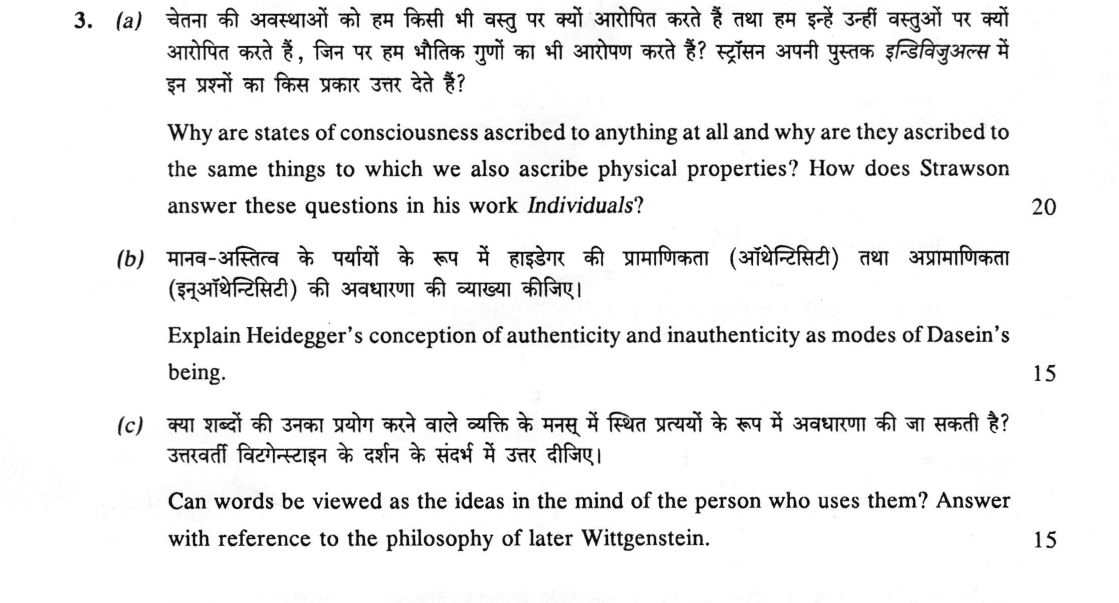
Why are states of consciousness ascribed to anything at all and why are they ascribed to the same things to which we also ascribe physical properties? How does Strawson answer these questions in his work Individuals? 20 marks
Explain Heidegger’s conception of authenticity and inauthenticity as modes of Dasein’s being. 15 marks
Can words be viewed as the ideas in the mind of the person who uses them? Answer with reference to the philosophy of later Wittgenstein. 15 marks
हिंदी में प्रश्न पढ़ें
चेतना की अवस्थाओं को हम किसी भी वस्तु पर क्यों आरोपित करते हैं तथा हम इन्हें उन्हीं वस्तुओं पर क्यों आरोपित करते हैं, जिन पर हम भौतिक गुणों का भी आरोपण करते हैं? स्ट्रॉसन अपनी पुस्तक इन्डिविजुअल्स में इन प्रश्नों का किस प्रकार उत्तर देते हैं? (20 अंक)
मानव-अस्तित्व के पर्यायों के रूप में हाइडेगर की प्रामाणिकता (ऑथेन्टिसिटी) तथा अप्रामाणिकता (इनऑथेन्टिसिटी) की अवधारणा की व्याख्या कीजिए। (15 अंक)
क्या शब्दों की उनका प्रयोग करने वाले व्यक्ति के मनस् में स्थित प्रत्ययों के रूप में अवधारणा की जा सकती है? उत्तरवर्ती विट्गेन्स्टाइन के दर्शन के संदर्भ में उत्तर दीजिए। (15 अंक)
Model answer
Drafted with AI by UPSC Answer Check against this question's marking rubric, to the expected length. UPSC does not publish answers for Mains — this is one way to score well, not an official key. How we build rubrics and answers.
**(a) Strawson on persons in *Individuals***
In Individuals (1959), chapter "Persons", Strawson's descriptive metaphysics describes the actual structure of our conceptual scheme rather than revising it. Within a single spatio-temporal framework, material bodies and persons are the basic particulars.
Strawson first rejects two answers. The Cartesian ascribes states of consciousness to a pure ego and physical properties to a body. The no-ownership theorist (early Wittgenstein, Schlick) says experiences are "had" by something only in the sense of being causally dependent on a particular body; strictly, nothing owns them. This is incoherent: to state it one must identify the experiences as those dependent on body B, but experiences can be identified only as someone's experiences, so the theory uses the very ownership it denies.
His answer: the concept of a person is logically primitive, the concept of a type of entity to which both M-predicates ("weighs ten stone", "is in the drawing-room") and P-predicates ("is smiling", "believes in God") are equally applicable. States of consciousness are ascribed at all because one can ascribe them to oneself only if one can ascribe them to others; and they are ascribed to the same things that bear physical properties because others can be identified only as embodied, their P-predicates being ascribed on logically adequate behavioural criteria, while one's own are self-ascribed without observation. The problem of other minds thus dissolves, and disembodied survival becomes a logically secondary, attenuated notion. Ayer ("The Concept of a Person", 1963) questioned both the primitiveness of the concept and the refutation of the no-ownership view.
(b) Heidegger: authenticity and inauthenticity as modes of Dasein's Being
In Being and Time (1927) Dasein is the entity whose Being is an issue for it; its essence lies in existence, and its Being is "in each case mine". Because it is mine, Dasein can choose and win itself, or lose itself (§9). Authenticity (Eigentlichkeit, "ownedness") and inauthenticity (Uneigentlichkeit) are therefore existential modes of Being-in-the-world grounded in care (Sorge), not moral grades.
Inauthenticity is Dasein's everyday, positive mode: it understands itself from the "they" (das Man), the anonymous public "one". Falling (Verfallen) shows itself in idle talk (Gerede), curiosity (Neugier) and ambiguity (Zweideutigkeit), which tranquillise and disperse Dasein.
Authenticity begins with Angst, which unlike fear (Furcht) has no determinate object and reveals Dasein's uncanniness (Unheimlichkeit). The silent call of conscience summons Dasein from the they-self to its Being-guilty (Schuldigsein). In Being-towards-death Dasein grasps death as its ownmost, non-relational, certain yet indefinite possibility, not to be outstripped. Anticipatory resoluteness (vorlaufende Entschlossenheit) takes this over, opening the moment of vision (Augenblick) and the repetition (Wiederholung) of inherited possibilities. Authenticity is not withdrawal from society: Dasein remains Being-with (Mitsein), and authentic existence is "a modification of the they".
(c) Later Wittgenstein: are words ideas in the mind?
No. The Philosophical Investigations (1953) opens by attacking the Augustinian picture (PI 1), in which every word names an object and meaning is what the word stands for; the idea theory (Locke) and the Tractatus share this picture. Instead, "for a large class of cases" the meaning of a word is its use in the language (PI 43), within language-games embedded in forms of life. Understanding is not an inner process accompanying words but an ability shown in use (PI 151–155).
Rule-following shows why an inner idea cannot fix meaning: since any mental sample can be variously interpreted, "obeying a rule" is a practice or custom, not a private state (PI 201–202). The private language argument (PI 243–271) is decisive. If "S" named a private sensation, there would be no criterion of correctness: "whatever is going to seem right to me is right", which means we cannot talk about "right" (PI 258). In the beetle in the box (PI 293) the private object "drops out of consideration as irrelevant". Sensation-words are learned as replacements for natural expressions of pain (PI 244).
This is not behaviourism: Wittgenstein denies that sensations are fictions (PI 307); he rejects only the grammar of inner naming. Kripke (1982) reads the rule-following argument as a sceptical paradox with a communitarian solution, a reading Baker and Hacker dispute.
How this answer will be evaluated
Evaluation rubric
Each sub-part is marked on its own, against the marks and word limit printed on the paper.
- (a) The two questions quoted are Strawson's own, from the chapter 'Persons' in Individuals (1959). The answer must (i) set up his framework - descriptive metaphysics, basic particulars, the concept of a person as logically primitive; (ii) give his answer to the first question by refuting the no-ownership theory; (iii) give his answer to the second by the argument that self-ascription requires other-ascription, which requires identifiable embodied subjects; (iv) explain M-predicates and P-predicates; (v) evaluate. 20 marks
Must cover
- P. F. Strawson, Individuals: An Essay in Descriptive Metaphysics (1959), chapter 3, 'Persons'
- Descriptive vs revisionary metaphysics
- Basic particulars; material bodies; the unified spatio-temporal framework
- The concept of a person as logically primitive
- M-predicates and P-predicates
- The no-ownership theory (associated with Schlick and the Tractatus-period Wittgenstein) and its self-refutation
- Logically adequate criteria; the problem of other minds
- Disembodied existence as logically secondary / attenuated
- A. J. Ayer's criticism
Loses marks
- Reversing Strawson's order of analysis by saying a person is a consciousness joined to a body - that is exactly the Cartesian account he rejects.
- Reading Strawson as a behaviourist; he insists P-predicates are also self-ascribed non-observationally, which no behaviourism allows.
- Naming the two predicate classes but failing to give Strawson's own examples, so the answer stays abstract.
- Answering only one of the two questions actually quoted in the paper; both are separately marked.
- Confusing descriptive metaphysics with ordinary language philosophy generally, or attributing the term 'revisionary metaphysics' to Austin or Ryle.
Earns more
- Framework: Individuals as descriptive (not revisionary) metaphysics; identification within a single spatio-temporal scheme; material bodies and persons as the two types of basic particular
- Consequences and evaluation: dissolution of the problem of other minds; disembodied survival as a logically secondary, attenuated and solitary notion; Ayer's objection that the no-ownership theory is not thereby refuted and the charge that 'primitive' is under-explained
- (b) Explain authenticity (Eigentlichkeit) and inauthenticity (Uneigentlichkeit) as MODES OF DASEIN'S BEING in Being and Time - that is, as existentialia, not moral categories. Required: the das Man analysis with its three modes of falling, the call of conscience, Angst, being-towards-death and anticipatory resoluteness, and the explicit point that inauthenticity is a positive and usual mode. 15 marks
Must cover
- Heidegger, Being and Time (Sein und Zeit, 1927)
- Dasein; Being-in-the-world (In-der-Welt-sein); care (Sorge)
- Eigentlichkeit and Uneigentlichkeit; das Man and the they-self
- Verfallen; Gerede, Neugier, Zweideutigkeit
- Angst vs Furcht (fear); Unheimlichkeit
- Call of conscience; Schuldigsein (Being-guilty)
- Sein zum Tode; ownmost, non-relational, not-to-be-outstripped possibility
- Vorlaufende Entschlossenheit (anticipatory resoluteness); Augenblick; Wiederholung
Loses marks
- Moralising the distinction - treating inauthenticity as sin or dishonesty and authenticity as a virtue; Heidegger explicitly denies that the analysis is evaluative.
- Saying authenticity consists in leaving society or das Man behind; it is a modified way of taking up the they, and Dasein remains Being-with (Mitsein).
- Confusing Angst with fear, or giving anxiety a determinate object.
- Reducing being-towards-death to thinking about one's biological demise or to morbid brooding, instead of relating to death as one's ownmost possibility.
- Importing Sartre's vocabulary (bad faith, existence precedes essence) as if it were Heidegger's; Heidegger repudiated the existentialist reading in the Letter on Humanism.
Earns more
- Dasein as the entity whose Being is an issue for it, whose essence lies in existence; authenticity/inauthenticity as existentialia (modes of Being), grounded in the care-structure of Being-in-the-world
- Anxiety (Angst) as individualising disclosure of Being-in-the-world (contrasted with fear, which has a definite object), and the silent call of conscience summoning Dasein to its Being-guilty
- (c) Answer the yes/no question - the later Wittgenstein's answer is NO - and justify it from the Philosophical Investigations: rejection of the Augustinian picture, meaning as use, understanding is not an inner process, rule-following, and above all the private language argument with the beetle in the box. A bare exposition of 'meaning is use' without the private language argument will not meet the demand. 15 marks
Must cover
- Wittgenstein, Philosophical Investigations (1953)
- Augustinian picture of language, PI 1 (Confessions I.8)
- PI 43 - meaning is use in the language
- Language-games (Sprachspiele); forms of life (Lebensform); family resemblance (PI 65-67)
- Rule-following, PI 201 and PI 202; rule-following as a practice/custom
- Private language argument, PI 243-271; PI 258 criterion of correctness; PI 293 beetle in the box
- PI 244 - the word replaces the natural expression of sensation
- PI 307 - not a behaviourist in disguise
- Kripke, Wittgenstein on Rules and Private Language (1982)
Loses marks
- Answering 'yes' or hedging; the later Wittgenstein's position is a clear rejection, and the question is a test of whether the candidate knows this.
- Attributing the view attacked to Locke alone and forgetting that the Tractatus and the Augustinian picture are Wittgenstein's declared targets.
- Stating 'meaning is use' as a slogan without the private language argument, which is the decisive argument against words-as-private-ideas.
- Reading Wittgenstein as denying that sensations exist, or as a behaviourist - PI 307 blocks this explicitly.
- Confusing the beetle in the box with the duck-rabbit (aspect-seeing, PI Part II/PPF), which concerns a different problem.
Earns more
- Understanding and meaning are not inner processes or accompaniments (PI 151-155, 329); the rule-following considerations (PI 201, 202) - an inner idea cannot determine correct future application; to obey a rule is a practice/custom
- Sensation-words get their grammar from public expressive behaviour (PI 244), and Wittgenstein's express denial that this is behaviourism (PI 307); interpretive dispute between Kripke's communitarian reading and Baker-Hacker
What "How" is asking you to do
Set out the route by which the outcome comes about, step by step. Many how stems ask how one thing affects another, and there the channel of transmission is precisely what is being marked.
Structure that answers it
Starting condition → step → step → outcome reached → the conditions the route depends on
Where marks are lost
Answering why it happens instead of how, the commonest single misread in the paper. An answer full of causes and significance that never traces the mechanism has answered a different question.
Practice this exact question
Write your answer and it is marked point by point against the model answer above — what you covered, what you missed, what you got wrong.
Evaluate my answer →More from Philosophy 2026 Paper I
- Q1 Answer the following questions in about 150 words each : (a) How does Spinoza explain the…
- Q2 (a) What, according to Aristotle, is the fundamental problem of metaphysics? Discuss this…
- Q3 (a) Why are states of consciousness ascribed to anything at all and why are they ascribed…
- Q4 (a) “Wittgenstein’s difficulty about not being able to say anything within a given langua…
- Q5 Answer the following questions in about 150 words each : (a) According to Nyāya view of i…
- Q6 (a) “A mango tree is grown out of a mango seed.” How do the Sāṁkhya philosophers explain…