Paper I — Q2
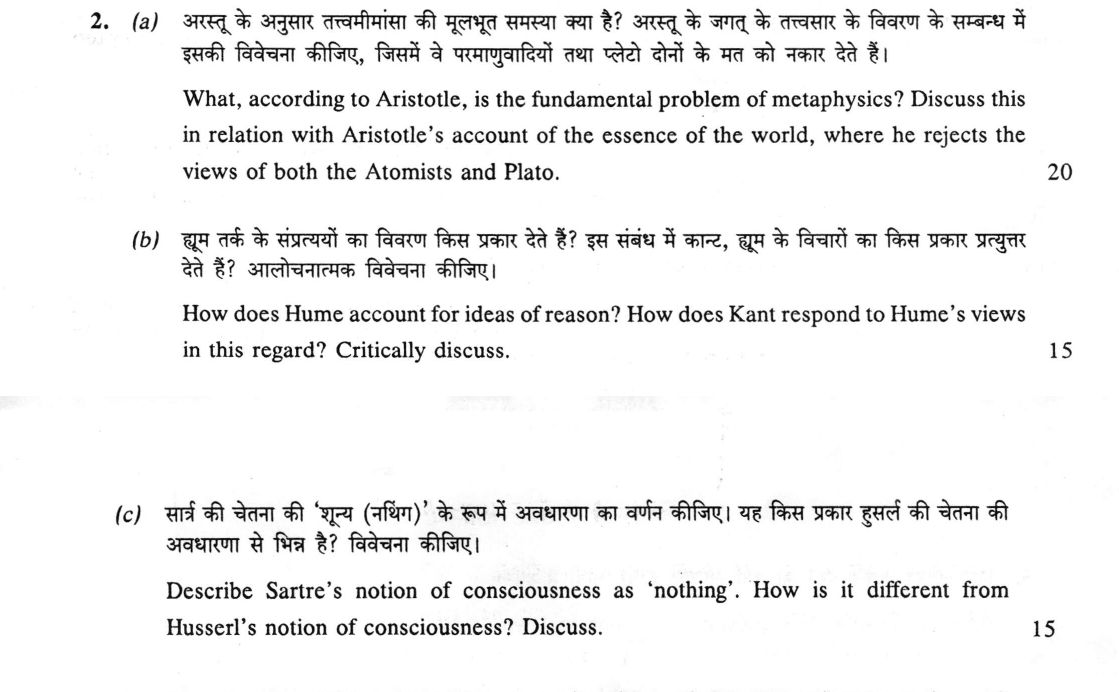
(a) What, according to Aristotle, is the fundamental problem of metaphysics? Discuss this in relation with Aristotle's account of…
What, according to Aristotle, is the fundamental problem of metaphysics? Discuss this in relation with Aristotle's account of the essence of the world, where he rejects the views of both the Atomists and Plato. 20 marks
How does Hume account for ideas of reason? How does Kant respond to Hume's views in this regard? Critically discuss. 15 marks
Describe Sartre’s notion of consciousness as ‘nothing’. How is it different from Husserl’s notion of consciousness? Discuss. 15 marks
हिंदी में प्रश्न पढ़ें
अरस्तू के अनुसार तत्त्वमीमांसा की मूलभूत समस्या क्या है? अरस्तू के जगत् के तत्त्वसार के विवरण के सम्बन्ध में इसकी विवेचना कीजिए, जिसमें वे परमाणुवादियों तथा प्लेटो दोनों के मत को नकार देते हैं। (20 अंक)
ह्यूम तर्क के संप्रत्ययों का विवरण किस प्रकार देते हैं? इस संबंध में कांट, ह्यूम के विचारों का किस प्रकार प्रत्युत्तर देते हैं? आलोचनात्मक विवेचना कीजिए। (15 अंक)
सार्त्र की चेतना की ‘शून्य (नथिंग)’ के रूप में अवधारणा का वर्णन कीजिए। यह किस प्रकार हुसर्ल की चेतना की अवधारणा से भिन्न है? विवेचना कीजिए। (15 अंक)
Model answer
Drafted with AI by UPSC Answer Check against this question's marking rubric, to the expected length. UPSC does not publish answers for Mains — this is one way to score well, not an official key. How we build rubrics and answers.
(a) Aristotle: being, substance and the rejection of the Atomists and Plato
For Aristotle the fundamental problem of metaphysics, "first philosophy", is being qua being (Metaphysics IV.1). Since being "is said in many ways" (pollachos legetai) but always with reference to one primary sense, the inquiry reduces to substance (ousia), on which all the other categories depend. Hence Metaphysics VII.1: the old question "what is being?" is really "what is substance?"
His answer is hylomorphic. A sensible substance is a composite (synholon) of matter (hyle) and form (eidos); its essence (to ti en einai) is the form, which is immanent in the individual, not separate from it. Change is explained by the four causes (material, formal, efficient, final) and by the passage from potentiality (dynamis) to actuality (energeia). The world as a whole depends on the unmoved mover of Metaphysics XII, pure actuality, "thought thinking itself", which moves as final cause.
This account is reached by rejecting two rivals. Against the Atomists (Leucippus, Democritus): atoms and void explain neither the form and unity of a substance nor the regular, end-directed character of nature, and what happens "always or for the most part" cannot be due to chance (Physics II.4–8). He also denies the void (Physics IV.6–9) and indivisible magnitudes (Physics VI). Against Plato, he rejects the separation (chorismos) of Forms: separate Forms cannot be the substance of things they are apart from; "participation" (methexis) is "empty words and poetical metaphor" (Met. I.9); the Third Man regress arises; and "no universal is a substance" (Met. VII.13). Essence, therefore, is form in the individual.
(b) Hume on the ideas of reason and Kant's reply
Hume tests every idea by the copy principle: simple ideas copy prior impressions (Treatise, 1739–40; Enquiry, 1748). Reason alone knows only relations of ideas; matters of fact rest on experience. The central supposed idea of reason, necessary connection, has no impression behind it: we observe only constant conjunction; necessity is only the mind's customary transition, projected onto objects (Treatise I.iii.14). Induction likewise rests on an unprovable uniformity of nature. The self is "a bundle of perceptions".
Kant, woken from his "dogmatic slumber" (Prolegomena), makes necessity a contribution of the mind. By the Copernican turn objects conform to our cognition; causality is a category of the understanding, and the Second Analogy shows that only a necessary rule of succession distinguishes an objective event from a merely subjective order of perceptions. The Ideas of Reason proper (soul, world, God) have no corresponding intuition; used constitutively they breed Paralogisms and Antinomies, so their legitimate use is only regulative.
Critically, Kant secures synthetic a priori causality only for appearances, conceding that things in themselves are unknowable. Strawson (The Bounds of Sense, 1966) keeps Kant's argument about the conditions of experience but rejects transcendental idealism as incoherent; a Humean may reply that Kant presupposes the necessary knowledge he claims to explain.
(c) Sartre's consciousness as 'nothing', and Husserl
In Being and Nothingness (1943) Sartre opposes being-in-itself (en-soi), which "is what it is", full and opaque, to being-for-itself (pour-soi), consciousness, which "is what it is not and is not what it is". Consciousness has no contents: it is pure intentional directedness towards what it is not, and exists only by negating (néantisation) the in-itself; through it nothingness enters the world as absence, lack and possibility. The Transcendence of the Ego (1936–37) expels the ego from consciousness: the "I" is a transcendent object constituted in reflection, while consciousness is translucent, impersonal spontaneity, aware of itself non-positionally in the pre-reflective cogito. Having no fixed essence (existence precedes essence), it is condemned to freedom; hence anguish and bad faith.
Sartre takes intentionality from Husserl but differs sharply. Husserl, after the epoché (Ideas I, 1913), studies consciousness as acts (noesis) correlated with meant objects (noema), unified by a transcendental ego that constitutes the sense of the world (Cartesian Meditations). For Sartre such an ego would be an opacity within consciousness and would make it a substance; the for-itself is nothing but its relation to being. Merleau-Ponty later criticised Sartre's rigid en-soi/pour-soi dualism for ignoring embodied, situated freedom.
How this answer will be evaluated
Evaluation rubric
Each sub-part is marked on its own, against the marks and word limit printed on the paper.
- (a) Three linked tasks: (i) identify what Aristotle takes to be the fundamental problem of metaphysics (what is being, which reduces to what is substance/ousia); (ii) expound his positive account of the essence of the world (hylomorphism, essence as form, the four causes, actuality/potentiality); (iii) show how that account is worked out by rejecting BOTH the Atomists' materialism and Plato's separate Forms. All three must appear. 20 marks
Must cover
- Metaphysics IV.1 - the science that studies being qua being
- Metaphysics VII.1, 1028b2 - 'what is being?' = 'what is substance (ousia)?'
- Being is said in many ways (pollachos legetai); the categories; substance as primary
- Hylomorphism: hyle and eidos/morphe; synholon; to ti en einai (essence)
- Four causes: material, formal, efficient, final; dynamis and energeia/entelecheia
- Leucippus and Democritus - atoms and void; chance vs teleology; Physics II.4-6 and II.8; rejection of the void, Physics IV.6-9
- Plato's Forms: chorismos, methexis as empty metaphor (Met. 991a20-22), Third Man argument (990b17, 1039a2), Met. VII.13 - no universal is a substance
- Metaphysics XII - the unmoved mover, pure actuality, noesis noeseos, moving as final cause
Loses marks
- Answering only 'substance is the fundamental problem' and then narrating the ten categories, without ever giving the hylomorphic account of the world's essence.
- Omitting one of the two rejections; the question names both the Atomists and Plato, so dropping either costs the whole 4 marks for that head.
- Misstating the Third Man argument (it is a regress generated by treating the Form itself as one more F, not a claim that there are three men).
- Attributing to Aristotle the view that form can exist separately from matter in the sensible world - he allows an exception only for the unmoved mover and disputes the case of nous.
- Confusing Aristotle's rejection of the void with a rejection of atomism as such; his objections to atomism are about form, unity, teleology and generation, not only about the void.
Earns more
- Positive account of essence: hylomorphism - sensible substance is a composite of matter (hyle) and form (eidos); essence (to ti en einai) is the form; the four causes; potentiality and actuality (dynamis/energeia, entelecheia)
- The unmoved mover of Metaphysics XII as pure actuality and final cause, thought thinking itself (noesis noeseos), completing the account of the world's essence
- The resulting synthesis - form immanent in the individual, chorismos abolished - plus the scholarly point that the Categories' primary substance (the individual) and Metaphysics VII's primacy of essence/form stand in a disputed relation
- (b) Two parts plus an evaluation. (i) Hume's account of what reason can yield: the copy principle, Hume's fork, the analysis of causal necessity into custom, and the treatment of substance, self and God as products of imagination rather than ideas of reason. (ii) Kant's reply: synthetic a priori judgements, the Copernican turn, causality as a category vindicated in the Second Analogy, and the regulative status of the three Ideas of Reason. (iii) Critical assessment of how far Kant answers Hume. 15 marks
Must cover
- Hume, A Treatise of Human Nature (1739-40) and An Enquiry concerning Human Understanding (1748)
- Copy principle; impressions and ideas
- Hume's fork - relations of ideas / matters of fact
- Constant conjunction; no impression of necessary connection; custom/habit; Treatise I.iii.14
- Problem of induction; uniformity of nature
- Bundle theory of the self
- Kant, Prolegomena Preface - 'dogmatic slumber'
- Synthetic a priori judgements; Copernican revolution (CPR B xvi)
- Category of causality; Transcendental Deduction; Second Analogy of Experience
- Transcendental Dialectic: Ideas of soul, world, God; regulative use; Paralogisms and Antinomies; postulates of pure practical reason
- P. F. Strawson, The Bounds of Sense (1966)
Loses marks
- Saying Hume 'denied causation'; he denies only that we have a rational insight into necessary connection, and he retains causal inference as a natural, customary operation.
- Claiming Kant refuted Hume outright; Kant concedes that the categories have no application to things in themselves, which is a major concession.
- Confusing Kant's regulative Ideas of Reason (soul, world, God) with the constitutive categories of the understanding - the question invites both, but they must not be conflated.
- Locating the vindication of causality in the Transcendental Aesthetic or in the Refutation of Idealism instead of the Second Analogy.
- Writing a general comparison of rationalism and empiricism with no textual specifics, which cannot earn the essential marks.
Earns more
- Causality as a category; the Transcendental Deduction and the Second Analogy of Experience establish it as a condition of objective temporal determination - necessity is a priori and objectively valid for appearances only
- Kant's Ideas of Reason in the strict sense (soul, world, God) in the Transcendental Dialectic: Paralogisms, Antinomies, Ideal; regulative not constitutive use, restored as postulates of pure practical reason
- Critical evaluation: Kant concedes Hume regarding things in themselves; Strawson's objection in The Bounds of Sense to transcendental idealism; the Humean rejoinder that synthetic a priori knowledge is presupposed rather than proved
- (c) Two directives. 'Describe' Sartre's thesis that consciousness (being-for-itself) is a nothingness - with the en-soi/pour-soi contrast, the rejection of contents and of the ego, and the consequence for freedom. Then 'discuss' how this differs from Husserl's conception of consciousness (noesis-noema, the transcendental ego, the epoche). 15 marks
Must cover
- Sartre, Being and Nothingness (L'Etre et le neant, 1943)
- etre-en-soi and etre-pour-soi; 'being is what it is'; the for-itself 'is not what it is and is what it is not'
- neant / neantisation; nothingness comes into the world through man
- Sartre, The Transcendence of the Ego (1936-37); ego as transcendent, not an inhabitant of consciousness
- pre-reflective cogito; non-positional consciousness
- Existence precedes essence; freedom, anguish, bad faith (mauvaise foi); useless passion
- Husserl, Ideas I (1913): epoche, phenomenological reduction, noesis-noema; Cartesian Meditations, the transcendental ego
- Merleau-Ponty's critique (Phenomenology of Perception)
Loses marks
- Treating Sartre's 'nothing' as sheer non-existence or as nihilism; it is a structural emptiness that is the condition of negation and freedom, not the absence of consciousness.
- Attributing the transcendental ego to Sartre; his best-known early essay exists precisely to expel it.
- Saying Husserl and Sartre agree because both accept intentionality, without stating any specific difference - the question demands the difference.
- Confusing Husserl's noema with a mental image or a sense-datum inside consciousness.
- Filling the answer with Sartrean ethics or the look/being-for-others while never stating the en-soi/pour-soi ontology.
Earns more
- Consciousness has no contents and no ego within it: 'The Transcendence of the Ego' makes the ego a transcendent object for consciousness; consciousness is translucent, an impersonal spontaneity; pre-reflective cogito and non-positional self-awareness
- Consequence: existence precedes essence, hence absolute freedom, anguish, bad faith; the for-itself as lack desiring to be in-itself-for-itself, man as a useless passion
- Critical close: Merleau-Ponty's objection to the rigid en-soi/pour-soi dichotomy and to absolute freedom; the problem of individuating a consciousness that is nothing
What "Discuss" is asking you to do
Lay the issue out from more than one side — how it arose, what is claimed for it, what is held against it, and where it now stands. UPSC attaches discuss to broad topics with several live dimensions, so coverage of the dimensions earns more than the strength of your opinion.
Structure that answers it
Set the issue up → the case as it is made → the case against → the dimension both sides leave out → where the balance now lies
Where marks are lost
Listing facts with no thread between them, or arguing one side throughout and calling it a discussion.
Practice this exact question
Write your answer and it is marked point by point against the model answer above — what you covered, what you missed, what you got wrong.
Evaluate my answer →More from Philosophy 2026 Paper I
- Q1 Answer the following questions in about 150 words each : (a) How does Spinoza explain the…
- Q2 (a) What, according to Aristotle, is the fundamental problem of metaphysics? Discuss this…
- Q3 (a) Why are states of consciousness ascribed to anything at all and why are they ascribed…
- Q4 (a) “Wittgenstein’s difficulty about not being able to say anything within a given langua…
- Q5 Answer the following questions in about 150 words each : (a) According to Nyāya view of i…