Paper I — Q4
(a) “Wittgenstein’s difficulty about not being able to say anything within a given language about the structure of that language…
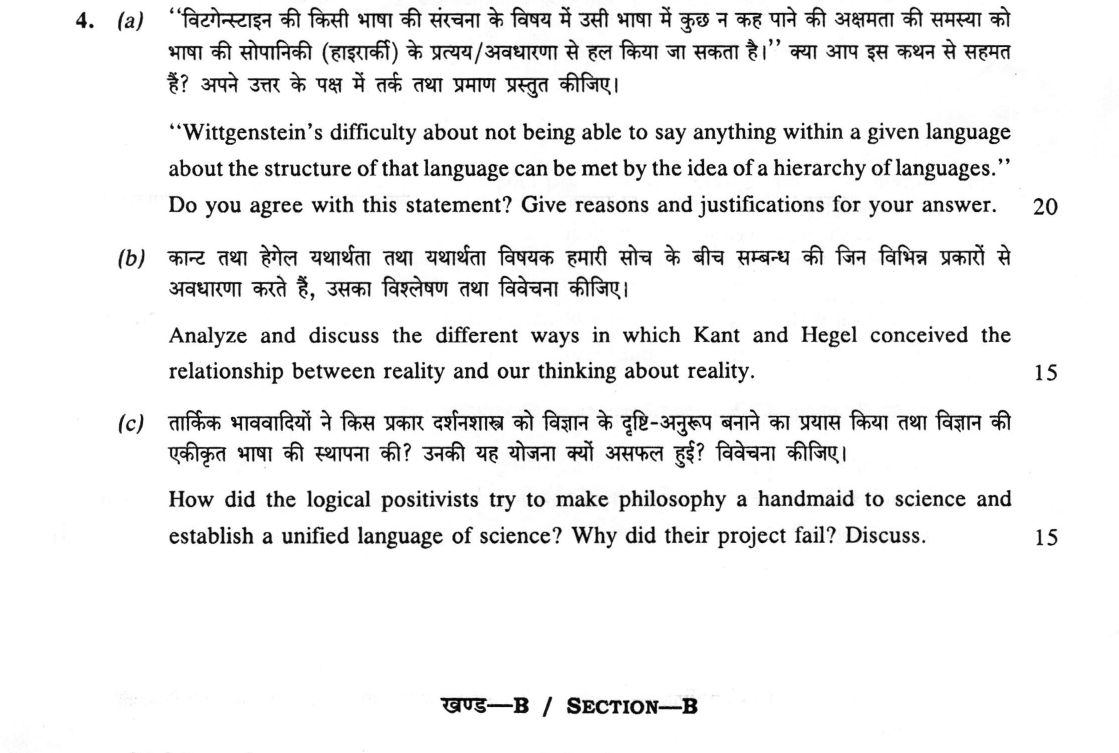
“Wittgenstein’s difficulty about not being able to say anything within a given language about the structure of that language can be met by the idea of a hierarchy of languages.” Do you agree with this statement? Give reasons and justifications for your answer. 20 marks
Analyze and discuss the different ways in which Kant and Hegel conceived the relationship between reality and our thinking about reality. 15 marks
How did the logical positivists try to make philosophy a handmaid to science and establish a unified language of science? Why did their project fail? Discuss. 15 marks
हिंदी में प्रश्न पढ़ें
“विट्गेन्स्टाइन की किसी भाषा की संरचना के विषय में उसी भाषा में कुछ न कह पाने की अक्षमता की समस्या को भाषा की सोपानिकी (हाइरार्की) के प्रत्यय/अवधारणा से हल किया जा सकता है।” क्या आप इस कथन से सहमत हैं? अपने उत्तर के पक्ष में तर्क तथा प्रमाण प्रस्तुत कीजिए। (20 अंक)
कान्ट तथा हेगेल यथार्थता तथा यथार्थता विषयक हमारी सोच के बीच सम्बन्ध को जिन विभिन्न प्रकारों से अवधारणा करते हैं, उसका विश्लेषण तथा विवेचना कीजिए। (15 अंक)
तार्किक भाववादियों ने किस प्रकार दर्शनशास्त्र को विज्ञान की सहायिका (हैंडमेड) बनाने तथा विज्ञान की एकीकृत भाषा स्थापित करने का प्रयास किया? उनकी यह योजना क्यों असफल हुई? विवेचना कीजिए। (15 अंक)
Model answer
Drafted with AI by UPSC Answer Check against this question's marking rubric, to the expected length. UPSC does not publish answers for Mains — this is one way to score well, not an official key. How we build rubrics and answers.
(a) Say/show and the hierarchy of languages
The difficulty arises from the Tractatus picture theory. A proposition pictures a fact by sharing its logical form, but it cannot represent that form itself: logical form "shows itself" and cannot be said (4.12–4.1212). Hence the book's own propositions are nonsensical elucidations, a ladder to be thrown away after climbing (6.54).
In his Introduction (1922) Russell suggested that every language has a structure about which nothing can be said in that language, but which a second language can describe, and so on without limit. Tarski gave this precision: truth for an object language is definable only in a richer metalanguage (Convention T). Carnap's Logical Syntax of Language (1934) claimed that what Wittgenstein held could only be shown can be stated as syntax. For formalised languages this succeeds.
But it does not meet Wittgenstein's difficulty. First, the regress is never completed: the structure of the whole hierarchy, or of language as such, remains unsayable, so the problem is only postponed. Second, Wittgenstein rejected Russell's Introduction as a misunderstanding; he had already told Russell (1919) that the theory of what can be said and what can only be shown is "the cardinal problem of philosophy". Third, showing extends beyond syntax to ethics, which "is transcendental" (6.421), to the metaphysical subject (5.632) and to the mystical, none of which a metalanguage captures. Non-hierarchical theories of truth such as Kripke's (1975) also show the hierarchy is not forced. The statement therefore holds for formal semantics, not as a dissolution of the say/show distinction.
(b) Kant and Hegel on reality and our thought of it
For Kant, thought does not copy an independent reality; objects must conform to our cognition (the Copernican revolution, B xvi). Knowledge arises only where the forms of intuition (space, time) and the categories, unified in the transcendental unity of apperception, combine: "thoughts without content are empty, intuitions without concepts are blind" (A51/B75). The categories therefore hold only of phenomena. Reality as it is in itself, the thing-in-itself, can be thought but not known; pushing the categories beyond experience yields the Antinomies. This is transcendental idealism with empirical realism.
Hegel rejects that limit. The thing-in-itself, abstracted from all determination, is an empty abstraction, a caput mortuum (Encyclopaedia §44). To know a limit as a limit is already to be beyond it, and to examine the faculty of knowing before knowing is like wanting to learn to swim before going into the water (§10). The categories are therefore not subjective forms imposed on a foreign material but "objective thoughts", the structure of reality itself, developing dialectically in the Concept (Begriff); hence absolute idealism and "what is rational is actual, and what is actual is rational" (Philosophy of Right, Preface).
The contrast: Kant keeps a gap between thought and being and so protects finitude and the givenness of the object; Hegel closes the gap in a self-knowing whole, at the price, critics such as Kierkegaard and Marx argued, of panlogism.
(c) Logical positivism: philosophy as handmaid of science, and its failure
The Vienna Circle (Schlick, Carnap, Neurath, Hahn, Feigl, Waismann), with Reichenbach and Ayer's Language, Truth and Logic (1936), announced a "scientific world-conception" (manifesto, 1929). Every meaningful statement is either analytic (true by logic and meaning) or empirically verifiable; metaphysics, theology and ethics are literally meaningless (Carnap's 1932 attack on Heidegger's "the Nothing nothings"). Philosophy thus has no doctrines of its own: it is the activity of clarification (Tractatus 4.112) and the logic of science. Unity of science meant one physicalist language into which all scientific statements could be translated (Neurath), resting on protocol sentences; Carnap's Aufbau (1928) and the International Encyclopedia of Unified Science pursued this.
The project failed for connected reasons. The verification principle is neither analytic nor empirically verifiable, and every precise version failed: universal laws cannot be conclusively verified, and Church (1949) showed that Ayer's revised criterion admits any statement. Protocol sentences proved revisable, so there was no incorrigible base, as Neurath himself conceded with his boat rebuilt at sea. Quine's "Two Dogmas of Empiricism" (1951) undermined the analytic/synthetic distinction and sentence-by-sentence reductionism in favour of holism. Kuhn (1962) and Sellars's attack on the Myth of the Given showed observation to be theory-laden. Popper, a critic rather than a member, replaced the criterion of meaning with falsifiability as a criterion only of demarcation.
How this answer will be evaluated
Evaluation rubric
Each sub-part is marked on its own, against the marks and word limit printed on the paper.
- (a) Take a reasoned position on whether Russell's hierarchy-of-languages proposal solves the Tractatus say/show difficulty. Required: (i) accurate statement of Wittgenstein's difficulty (picture theory, logical form cannot be said but only shown, the ladder of 6.54); (ii) Russell's proposal in his Introduction to the Tractatus and its development by Tarski and Carnap; (iii) arguments for and against; (iv) a clear verdict with reasons. 20 marks
Must cover
- Wittgenstein, Tractatus Logico-Philosophicus (1921/1922); picture theory of the proposition
- 4.12, 4.121, 4.1212 - logical form shown not said; 6.54 the ladder; proposition 7
- Russell's Introduction to the Tractatus (1922) - hierarchy of languages
- Russell's theory of types; vicious-circle principle; Russell's paradox; Principia Mathematica
- Tarski, The Concept of Truth in Formalized Languages (1933/1935); object language and metalanguage; undefinability theorem; Convention T; semantically closed languages and the Liar
- Carnap, The Logical Syntax of Language (1934); Godel arithmetisation; principle of tolerance
- Wittgenstein's 1919 letter to Russell on the cardinal problem of philosophy
- Tractatus 6.421 (ethics is transcendental), 5.632 (the subject does not belong to the world)
- Kripke, 'Outline of a Theory of Truth' (1975) as a non-hierarchical alternative
Loses marks
- Not taking a position at all; the question asks 'do you agree', so an answer that merely summarises both sides without a verdict loses the verdict mark and reads as evasive.
- Attributing the hierarchy-of-languages proposal to Wittgenstein himself, or to Tarski alone, when the proposal in this context is Russell's Introduction.
- Confusing Tarski's undefinability theorem with Godel's incompleteness theorems - related in technique, distinct in content.
- Reducing the say/show distinction to a point about syntax, and so missing why Wittgenstein thought the hierarchy irrelevant to ethics, value and the mystical.
- Treating the Tractatus' self-condemnation as an oversight rather than as deliberate (6.54), which makes the whole discussion misfire.
Earns more
- The developed case in favour: Tarski's object-language/metalanguage hierarchy, the undefinability of truth within a language, Convention T, and the diagnosis of semantically closed languages; Carnap's Logical Syntax of Language, which claims that what Wittgenstein said could only be shown can be said in syntax
- Decisive objections: infinite regress - the top language's structure is never sayable, so the problem is postponed; Wittgenstein's own rejection of Russell's reading (letter to Russell, 1919: the theory of what can be expressed and what cannot is the cardinal problem of philosophy)
- Further objections: showing covers more than syntax - ethics (6.421), the metaphysical subject (5.632), the mystical; Tarski restricted his method to formalised languages and doubted its extension to semantically closed natural language; alternatives such as Kripke's fixed-point theory and dialetheist treatments
- (b) Analyse and compare the DIFFERENT ways Kant and Hegel conceive the relation between reality and our thought of it. Required: Kant's Copernican turn with its phenomena/noumena limit, and Hegel's rejection of the thing-in-itself and his identification of the categories with the self-developing structure of reality itself. A bare summary of each philosopher without the specific contrast will not do. 15 marks
Must cover
- Kant, Critique of Pure Reason; Copernican revolution (B xvi)
- Forms of intuition (space and time); twelve categories in four groups; transcendental unity of apperception (B131)
- 'Thoughts without content are empty, intuitions without concepts are blind' (A51/B75)
- Phenomena and noumena / thing-in-itself; transcendental idealism and empirical realism; regulative Ideas; Antinomies
- Hegel, Encyclopaedia Logic and Science of Logic; the thing-in-itself as caput mortuum (Enc. Logic 44)
- The swimming analogy (Enc. Logic 10); the argument that to know a limit is to be beyond it
- The Concept (Begriff); dialectic; absolute idealism
- Philosophy of Right, Preface - the rational is actual, the actual is rational
Loses marks
- Describing Hegel's idealism as subjective idealism in Berkeley's sense; Hegel's absolute idealism claims that reality is itself conceptual, not that it is my idea.
- Saying Kant denied the existence of things in themselves; he denies only that we can KNOW them, and their status in his system is itself disputed.
- Giving parallel summaries of Kant and of Hegel without ever stating a contrast, when the directive is to analyse the DIFFERENT ways.
- Attributing 'thesis-antithesis-synthesis' to Hegel as his own vocabulary.
- Confusing Kant's categories of the understanding with his Ideas of reason, which have regulative and not constitutive use.
Earns more
- Kant's limit: we know phenomena, not things in themselves; transcendental idealism with empirical realism; Ideas of reason regulative only; the Antinomies as reason's overreach
- Evaluation: Kant secures finitude and the givenness of the object, Hegel abolishes the unknowable at the risk of panlogism; the objections of Schelling, Kierkegaard, Feuerbach and Marx's inversion
- (c) Two parts. (i) How the logical positivists tried to make philosophy a servant of science (verification principle, philosophy as logical clarification/logic of science, elimination of metaphysics) and to build a unified language of science (physicalism, protocol sentences, unity of science programme). (ii) Why the project failed - at least three substantive, correctly attributed reasons. 15 marks
Must cover
- Vienna Circle; Moritz Schlick; Carnap, Neurath, Hahn, Feigl, Waismann; Reichenbach; A. J. Ayer, Language, Truth and Logic (1936)
- The 1929 manifesto, The Scientific Conception of the World: The Vienna Circle
- Verification principle; analytic/synthetic; elimination of metaphysics; Carnap 1932 on Heidegger; emotivism
- Tractatus 4.112 - philosophy as an activity of clarification
- Neurath's physicalism; protocol sentences; Neurath's boat; Carnap's Der logische Aufbau der Welt (1928); International Encyclopedia of Unified Science
- Self-refutation of the verification principle; Church's 1949 objection to Ayer's revised criterion
- Quine, 'Two Dogmas of Empiricism' (1951); Duhem-Quine confirmation holism
- Popper, Logik der Forschung (1934) - falsifiability as demarcation, not meaning
- Kuhn, The Structure of Scientific Revolutions (1962); theory-ladenness of observation; Sellars on the Myth of the Given
Loses marks
- Attributing falsificationism to the logical positivists; Popper was a critic of the Circle, not a member, and his criterion is of demarcation, not of meaning.
- Saying the positivists rejected metaphysics as 'false'; their claim is stronger and stranger - metaphysical utterances are meaningless, neither true nor false.
- Giving the exposition without naming three real reasons for failure, or offering only the self-refutation point when the question asks why the project failed.
- Confusing Neurath's boat (anti-foundationalism) with Neurath's physicalism, or crediting the boat metaphor to Quine, who borrowed it.
- Treating 'unity of science' as merely the claim that sciences cooperate; the thesis was the translatability of all scientific statements into one physicalist language.
Earns more
- Philosophy as an activity of logical clarification and the logic of science, with no doctrines of its own (Tractatus 4.112) - the sense in which it becomes a handmaid to science
- Failure 2 - Quine's 'Two Dogmas of Empiricism' (1951) against the analytic/synthetic distinction and reductionism, with confirmation holism (Duhem-Quine); and the protocol-sentence debate with Neurath's boat showing there is no incorrigible observational base
What "Discuss" is asking you to do
Lay the issue out from more than one side — how it arose, what is claimed for it, what is held against it, and where it now stands. UPSC attaches discuss to broad topics with several live dimensions, so coverage of the dimensions earns more than the strength of your opinion.
Structure that answers it
Set the issue up → the case as it is made → the case against → the dimension both sides leave out → where the balance now lies
Where marks are lost
Listing facts with no thread between them, or arguing one side throughout and calling it a discussion.
Practice this exact question
Write your answer and it is marked point by point against the model answer above — what you covered, what you missed, what you got wrong.
Evaluate my answer →More from Philosophy 2026 Paper I
- Q1 Answer the following questions in about 150 words each : (a) How does Spinoza explain the…
- Q2 (a) What, according to Aristotle, is the fundamental problem of metaphysics? Discuss this…
- Q3 (a) Why are states of consciousness ascribed to anything at all and why are they ascribed…
- Q4 (a) “Wittgenstein’s difficulty about not being able to say anything within a given langua…
- Q5 Answer the following questions in about 150 words each : (a) According to Nyāya view of i…
- Q6 (a) “A mango tree is grown out of a mango seed.” How do the Sāṁkhya philosophers explain…
- Q7 (a) Critically explain the arguments presented by the Akhyātivādins for explaining errone…