Paper I — Q7
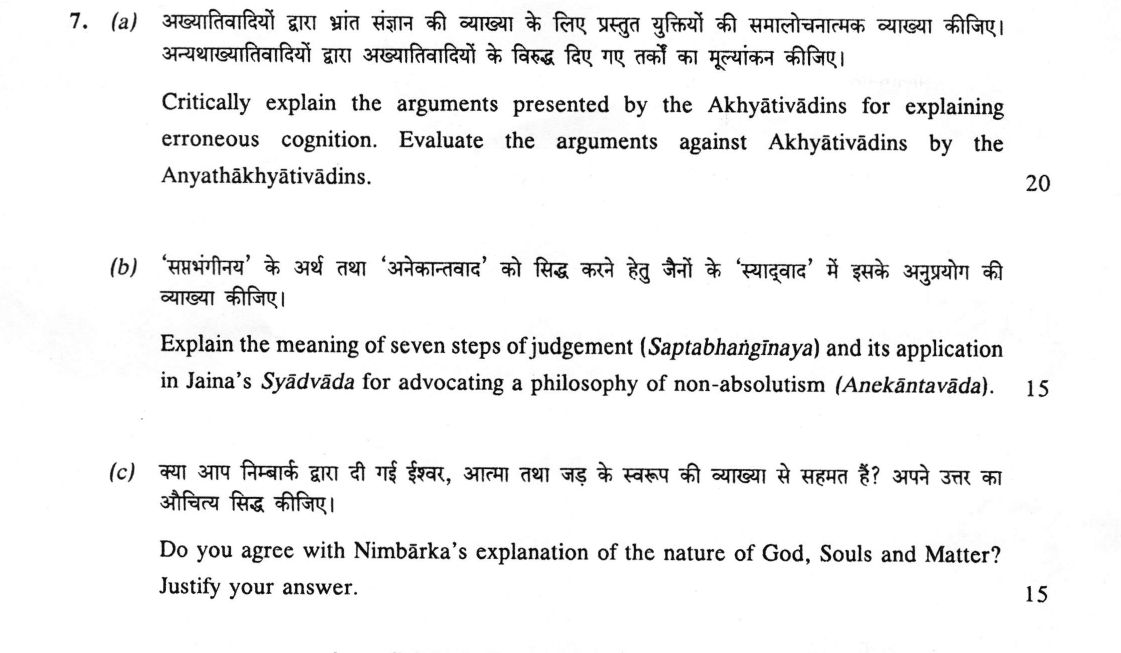
(a) Critically explain the arguments presented by the Akhyātivādins for explaining erroneous cognition. Evaluate the arguments…
Critically explain the arguments presented by the Akhyātivādins for explaining erroneous cognition. Evaluate the arguments against Akhyātivādins by the Anyathākhyātivādins. 20 marks
Explain the meaning of seven steps of judgement (Saptabhaṅgīnaya) and its application in Jaina's Syādvāda for advocating a philosophy of non-absolutism (Anekāntavāda). 15 marks
Do you agree with Nimbārka's explanation of the nature of God, Souls and Matter? Justify your answer. 15 marks
हिंदी में प्रश्न पढ़ें
अख्यातिवादियों द्वारा भ्रान्त संज्ञान की व्याख्या के लिए प्रस्तुत युक्तियों की समालोचनात्मक व्याख्या कीजिए। अन्यथाख्यातिवादियों द्वारा अख्यातिवादियों के विरुद्ध दिए गए तर्कों का मूल्यांकन कीजिए। (20 अंक)
‘सप्तभंगीनय’ के अर्थ तथा ‘अनेकान्तवाद’ को सिद्ध करने हेतु जैनों के ‘स्याद्वाद’ में इसके अनुप्रयोग की व्याख्या कीजिए। (15 अंक)
क्या आप निम्बार्क द्वारा दी गई ईश्वर, आत्मा तथा जड़ के स्वरूप की व्याख्या से सहमत हैं? अपने उत्तर का औचित्य सिद्ध कीजिए। (15 अंक)
Model answer
Drafted with AI by UPSC Answer Check against this question's marking rubric, to the expected length. UPSC does not publish answers for Mains — this is one way to score well, not an official key. How we build rubrics and answers.
(a) Akhyāti and the Nyāya critique
Prabhākara Mīmāṁsā holds that every cognition is valid in itself (svataḥ-prāmāṇya): each cognition reveals knower, known and knowing together (tripuṭī-saṁvit). Error must therefore be explained without any false cognition; hence akhyāti, "non-apprehension" (also vivekākhyāti).
In "this is silver", said of a shell, there are two cognitions, not one. Perception grasps the "this", a present bright object, but not its distinguishing shell-features; the brightness revives a memory of silver seen elsewhere. The memory, however, is not cognised as memory: its reference to the past is lost (smṛti-pramoṣa). Both cognitions are true of their objects; the error is purely negative, a failure to grasp their difference (bheda-agraha), and this non-discrimination prompts the same action a cognition of silver would.
The Naiyāyikas hold anyathākhyāti: a real object is cognised otherwise than it is, silver existing elsewhere being cognised here through jñāna-lakṣaṇa-pratyāsatti and a defect (doṣa). Against akhyāti they argue: first, "this is silver" is experienced as one judgement relating subject and predicate, not as two cognitions; second, a mere absence of discrimination cannot move a person to pick up the shell, which only a positive cognition can; third, the sublating cognition "this is not silver" (nedaṁ rajatam) negates a relation that must have been positively cognised. Validity is thus extrinsic (parataḥ).
Evaluation: the Nyāya arguments fit the experience of error better, but its extraordinary contact with silver elsewhere looks ad hoc, while Prabhākara saves the validity of cognition at the cost of experience. This tension produced rival accounts such as Kumārila's viparītakhyāti and Advaita's anirvacanīyakhyāti.
(b) Saptabhaṅgī and syādvāda
Anekāntavāda holds that reality is many-sided: the real is "endowed with origination, destruction and permanence" (utpāda-vyaya-dhrauvya-yuktaṁ sat, Tattvārthasūtra 5.29), permanent as substance (dravya), changing as mode (paryāya). Any judgement grasps it only from a standpoint (naya). Syādvāda expresses this by prefixing syāt, "in a certain respect" (not "perhaps"), together with eva, "definitely".
The seven-fold predication (saptabhaṅgī), about a pot: (1) syād asti: in some respect it exists, as clay, here, now, in its own form (svadravya, svakṣetra, svakāla, svabhāva); (2) syān nāsti: in some respect it does not exist, as cloth or elsewhere; (3) syād asti nāsti: it exists and does not, asserted successively (kramārpita); (4) syād avaktavyam: asserted simultaneously (sahārpita), existence and non-existence cannot be expressed by one word, so it is inexpressible; (5) syād asti avaktavyam; (6) syān nāsti avaktavyam; (7) syād asti nāsti avaktavyam.
Application: each bhaṅga is true from its respect and none exhausts the object, so together they display its many-sidedness. Śaṅkara (Brahmasūtrabhāṣya II.2.33) objects that contradictory attributes cannot belong to one thing and that syādvāda ends in doubt. The Jaina reply is that the respects differ, so there is no contradiction, and each bhaṅga is definite (eva), not doubtful.
(c) Nimbārka on God, souls and matter: an assessment
Nimbārka (Vedānta-pārijāta-saurabha, elaborated in Śrīnivāsa's Vedānta-kaustubha) teaches svābhāvika-bhedābheda (dvaitādvaita): Brahman (Kṛṣṇa), souls (cit) and matter (acit) are related by a difference and non-difference that are natural, not due to adjuncts. Souls are atomic, many, eternal, knowers, agents and enjoyers; matter is real. Both are aṁśa and śakti of Brahman, who is therefore both material and efficient cause of the world.
Non-difference means that cit and acit have no independent being (paratantra-sattā): they exist and act only through Brahman, as the coil exists only as the snake. Difference means they keep their own natures, even in release, where the soul, attained through devotion and surrender (bhakti, prapatti), becomes like Brahman and shares His bliss without becoming identical with Him.
Assessment: I broadly agree. The view honours both the identity and the difference texts of the Upaniṣads, keeps souls and world real (against Advaita), and, unlike Bhāskara's aupādhika bhedābheda, makes difference natural and permanent rather than an effect of limiting adjuncts; nor does it need Rāmānuja's body-soul model. The standard objection is that difference and non-difference cannot both be true of the same relata. Nimbārka's reply, that they hold in different respects (dependence of being, distinctness of nature), is sound, though critics say this amounts to qualified difference rather than genuine identity.
How this answer will be evaluated
Evaluation rubric
Each sub-part is marked on its own, against the marks and word limit printed on the paper.
- (a) Two explicit tasks. (i) Critically explain the Akhyātivādins' (Prabhākara Mīmāṁsā) account of erroneous cognition - the two-cognitions analysis, bheda-agraha and smṛti-pramoṣa, and the motive of preserving the validity of all cognition. (ii) Evaluate the Anyathākhyātivādins' (Nyāya) arguments AGAINST akhyāti, and assess whether the Nyāya alternative fares better. 20 marks
Must cover
- Khyātivāda; śukti-rajata (shell-silver) and rajju-sarpa (rope-snake)
- Akhyāti / vivekākhyāti; Prabhākara Mīmāṁsā
- Bheda-agraha (vivekāgraha, asaṁsargāgraha); smṛti-pramoṣa
- Triputī-saṁvit; svataḥ-prāmāṇya; all cognition is valid
- Anyathākhyāti; Nyāya; anyatra and anyathā
- Jñāna-lakṣaṇa-pratyāsatti (with sāmānya-lakṣaṇa and yogaja as the other alaukika sannikarṣas); doṣa
- Bādhaka-jñāna / the sublating cognition 'nedaṁ rajatam'; parataḥ-prāmāṇya
- Viśeṣya-viśeṣaṇa structure of the erroneous judgement
- Other theories: ātmakhyāti (Yogācāra), asatkhyāti (Mādhyamika), viparītakhyāti (Kumārila), satkhyāti (Rāmānuja), anirvacanīyakhyāti (Advaita)
Loses marks
- Attributing akhyāti to Kumārila; Kumārila's Bhāṭṭa school holds viparītakhyāti, and akhyāti is Prabhākara's.
- Describing akhyāti as the claim that the silver is unreal or non-existent; the whole point is that both components are real and both cognitions valid, and only their difference goes unnoticed.
- Confusing anyathākhyāti (Nyāya) with anirvacanīyakhyāti (Advaita) or with ātmakhyāti (Yogācāra).
- Giving the two theories but skipping the evaluation of Nyāya's arguments, which the second sentence of the question expressly asks for.
- Omitting jñāna-lakṣaṇa-pratyāsatti, which is the specific mechanism that makes anyathākhyāti work and is also its main vulnerability.
Earns more
- The rationale: Prabhākara's doctrine that all cognition as such is valid (with triputī-saṁvit and svataḥ-prāmāṇya); error is negative, an omission, so no non-existent object is ever cognised
- Evaluation of the Nyāya position itself: the ad hoc character of jñāna-lakṣaṇa-pratyāsatti and the difficulty of an object elsewhere being perceived here; Advaita's anirvacanīya-khyāti as the rival diagnosis
- Placing the debate: naming other khyātivādas with correct attribution - ātmakhyāti (Yogācāra), asatkhyāti (Mādhyamika), viparītakhyāti (Kumārila/Bhāṭṭa), satkhyāti or yathārthakhyāti (Rāmānuja), anirvacanīyakhyāti (Advaita)
- (b) Explain the MEANING of the seven-fold predication (saptabhaṅgī) - all seven bhaṅgas, in order, with the sense of 'syāt' - and its APPLICATION in syādvāda to establish anekāntavāda. The standard objection (Śaṅkara's charge of contradiction and of mere doubt) and the Jaina reply should be included. 15 marks
Must cover
- Anekāntavāda; Syādvāda; Saptabhaṅgīnaya
- Umāsvāti, Tattvārthasūtra 5.29 - utpāda-vyaya-dhrauvya-yuktaṁ sat; dravya and paryāya
- The seven nayas: naigama, saṁgraha, vyavahāra, ṛjusūtra, śabda, samabhirūḍha, evaṁbhūta; durnaya/nayābhāsa
- Syāt as 'in a certain respect' (apekṣā), with eva; svadravya, svakṣetra, svakāla, svabhāva
- The seven bhaṅgas including syād avaktavyam
- Kramārpita and sahārpita (successive and simultaneous predication)
- Śaṅkara, Brahmasūtrabhāṣya II.2.33; the charge of saṁśayavāda
- Samantabhadra (Āptamīmāṁsā), Siddhasena Divākara (Sanmatitarka), Kundakunda
Loses marks
- Translating 'syāt' as 'maybe' or 'perhaps', which turns syādvāda into scepticism - this is the single most heavily penalised error on this question.
- Giving fewer than seven bhaṅgas, or getting their order wrong, especially by placing avaktavya last.
- Confusing syādvāda with saptabhaṅgī and anekāntavāda as though they were one doctrine; anekānta is the ontology, naya the standpoint-theory, syādvāda/saptabhaṅgī the mode of predication.
- Explaining the seven bhaṅgas without ever showing how they establish anekāntavāda, when the question asks precisely for the application.
- Omitting the objection and reply, so that the 'advocating' half of the question is left unsupported.
Earns more
- Why the fourth bhaṅga is avaktavya: when being and non-being are predicated simultaneously (sahārpita), no single word can convey both, whereas successive predication (kramārpita) gives the third bhaṅga; and the combinatorial reason for exactly seven
- Objections and replies: Śaṅkara (Brahmasūtrabhāṣya II.2.33) on contradictory attributes, saṁśaya and self-refutation, echoed by Rāmānuja; the Jaina reply that the respects differ so non-contradiction is untouched, that each bhaṅga is definite, and that anekānta applies to itself
- (c) Take and justify a position on Nimbārka's account of God, souls and matter. The answer must first expound svābhāvika-bhedābheda (dvaitādvaita) accurately - Brahman, cit and acit, difference and non-difference both real and natural - and then argue for or against it, using the standard objections and the comparison with Bhāskara, Rāmānuja and Madhva. 15 marks
Must cover
- Nimbārka; dvaitādvaita / svābhāvika-bhedābheda; Vedānta-pārijāta-saurabha; Śrīnivāsa's Vedānta-kaustubha
- Tattva-traya: Brahman (Īśvara/Kṛṣṇa), cit, acit
- Aṁśa and śakti; para-tantra dependence; Brahman as upādāna and nimitta cause
- Souls as aṇu, many, eternal, jñātṛ, kartṛ, bhoktṛ
- Bhakti, prapatti, gurūpasatti; mokṣa as likeness, not identity
- Bhāskara's aupādhika bhedābheda; Rāmānuja's śarīra-śarīri-bhāva; Madhva's dvaita; Caitanya's acintya-bhedābheda
- The objection that bheda and abheda cannot both be real of the same relata; doṣa-prasaṅga
Loses marks
- Confusing Nimbārka with Bhāskara; Bhāskara's difference is due to limiting adjuncts and disappears in release, whereas Nimbārka's is natural and permanent - this is the distinguishing mark of dvaitādvaita.
- Attributing the body-soul (śarīra-śarīri) relation to Nimbārka; that is Rāmānuja's characteristic device.
- Saying Nimbārka teaches identity in liberation; the released soul attains a nature similar to Brahman and shares His bliss but remains distinct.
- Giving no verdict at all, when the question asks 'do you agree' and requires justification.
- Treating acit as unreal or illusory; for Nimbārka matter is a real power of Brahman, not māyā in the Advaitic sense.
Earns more
- Content of the non-difference: cit and acit have no independent existence, being aṁśa and śakti of Brahman, dependent on Him for being and activity; Brahman is both material and efficient cause through the transformation of His powers
- Contrast that fixes Nimbārka's position: Bhāskara's aupādhika bhedābheda, Rāmānuja's śarīra-śarīri-bhāva, Madhva's absolute difference, Caitanya's acintya-bhedābheda
What "Critically explain" is asking you to do
Make the working of something clear — what sets it off, what follows from what, and what it produces. Explain is the Commission's mechanism word: it dominates the technical papers and the “explain why” stems, where the marks sit in the causal chain and not in the label. “Critically” is not a section added at the end: name the yardstick you are judging by — the evidence, the stated objective, a constitutional principle, a rival explanation — and let a verdict close each part of the body. Where the question quotes a claim, that verdict must land on the claim itself, accepted, qualified or rejected, and not on the theme in general.
Structure that answers it
State what it is → the initiating condition → the chain of cause, step by step → an instance where it plays out → what the chain produces
Where marks are lost
Merits in one paragraph, demerits in the next, and a conclusion calling for a balanced and holistic approach. That is a survey with the judgement left out and it holds the answer in the middle band. The opposite error is reading “critically” as permission to attack — and with the odd pairings, critically describe or critically explain, the exposition still carries most of the marks, the judgement being a layer on it rather than a substitute for it.
Practice this exact question
Write your answer and it is marked point by point against the model answer above — what you covered, what you missed, what you got wrong.
Evaluate my answer →More from Philosophy 2026 Paper I
- Q4 (a) “Wittgenstein’s difficulty about not being able to say anything within a given langua…
- Q5 Answer the following questions in about 150 words each : (a) According to Nyāya view of i…
- Q6 (a) “A mango tree is grown out of a mango seed.” How do the Sāṁkhya philosophers explain…
- Q7 (a) Critically explain the arguments presented by the Akhyātivādins for explaining errone…
- Q8 (a) Present an account of Upamāna as an instrument of knowledge (Pramāṇa). How is Nyāya v…