Paper I — Q8
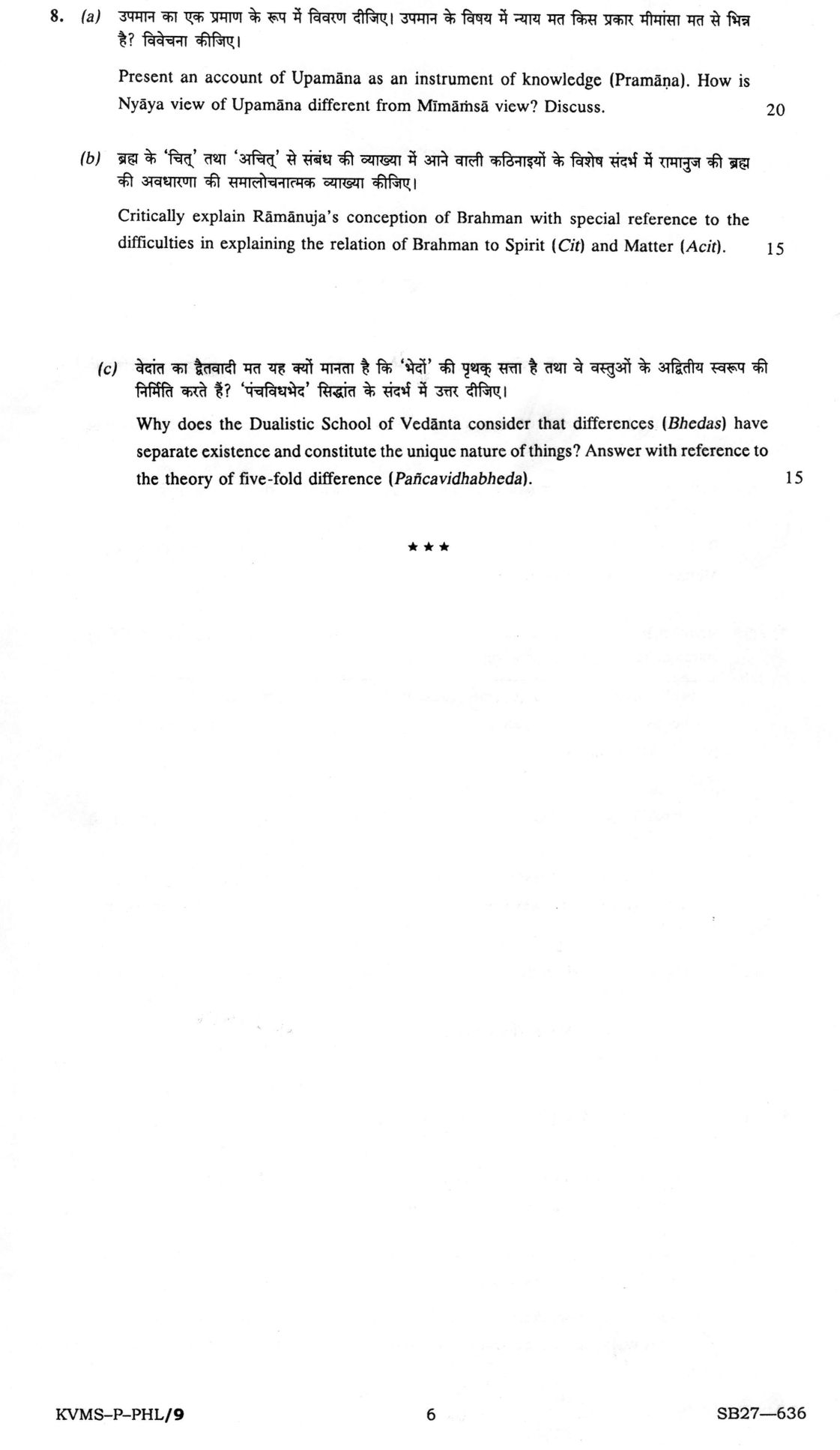
(a) Present an account of Upamāna as an instrument of knowledge (Pramāṇa). How is Nyāya view of Upamāna different from Mīmāṃsā…
Present an account of Upamāna as an instrument of knowledge (Pramāṇa). How is Nyāya view of Upamāna different from Mīmāṃsā view? Discuss. 20 marks
Critically explain Rāmānuja's conception of Brahman with special reference to the difficulties in explaining the relation of Brahman to Spirit (Cit) and Matter (Acit). 15 marks
Why does the Dualistic School of Vedānta consider that differences (Bhedas) have separate existence and constitute the unique nature of things? Answer with reference to the theory of five-fold difference (Pañcavidhabheda). 15 marks
हिंदी में प्रश्न पढ़ें
उपमान का एक प्रमाण के रूप में विवरण दीजिए। उपमान के विषय में न्याय मत किस प्रकार मीमांसा मत से भिन्न है? विवेचना कीजिए। (20 अंक)
ब्रह्म के ‘चित्’ तथा ‘अचित्’ से संबंध की व्याख्या में आने वाली कठिनाइयों के विशेष संदर्भ में रामानुज की ब्रह्म की अवधारणा की समालोचनात्मक व्याख्या कीजिए। (15 अंक)
वेदांत का द्वैतवादी मत यह क्यों मानता है कि ‘भेदों’ की पृथक् सत्ता है तथा वे वस्तुओं के अद्वितीय स्वरूप की निर्मिति करते हैं? ‘पंचविधभेद’ सिद्धांत के संदर्भ में उत्तर दीजिए। (15 अंक)
Model answer
Drafted with AI by UPSC Answer Check against this question's marking rubric, to the expected length. UPSC does not publish answers for Mains — this is one way to score well, not an official key. How we build rubrics and answers.
(a) Upamāna: the Nyāya and Mīmāṁsā accounts
Nyāya counts comparison (upamāna) as the third of its four pramāṇas. Nyāyasūtra 1.1.6 defines it as "establishing what is to be known through similarity to something well known" (prasiddha-sādharmyāt sādhya-sādhanam). In the standard case a townsman ignorant of the gavaya (wild ox) hears from a reliable forester, "a gavaya is like a cow" (atideśa-vākya). In the forest he sees an animal like a cow, recalls the statement, and concludes, "this is what is called a gavaya". The instrument (karaṇa) is the perception of similarity; the result (upamiti) is knowledge of the relation between the name and its bearer (saṁjñā-saṁjñi-sambandha). It is irreducible: the statement alone does not identify the animal, perception alone does not supply the name, and there is no vyāpti or parāmarśa, so it is not inference.
For Mīmāṁsā (Śabara; Kumārila's Ślokavārttika), followed by Advaita, the case runs the other way. A man who knows cows, and has heard nothing, sees a gavaya and perceives its likeness to a cow; he then knows, "my cow is like this gavaya". The object of upamiti is the similarity as it resides in the remembered, absent cow. This is not perception, since the cow is absent; not inference, since there is no concomitance; and not testimony, since no one has spoken.
Thus Nyāya's upamiti is a semantic cognition of the word-object relation, reached from the present animal and dependent on testimony; Mīmāṁsā's is a cognition of the absent cow's similarity, reached without any statement. Vaiśeṣika, Sāṁkhya, the Buddhists and the Cārvākas do not accept upamāna as a separate pramāṇa.
(b) Rāmānuja's Brahman and the difficulty of cit and acit
For Rāmānuja (Śrībhāṣya, Vedārthasaṁgraha) Brahman is the personal God, Nārāyaṇa: saguṇa, possessed of infinite auspicious qualities (ananta-kalyāṇa-guṇa), free of every defect, the inner controller (antaryāmin) of all. Souls (cit) and matter (acit) are real, but not independent: they are Brahman's body (śarīra) and He is their self (śarīrin), and they are inseparable from Him (apṛthak-siddhi). Brahman is thus one, qualified by cit and acit (viśiṣṭa-advaita), and "tat tvam asi" is read as co-reference (sāmānādhikaraṇya) to one Brahman qualified in two ways.
Difficulties arise. First, transfer of defects (doṣa-prasaṅga): if the suffering, ignorant world is His body, how is Brahman untouched? Rāmānuja answers that defects belong to the body, not the self; critics find this hard to sustain. Second, the body-soul analogy is imperfect: ordinary bodies are separable and not created by their souls, so apṛthak-siddhi remains an unanalysed technical relation. Third, instability: the eternal distinctness of cit and acit pulls toward dualism (Madhva), inseparability toward monism (Advaita). Fourth, if God is the inner controller, human agency and evil seem to be His; Rāmānuja appeals to divine permission (anumati) and beginningless karma (Brahmasūtra II.1.34–35).
(c) Madhva: why differences are real and constitute things
For Madhva's Dvaita, reality is of two kinds: Viṣṇu alone is independent (svatantra); souls and matter are real but dependent (paratantra). Difference is real, and it is not a relation or quality added to things but their very nature (svarūpa). His reasons are these. Difference is given in perception: to see a pot is already to see it as distinct from what is not the pot, and the witness-consciousness (sākṣin) guarantees this cognition. To deny difference is self-refuting, since the denial is distinct from the assertion it opposes. If difference were a relation over and above things, a further relation would be needed to relate it, and so on without end; so difference must be the thing's own nature. Viśeṣa, a self-explaining distinguishing principle (unlike the Vaiśeṣika category), accounts for distinctions within one thing.
This is set out as the five-fold difference (pañcavidha-bheda): between God and soul, God and matter, soul and soul, soul and matter, and one material thing and another. Each difference is eternal, even in release, where the soul enjoys its own bliss in devotion, never becoming God. Madhva adds gradation among souls (tāratamya) and reads "tat tvam asi" as "sa ātmā atat tvam asi", "you are not that". Advaitins reply that knowing a difference presupposes knowing its counter-correlate (pratiyogin), a mutual dependence that Vyāsatīrtha's Nyāyāmṛta tries to answer.
How this answer will be evaluated
Evaluation rubric
Each sub-part is marked on its own, against the marks and word limit printed on the paper.
- (a) Two tasks. (i) Give an account of upamāna as a pramāṇa: its definition, the gavaya illustration, what it yields, and why it is irreducible to perception, inference or testimony. (ii) Show how the Nyāya view differs from the Mīmāṁsā view - what each takes to be the object of upamiti, the direction of the cognition, and the role (or absence) of an authoritative statement. 20 marks
Must cover
- Upamāna as the third pramāṇa of Nyāya; the four pramāṇas of Nyāya
- Nyāyasūtra 1.1.6 - prasiddha-sādharmyāt sādhya-sādhanam upamānam; Vātsyāyana's Bhāṣya
- Upamiti as saṁjñā-saṁjñi-sambandha-jñāna; sādṛśya-jñāna as karaṇa (Tarkasaṁgraha)
- Gavaya (the wild ox / nīlgai) and the atideśa-vākya of the forester
- Śabara on Jaimini 1.1.5; Kumārila Bhaṭṭa, Ślokavārttika, Upamāna-pariccheda
- Sādṛśya of the remembered and absent cow as the object of Mīmāṁsā upamiti
- Schools that reject or subsume upamāna: Vaiśeṣika, Sāṁkhya, Buddhists, Cārvāka; Advaita's six pramāṇas following the Bhāṭṭas
Loses marks
- Giving only the gavaya story in its Nyāya form and treating it as the common position of all schools; the Mīmāṁsā case runs in the opposite direction, from the perceived gavaya back to the remembered cow.
- Saying Mīmāṁsā requires the forester's statement; on Kumārila's analysis no verbal statement whatever is involved, and that is precisely his criticism of Nyāya.
- Stating the Nyāya result as knowledge of the ANIMAL rather than of the relation between the word and the animal; for Nyāya upamiti is a semantic cognition.
- Reducing upamāna to analogy or to argument from analogy in the Western sense - it is not a probabilistic inference but a distinct means of knowledge.
- Listing which schools accept how many pramāṇas without ever stating the Nyāya-Mīmāṁsā difference that the question asks for.
Earns more
- The gavaya illustration worked through in the Nyāya form: the reliable forester's atideśa-vākya 'a gavaya is like a cow', the subsequent perception of the resembling animal, the recollection, and the resulting knowledge of the word's denotation
- Irreducibility arguments: for Nyāya, that the sentence alone does not yield the name-object relation and that there is no vyāpti or parāmarśa; for Mīmāṁsā, that the similarity in an absent object is neither perceptible nor inferable nor told
- Placing the debate: Advaita follows the Bhāṭṭa analysis (Vedāntaparibhāṣā); Vaiśeṣika and Sāṁkhya subsume upamāna under inference or testimony; Buddhists and Cārvāka reject it; plus the Nyāya-Vaiśeṣika reduction of sādṛśya to common properties as a criticism of the Mīmāṁsā view
- (b) Explain Rāmānuja's conception of Brahman (saguṇa, personal, possessor of infinite auspicious qualities, the sole reality with cit and acit as its body) and then, as the question specifically requires, set out and assess the DIFFICULTIES in explaining Brahman's relation to cit and acit - the transfer of defects, the instability between monism and dualism, the limits of the body-soul analogy, and the problem of agency and evil. 15 marks
Must cover
- Rāmānuja; Viśiṣṭādvaita; Śrībhāṣya; Vedārthasaṁgraha; predecessors Nāthamuni and Yāmunācārya
- Saguṇa, saviśeṣa Brahman; ananta-kalyāṇa-guṇa; antaryāmin
- Saptavidha-anupapatti (the seven untenables against avidyā)
- Cit and acit; jīvas as aṇu, jñātṛ, kartṛ, bhoktṛ; baddha, mukta, nitya; prakṛti and the guṇas
- Śarīra-śarīri-bhāva; niyāmya, dhārya, śeṣa; aprthak-siddhi
- Sāmānādhikaraṇya reading of tat tvam asi; brahma-pariṇāma; kāraṇāvasthā and kāryāvasthā
- Doṣa-prasaṅga (transfer of defects)
- Brahmasūtra II.1.34-35 on God's impartiality and beginningless karma; anumati
- Mukti as sāmya/communion, not identity; the mukta lacks jagad-vyāpāra
Loses marks
- Saying Rāmānuja holds Brahman to be nirguṇa, or that he accepts māyā in the Advaitic sense; he rejects both, and the world for him is real.
- Presenting cit and acit as attributes in a loose sense without the technical body-soul relation and aprthak-siddhi, which is where the entire difficulty lies.
- Skipping the 'difficulties' half; the question explicitly asks for the difficulties in explaining the relation, and an exposition alone cannot pass the essential requirement.
- Confusing the śarīra-śarīri relation with Nimbārka's aṁśa-śakti relation or with the Advaitic adhyāsa.
- Claiming that for Rāmānuja the liberated soul becomes identical with Brahman; it attains His nature and communion but never identity, and never cosmic creatorship.
Earns more
- Difficulty of instability and of the analogy: eternal distinctness of cit and acit makes the non-duality nominal, so the system is pressed towards dualism by Madhva and towards Advaita by Advaitins; and the body-soul analogy is imperfect (ordinary bodies are separable and not created by their souls), leaving aprthak-siddhi an unanalysed technical relation
- Difficulty of agency, evil and liberation: the antaryāmin doctrine threatens jīva agency and makes God answerable for evil, met by anumati and by beginningless karma (Brahmasūtra II.1.34-35, vaiṣamya-nairghṛṇye na sāpekṣatvāt); mukti as likeness and communion, not identity, the mukta lacking cosmic creatorship
- (c) Answer the 'why': give Madhva's reasons for holding that bheda is real and constitutes the very nature (svarūpa) of a thing - the perceptual givenness of difference, the self-refutation of any denial of difference, and the regress that follows from treating difference as a relation - and set this out through the five-fold difference (pañcavidhabheda). 15 marks
Must cover
- Madhvācārya (Ānandatīrtha); Dvaita Vedānta; Brahmasūtrabhāṣya, Anuvyākhyāna; Jayatīrtha, Vyāsatīrtha
- Svatantra and paratantra/asvatantra tattva; Viṣṇu as the sole independent reality
- Bheda as svarūpa of the thing; difference given in perception; sākṣin as self-validating witness
- Viśeṣa as Madhva's distinguishing principle (distinct from the Vaiśeṣika viśeṣa)
- Pañcavidhabheda: jīva-īśvara, jaḍa-īśvara, jīva-jīva, jaḍa-jīva, jaḍa-jaḍa
- Tāratamya (gradation of souls); jīva-traividhya - mukti-yogya, nitya-saṁsārin, tamo-yogya
- Bimba-pratibimba-bhāva; mokṣa as svarūpānanda without identity; bhakti
- Advaita objections: pratiyogin and mutual dependence (Śrīharṣa, Citsukha, Madhusūdana's Advaitasiddhi vs Vyāsatīrtha's Nyāyāmṛta)
- Madhva's reading of tat tvam asi as sa ātmā atat tvam asi
Loses marks
- Listing fewer than five differences, or inventing a sixth such as a difference between one God and another; the list is exactly five and must be complete.
- Treating bheda as a relation or quality superadded to things, which is precisely the view Madhva rejects in favour of difference as svarūpa.
- Answering 'what' rather than 'why' - the question asks for Madhva's REASONS, so the perceptual, self-refutation and regress arguments must appear.
- Confusing Madhva's viśeṣa with the Vaiśeṣika category of the same name, which belongs only to eternal substances.
- Omitting the framework of dependence - without svatantra/paratantra, Madhva's pluralism looks like mere plurality rather than a theistic system.
Earns more
- The regress argument and the device of viśeṣa: if difference were a property related to the thing, a further relation would be needed ad infinitum, so difference must be the thing's own nature; Madhva's viśeṣa is a self-explaining distinguishing principle, distinct from the Vaiśeṣika viśeṣa
- Objections: the Advaita dialectical charge of mutual dependence between knowing a difference and knowing its counter-correlate (pratiyogin); the strain on the unity texts (ekam evādvitīyam; Madhva's reading of tat tvam asi as 'sa ātmā atat tvam asi'); the problem of tamo-yogya souls; viśeṣa as ad hoc
What "Discuss" is asking you to do
Lay the issue out from more than one side — how it arose, what is claimed for it, what is held against it, and where it now stands. UPSC attaches discuss to broad topics with several live dimensions, so coverage of the dimensions earns more than the strength of your opinion.
Structure that answers it
Set the issue up → the case as it is made → the case against → the dimension both sides leave out → where the balance now lies
Where marks are lost
Listing facts with no thread between them, or arguing one side throughout and calling it a discussion.
Practice this exact question
Write your answer and it is marked point by point against the model answer above — what you covered, what you missed, what you got wrong.
Evaluate my answer →More from Philosophy 2026 Paper I
- Q5 Answer the following questions in about 150 words each : (a) According to Nyāya view of i…
- Q6 (a) “A mango tree is grown out of a mango seed.” How do the Sāṁkhya philosophers explain…
- Q7 (a) Critically explain the arguments presented by the Akhyātivādins for explaining errone…
- Q8 (a) Present an account of Upamāna as an instrument of knowledge (Pramāṇa). How is Nyāya v…