Paper I — Q6
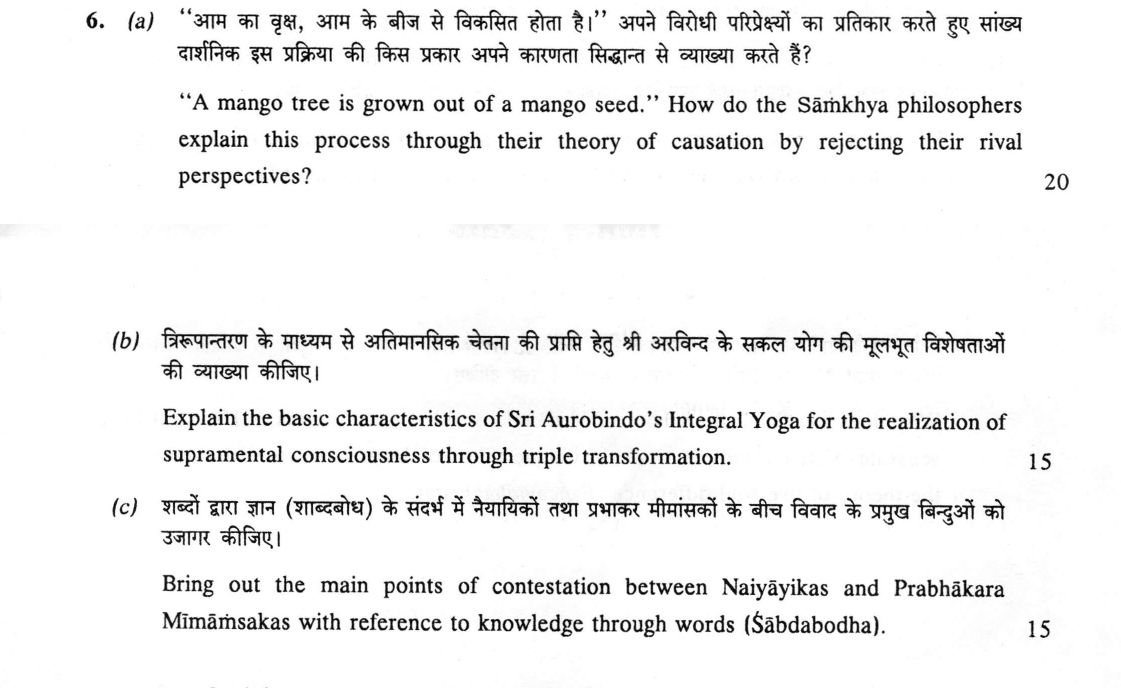
(a) “A mango tree is grown out of a mango seed.” How do the Sāṁkhya philosophers explain this process through their theory of…
“A mango tree is grown out of a mango seed.” How do the Sāṁkhya philosophers explain this process through their theory of causation by rejecting their rival perspectives? 20 marks
Explain the basic characteristics of Sri Aurobindo's Integral Yoga for the realization of supramental consciousness through triple transformation. 15 marks
Bring out the main points of contestation between Naiyāyikas and Prabhākara Mīmāṃsakas with reference to knowledge through words (Śābdabodha). 15 marks
हिंदी में प्रश्न पढ़ें
“आम का वृक्ष, आम के बीज से विकसित होता है।” अपने विरोधी परिप्रेक्ष्यों का प्रतिकार करते हुए सांख्य दार्शनिक इस प्रक्रिया की किस प्रकार अपने कारणता सिद्धान्त से व्याख्या करते हैं? (20 अंक)
त्रिरूपान्तरण के माध्यम से अतिमानसिक चेतना की प्राप्ति हेतु श्री अरविन्द के सकल योग की मूलभूत विशेषताओं की व्याख्या कीजिए। (15 अंक)
शब्दों द्वारा ज्ञान (शाब्दबोध) के संदर्भ में नैयायिकों तथा प्रभाकर मीमांसकों के बीच विवाद के प्रमुख बिन्दुओं को उजागर कीजिए। (15 अंक)
Model answer
Drafted with AI by UPSC Answer Check against this question's marking rubric, to the expected length. UPSC does not publish answers for Mains — this is one way to score well, not an official key. How we build rubrics and answers.
(a) Sāṁkhya: the mango seed and satkāryavāda
Sāṁkhya explains the seed becoming a tree by satkāryavāda: the effect exists, unmanifest, in its material cause before production; causation is its manifestation (āvirbhāva) and destruction its withdrawal (tirobhāva). In its Sāṁkhya form this is pariṇāmavāda: the cause really transforms into the effect. The mango tree is not a new entity but the seed's latent form made manifest.
Sāṁkhyakārikā 9 gives five reasons, each fitting the case. (1) Asad-akaraṇāt: what does not exist cannot be produced. (2) Upādāna-grahaṇāt: one who wants a mango tree takes a mango seed, not a pebble. (3) Sarva-sambhavābhāvāt: otherwise anything would come from anything. (4) Śaktasya śakya-karaṇāt: only a cause potent for this effect produces it. (5) Kāraṇa-bhāvāt: the effect has the nature of its cause.
These reject the rivals. Nyāya-Vaiśeṣika ārambhavāda holds that a new whole (avayavī), absent before, arises and inheres (samavāya) in its parts; for Sāṁkhya a previously non-existent tree could have no determinate cause. The Buddhist asatkāryavāda, with momentariness and destruction without remainder, leaves no continuing material to become the tree. Later Advaita vivartavāda makes change only apparent (rope-snake); Sāṁkhya insists the transformation is real.
To the objection that production is pointless if the effect already exists, Sāṁkhya replies that only the manifest effect has its own function (a seed gives no shade). Soil and water are instrumental causes that merely remove obstacles, as a farmer breaches a dyke to let water flow (Yogasūtra 4.3). Generalised, all effects lie unmanifest in mūlaprakṛti, the equilibrium of the three guṇas.
(b) Sri Aurobindo's Integral Yoga and the triple transformation
Integral Yoga (Pūrṇa Yoga), set out in The Synthesis of Yoga and The Life Divine, rests on Aurobindo's metaphysics of involution and evolution: Sachchidananda has involved itself in the Inconscient, and consciousness evolves through matter, life and mind towards the Supermind (Vijñāna, Truth-Consciousness). Its basic features follow. It synthesises the yogas of knowledge, works and devotion. It rejects both the materialist denial and the ascetic refusal of the world: "all life is Yoga". Its method is aspiration, rejection of the movements of the lower nature, and surrender (ātma-samarpaṇa) to the Divine Mother (Shakti); the decisive agency is the descent of a higher consciousness, not only the seeker's ascent.
It proceeds through a triple transformation, in order. The psychic transformation brings forward the psychic being (caitya puruṣa), the evolving soul behind mind, life and body, distinct from the ego and representing the jīvātman in nature. The spiritual transformation opens the being to the higher planes, Higher Mind, Illumined Mind, Intuition and Overmind, whose descent brings peace, wideness and cosmic consciousness, though still within the Ignorance. The supramental transformation, the descent of the Supermind, transforms even the body and creates the gnostic being and a divine life on earth.
(c) Naiyāyikas and Prābhākaras on śābdabodha
Both accept verbal testimony (śabda) as a pramāṇa, but differ on several points.
First and central is how sentence-meaning arises. For Prabhākara (anvitābhidhānavāda) words denote their meanings only as already connected with other meanings in the sentence. He argues from how children learn (vṛddha-vyavahāra): watching an elder act on "bring the cow", the child isolates word-meanings by substitution (āvāpa-udvāpa), always within a sentence. Nyāya, broadly with Kumārila (abhihitānvayavāda), holds that words first denote separate meanings, which are then connected through expectancy (ākāṅkṣā), compatibility (yogyatā) and proximity (sannidhi).
Second, Nyāya adds the speaker's intention (tātparya) as a condition; for Prabhākara connection is already in the words' denotation. Third, Prabhākara holds that language primarily conveys what is to be done (kārya/niyoga), so statements of fact (siddhārtha) are authoritative only as subservient to injunctions; Nyāya allows śabda to convey existent things. Fourth, for Nyāya the chief qualificand of verbal cognition is the meaning of the nominative word; for Prabhākara it is niyoga. Fifth, Prabhākara's Veda is authorless (apauruṣeya) and self-valid (svataḥ-prāmāṇya); for Nyāya it is authored by Īśvara, a trustworthy speaker (āpta), and its validity is extrinsic (parataḥ). Finally, Nyāya holds that a word denotes individual, form and universal together (Nyāyasūtra 2.2.66), while Mīmāṁsā makes the universal the primary meaning.
How this answer will be evaluated
Evaluation rubric
Each sub-part is marked on its own, against the marks and word limit printed on the paper.
- (a) Use the seed-to-tree example to expound satkāryavāda (in its Sāṁkhya form, pariṇāmavāda): state the doctrine, give the five arguments of Sāṁkhyakārikā 9, apply them to the mango case, and - as the question expressly requires - show how Sāṁkhya REJECTS its rivals (Nyāya-Vaiśeṣika ārambhavāda, Buddhist momentarist asatkāryavāda, Advaita vivartavāda), closing with the standard objection to satkāryavāda and Sāṁkhya's reply. 20 marks
Must cover
- Satkāryavāda; pariṇāmavāda; abhivyakti / āvirbhāva and tirobhāva
- Sāṁkhyakārikā 9 and its five reasons: asad-akaraṇāt, upādāna-grahaṇāt, sarva-sambhavābhāvāt, śaktasya śakya-karaṇāt, kāraṇa-bhāvāt
- Mūlaprakṛti, avyakta and vyakta; sattva, rajas, tamas; the twenty-five tattvas
- Nyāya-Vaiśeṣika ārambhavāda / asatkāryavāda; avayavī; samavāya
- Buddhist asatkāryavāda with kṣaṇikavāda and niranvaya-vināśa
- Advaita vivartavāda (Śaṅkara); rope-snake and clay-pot illustrations
- Yogasūtra 4.3 - the farmer who removes the obstruction (kṣetrikavat)
Loses marks
- Confusing pariṇāmavāda with vivartavāda; Sāṁkhya holds the transformation to be REAL, Advaita holds it to be only apparent - both are forms of satkāryavāda in a broad sense, and the distinction must be kept.
- Giving fewer than the five arguments of kārikā 9, or inventing arguments that are not there.
- Attributing asatkāryavāda to Advaita, or ārambhavāda to the Buddhists; ārambhavāda is specifically the Nyāya-Vaiśeṣika doctrine of the new whole.
- Ignoring the explicit instruction to reject rival views and simply expounding satkāryavāda.
- Failing to answer the mango example at all, so that the answer never shows the doctrine at work on the case given.
Earns more
- Rejection of the Buddhist momentarist account (niranvaya-vināśa leaves no material continuity) and of Advaita vivartavāda (apparent rather than real transformation; rope-snake), with Sāṁkhya's insistence on real pariṇāma
- Application to prakṛti: the mango case generalised - all effects lie unmanifest in mūlaprakṛti as a configuration of sattva, rajas and tamas; the evolutes mahat/buddhi, ahaṁkāra, manas with the ten indriyas, five tanmātras and five mahābhūtas; auxiliary causes merely remove obstacles (Yogasūtra 4.3, the farmer analogy)
- The standard objection that production becomes redundant (one could drink curd in the milk) and Sāṁkhya's reply distinguishing the unmanifest from the manifest state, in which alone the effect has its own causal efficacy
- (b) Explain the basic characteristics of Sri Aurobindo's Integral Yoga specifically as the means to supramental consciousness THROUGH the triple transformation. Both elements are required: the distinguishing features of Pūrṇa Yoga (aspiration, rejection, surrender; synthesis of the yogas; rejection of world-negation) and the three stages - psychic, spiritual and supramental transformation - in order. 15 marks
Must cover
- Sri Aurobindo; The Life Divine; The Synthesis of Yoga; Integral or Pūrṇa Yoga
- Sachchidananda (Sat-Chit-Ananda); involution and evolution; the Inconscient and the Ignorance
- The gradation: Higher Mind, Illumined Mind, Intuition, Overmind, Supermind (Vijñāna / Truth-Consciousness)
- Aspiration, rejection, surrender (ātma-samarpaṇa); the Divine Mother/Shakti
- 'All life is Yoga'; the refusal of the ascetic and the materialist denial
- Triple transformation: psychic, spiritual, supramental
- Psychic being (caitya puruṣa), distinguished from the jīvātman
- The gnostic being; divine life on earth
Loses marks
- Reversing or reordering the three transformations; the psychic comes first, the spiritual second, the supramental last, and Aurobindo insists on that sequence.
- Confusing Overmind with Supermind; Overmind is the plane of separated cosmic totalities and the last step before the Supermind, not the Supermind itself.
- Identifying the psychic being with the ego, the mind or the vital; it is the evolving soul-personality behind them.
- Presenting Integral Yoga as a synthesis of the three classical yogas only, and omitting the transformation of the body and the descent of the Supermind, which are its distinctive claims.
- Treating Aurobindo as an Advaitin; he explicitly rejects world-negating māyāvāda while accepting the reality of Brahman.
Earns more
- The threefold practice and the primacy of descent: aspiration, rejection and surrender (ātma-samarpaṇa) to the Divine Shakti/Mother, with the transforming agency being the descent of a higher consciousness, not only the seeker's ascent
- Spiritual transformation: ascent to and descent of the higher planes - Higher Mind, Illumined Mind, Intuition, Overmind - bringing cosmic consciousness, peace and wideness, yet still bounded by the Ignorance
- (c) Bring out the MAIN POINTS OF DISPUTE between Naiyāyikas and Prābhākara Mīmāṁsakas on śābdabodha (verbal knowledge). The central axis is anvitābhidhānavāda (Prabhākara) versus abhihitānvayavāda (which Nyāya broadly shares with the Bhāṭṭas); further axes are tātparya and the authorship of the Veda, intrinsic versus extrinsic validity, the chief qualificand of the sentence-meaning, and whether śabda conveys only what is to be done. 15 marks
Must cover
- Śābdabodha; śabda as pramāṇa
- Anvitābhidhānavāda (Prabhākara) and abhihitānvayavāda (Kumārila/Bhāṭṭa, broadly shared by Nyāya)
- Ākāṅkṣā, yogyatā, sannidhi/āsatti, tātparya
- Vṛddha-vyavahāra; āvāpa-udvāpa
- Kārya / niyoga; vidhi and arthavāda
- Apauruṣeya versus pauruṣeya Veda; āptatva; Īśvara as author for Nyāya
- Svataḥ-prāmāṇya and parataḥ-prāmāṇya
- Nyāyasūtra 2.2.66 - vyakti, ākṛti and jāti as what a word denotes
- Mukhya-viśeṣya (chief qualificand) of the verbal cognition
Loses marks
- Swapping the two theories - attributing anvitābhidhāna to Kumārila and abhihitānvaya to Prabhākara; the reverse is correct.
- Treating the dispute as Nyāya versus Mīmāṁsā as a whole; the question names the PRĀBHĀKARA Mīmāṁsakas specifically, and on abhihitānvaya Nyāya is closer to the Bhāṭṭas than to Prabhākara.
- Dragging in the sphoṭa theory as a point of contestation between these two; both Nyāya and Mīmāṁsā reject sphoṭa, which is the grammarians' (Bhartṛhari's) doctrine.
- Listing the conditions of verbal knowledge without noting that tātparya is the specifically Nyāya addition and why Mīmāṁsā resists it.
- Omitting the apauruṣeya/pauruṣeya difference, which underlies the whole disagreement about how a sentence acquires authority.
Earns more
- Prabhākara's argument from vṛddha-vyavahāra: the child learns word-meanings only through the elders' injunctions and responses, by āvāpa and udvāpa, hence always in a connected, action-directed sense
- Further contested points: whether śabda conveys only kārya/niyoga (Prabhākara) or also siddhārtha descriptive content (Nyāya); and what is the chief qualificand of the verbal cognition - the nominative meaning for Nyāya, niyoga for Prabhākara
What "Explain" is asking you to do
Make the working of something clear — what sets it off, what follows from what, and what it produces. Explain is the Commission's mechanism word: it dominates the technical papers and the “explain why” stems, where the marks sit in the causal chain and not in the label.
Structure that answers it
State what it is → the initiating condition → the chain of cause, step by step → an instance where it plays out → what the chain produces
Where marks are lost
Describing what something looks like instead of why it works that way. Naming the stages without linking them reads as description too.
Practice this exact question
Write your answer and it is marked point by point against the model answer above — what you covered, what you missed, what you got wrong.
Evaluate my answer →More from Philosophy 2026 Paper I
- Q3 (a) Why are states of consciousness ascribed to anything at all and why are they ascribed…
- Q4 (a) “Wittgenstein’s difficulty about not being able to say anything within a given langua…
- Q5 Answer the following questions in about 150 words each : (a) According to Nyāya view of i…
- Q6 (a) “A mango tree is grown out of a mango seed.” How do the Sāṁkhya philosophers explain…
- Q7 (a) Critically explain the arguments presented by the Akhyātivādins for explaining errone…
- Q8 (a) Present an account of Upamāna as an instrument of knowledge (Pramāṇa). How is Nyāya v…