Paper I — Q5
(a) According to Nyāya view of inference (Anumāna), what are the characteristics that ascertain the validity of inferential sign…
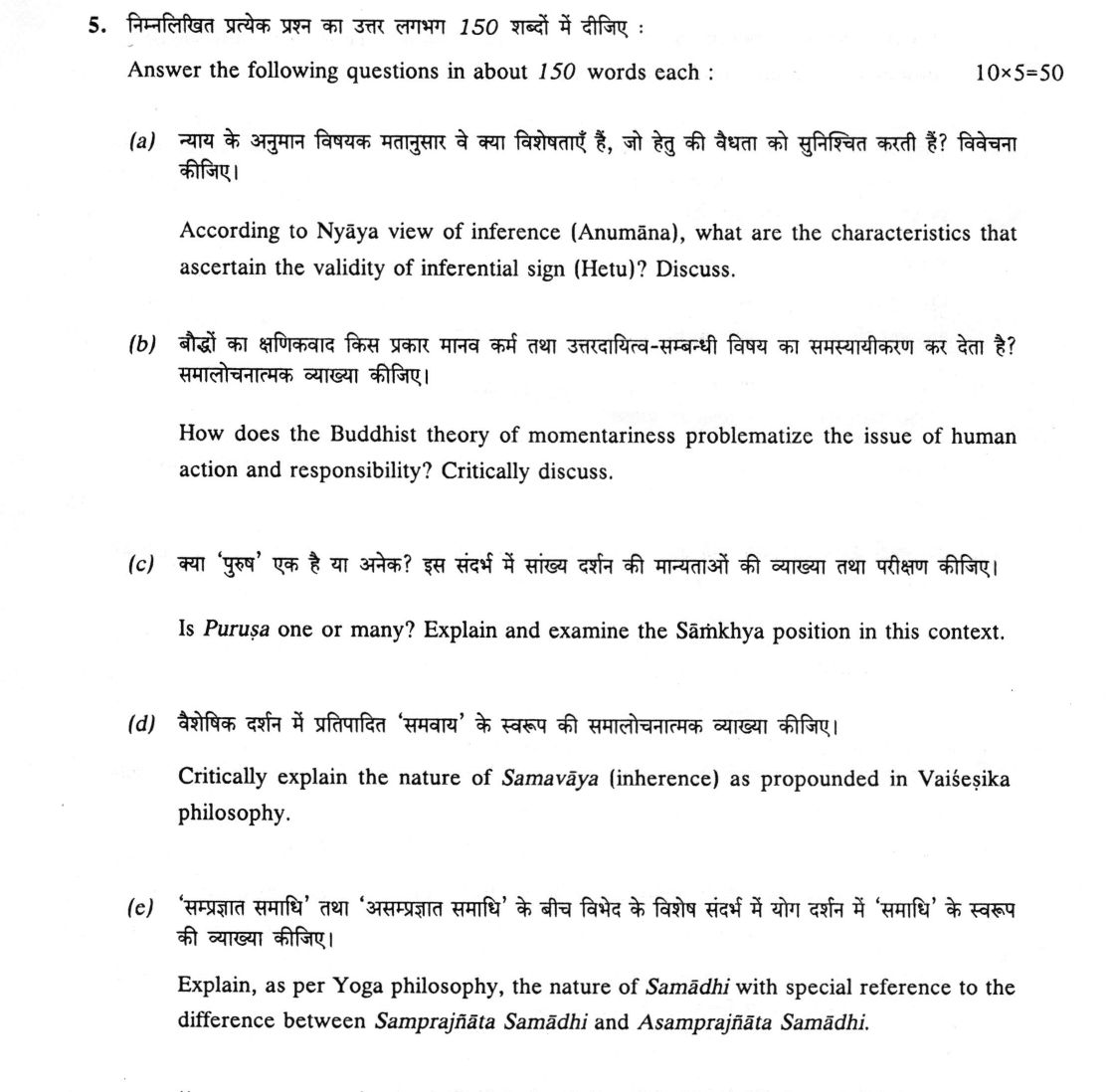
Answer the following questions in about 150 words each :
According to Nyāya view of inference (Anumāna), what are the characteristics that ascertain the validity of inferential sign (Hetu)? Discuss. 10 marks
How does the Buddhist theory of momentariness problematize the issue of human action and responsibility? Critically discuss. 10 marks
Is Puruṣa one or many? Explain and examine the Sāṁkhya position in this context. 10 marks
Critically explain the nature of Samavāya (inherence) as propounded in Vaiśeṣika philosophy. 10 marks
Explain, as per Yoga philosophy, the nature of Samādhi with special reference to the difference between Samprajñāta Samādhi and Asamprajñāta Samādhi. 10 marks
हिंदी में प्रश्न पढ़ें
निम्नलिखित प्रत्येक प्रश्न का उत्तर लगभग 150 शब्दों में दीजिए :
न्याय के अनुमान विषयक मतानुसार वे क्या विशेषताएँ हैं, जो हेतु की वैधता को सुनिश्चित करती हैं? विवेचना कीजिए। (10 अंक)
बौद्धों का क्षणिकवाद किस प्रकार मानव कर्म तथा उत्तरदायित्व-सम्बन्धी विषय का समस्यायीकरण कर देता है? समालोचनात्मक व्याख्या कीजिए। (10 अंक)
क्या ‘पुरुष’ एक है या अनेक? इस संदर्भ में सांख्य दर्शन की मान्यताओं की व्याख्या तथा परीक्षण कीजिए। (10 अंक)
वैशेषिक दर्शन में प्रतिपादित ‘समवाय’ के स्वरूप की समालोचनात्मक व्याख्या कीजिए। (10 अंक)
‘सम्प्रज्ञात समाधि’ तथा ‘असम्प्रज्ञात समाधि’ के बीच विभेद के विशेष संदर्भ में योग दर्शन में ‘समाधि’ के स्वरूप की व्याख्या कीजिए। (10 अंक)
Model answer
Drafted with AI by UPSC Answer Check against this question's marking rubric, to the 150-word length. UPSC does not publish answers for Mains — this is one way to score well, not an official key. How we build rubrics and answers.
(a) Nyāya: the characteristics of a valid hetu
In inference (anumāna) the mark (hetu/liṅga), smoke, proves the probandum (sādhya), fire, in the subject (pakṣa), the hill, through invariable concomitance (vyāpti) free of any limiting condition (upādhi). Nyāya requires the hetu to have five features (pañcarūpa): (1) pakṣadharmatva, presence in the pakṣa (smoke on the hill); (2) sapakṣasattva, presence in a similar instance where the sādhya is known (the kitchen); (3) vipakṣāsattva, absence from every dissimilar instance where the sādhya is absent (the lake); (4) abādhitatva, the sādhya is not contradicted by a stronger pramāṇa such as perception ("fire is cold" fails); (5) asatpratipakṣatva, no equally strong counter-inference proves the opposite.
Each failure yields a fallacy (hetvābhāsa, Nyāyasūtra 1.2.4–9): absence from the pakṣa gives asiddha/sādhyasama; presence in the vipakṣa gives savyabhicāra; a hetu pervaded by the absence of the sādhya is viruddha; a counter-inference gives satpratipakṣa/prakaraṇasama; contradiction by stronger proof gives bādhita/kālātīta. The first three features alone form Dignāga's Buddhist trairūpya; Nyāya adds the last two because a hetu can pass the triple test and still be overridden.
(b) Momentariness and moral responsibility
Buddhism holds that whatever exists is momentary (yat sat tat kṣaṇikam): Dharmakīrti argues that the existent is the causally efficient (arthakriyākāritva) and perishes without remainder (niranvaya-vināśa). With no enduring self (anātman), responsibility becomes problematic. The agent perishes at once, so the deed is lost to its doer (kṛtahāni), and a later moment that did nothing reaps the fruit (akṛtābhyāgama).
The Buddhist reply is the causal series (santāna): each moment conditions the next (pratītyasamutpāda), so the one who reaps is "neither the same nor another" (Milindapañha), like a lamp's flame burning through the night. Karma is carried as seeds (bīja, Abhidharmakośa) or, in Yogācāra, as traces (vāsanā) in the ālayavijñāna; person and agent are conventional truths (saṃvṛti), not ultimate. Critics such as Śaṅkara (Brahmasūtrabhāṣya II.2.18–27) and Udayana reply that a series which remembers, owns deeds and seeks release either functions as a self or fails to carry desert; the Buddhist answer relocates rather than dissolves the problem.
(c) Sāṁkhya: is puruṣa one or many?
Sāṁkhya answers: many (puruṣa-bahutva), though prakṛti is one. Puruṣa is pure consciousness: witness (sākṣin), seer, neutral, isolated (kaivalya) and non-agent (akartṛ) (Sāṁkhyakārikā 19). Kārikā 18 gives three proofs: (i) birth, death and the sense-organs are allotted separately to each (janana-maraṇa-karaṇānāṁ pratiniyamāt); (ii) activity is not simultaneous in all (ayugapat pravṛtteḥ); (iii) the proportion of the guṇas differs between beings (traiguṇya-viparyayāt). Were puruṣa one, the birth or release of one would be that of all.
Examination: birth, organs, activity and the guṇas belong to prakṛti, to the subtle body (liṅga-śarīra) and buddhi, so kārikā 18 proves at most many subtle bodies, not many selves. Śaṅkara (Brahmasūtrabhāṣya II.2) presses this: quality-less consciousnesses lack any principle of individuation, and one Self appearing through many adjuncts (upādhi) explains the same facts. Sāṁkhya replies that bondage and release are experienced by distinct subjects (svarūpa-bheda); Yoga keeps plurality and adds Īśvara as a special puruṣa (Yogasūtra 1.24).
(d) Vaiśeṣika: samavāya (inherence)
Samavāya is the sixth category (padārtha) of Kaṇāda and Praśastapāda: the relation between things never found apart (ayutasiddha), grounding the cognition "this is here" (iha-pratyaya). It holds in five loci: whole and parts, substance and quality, substance and action, universal and individual, and eternal substance and its viśeṣa. It is one, eternal, partless and asymmetric: the cloth inheres in the threads, not the threads in the cloth. It differs from contact (saṁyoga), a quality that is non-eternal, many, produced by action and holds between separable things.
Critically, the chief objection is regress (anavasthā): if samavāya is a distinct entity, what relates it to its relata? Another samavāya, and so on. Śaṅkara (Brahmasūtrabhāṣya II.2.13) uses this against Vaiśeṣika atomism; and one eternal samavāya cannot explain why this quality inheres here and not everywhere. Vaiśeṣika replies that samavāya relates itself to its terms (svarūpa-sambandha), needing no further link, though critics call this an ad hoc stop.
(e) Samādhi in Yoga: samprajñāta and asamprajñāta
For Patañjali, yoga is the cessation of the modifications of mind (citta-vṛtti-nirodhaḥ, Yogasūtra 1.2), after which the seer abides in its own nature (1.3). Samādhi, the eighth limb, is concentration in which only the object shines (3.3).
Samprajñāta samādhi is "with cognition" and sabīja (with seed): the one-pointed (ekāgra) mind is absorbed in an object through four stages, vitarka (gross object), vicāra (subtle object), ānanda (bliss) and asmitā (pure I-sense) (1.17). Its fruit is truth-bearing insight (ṛtambharā prajñā, 1.48), yet it leaves saṁskāras that can sprout again.
Asamprajñāta samādhi arises from practising the cessation-cognition through supreme detachment (para-vairāgya); all vṛttis cease and only latent impressions remain (saṁskāra-śeṣa, 1.18). When even these dissolve, the samādhi is nirbīja (1.51). The mind is then niruddha; this is not sleep, since sleep is itself a vṛtti (1.10). Through dharma-megha samādhi (4.29) it leads to kaivalya, the isolation of puruṣa (4.34).
How this answer will be evaluated
Evaluation rubric
Each sub-part is marked on its own, against the marks and word limit printed on the paper.
- (a) State and discuss the characteristics (rūpa) that a hetu/liṅga must possess for a Nyāya inference to be valid. The expected core is the pañcarūpa (five-featured) hetu of Nyāya, contrasted with the Buddhist trairūpya, with the corresponding hetvābhāsas named. 10 marks · 150 words
Must cover
- Anumāna; pakṣa, sādhya, hetu/liṅga, vyāpti, parāmarśa, pakṣadharmatā
- Pañcarūpa hetu: pakṣadharmatva, sapakṣasattva, vipakṣāsattva, abādhitatva, asatpratipakṣatva
- Sapakṣa and vipakṣa; the kitchen and the lake as standard instances
- Hetvābhāsa; the five fallacies of Nyāyasūtra 1.2.4-9: savyabhicāra/anaikāntika, viruddha, prakaraṇasama/satpratipakṣa, sādhyasama/asiddha, kālātīta/bādhita
- Upādhi; nirupādhika vyāpti
- Dignāga's trairūpya as the Buddhist three-featured mark
Loses marks
- Listing only the Buddhist three characteristics and presenting them as the Nyāya view; Nyāya requires five.
- Confusing sapakṣa with pakṣa, or giving the lake as a sapakṣa - the lake is the vipakṣa for the fire inference.
- Describing the five members of the Nyāya syllogism (pratijñā, hetu, udāharaṇa, upanaya, nigamana) instead of the five characteristics of the hetu; the question asks about the hetu, not the pañcāvayava.
- Omitting vyāpti altogether, or treating pakṣadharmatā as sufficient without invariable concomitance.
- Naming the fallacies without connecting each to the condition it violates, which wastes the comparative point.
Earns more
- Contrast with Dignāga's trairūpya (only three conditions) and/or naming the corresponding hetvābhāsas - savyabhicāra, viruddha, satpratipakṣa, asiddha, bādhita
- (b) Show HOW kṣaṇikavāda creates a problem for agency and moral responsibility - the two classical difficulties are kṛtahāni (loss of the deed performed) and akṛtābhyāgama (accrual of a deed not performed) - then critically discuss, i.e. give the Buddhist replies (santāna, two truths, ālayavijñāna) and assess whether they succeed. 10 marks · 150 words
Must cover
- Kṣaṇikavāda; yat sat tat kṣaṇikam; anitya, anātmavāda, pratītyasamutpāda
- Dharmakīrti's arthakriyākāritva argument; niranvaya-vināśa
- Kṛtahāni and akṛtābhyāgama
- Santāna / santati (the causal series); Milindapañha - Nāgasena and King Milinda, 'na ca so na ca añño'; flame, milk-curd and chariot analogies
- Buddhaghosa, Visuddhimagga - deeds exist but no doer
- Saṃvṛti-satya and paramārtha-satya; Nāgārjuna, Mūlamadhyamakakārikā 24.8-10
- Bīja (seeds) in Vasubandhu's Abhidharmakośa; ālayavijñāna and vāsanā in Yogācāra
- Critics: Udayana (Ātmatattvaviveka), Śaṅkara (Brahmasūtrabhāṣya II.2.18-27), Kumārila
Loses marks
- Writing a general note on anitya or the four noble truths without ever stating the specific problem for action and responsibility, which is what is asked.
- Failing to use the technical terms kṛtahāni and akṛtābhyāgama, which are exactly what the examiner is looking for.
- Saying Buddhism accepts a transmigrating soul that carries karma; the whole difficulty arises because it does not.
- Confusing ālayavijñāna (a Yogācāra doctrine) with the early Buddhist or Sautrāntika position, or presenting it as the standard Buddhist answer.
- Offering only the critique with no Buddhist reply, when the directive 'critically discuss' requires both sides.
Earns more
- Further replies: the two truths, saṃvṛti and paramārtha (Mūlamadhyamakakārikā 24.8-10); karmic seeds (bīja) in the Abhidharmakośa and the Yogācāra ālayavijñāna as carrier of vāsanās
- Critical evaluation: the Nyāya/Advaita rejoinder (Udayana, Śaṅkara at Brahmasūtrabhāṣya II.2.18-27) that the series either functions as a self, readmitting what was denied, or fails to carry desert; the difficulty of niranvaya-vināśa
- (c) Answer the question directly - Sāṁkhya holds puruṣa to be MANY (puruṣa-bahutva) - expound the arguments of Sāṁkhyakārikā 18 together with the nature of puruṣa, and then EXAMINE, i.e. assess the arguments critically, principally against the Advaita objection. 10 marks · 150 words
Must cover
- Puruṣa-bahutva; Īśvarakṛṣṇa, Sāṁkhyakārikā 18 and 19
- janana-maraṇa-karaṇānāṁ pratiniyamāt; ayugapat pravṛtteḥ; traiguṇya-viparyayāt
- Sattva, rajas, tamas; prakṛti and its evolutes
- Sākṣin, draṣṭṛ, kevala/kaivalya, madhyastha, akartṛ; nirguṇa, niṣkriya, kūṭastha-nitya, cetana
- Śaṅkara's objection in Brahmasūtrabhāṣya II.2 - no principle of individuation among quality-less selves
- Liṅga-śarīra / buddhi as what the arguments really individuate
- Yogasūtra 1.24 - Īśvara as puruṣa-viśeṣa
Loses marks
- Answering 'one', or leaving the answer ambiguous; Sāṁkhya is unambiguously pluralist about puruṣa, though monist about prakṛti.
- Attributing agency, enjoyment or the guṇas to puruṣa; puruṣa is akartṛ and nirguṇa, and it is buddhi that acts and is modified.
- Giving fewer than the three kārikā 18 arguments, or garbling them (e.g. offering 'different bodies' as a separate fourth argument).
- Confusing Sāṁkhya's kaivalya (isolation of puruṣa from prakṛti) with Advaita's identity with Brahman.
- Skipping the 'examine' half - a purely expository answer cannot exceed 6.
Earns more
- The liberation argument: if puruṣa were one, the release of one would release all and the bondage of one bind all, contrary to observation
- Critical examination - the internal objection that birth, death, organs and guṇas all belong to prakṛti, so kārikā 18 proves at most a plurality of buddhis/liṅga-śarīras; Sāṁkhya's reply of svarūpa-bheda; Yoga's acceptance of plurality plus Īśvara as puruṣa-viśeṣa (Yogasūtra 1.24)
- (d) Explain samavāya as Vaiśeṣika propounds it - its definition, its five loci, its status as one, eternal and a distinct padārtha, and its contrast with saṁyoga - and then criticise it, above all with the regress objection and Śaṅkara's use of it. 10 marks · 150 words
Must cover
- Samavāya as the sixth padārtha; Kaṇāda's Vaiśeṣikasūtra; Praśastapāda's Padārthadharmasaṁgraha
- Ayutasiddha (inseparable); iha-pratyaya ('here' cognition)
- The five loci: avayavī-avayava, dravya-guṇa, dravya-karma, sāmānya-vyakti, nitya-dravya-viśeṣa
- Samavāya as eka, nitya, partless, asymmetric
- Saṁyoga as a guṇa, anitya, many, between yutasiddha relata
- Anavasthā (infinite regress); svarūpa-sambandha as the reply
- Śaṅkara, Brahmasūtrabhāṣya II.2.13; Buddhist rejection of inherence
Loses marks
- Confusing samavāya with saṁyoga, or calling samavāya a guṇa; saṁyoga is the quality, samavāya is a separate category.
- Saying samavāya is many; classical Vaiśeṣika insists it is numerically one and eternal (it is Prabhākara who makes inherence many).
- Listing only three or four of the five loci, or inventing a sixth such as cause-effect.
- Presenting the regress objection without the Vaiśeṣika reply, or vice versa, when 'critically explain' asks for both.
- Making samavāya symmetric - saying the threads inhere in the cloth and the cloth in the threads.
Earns more
- Contrast with saṁyoga: a quality, non-eternal, many, produced by action, between separables (yutasiddha) and terminable
- Further criticism: Śaṅkara's argument at Brahmasūtrabhāṣya II.2.13 that samavāya, being other than its relata, needs a further relation; the Buddhist rejection of inherence as a fiction; the objection that a single samavāya cannot yield determinate particular relations
- (e) Explain samādhi in Yoga (Pātañjala) philosophy, with the DIFFERENCE between samprajñāta and asamprajñāta as the organising focus: object-supported versus objectless, sabīja versus nirbīja, their stages and their respective fruits. 10 marks · 150 words
Must cover
- Patañjali, Yogasūtra; Vyāsa's Yogabhāṣya
- Yogasūtra 1.2 - yogaś citta-vṛtti-nirodhaḥ; 1.3 - the seer abides in its own nature
- Citta-bhūmis: kṣipta, mūḍha, vikṣipta, ekāgra, niruddha
- Aṣṭāṅga-yoga; saṁyama (dhāraṇā + dhyāna + samādhi, Yogasūtra 3.4)
- Samprajñāta / sabīja; vitarka, vicāra, ānanda, asmitā (Yogasūtra 1.17); savitarka-nirvitarka, savicāra-nirvicāra
- Ṛtambharā prajñā (Yogasūtra 1.48)
- Asamprajñāta / nirbīja; Yogasūtra 1.18 saṁskāra-śeṣa; 1.51 nirbīja samādhi
- Abhyāsa and vairāgya (1.12); para-vairāgya (1.16); bhava-pratyaya and upāya-pratyaya (1.19-20)
- Dharma-megha-samādhi (4.29); kaivalya (4.34)
Loses marks
- Equating asamprajñāta samādhi with unconsciousness, sleep or a blank mind; it is the cessation of vṛttis with the seer abiding in its own nature, expressly distinguished from nidrā, which is itself a vṛtti.
- Reversing sabīja and nirbīja, or attaching 'seedless' to samprajñāta.
- Omitting the four forms of samprajñāta, or confusing ānanda and asmitā with emotional states rather than with progressively subtler objects of concentration.
- Treating samādhi as identical with dhyāna, or ignoring the saṁyama triad.
- Importing Advaitic terminology (savikalpa/nirvikalpa samādhi) as though it were Patañjali's; those terms belong to the Vedāntic tradition, and a candidate who mentions them should mark them as such.
Earns more
- Framework: yogaś citta-vṛtti-nirodhaḥ (Yogasūtra 1.2) and the seer abiding in its own form (1.3); samādhi as the eighth aṅga of aṣṭāṅga-yoga; samprajñāta belongs to the ekāgra bhūmi and asamprajñāta to the niruddha bhūmi
- Fruits: ṛtambharā prajñā in samprajñāta (1.48); dharma-megha-samādhi (4.29) and kaivalya (4.34) through asamprajñāta
What "Discuss" is asking you to do
Lay the issue out from more than one side — how it arose, what is claimed for it, what is held against it, and where it now stands. UPSC attaches discuss to broad topics with several live dimensions, so coverage of the dimensions earns more than the strength of your opinion.
Structure that answers it
Set the issue up → the case as it is made → the case against → the dimension both sides leave out → where the balance now lies
Where marks are lost
Listing facts with no thread between them, or arguing one side throughout and calling it a discussion.
Practice this exact question
Write your answer and it is marked point by point against the model answer above — what you covered, what you missed, what you got wrong.
Evaluate my answer →More from Philosophy 2026 Paper I
- Q2 (a) What, according to Aristotle, is the fundamental problem of metaphysics? Discuss this…
- Q3 (a) Why are states of consciousness ascribed to anything at all and why are they ascribed…
- Q4 (a) “Wittgenstein’s difficulty about not being able to say anything within a given langua…
- Q5 Answer the following questions in about 150 words each : (a) According to Nyāya view of i…
- Q6 (a) “A mango tree is grown out of a mango seed.” How do the Sāṁkhya philosophers explain…
- Q7 (a) Critically explain the arguments presented by the Akhyātivādins for explaining errone…
- Q8 (a) Present an account of Upamāna as an instrument of knowledge (Pramāṇa). How is Nyāya v…