Paper I — Q1
An electron is moving under the influence of a point nucleus of atomic number Z. Show that the orbit of the electron is an…
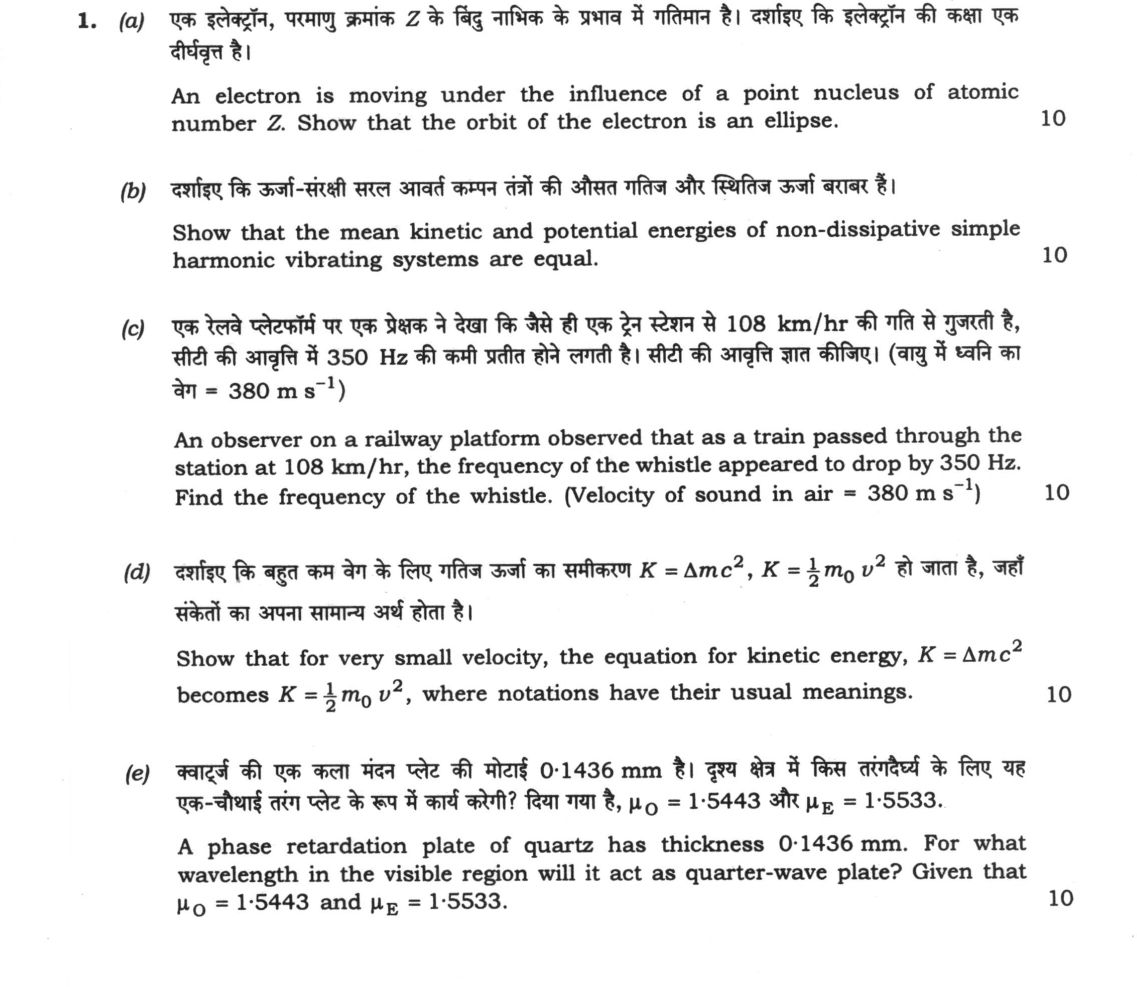
An electron is moving under the influence of a point nucleus of atomic number Z. Show that the orbit of the electron is an ellipse. 10 marks
Show that the mean kinetic and potential energies of non-dissipative simple harmonic vibrating systems are equal. 10 marks
An observer on a railway platform observed that as a train passed through the station at 108 km/hr, the frequency of the whistle appeared to drop by 350 Hz. Find the frequency of the whistle. (Velocity of sound in air = 380 m s⁻¹) 10 marks
Show that for very small velocity, the equation for kinetic energy, K = Δmc² becomes K = ½m₀v², where notations have their usual meanings. 10 marks
A phase retardation plate of quartz has thickness 0·1436 mm. For what wavelength in the visible region will it act as quarter-wave plate? Given that μ₀ = 1·5443 and μᴇ = 1·5533. 10 marks
हिंदी में प्रश्न पढ़ें
एक इलेक्ट्रॉन, परमाणु क्रमांक Z के बिंदु नाभिक के प्रभाव में गतिमान है। दर्शाइए कि इलेक्ट्रॉन की कक्षा एक दीर्घवृत्त है। 10 अंक
दर्शाइए कि ऊर्जा-संरक्षी सरल आवर्त कंपन तंत्रों की औसत गतिज और स्थितिज ऊर्जा बराबर हैं। 10 अंक
एक रेलवे प्लेटफॉर्म पर एक प्रेक्षक ने देखा कि जैसे ही एक ट्रेन स्टेशन से 108 km/hr की गति से गुजरती है, सीटी की आवृत्ति में 350 Hz की कमी प्रतीत होने लगती है। सीटी की आवृत्ति ज्ञात कीजिए। (वायु में ध्वनि का वेग = 380 m s⁻¹) 10 अंक
दर्शाइए कि बहुत कम वेग के लिए गतिज ऊर्जा का समीकरण K = Δmc², K = ½m₀v² हो जाता है, जहाँ संकेतों का अपना सामान्य अर्थ होता है। 10 अंक
क्वार्ट्ज की एक कला मंदन प्लेट की मोटाई 0·1436 mm है। दृश्य क्षेत्र में किस तरंगदैर्घ्य के लिए यह एक-चौथाई तरंग प्लेट के रूप में कार्य करेगी? दिया गया है, μ₀ = 1·5443 और μᴇ = 1·5533। 10 अंक
Model answer
Written by UPSC Answer Check against this question's marking rubric, to the expected length. UPSC does not publish answers for Mains — this is one way to score well, not an official key.
(a) For a fixed nucleus, the force on the electron is central and inverse-square: F(r) = -Ze²/(4π ε₀ r²) = -k/r², where k = Ze²/(4π ε₀).
Let u = 1/r and h = r² dθ/dt. Use Binet’s formula: d²u/dθ² + u = -F(1/u)/(m h² u²).
Substituting F = -k u²: d²u/dθ² + u = k/(m h²).
This is simple harmonic motion in u. Hence u = k/(m h²) + C cos(θ - θ₀).
Therefore r = 1/u = (m h²/k)/[1 + (C m h²/k) cos(θ - θ₀)].
This is the standard conic equation r = p/(1 + e cos(θ - θ₀)), with p = m h²/k and e = C m h²/k. For a bound electron the total energy E < 0, and e² = 1 + 2 E L²/(m k²), where L = m h is the angular momentum. Since E < 0, e < 1. Thus the orbit is an ellipse, with the nucleus at one focus.
(b) For a non-dissipative simple harmonic vibrator, x = A sin(ωt + φ), v = Aω cos(ωt + φ).
Kinetic energy: K = ½ m v² = ½ m A²ω² cos²(ωt + φ).
Potential energy: U = ½ mω² x² = ½ m A²ω² sin²(ωt + φ).
Averaging over one period, ⟨cos²⟩ = ⟨sin²⟩ = ½. Hence ⟨K⟩ = ¼ m A²ω², ⟨U⟩ = ¼ m A²ω².
Thus ⟨K⟩ = ⟨U⟩. The total energy is constant: E = ⟨K⟩ + ⟨U⟩ = ½ m A²ω².
(c) Let the whistle frequency be f. The train speed is v_s = 108 km/hr = 108 × 1000/3600 = 30 m s⁻¹.
Observer is stationary. For a moving source approaching the observer: f₁ = f v/(v - v_s) = f × 380/(380 - 30) = f × 380/350.
When receding: f₂ = f v/(v + v_s) = f × 380/(380 + 30) = f × 380/410.
The apparent drop is f₁ - f₂ = 350 Hz.
So f × 380(1/350 - 1/410) = 350.
Now 1/350 - 1/410 = 60/(350 × 410).
Hence f × 380 × 60/(350 × 410) = 350, f = 350 × 350 × 410/(380 × 60) = 502250/228 = 251125/114 Hz.
f = 251125/114 Hz ≈ 2202.85 Hz.
(i) Relativistic kinetic energy is K = Δm c² = (m - m₀)c², where m = m₀/√(1 - v²/c²).
Thus K = m₀c²[1/√(1 - v²/c²) - 1].
For v << c, let x = v²/c². By the binomial theorem, (1 - x)^(-1/2) = 1 + x/2 + 3x²/8 + ...
So K = m₀c²[x/2 + 3x²/8 + ...] = ½m₀v² + 3m₀v⁴/(8c²) + ...
For very small velocity, v⁴/c² is negligible compared with v². Therefore K ≈ ½m₀v².
(ii) For a quarter-wave plate, the phase retardation is an odd multiple of π/2: δ = 2π(μₑ - μ₀)d/λ = (2n + 1)π/2.
Thus (2n + 1)λ = 4(μₑ - μ₀)d.
Here μₑ - μ₀ = 1.5533 - 1.5443 = 0.0090, d = 0.1436 mm = 1.436 × 10⁻⁴ m.
Therefore 4(μₑ - μ₀)d = 4 × 0.0090 × 1.436 × 10⁻⁴ = 5.1696 × 10⁻⁶ m = 5169.6 nm.
Hence λ = 5169.6 nm/(2n + 1).
For visible wavelengths (400–700 nm):
- n = 4 gives λ = 5169.6/9 = 574.4 nm.
- n = 5 gives λ = 5169.6/11 = 469.96 nm ≈ 470.0 nm.
Thus, with the stated thickness, the plate acts as a quarter-wave plate in the visible region at λ ≈ 574.4 nm and λ ≈ 470.0 nm. If the intended thickness were 0.01436 mm, the first-order visible answer would be 516.96 nm.
What "Solve" is asking you to do
Choose the method, then carry it through to a final answer. Identifying what kind of problem this is and why that method applies is the first thing marked; a correct figure arrived at invisibly earns almost nothing.
Structure that answers it
Given data and what is required → method chosen, with the reason it applies → set-up (equation, circuit, free body, trial balance) → working, step by step → answer with units and any condition of validity
Where marks are lost
Doing the middle steps mentally and writing only the result. In mathematics papers, a further loss comes from giving a decimal where the exact value in surds or fractions was wanted, or from skipping the justification a part explicitly asks for.
How this answer will be evaluated
Approach
Framework: Principle > Setup and diagram > Derivation > Result and limiting case. (a) derive: given > assumptions > stepwise derivation > result > check | (b) derive: given > assumptions > stepwise derivation > result > check | (c) calculate: given > formula > substitution > result with units > interpretation | (d) derive: given > assumptions > stepwise derivation > result > check | (e) calculate: given > formula > substitution > result with units > interpretation Full marks: Rigorous derivation with all steps shown, correct units, and physical interpretation.
Key points expected
- State Newton's second law for central force
- Apply conservation of angular momentum
- Derive Binet's equation or equivalent
- Show resulting equation is that of an ellipse
- Define $x(t)$ and $v(t)$ for SHM
- Calculate time average of $K = \frac{1}{2}mv^2$
- Calculate time average of $U = \frac{1}{2}kx^2$
- Show $\langle K \rangle = \langle U \rangle$
Evaluation rubric
Each sub-part is marked on its own, against the marks and word limit printed on the paper.
- (a) Derive the equation of the orbit for an electron in a Coulomb field. 10 marks
derive— given → assumptions → stepwise derivation → result → check
Must cover
- State Newton's second law for central force
- Apply conservation of angular momentum
- Derive Binet's equation or equivalent
- Show resulting equation is that of an ellipse
Loses marks
- Assuming circular orbit without proof
- Missing the force law $F \propto 1/r^2$
Earns more
- Identify focus as the nucleus
- Mention total energy is negative
Extra mark
- Relate semi-latus rectum to angular momentum
- (b) Prove the equality of mean kinetic and potential energies in SHM. 10 marks
derive— given → assumptions → stepwise derivation → result → check
Must cover
- Define $x(t)$ and $v(t)$ for SHM
- Calculate time average of $K = \frac{1}{2}mv^2$
- Calculate time average of $U = \frac{1}{2}kx^2$
- Show $\langle K \rangle = \langle U \rangle$
Loses marks
- Confusing instantaneous with mean values
- Incorrect integration limits for time average
Earns more
- Use of $\omega^2 = k/m$ substitution
- Mentioning Virial theorem context
Extra mark
- Graphical representation of energy exchange
- (c) Calculate the source frequency of the train whistle using Doppler effect. 10 marks
calculate— given → formula → substitution → result with units → interpretation
Must cover
- Convert train velocity to m/s
- Write Doppler formula for approaching source
- Write Doppler formula for receding source
- Solve simultaneous equations for $f_0$
Loses marks
- Using wrong Doppler formula (e.g. for moving observer)
- Arithmetic errors in velocity conversion
Earns more
- Correct sign convention for velocities
- Final answer with units (Hz)
Extra mark
- Physical interpretation of frequency drop
- (d) Show relativistic kinetic energy reduces to classical form for $v \ll c$. 10 marks
derive— given → assumptions → stepwise derivation → result → check
Must cover
- State $K = (\gamma - 1)m_0c^2$
- Use binomial expansion for $(1-v^2/c^2)^{-1/2}$
- Neglect terms of order $(v/c)^4$ and higher
- Arrive at $K = \frac{1}{2}m_0v^2$
Loses marks
- Skipping the binomial expansion step
- Incorrect definition of $\gamma$
Earns more
- Explicitly stating the condition $v \ll c$
- Showing the first two terms of expansion
Extra mark
- Mentioning the next order correction term
- (e) Find the wavelength for which the quartz plate acts as a quarter-wave plate. 10 marks
calculate— given → formula → substitution → result with units → interpretation
Must cover
- State condition for quarter-wave plate: $\Delta \phi = \pi/2$
- Relate phase difference to path difference $d(\mu_E - \mu_O)$
- Substitute given values for $d$ and refractive indices
- Solve for wavelength $\lambda$
Loses marks
- Using half-wave plate condition ($\Delta \phi = \pi$)
- Swapping $\mu_O$ and $\mu_E$ in the difference
Earns more
- Correct unit conversion for thickness
- Result in visible spectrum range (nm)
Extra mark
- Identifying the color of the wavelength
Practice this exact question
Write your answer and it is marked point by point against the model answer above — what you covered, what you missed, what you got wrong.
Evaluate my answer →More from Physics 2022 Paper I
- Q1 An electron is moving under the influence of a point nucleus of atomic number Z. Show tha…
- Q2 Consider two frames of reference S and S' having a common origin O. The frame S' is rotat…
- Q3 (a) A homogeneous right triangular pyramid with the base side a and height 3a/2 is shown…
- Q4 (a) Consider the diagram below with a water flow rate Q. Derive the expression for Q in t…