Paper I — Q8
(a) In a partially conducting medium, εᵣ = 18.5, μᵣ = 800 and σ = 1 S m⁻¹. Find α, β, η and the velocity u, for a frequency of…
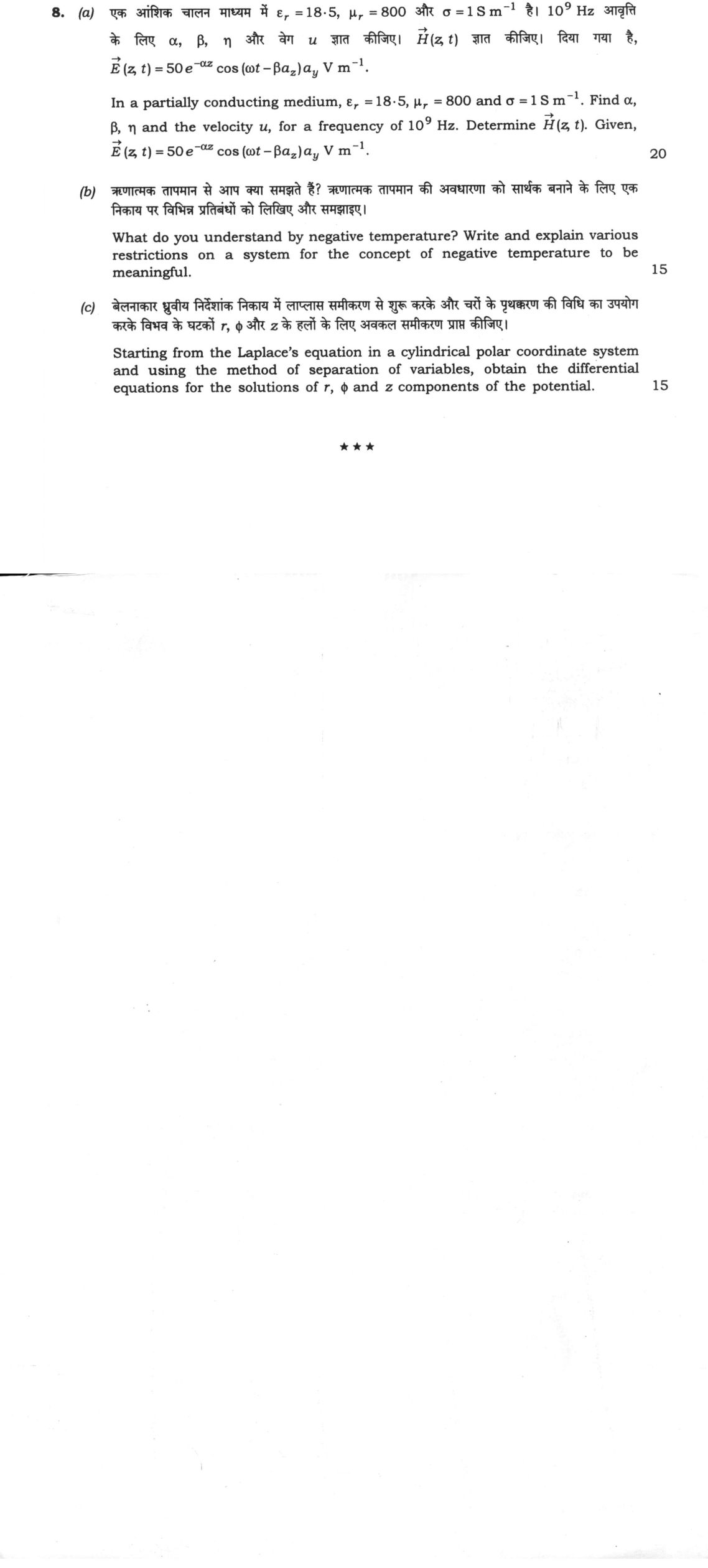
In a partially conducting medium, εᵣ = 18.5, μᵣ = 800 and σ = 1 S m⁻¹. Find α, β, η and the velocity u, for a frequency of 10⁹ Hz. Determine H⃗(z, t). Given, E⃗(z, t) = 50 e⁻α z cos(ω t - β a_z) a_y V m⁻¹. 20 marks
What do you understand by negative temperature? Write and explain various restrictions on a system for the concept of negative temperature to be meaningful. 15 marks
Starting from the Laplace's equation in a cylindrical polar coordinate system and using the method of separation of variables, obtain the differential equations for the solutions of r, φ and z components of the potential. 15 marks
हिंदी में प्रश्न पढ़ें
एक आंशिक चालन माध्यम में εᵣ = 18.5, μᵣ = 800 और σ = 1 S m⁻¹ है। 10⁹ Hz आवृत्ति के लिए α, β, η और वेग u ज्ञात कीजिए। H⃗(z, t) ज्ञात कीजिए। दिया गया है, E⃗(z, t) = 50 e⁻α z cos(ω t - β a_z) a_y V m⁻¹। (20 अंक)
ऋणात्मक तापमान से आप क्या समझते हैं? ऋणात्मक तापमान की अवधारणा को सार्थक बनाने के लिए एक निकाय पर विभिन्न प्रतिबंधों को लिखिए और समझाइए। (15 अंक)
बेलनाकार ध्रुवीय निर्देशांक निकाय में लाप्लास समीकरण से शुरू करके और चरों के पृथक्करण की विधि का उपयोग करके विभव के घटकों r, φ और z के हलों के लिए अवकल समीकरण प्राप्त कीजिए। (15 अंक)
Model answer
Written by UPSC Answer Check against this question's marking rubric, to the expected length. UPSC does not publish answers for Mains — this is one way to score well, not an official key.
(a) Interpreting the given phase term as β z, the field is E(z,t) = 50 e^(−α z) cos(ωt − β z) a_y V/m.
Using μ₀ = 4π×10⁻⁷ H/m and ε₀ = 8.854×10⁻¹² F/m:
ε = ε₀ εᵣ = 8.854×10⁻¹² × 18.5 = 1.638×10⁻¹⁰ F/m μ = μ₀ μᵣ = 4π×10⁻⁷ × 800 = 1.005×10⁻³ H/m ω = 2π×10⁹ = 6.283×10⁹ rad/s
Loss tangent: p = σ/(ωε) = 1/(6.283×10⁹ × 1.638×10⁻¹⁰) = 0.9716
For a lossy dielectric, using γ = √(jωμ(σ + jωε)) = α + jβ:
α = ω√(με/2) [√(1 + p²) − 1]^(1/2) β = ω√(με/2) [√(1 + p²) + 1]^(1/2)
Now √(με) = 4.058×10⁻⁷ s/m, so ω√(με) = 6.283×10⁹ × 4.058×10⁻⁷ = 2549.7 rad/m √(1 + p²) = 1.3943
Thus α = 2549.7 × 0.4440 = 1132 Np/m β = 2549.7 × 1.09414 = 2789.7 rad/m
Phase velocity: u = ω/β = 6.283×10⁹/2789.7 = 2.252×10⁶ m/s
Intrinsic impedance: η = √(μ/ε)/(1 − jp)^(1/2)
√(μ/ε) = 2477 Ω |η| = 2477/(1 + p²)^(1/4) = 2098 Ω θ = (1/2) tan⁻¹(p) = 0.3855 rad = 22.09°
So η = 2098 ∠22.09° Ω = 1944 + j789 Ω
For E along y and propagation along +z, Maxwell’s equations give H = −(1/η) E a_x
Therefore H(z,t) = −(50/2098) e^(−1132 z) cos(6.283×10⁹ t − 2789.7 z − 0.3855) a_x A/m
i.e. H(z,t) = −0.02383 e^(−1132 z) cos(2π×10⁹ t − 2789.7 z − 0.3855) a_x A/m.
(b) Negative temperature arises from the thermodynamic definition 1/T = (∂S/∂U)_(V,N). If entropy S decreases as internal energy U increases, then ∂S/∂U < 0 and hence T < 0. It is not a temperature below absolute zero; a negative-temperature system is hotter than any positive-temperature system. Heat flows from a negative-temperature body to a positive-temperature body.
For negative temperature to be meaningful, the following restrictions are essential:
- The system must have a bounded energy spectrum. If energy can increase without limit, the partition function diverges for T < 0 and no equilibrium negative temperature exists.
- The system must be in internal thermal equilibrium among a restricted set of degrees of freedom, usually spin or other bounded degrees of freedom.
- The ordinary unbounded translational or kinetic degrees must be effectively decoupled or absent; otherwise they absorb energy and destroy negative temperature.
- The population distribution must be inverted: higher-energy states are more populated than lower-energy states. For T < 0, the Boltzmann factor exp(−E/kT) increases with E.
- The system must be sufficiently isolated from positive-temperature reservoirs, or prepared by a fast non-adiabatic process such as laser pumping or rapid spin inversion.
- The density of states must fall sufficiently or the number of states must be finite so that the partition function converges.
Thus negative temperature is a stable thermodynamic concept only for bounded, internally equilibrated systems with population inversion.
(c) Laplace’s equation in cylindrical polar coordinates is (1/r) ∂/∂r(r ∂V/∂r) + (1/r²) ∂²V/∂φ² + ∂²V/∂z² = 0.
Let V(r,φ,z) = R(r) Φ(φ) Z(z).
Substituting and dividing by RΦZ: (1/(rR)) d/dr(r dR/dr) + (1/(r²Φ)) d²Φ/dφ² + (1/Z) d²Z/dz² = 0.
Separate the z-part: (1/Z) d²Z/dz² = k_z².
Hence d²Z/dz² − k_z² Z = 0.
The remaining equation is (1/(rR)) d/dr(r dR/dr) + (1/(r²Φ)) d²Φ/dφ² + k_z² = 0.
Multiply by r²: (r/R) d/dr(r dR/dr) + (1/Φ) d²Φ/dφ² + k_z² r² = 0.
Separate the φ-part: (1/Φ) d²Φ/dφ² = −n².
Thus d²Φ/dφ² + n² Φ = 0.
Single-valuedness of V requires Φ(φ + 2π) = Φ(φ), so n = 0, ±1, ±2, ...
The radial equation becomes r² d²R/dr² + r dR/dr + (k_z² r² − n²) R = 0.
Therefore the separated differential equations are:
d²Z/dz² − k_z² Z = 0 d²Φ/dφ² + n² Φ = 0 r² d²R/dr² + r dR/dr + (k_z² r² − n²) R = 0
The radial equation is Bessel’s equation of order n. If the separation constant is chosen with the opposite sign, the radial equation becomes the modified Bessel equation.
What "Solve" is asking you to do
Choose the method, then carry it through to a final answer. Identifying what kind of problem this is and why that method applies is the first thing marked; a correct figure arrived at invisibly earns almost nothing.
Structure that answers it
Given data and what is required → method chosen, with the reason it applies → set-up (equation, circuit, free body, trial balance) → working, step by step → answer with units and any condition of validity
Where marks are lost
Doing the middle steps mentally and writing only the result. In mathematics papers, a further loss comes from giving a decimal where the exact value in surds or fractions was wanted, or from skipping the justification a part explicitly asks for.
How this answer will be evaluated
Approach
(a) calculate: given > formula > substitution > result with units > interpretation | (b) explain: definition/context > points in order > small example > short close | (c) derive: given > assumptions > stepwise derivation > result > check Full marks: Rigorous derivation with all constants defined and units checked.
Key points expected
- Calculate complex propagation constant γ = α + jβ
- Determine intrinsic impedance η of the medium
- Calculate phase velocity u
- Derive H(z,t) using Maxwell's curl equation
- Define negative T via population inversion
- State requirement of bounded energy spectrum
- Explain negative T is 'hotter' than positive T
- Mention requirement of thermal isolation
Evaluation rubric
Each sub-part is marked on its own, against the marks and word limit printed on the paper.
- (a) Compute wave parameters and magnetic field vector for a lossy medium. 20 marks
calculate— given → formula → substitution → result with units → interpretation
Must cover
- Calculate complex propagation constant γ = α + jβ
- Determine intrinsic impedance η of the medium
- Calculate phase velocity u
- Derive H(z,t) using Maxwell's curl equation
Loses marks
- Using lossless medium approximations
- Incorrect direction for H field vector
Earns more
- Explicit calculation of loss tangent tan δ
- Correct unit conversion for frequency
- Verification of E/H ratio
Extra mark
- Comparison of α and β magnitudes
- (b) Define negative temperature and list system restrictions for its validity. 15 marks
explain— definition/context → points in order → small example → short close
Must cover
- Define negative T via population inversion
- State requirement of bounded energy spectrum
- Explain negative T is 'hotter' than positive T
- Mention requirement of thermal isolation
Loses marks
- Confusing with absolute zero
- Claiming it violates thermodynamics
Earns more
- Reference to spin systems or lasers
- Explanation of entropy decrease with energy
Extra mark
- Mention of specific experimental realization
- (c) Derive ODEs for r, φ, z components of potential in cylindrical coordinates. 15 marks
derive— given → assumptions → stepwise derivation → result → check
Must cover
- Write Laplace's equation in cylindrical coordinates
- Apply separation of variables V = RΦZ
- Derive ODE for radial component R(r)
- Derive ODE for angular component Φ(φ)
Loses marks
- Skipping separation steps
- Incorrect coordinate transformation
Earns more
- Derivation of ODE for z-component Z(z)
- Identification of separation constants
Extra mark
- Mention of Bessel functions for radial part
Practice this exact question
Write your answer and it is marked point by point against the model answer above — what you covered, what you missed, what you got wrong.
Evaluate my answer →More from Physics 2022 Paper I
- Q5 (a) Assume that the Earth's atmosphere is pure nitrogen in thermodynamic equilibrium at a…
- Q6 (a) Write down Maxwell's equations in a non-conducting medium with constant permeability…
- Q7 (a) A metal guitar string with a length of 70 cm vibrates at its fundamental frequency of…
- Q8 (a) In a partially conducting medium, εᵣ = 18.5, μᵣ = 800 and σ = 1 S m⁻¹. Find α, β, η a…