Paper I — Q4
(a) Consider the diagram below with a water flow rate Q. Derive the expression for Q in terms of the difference in the manometer…
Consider the diagram below with a water flow rate Q. Derive the expression for Q in terms of the difference in the manometer heights h and the cross-section areas A₁ and A₂ : 15 marks
Discuss the phenomenon of Fraunhofer diffraction at a single slit and show that the intensities of successive maxima are nearly in the ratio
1 : 4/9π² : 4/25π² : 4/49π² 20 marks
Two spaceships approach each other, both moving with same speed as measured by a stationary observer on the Earth. Their relative speed is 0·7c. Determine the velocity of each spaceship as measured by the stationary observer on the Earth. 15 marks
हिंदी में प्रश्न पढ़ें
नीचे दिए गए आरेख पर विचार कीजिए, जिसमें Q जल-प्रवाह दर है। दाबमापी (मैनोमीटर) की ऊँचाइयों में अंतर h तथा अनुप्रस्थ-काट क्षेत्रफलों A₁ और A₂ के सापेक्ष Q के मान के लिए व्यंजक व्युत्पन्न कीजिए : 15 marks
एकल स्लिट फ्रॉनहोफर विवर्तन की परिघटना पर चर्चा कीजिए और दर्शाइए कि क्रमिक उच्चिष्ठ की तीव्रताओं का लगभग अनुपात है
1 : 4/9π² : 4/25π² : 4/49π² 20
दो अंतरिक्ष-यान एक-दूसरे के पास पहुँच रहे हैं। पृथ्वी पर एक स्थिर प्रेक्षक द्वारा मापा जाता है कि दोनों एक ही गति से गतिमान हैं। उनकी सापेक्ष गति 0·7c है। पृथ्वी पर स्थित प्रेक्षक द्वारा मापे गए प्रत्येक अंतरिक्ष-यान के वेग का निर्धारण कीजिए। 15
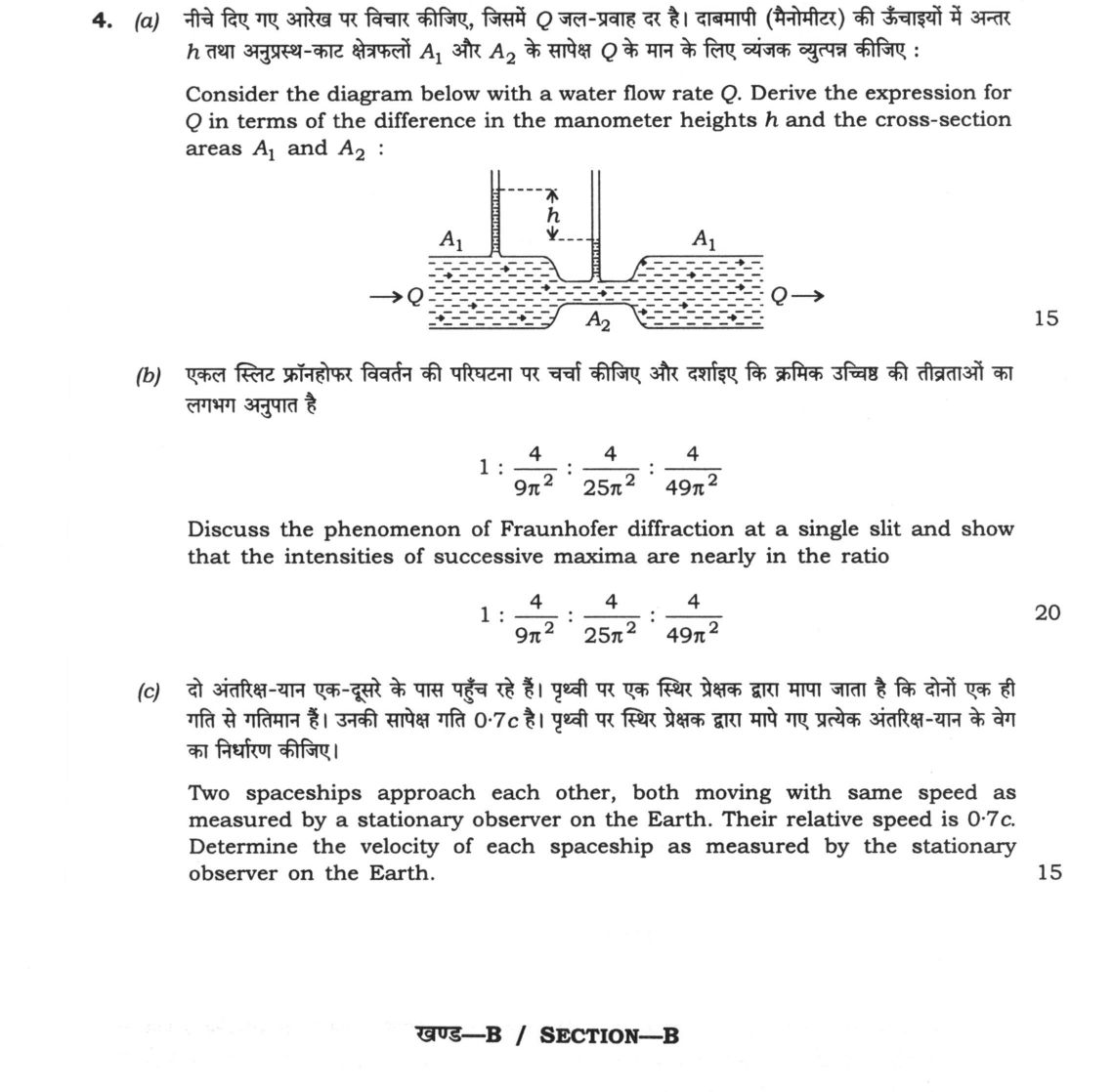
The figure this question refers to, in words
The question paper is a scan and the diagram did not survive as text. This is the figure as read from the original page — every component, value and label — so the question can be worked from the text below.
(a) A horizontal Venturimeter with water flowing from left to right at a flow rate Q (indicated by '-> Q' on the left and 'Q ->' on the right). The tube has an initial cross-sectional area A1, tapers down to a throat of cross-sectional area A2, and then expands back to cross-sectional area A1. Two vertical open manometer tubes are attached: one at the wider section of area A1, and the other at the throat of area A2. The water rises to a higher level in the first tube than in the second tube at the throat. The vertical difference in the liquid levels between these two manometer tubes is marked with a double-ended arrow labelled 'h'.
Model answer
Written by UPSC Answer Check against this question's marking rubric, to the expected length. UPSC does not publish answers for Mains — this is one way to score well, not an official key.
(a) Let water be incompressible, steady, non-viscous and irrotational. At the wider section 1, let pressure be p₁, speed v₁ and area A₁. At the throat section 2, let pressure be p₂, speed v₂ and area A₂. Since the duct is horizontal, the Bernoulli equation between sections 1 and 2 is p₁ + 1/2 ρv₁² = p₂ + 1/2 ρv₂². Hence p₁ − p₂ = 1/2 ρ(v₂² − v₁²). By the continuity equation for water, Q = A₁v₁ = A₂v₂, so v₁ = Q/A₁ and v₂ = Q/A₂. Substituting, p₁ − p₂ = ρQ²/2 (1/A₂² − 1/A₁²) = ρQ²/2 ((A₁² − A₂²)/(A₁²A₂²)).
The two vertical open manometer tubes measure the pressure-head difference. Since the pipe is horizontal and the same liquid water is used, p₁ − p₂ = ρgh. Equating the two expressions for p₁ − p₂, ρgh = ρQ²/2 ((A₁² − A₂²)/(A₁²A₂²)). Cancelling ρ and solving for Q, Q² = 2gh A₁²A₂²/(A₁² − A₂²). Therefore Q = A₁A₂ √(2gh/(A₁² − A₂²)). This is valid for a horizontal venturimeter, steady incompressible flow, no viscous losses, and the same liquid in the manometer as in the pipe. If a manometer liquid of density ρₘ is used, h is replaced by h(ρₘ/ρ − 1).
(b) In Fraunhofer diffraction at a single slit, the source and screen are effectively at infinity, so a plane wavefront falls normally on a slit of width a. According to Huygens’ principle, every point of the slit acts as a source of secondary wavelets. These wavelets interfere on the screen. For diffraction angle θ, the path difference between wavelets from the two edges of the slit is a sinθ.
Divide the slit into infinitesimal strips of width dx. Let x be the distance of a strip from the centre of the slit. Its phase lag relative to the centre is δ = (2π/λ)x sinθ. The contribution to the resultant amplitude is dE = (E₀/a) exp[−i(2π/λ)x sinθ] dx. Integrating from x = −a/2 to x = +a/2, E = (E₀/a) ∫ exp[−i(2π/λ)x sinθ] dx = (E₀/a) [exp[−i(2π/λ)x sinθ] / (−i(2π/λ) sinθ)] from −a/2 to a/2 = (E₀/a) (exp[−i(πa sinθ/λ)] − exp[i(πa sinθ/λ)]) / (−i(2π/λ) sinθ) = (E₀/a) (−2i sin(πa sinθ/λ)) / (−i(2π/λ) sinθ) = E₀ sin(πa sinθ/λ) / (πa sinθ/λ). Let β = (πa sinθ)/λ. Then E = E₀ sinβ/β. Therefore the intensity is I = I₀ (sinβ/β)², where I₀ is the intensity at θ = 0.
Minima occur when sinβ = 0 but β ≠ 0, i.e. β = mπ, m = ±1, ±2, ±3, … or a sinθ = mλ. The central maximum is at β = 0. Secondary maxima are obtained from dI/dβ = 0: d/dβ (sin²β/β²) = 0 ⇒ (2 sinβ cosβ β² − sin²β 2β)/β⁴ = 0 ⇒ 2 sinβ (β cosβ − sinβ)/β³ = 0. For nonzero maxima, tanβ = β. The exact roots of tanβ = β are close to βₙ ≈ (2n+1)π/2 for n = 1, 2, 3, … At these approximate values, sinβ ≈ ±1, so Iₙ/I₀ ≈ 1/βₙ². Hence I₁/I₀ ≈ 1/(3π/2)² = 4/(9π²), I₂/I₀ ≈ 1/(5π/2)² = 4/(25π²), I₃/I₀ ≈ 1/(7π/2)² = 4/(49π²). Therefore the intensities of successive maxima are nearly in the ratio 1 : 4/(9π²) : 4/(25π²) : 4/(49π²). The central maximum is the brightest; the secondary maxima fall off rapidly.
(c) Let the speed of each spaceship relative to the Earth observer be u. Since they approach each other, their velocities in the Earth frame are +u and −u along the line of motion. Using the relativistic velocity-addition formula, the speed of one spaceship relative to the other is w = (u + u)/(1 + u²/c²) = 2u/(1 + u²/c²). Given w = 0.7c, let x = u/c. Then 0.7 = 2x/(1 + x²). Thus 0.7(1 + x²) = 2x ⇒ 0.7x² − 2x + 0.7 = 0. Multiplying by 10, 7x² − 20x + 7 = 0. Solving, x = (20 ± √(400 − 196))/14 = (20 ± √204)/14 = (10 ± √51)/7. The positive sign gives x = (10 + √51)/7 ≈ 2.45 > 1, which is impossible. Hence x = (10 − √51)/7 ≈ 0.408. Therefore u ≈ 0.408c ≈ 1.22 × 10⁸ m s⁻¹. So, as measured by the stationary Earth observer, one spaceship moves with velocity +0.408c and the other with velocity −0.408c along their line of approach.
What "Derive" is asking you to do
Reach the stated expression from a starting relation, justifying every step. The destination is printed in the question, so only the route earns marks, and the assumptions you work under are part of that route.
Structure that answers it
Assumptions and notation defined → starting relation or governing equation → each step with its justification → the required expression → limiting case or boundary check
Where marks are lost
Writing the standard result first and fitting three lines to it, which an examiner reads at a glance. Marks also go on assumptions left unstated — lossless medium, small amplitude, errors independent with zero mean — and on symbols used before they are defined, even when the question says usual notations.
How this answer will be evaluated
Approach
Framework: Principle > Setup and diagram > Derivation > Result and limiting case. (a) derive: given > assumptions > stepwise derivation > result > check | (b) discuss: intro > 3-4 dimensions > example > balanced close | (c) calculate: given > formula > substitution > result with units > interpretation Full marks: Complete derivations with all steps, correct results, physical interpretation
Key points expected
- Apply Bernoulli's equation between sections 1 and 2
- Apply continuity equation Q = A1v1 = A2v2
- Relate pressure difference to manometer height h
- Solve for Q explicitly in terms of h, A1, A2
- Define Fraunhofer diffraction conditions (far-field)
- Derive intensity distribution I(θ) for single slit
- Locate secondary maxima positions (tan α = α)
- Calculate intensity ratio 1 : 4/9π² : 4/25π² : 4/49π²
Evaluation rubric
Each sub-part is marked on its own, against the marks and word limit printed on the paper.
- (a) Derive expression for Q in terms of h, A1, A2 15 marks
derive— given → assumptions → stepwise derivation → result → check
Must cover
- Apply Bernoulli's equation between sections 1 and 2
- Apply continuity equation Q = A1v1 = A2v2
- Relate pressure difference to manometer height h
- Solve for Q explicitly in terms of h, A1, A2
Loses marks
- Formula substitution without derivation steps
- Dropping units or dimensional check
Earns more
- Labelled diagram of Venturi tube with manometer
- State assumptions: incompressible, steady, non-viscous flow
- Check dimensions of final expression
Extra mark
- Physical interpretation of Venturi effect
- (b) Discuss Fraunhofer diffraction and show intensity ratio 20 marks
discuss— intro → 3-4 dimensions → example → balanced close
Must cover
- Define Fraunhofer diffraction conditions (far-field)
- Derive intensity distribution I(θ) for single slit
- Locate secondary maxima positions (tan α = α)
- Calculate intensity ratio 1 : 4/9π² : 4/25π² : 4/49π²
Loses marks
- No derivation of intensity distribution
- Incorrect maxima positions or ratio calculation
Earns more
- Labelled diffraction pattern diagram
- Explain central maximum vs secondary maxima
- Show mathematical steps for ratio derivation
Extra mark
- Physical interpretation of intensity falloff
- (c) Calculate velocity of each spaceship 15 marks
calculate— given → formula → substitution → result with units → interpretation
Must cover
- Apply relativistic velocity addition formula
- Set up equation with relative speed 0.7c
- Solve for individual velocity v
- State result with units (fraction of c)
Loses marks
- Using classical velocity addition
- Arithmetic errors in solving equation
Earns more
- State relativistic velocity addition formula explicitly
- Show algebraic steps in solving
- Verify result is less than c
Extra mark
- Physical interpretation of relativistic effects
Practice this exact question
Write your answer and it is marked point by point against the model answer above — what you covered, what you missed, what you got wrong.
Evaluate my answer →More from Physics 2022 Paper I
- Q1 An electron is moving under the influence of a point nucleus of atomic number Z. Show tha…
- Q2 Consider two frames of reference S and S' having a common origin O. The frame S' is rotat…
- Q3 (a) A homogeneous right triangular pyramid with the base side a and height 3a/2 is shown…
- Q4 (a) Consider the diagram below with a water flow rate Q. Derive the expression for Q in t…
- Q5 (a) Assume that the Earth's atmosphere is pure nitrogen in thermodynamic equilibrium at a…
- Q6 (a) Write down Maxwell's equations in a non-conducting medium with constant permeability…
- Q7 (a) A metal guitar string with a length of 70 cm vibrates at its fundamental frequency of…