Paper I — Q6
(a) Write down Maxwell's equations in a non-conducting medium with constant permeability and susceptibility (ρ = j = 0). Show…
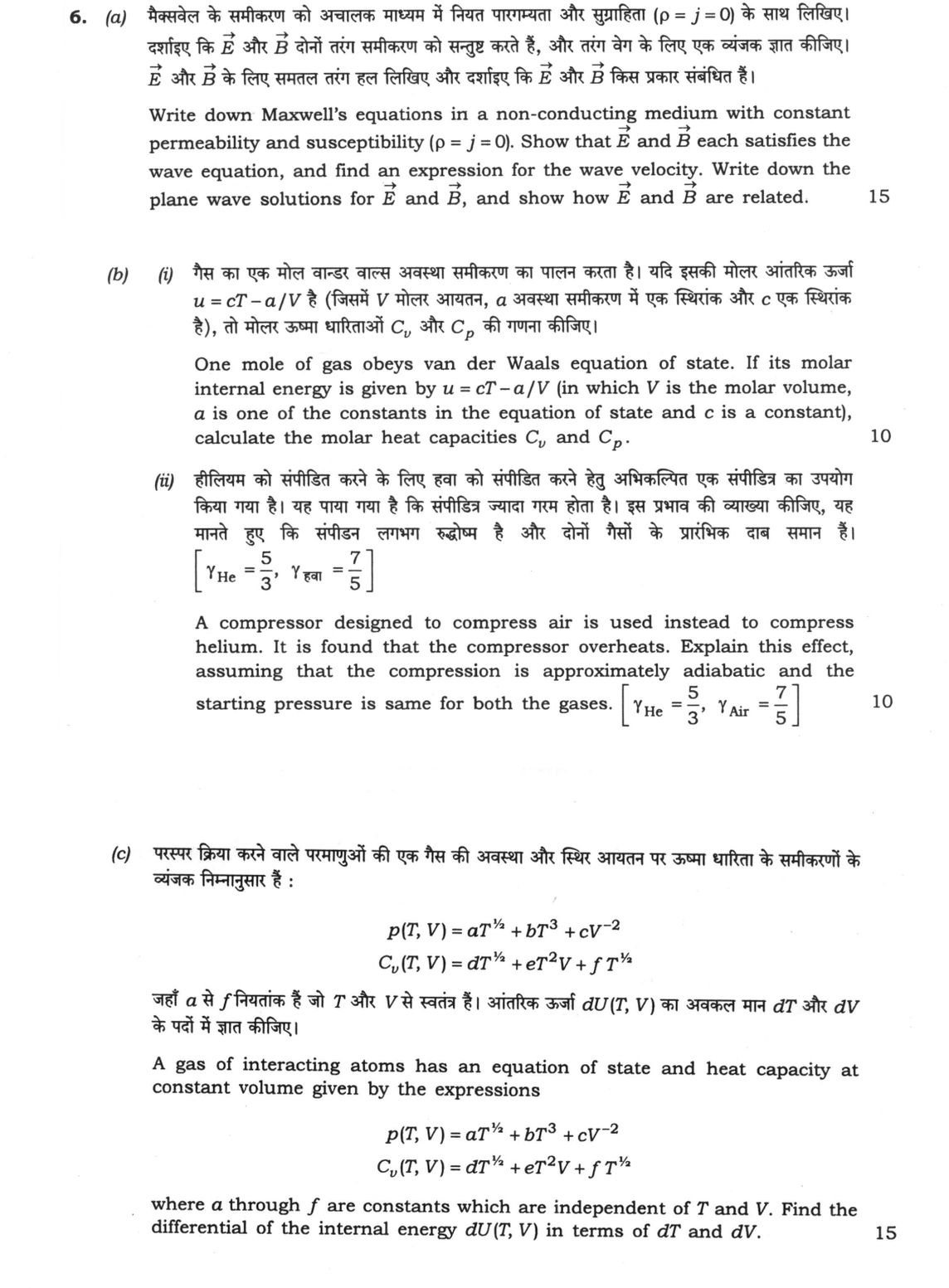
Write down Maxwell's equations in a non-conducting medium with constant permeability and susceptibility (ρ = j = 0). Show that E⃗ and B⃗ each satisfies the wave equation, and find an expression for the wave velocity. Write down the plane wave solutions for E⃗ and B⃗, and show how E⃗ and B⃗ are related. 15 marks
One mole of gas obeys van der Waals equation of state. If its molar internal energy is given by u = cT – a/V (in which V is the molar volume, a is one of the constants in the equation of state and c is a constant), calculate the molar heat capacities Cv and Cp. 10 marks
A compressor designed to compress air is used instead to compress helium. It is found that the compressor overheats. Explain this effect, assuming that the compression is approximately adiabatic and the starting pressure is same for both the gases. [γHe = 5/3, γAir = 7/5] 10 marks
A gas of interacting atoms has an equation of state and heat capacity at constant volume given by the expressions
p(T, V) = aT¹/2 + bT³ + cV⁻²
Cᵥ(T, V) = dT¹/2 + eT^2V + fT¹/2
where a through f are constants which are independent of T and V. Find the differential of the internal energy dU(T, V) in terms of dT and dV. 15 marks
हिंदी में प्रश्न पढ़ें
मैक्सवेल के समीकरण को अचालक माध्यम में नियत पारगम्यता और सुग्राहिता (ρ = j = 0) के साथ लिखिए। दर्शाइए कि E⃗ और B⃗ दोनों तरंग समीकरण को संतुष्ट करते हैं, और तरंग वेग के लिए एक व्यंजक प्राप्त कीजिए। E⃗ और B⃗ के लिए समतल तरंग हल लिखिए और दर्शाइए कि E⃗ और B⃗ किस प्रकार संबंधित हैं। (15 अंक)
गैस का एक मोल वान्डर वाल्स अवस्था समीकरण का पालन करता है। यदि इसकी मोलर आंतरिक ऊर्जा u = cT – a/V है (जिसमें V मोलर आयतन, a अवस्था समीकरण में एक स्थिरांक और c एक स्थिरांक है), तो मोलर उष्मा धारिताओं Cv और Cp की गणना कीजिए। (10 अंक)
हीलियम को संपीड़ित करने के लिए हवा को संपीड़ित करने हेतु अभिकल्पित एक संपीड़ित्र का उपयोग किया गया है। यह पाया गया कि संपीड़ित्र ज्यादा गरम होता है। इस प्रभाव की व्याख्या कीजिए, यह मानते हुए कि संपीड़न लगभग रुद्धोष्म है और दोनों गैसों के प्रारंभिक दाब समान हैं। [γHe = 5/3, γहवा = 7/5] (10 अंक)
परस्पर क्रिया करने वाले परमाणुओं की एक गैस की अवस्था और स्थिर आयतन पर ऊष्मा धारिता के समीकरणों के व्यंजक निम्नानुसार हैं :
p(T, V) = aT¹/2 + bT³ + cV⁻²
Cᵥ(T, V) = dT¹/2 + eT^2V + fT¹/2
जहाँ a से f नियतांक हैं जो T और V से स्वतंत्र हैं। आंतरिक ऊर्जा dU(T, V) का अवकल मान dT और dV के पदों में ज्ञात कीजिए। (15 अंक)
Model answer
Written by UPSC Answer Check against this question's marking rubric, to the expected length. UPSC does not publish answers for Mains — this is one way to score well, not an official key.
(a) Maxwell's equations in a non-conducting medium with ρ=0, j=0 are: ∇·D = 0, ∇·B = 0, ∇×E = -∂B/∂t, ∇×H = ∂D/∂t. For a linear isotropic medium with constant permittivity ε and permeability μ, D=εE, B=μH. Then: ∇·E = 0, ∇·B = 0, ∇×E = -∂B/∂t, ∇×B = με ∂E/∂t.
Take curl of ∇×E = -∂B/∂t: ∇×(∇×E) = -∂/∂t (∇×B) = -με ∂²E/∂t². Using the vector identity ∇×(∇×E) = ∇(∇·E) - ∇²E, and ∇·E=0, we get -∇²E = -με ∂²E/∂t², so: ∇²E = με ∂²E/∂t². Similarly, take curl of ∇×B = με ∂E/∂t: ∇×(∇×B) = με ∂/∂t (∇×E) = -με ∂²B/∂t². Using ∇×(∇×B) = -∇²B, we get: ∇²B = με ∂²B/∂t². Thus E and B each satisfy the wave equation with wave velocity: v = 1/√(με). If ε = ε₀(1+χₑ) and μ = μ₀(1+χₘ), then v = c/√((1+χₑ)(1+χₘ)).
Plane wave solutions are: E = E₀ exp[i(k·r - ωt)], B = B₀ exp[i(k·r - ωt)]. From ∇·E=0 and ∇·B=0, we get k·E₀=0 and k·B₀=0, so both fields are transverse. From Faraday's law, ∇×E = -∂B/∂t gives i k×E = iω B, hence k×E = ω B. Therefore: B = (1/ω) k×E = (1/v) n̂×E, where n̂ is the unit vector in the direction of k. So E, B, and k are mutually perpendicular, E and B are in phase, and the magnitudes satisfy |E| = v|B|.
(b)(i) The van der Waals equation for one mole is: (p + a/V²)(V - b) = RT, so p = RT/(V-b) - a/V². The molar internal energy is u = cT - a/V. At constant volume, Cᵥ = (∂u/∂T)_V = c. For Cₚ, use the general thermodynamic relation: Cₚ - Cᵥ = -T (∂p/∂T)_V² / (∂p/∂V)_T. Compute: (∂p/∂T)_V = R/(V-b), (∂p/∂V)_T = -RT/(V-b)² + 2a/V³. Then: Cₚ - c = -T [R/(V-b)]² / [-RT/(V-b)² + 2a/V³] = -T R²/(V-b)² / [(-RT V³ + 2a(V-b)²)/(V³(V-b)²)] = T R² V³ / [RT V³ - 2a(V-b)²] = R² T / [RT - 2a(V-b)²/V³]. Thus: Cᵥ = c, Cₚ = c + R² T / [RT - 2a(V-b)²/V³] or equivalently Cₚ = c + R / [1 - 2a(V-b)²/(R T V³)]. Units: Cᵥ and Cₚ are in J mol⁻¹ K⁻¹.
(b)(ii) For an adiabatic process, T p^((1-γ)/γ) = constant. If the starting pressure is the same and the compressor produces the same pressure ratio, then: T₂/T₁ = (p₂/p₁)^((γ-1)/γ). For helium, γ = 5/3, so (γ-1)/γ = (2/3)/(5/3) = 2/5 = 0.400. For air, γ = 7/5, so (γ-1)/γ = (2/5)/(7/5) = 2/7 ≈ 0.286. Since 0.400 > 0.286, helium reaches a higher final temperature than air for the same compression. Hence the compressor designed for air overheats when used for helium. If the compressor is of fixed volume-ratio type, then T₂/T₁ = (V₁/V₂)^(γ-1), and γ-1 is 2/3 for He and 2/5 for air, again giving a larger temperature rise for helium.
(c) The thermodynamic identity for dU is: dU = Cᵥ dT + [T(∂p/∂T)_V - p] dV. Given: p = a√T + bT³ + cV⁻², Cᵥ = d√T + eT²V + f√T = (d+f)√T + eT²V. Compute: ∂p/∂T = a/(2√T) + 3bT². Then: T(∂p/∂T)_V - p = T[a/(2√T) + 3bT²] - [a√T + bT³ + cV⁻²] = (a√T)/2 + 3bT³ - a√T - bT³ - cV⁻² = -(a√T)/2 + 2bT³ - cV⁻². Therefore: dU = [(d+f)√T + eT²V] dT + [-(a√T)/2 + 2bT³ - cV⁻²] dV. Equivalently, in the original Cᵥ terms: dU = (d√T + eT²V + f√T) dT + (-(a√T)/2 + 2bT³ - cV⁻²) dV. Note: for the given p and Cᵥ to describe a single thermodynamic state function U, the exactness condition requires e = 6b and a = 0; otherwise the data are thermodynamically inconsistent. The expression above is the formal differential obtained from the standard identity.
What "Derive" is asking you to do
Reach the stated expression from a starting relation, justifying every step. The destination is printed in the question, so only the route earns marks, and the assumptions you work under are part of that route.
Structure that answers it
Assumptions and notation defined → starting relation or governing equation → each step with its justification → the required expression → limiting case or boundary check
Where marks are lost
Writing the standard result first and fitting three lines to it, which an examiner reads at a glance. Marks also go on assumptions left unstated — lossless medium, small amplitude, errors independent with zero mean — and on symbols used before they are defined, even when the question says usual notations.
How this answer will be evaluated
Approach
(a) derive: given > assumptions > stepwise derivation > result > check | (b(i)) calculate: given > formula > substitution > result with units > interpretation | (b(ii)) explain: definition/context > points in order > small example > short close | (c) derive: given > assumptions > stepwise derivation > result > check Full marks: Complete derivations with all steps shown, correct final expressions, and physical interpretation.
Key points expected
- State Maxwell's equations for non-conducting medium (ρ=j=0)
- Derive wave equation for E and B using curl of curl identity
- Identify wave velocity v = 1/√(με)
- Show relation B = (1/v) k̂ × E for plane waves
- Use Cv = (∂u/∂T)_V to find Cv = c
- Use Cp - Cv = T(∂p/∂T)_V (∂V/∂T)_p
- Apply van der Waals equation to find (∂p/∂T)_V
- Express Cp in terms of Cv and van der Waals constants
Evaluation rubric
Each sub-part is marked on its own, against the marks and word limit printed on the paper.
- (a) Derive wave equation for E and B from Maxwell's equations and find wave velocity. 15 marks
derive— given → assumptions → stepwise derivation → result → check
Must cover
- State Maxwell's equations for non-conducting medium (ρ=j=0)
- Derive wave equation for E and B using curl of curl identity
- Identify wave velocity v = 1/√(με)
- Show relation B = (1/v) k̂ × E for plane waves
Loses marks
- Writing wave equation without derivation from Maxwell's equations
- Omitting the relation between E and B for plane waves
Earns more
- Explicitly show vector calculus steps for curl operations
- State assumptions: constant μ, ε, and susceptibility
- Verify dimensions of wave velocity
Extra mark
- Mention physical interpretation of E and B being in phase
- (b(i)) Calculate molar heat capacities Cv and Cp for van der Waals gas. 10 marks
calculate— given → formula → substitution → result with units → interpretation
Must cover
- Use Cv = (∂u/∂T)_V to find Cv = c
- Use Cp - Cv = T(∂p/∂T)_V (∂V/∂T)_p
- Apply van der Waals equation to find (∂p/∂T)_V
- Express Cp in terms of Cv and van der Waals constants
Loses marks
- Assuming Cp - Cv = R without derivation
- Failing to use the given internal energy expression
Earns more
- Show explicit differentiation of van der Waals equation
- State that Cv is independent of V for this gas
Extra mark
- Compare result with ideal gas limit
- (b(ii)) Explain why compressor overheats when compressing helium instead of air. 10 marks
explain— definition/context → points in order → small example → short close
Must cover
- Use adiabatic relation TV^(γ-1) = constant
- Compare γ values: γ_He = 5/3 > γ_Air = 7/5
- Show higher γ leads to greater temperature rise
- Relate temperature rise to compressor overheating
Loses marks
- Not using the given γ values
- Confusing adiabatic with isothermal compression
Earns more
- Calculate ratio of temperature rises for same compression
- Mention that helium is monatomic vs diatomic air
Extra mark
- Provide numerical example of temperature difference
- (c) Find differential of internal energy dU(T,V) in terms of dT and dV. 15 marks
derive— given → assumptions → stepwise derivation → result → check
Must cover
- Use dU = Cv dT + [T(∂p/∂T)_V - p] dV
- Calculate (∂p/∂T)_V from given p(T,V)
- Compute T(∂p/∂T)_V - p term
- Write final dU expression with all constants
Loses marks
- Using wrong thermodynamic identity for dU
- Arithmetic errors in combining terms
Earns more
- Show step-by-step differentiation of p(T,V)
- Verify that dU is an exact differential
Extra mark
- Integrate to find U(T,V) explicitly
Practice this exact question
Write your answer and it is marked point by point against the model answer above — what you covered, what you missed, what you got wrong.
Evaluate my answer →More from Physics 2022 Paper I
- Q3 (a) A homogeneous right triangular pyramid with the base side a and height 3a/2 is shown…
- Q4 (a) Consider the diagram below with a water flow rate Q. Derive the expression for Q in t…
- Q5 (a) Assume that the Earth's atmosphere is pure nitrogen in thermodynamic equilibrium at a…
- Q6 (a) Write down Maxwell's equations in a non-conducting medium with constant permeability…
- Q7 (a) A metal guitar string with a length of 70 cm vibrates at its fundamental frequency of…
- Q8 (a) In a partially conducting medium, εᵣ = 18.5, μᵣ = 800 and σ = 1 S m⁻¹. Find α, β, η a…