Paper I — Q7
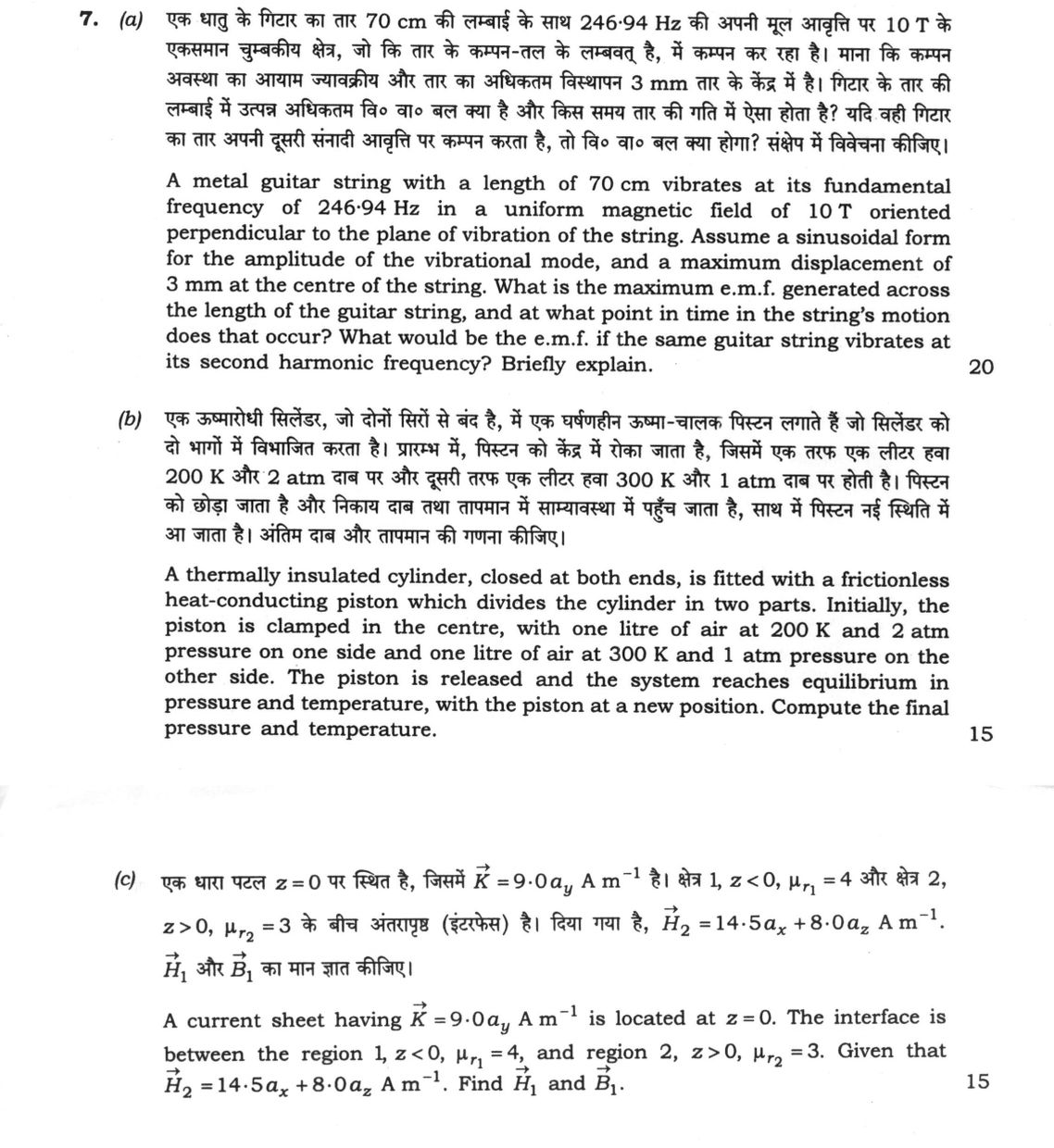
(a) A metal guitar string with a length of 70 cm vibrates at its fundamental frequency of 246.94 Hz in a uniform magnetic field…
A metal guitar string with a length of 70 cm vibrates at its fundamental frequency of 246.94 Hz in a uniform magnetic field of 10 T oriented perpendicular to the plane of vibration of the string. Assume a sinusoidal form for the amplitude of the vibrational mode, and a maximum displacement of 3 mm at the centre of the string. What is the maximum e.m.f. generated across the length of the guitar string, and at what point in time in the string's motion does that occur? What would be the e.m.f. if the same guitar string vibrates at its second harmonic frequency? Briefly explain. 20 marks
A thermally insulated cylinder, closed at both ends, is fitted with a frictionless heat-conducting piston which divides the cylinder in two parts. Initially, the piston is clamped in the centre, with one litre of air at 200 K and 2 atm pressure on one side and one litre of air at 300 K and 1 atm pressure on the other side. The piston is released and the system reaches equilibrium in pressure and temperature, with the piston at a new position. Compute the final pressure and temperature. 15 marks
A current sheet having K⃗ = 9.0 a_y A m⁻¹ is located at z = 0. The interface is between the region 1, z < 0, μᵣ₁ = 4, and region 2, z > 0, μᵣ₂ = 3. Given that H⃗₂ = 14.5 aₓ + 8.0 a_z A m⁻¹. Find H⃗₁ and B⃗₁. 15 marks
हिंदी में प्रश्न पढ़ें
एक धातु के गिटार का तार 70 cm की लंबाई के साथ 246.94 Hz की अपनी मूल आवृत्ति पर 10 T के एकसमान चुंबकीय क्षेत्र, जो कि तार के कंपन-तल के लंबवत् है, में कंपन कर रहा है। माना कि कंपन अवस्था का आयाम ज्यावक्रीय और तार का अधिकतम विस्थापन 3 mm तार के केंद्र में है। गिटार के तार की लंबाई में उत्पन्न अधिकतम वि. बा.ओ. बल क्या है और किस समय तार की गति में ऐसा होता है? यदि वही गिटार का तार अपनी दूसरी संगादी आवृत्ति पर कंपन करता है, तो वि. बा.ओ. बल क्या होगा? संक्षेप में विवेचना कीजिए। (20 अंक)
एक ऊष्मारोधी सिलेंडर, जो दोनों सिरों से बंद है, में एक घर्षणहीन ऊष्मा-चालक पिस्टन लगाते हैं जो सिलेंडर को दो भागों में विभाजित करता है। प्रारंभ में, पिस्टन को केंद्र में रोका जाता है, जिसमें एक तरफ एक लीटर हवा 200 K और 2 atm दाब पर और दूसरी तरफ एक लीटर हवा 300 K और 1 atm दाब पर होती है। पिस्टन को छोड़ा जाता है और निकाय दाब तथा तापमान में साम्यावस्था में पहुँच जाता है, साथ में पिस्टन नई स्थिति में आ जाता है। अंतिम दाब और तापमान की गणना कीजिए। (15 अंक)
एक धारा पटल z = 0 पर स्थित है, जिसमें K⃗ = 9.0 a_y A m⁻¹ है। क्षेत्र 1, z < 0, μᵣ₁ = 4 और क्षेत्र 2, z > 0, μᵣ₂ = 3 के बीच अंतरापृष्ठ (इंटरफेस) है। दिया गया है, H⃗₂ = 14.5 aₓ + 8.0 a_z A m⁻¹। H⃗₁ और B⃗₁ का मान ज्ञात कीजिए। (15 अंक)
Model answer
Written by UPSC Answer Check against this question's marking rubric, to the expected length. UPSC does not publish answers for Mains — this is one way to score well, not an official key.
(a)(i) Take the string along x, 0≤x≤L=0.70 m, transverse displacement u in z, and B=10 T a_y. For the fundamental, the centre antinode gives A=0.003 m: u₁=A sin(πx/L) cos(ω₁t), ω₁=2πf₁=2π(246.94) s⁻¹=1551.57 s⁻¹. The velocity is v=∂u₁/∂t a_z=-Aω₁ sin(πx/L) sin(ω₁t) a_z. The exact element of the curved string is dl=(dx,0,du)=(1,0,∂u₁/∂x)dx. The motional e.m.f. theorem gives ε=∫(v×B)·dl. Since v×B=-B v_z a_x, the z part of dl is orthogonal and does not contribute, so ε₁(t)=-B∫₀ᴸ v_z dx =B Aω₁ sin(ω₁t)∫₀ᴸ sin(πx/L)dx =B Aω₁(2L/π) sin(ω₁t). Thus the maximum magnitude is ε_max=B Aω₁(2L/π)=4 B A L f₁ =4(10 T)(0.003 m)(0.70 m)(246.94 s⁻¹)=20.74296 V≈20.74 V. With t=0 at maximum displacement, the first maximum occurs at t=T/4=1/(4f₁)=1.01 ms; in the motion this is when the string passes through zero displacement with maximum transverse speed. Valid for small amplitude, fixed ends, uniform B, open circuit.
(a)(ii) For a pure second harmonic, f₂=2f₁ and the centre is a node. Write u₂=A₂ sin(2πx/L) cos(ω₂t). Then v_z₂=-A₂ω₂ sin(2πx/L) sin(ω₂t), and the same exact line element gives ε₂(t)=-B∫₀ᴸ v_z₂ dx =B A₂ω₂ sin(ω₂t)∫₀ᴸ sin(2πx/L)dx =B A₂ω₂ sin(ω₂t)[-L/(2π)cos(2πx/L)]₀ᴸ=0. The two halves have equal and opposite velocities, so their contributions cancel; equivalently the flux through the loop made by the string and a straight return path is zero at all times. The quoted 3 mm cannot be the centre displacement for this mode; if it is the antinode amplitude, the e.m.f. is still 0 V for a pure second harmonic.
(b) Let side 1 be 1 L, 200 K, 2 atm; side 2 be 1 L, 300 K, 1 atm. Treat air as ideal gas with constant C_v. The piston is heat-conducting and frictionless, so final T and P are common. The cylinder is insulated, so total internal energy is constant; internal piston work cancels. For each side nᵢR=PᵢVᵢ/Tᵢ: n₁R=(2 atm)(1 L)/(200 K)=0.0100 atm L K⁻¹, n₂R=(1 atm)(1 L)/(300 K)=0.003333 atm L K⁻¹. Thus n₁:n₂=3:1. Energy conservation gives n₁T₁+n₂T₂=(n₁+n₂)T_f, so T_f=(3×200 K+1×300 K)/4=225 K. The total ideal-gas equation gives P_f(2 L)=(n₁+n₂)R T_f=(0.0100+0.003333)(225) atm L =3.00 atm L, so P_f=1.50 atm =1.52×10⁵ Pa. Check: V₁f=n₁RT_f/P_f=1.5 L, V₂f=0.5 L, sum 2 L.
(c) Use the magnetostatic boundary conditions at z=0, with n=a_z from region 1 to region 2: n×(H₂-H₁)=K, and B₁z=B₂z. Given K=9.0 a_y A m⁻¹ and H₂=14.5 aₓ+8.0 a_z A m⁻¹. Write H₁=H₁x aₓ+H₁y a_y+H₁z a_z. Then a_z×(H₂-H₁)=H₁y aₓ+(14.5-H₁x)a_y. Equating to 9.0 a_y gives H₁y=0 and 14.5-H₁x=9.0, so H₁x=5.5 A m⁻¹. Normal B continuity gives B₁z=B₂z=μ₀μᵣ₂H₂z=(3μ₀)(8.0)=24μ₀ T. Since B₁z=μ₀μᵣ₁H₁z=4μ₀H₁z, H₁z=6.0 A m⁻¹. Therefore H₁=5.5 aₓ+6.0 a_z A m⁻¹. Then B₁=μ₀μᵣ₁H₁=4μ₀(5.5 aₓ+6.0 a_z) =22μ₀ aₓ+24μ₀ a_z T =(88π×10⁻⁷ aₓ+96π×10⁻⁷ a_z) T ≈2.765×10⁻⁵ aₓ+3.016×10⁻⁵ a_z T. Check: n×(H₂-H₁)=a_z×(9.0 aₓ+2.0 a_z)=9.0 a_y A m⁻¹.
What "Solve" is asking you to do
Choose the method, then carry it through to a final answer. Identifying what kind of problem this is and why that method applies is the first thing marked; a correct figure arrived at invisibly earns almost nothing.
Structure that answers it
Given data and what is required → method chosen, with the reason it applies → set-up (equation, circuit, free body, trial balance) → working, step by step → answer with units and any condition of validity
Where marks are lost
Doing the middle steps mentally and writing only the result. In mathematics papers, a further loss comes from giving a decimal where the exact value in surds or fractions was wanted, or from skipping the justification a part explicitly asks for.
How this answer will be evaluated
Approach
(a) calculate: given > formula > substitution > result with units > interpretation | (b) calculate: given > formula > substitution > result with units > interpretation | (c) calculate: given > formula > substitution > result with units > interpretation Full marks: Complete derivations with correct physics, all units, clear explanations, and physical insight.
Key points expected
- Apply Faraday's law to moving conductor in B-field
- Derive e.m.f. expression using sinusoidal displacement y(x,t)
- Calculate numerical value for fundamental frequency 246.94 Hz
- Determine e.m.f. for second harmonic and explain difference
- Apply ideal gas law to both initial states
- Use conservation of total moles in system
- Apply energy conservation for adiabatic process
- Solve simultaneous equations for P_f and T_f
Evaluation rubric
Each sub-part is marked on its own, against the marks and word limit printed on the paper.
- (a) Calculate maximum e.m.f. for fundamental and second harmonic modes with physical explanation. 20 marks
calculate— given → formula → substitution → result with units → interpretation
Must cover
- Apply Faraday's law to moving conductor in B-field
- Derive e.m.f. expression using sinusoidal displacement y(x,t)
- Calculate numerical value for fundamental frequency 246.94 Hz
- Determine e.m.f. for second harmonic and explain difference
Loses marks
- Using static magnetic field formula without motion
- Ignoring sinusoidal nature of vibration
- Failing to compare fundamental vs harmonic
Earns more
- Identify time of maximum e.m.f. in vibration cycle
- Show dependence on frequency and amplitude
- Discuss why second harmonic e.m.f. differs
- Include units in all intermediate steps
Extra mark
- Sketch string displacement and e.m.f. vs time
- Mention practical applications of string e.m.f.
- (b) Compute final equilibrium pressure and temperature of two-gas system. 15 marks
calculate— given → formula → substitution → result with units → interpretation
Must cover
- Apply ideal gas law to both initial states
- Use conservation of total moles in system
- Apply energy conservation for adiabatic process
- Solve simultaneous equations for P_f and T_f
Loses marks
- Assuming equal final temperatures without derivation
- Ignoring volume change of each gas
- Using wrong gas constant or units
Earns more
- Calculate final piston position/volumes
- Verify energy balance between two sides
- State assumptions (ideal gas, no heat loss)
- Check limiting cases for validity
Extra mark
- Discuss entropy change of system
- Compare with isothermal equilibrium case
- (c) Find H₁ and B₁ given H₂, current sheet K, and relative permeabilities. 15 marks
calculate— given → formula → substitution → result with units → interpretation
Must cover
- Apply boundary condition for H at interface
- Use K = 9.0 a_y A/m in boundary equation
- Calculate H₁ components using μ_r values
- Compute B₁ = μ₀μ_r₁H₁ with correct units
Loses marks
- Ignoring current sheet in boundary condition
- Swapping μ_r₁ and μ_r₂ in calculations
- Forgetting μ₀ in B₁ calculation
Earns more
- State boundary condition: n×(H₂-H₁)=K
- Show vector component calculations explicitly
- Verify tangential H discontinuity equals K
- Check normal B continuity
Extra mark
- Sketch field vectors at interface
- Discuss physical meaning of H discontinuity
Practice this exact question
Write your answer and it is marked point by point against the model answer above — what you covered, what you missed, what you got wrong.
Evaluate my answer →More from Physics 2022 Paper I
- Q4 (a) Consider the diagram below with a water flow rate Q. Derive the expression for Q in t…
- Q5 (a) Assume that the Earth's atmosphere is pure nitrogen in thermodynamic equilibrium at a…
- Q6 (a) Write down Maxwell's equations in a non-conducting medium with constant permeability…
- Q7 (a) A metal guitar string with a length of 70 cm vibrates at its fundamental frequency of…
- Q8 (a) In a partially conducting medium, εᵣ = 18.5, μᵣ = 800 and σ = 1 S m⁻¹. Find α, β, η a…