Paper I — Q3
(a) A homogeneous right triangular pyramid with the base side a and height 3a/2 is shown below. Obtain the moment of inertia…
A homogeneous right triangular pyramid with the base side a and height 3a/2 is shown below. Obtain the moment of inertia tensor of the pyramid : 20 marks
Newton's rings are observed between a spherical surface of radius of curvature 100 cm and a plane glass plate. The diameters of 4th and 15th bright rings are 0·314 cm and 0·574 cm, respectively. Calculate the diameters of 24th and 36th bright rings and also the wavelength of light used. 15 marks
In He-Ne laser, what is the function of He gas? Explain the answer with the help of energy level diagram for He-Ne laser. 15 marks
हिंदी में प्रश्न पढ़ें
एक समांगी समकोणीय पिरामिड, जिसका आधार पार्श्व a और जिसकी ऊँचाई 3a/2 है, नीचे चित्र में दिखाया गया है। पिरामिड का जड़त्व-आघूर्ण प्रदिश (टेंसर) ज्ञात कीजिए : 20 marks
न्यूटन के वलय (रिंग) 100 cm वक्रता-त्रिज्या की एक गोलाकार सतह और समतल कांच की प्लेट के मध्य देखे जाते हैं। 4वें और 15वें दीप्त वलयों के व्यास क्रमशः: 0·314 cm और 0·574 cm हैं। 24वें और 36वें दीप्त वलयों के व्यास और प्रयुक्त प्रकाश के तरंगदैर्ध्य की गणना कीजिए। 15
He-Ne लेजर में He गैस की क्या भूमिका है? He-Ne लेजर के लिए ऊर्जा स्तर आरेख की सहायता से उत्तर स्पष्ट कीजिए। 15
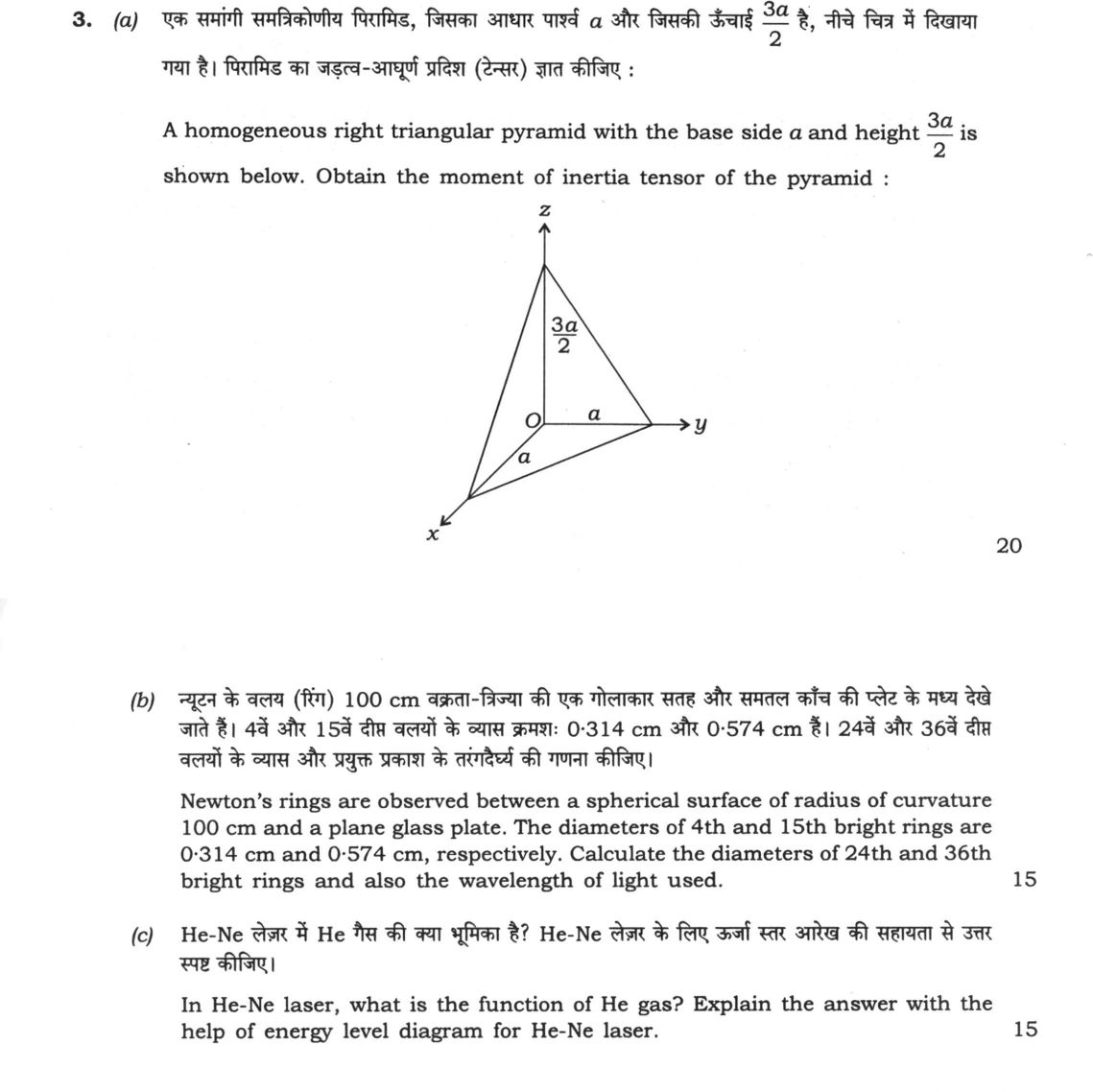
The figure this question refers to, in words
The question paper is a scan and the diagram did not survive as text. This is the figure as read from the original page — every component, value and label — so the question can be worked from the text below.
(a) A 3D Cartesian coordinate system with origin O. A right triangular pyramid is positioned with its apex at the origin O. The base of the pyramid lies in the x-y plane. The base is a right-angled triangle with the right angle at the origin O. One leg of the base triangle lies along the positive x-axis with length labeled 'a'. The other leg lies along the positive y-axis with length labeled 'a'. The third side of the base connects the points (a, 0, 0) and (0, a, 0). The height of the pyramid extends from the origin O along the positive z-axis to the apex, with the length labeled '3a/2'. The edges of the pyramid connect the apex on the z-axis to the vertices of the base triangle.
Model answer
Written by UPSC Answer Check against this question's marking rubric, to the expected length. UPSC does not publish answers for Mains — this is one way to score well, not an official key.
(a) The standard moment of inertia tensor is about the centre of mass. From the figure the tetrahedron has vertices O(0,0,0), A(a,0,0), B(0,a,0), C(0,0,3a/2); put h=3a/2. Its volume is V=a²h/6=a³/4, so for mass M the density is ρ=4M/a³. The centroid of a tetrahedron is the average of its vertices, r₀=(O+A+B+C)/4=(a/4,a/4,3a/8). The same simplex formula with p=1 and q=r=0 gives ∫x dV=aV/4, and similarly for y and z, confirming the centroid.
For the simplex x,y,z≥0, x/a+y/a+z/h≤1, set X=x/a, Y=y/a, Z=z/h. Dirichlet's simplex integral, valid for non-negative integers p,q,r, is obtained by integrating Z first over 0 to 1-X-Y: ∫ x^p y^q z^r dV = a^(p+1) a^(q+1) h^(r+1) times the integral over the unit simplex of X^p Y^q Z^r dX dY dZ. The Z integral gives (1-X-Y)^(r+1)/(r+1). Then ∫ from 0 to 1-X of Y^q (1-X-Y)^(r+1) dY = (1-X)^(q+r+2) q!(r+1)!/(q+r+2)!, and ∫ from 0 to 1 of X^p (1-X)^(q+r+2) dX = p!(q+r+2)!/(p+q+r+3)!. Multiplying by 1/(r+1) gives p!q!r!/(p+q+r+3)!. The hypotheses are met here because the pyramid is exactly this simplex and the required exponents are 0, 1 and 2. Hence ∫x²dV=∫y²dV=a⁴h/60=a⁵/40, ∫z²dV=a²h³/60=9a⁵/160, ∫xy dV=a⁴h/120=a⁵/80, ∫xz dV=∫yz dV=a³h²/120=3a⁵/160.
About O, using Ixx=∫(y²+z²)dm and Ixy=-∫xy dm: Ixx(O)=Iyy(O)=ρ(∫y²+∫z²)=13Ma²/40, Izz(O)=ρ(∫x²+∫y²)=Ma²/5, Ixy(O)=-ρ∫xy=-Ma²/20, Ixz(O)=Iyz(O)=-ρ∫xz=-3Ma²/40.
The tensor parallel-axis theorem is I(O)=I(CM)+M[(r₀·r₀)1-r₀r₀ᵀ], so I(CM)=I(O)-M[(r₀·r₀)1-r₀r₀ᵀ]. Here r₀·r₀=17a²/64. Componentwise, Ixx(CM)=Ixx(O)-M(17a²/64-a²/16)=Ma²(13/40-13/64)=39Ma²/320, Iyy(CM)=39Ma²/320, Izz(CM)=Izz(O)-M(17a²/64-9a²/64)=Ma²(1/5-1/8)=3Ma²/40, Ixy(CM)=Ixy(O)+M(a/4)(a/4)=Ma²(-1/20+1/16)=Ma²/80, Ixz(CM)=Iyz(CM)=Ixz(O)+M(a/4)(3a/8)=Ma²(-3/40+3/32)=3Ma²/160.
I(CM)=Ma²[[39/320,1/80,3/160],[1/80,39/320,3/160],[3/160,3/160,3/40]], with units kg m² if M is in kg and a in m. As a check, the trace about O is 17Ma²/20 and the trace about CM is 51Ma²/160; their difference is 17Ma²/32=2M(r₀·r₀), as the parallel-axis theorem requires. The matrix is symmetric and positive definite; the off-diagonal magnitudes are small compared with the diagonal entries.
(b) The air film has refractive index μ=1. For paraxial rays the film thickness is t=t₀+r²/(2R), where t₀ is any small central thickness or counting offset. The sagitta of a sphere is t=R-sqrt(R²-r²); for r≪R this becomes r²/(2R), and here the largest radius is below 0.44 cm while R=100 cm, so the approximation is excellent. In reflected light one reflection has a phase reversal, so the nth bright ring, with n=1 for the first bright ring, satisfies 2μ(t₀+r²/(2R))=(n-1/2)λ. Therefore Dₙ²=4r²=4(n-1/2)λR/μ+C, where C is a constant. C absorbs any central gap, dust, or mislabelling of the first bright ring; it is not needed because two diameters are given. If the ideal contact formula without C were forced through both given diameters, it would give different wavelengths, about 704 nm from D₄ and 568 nm from D₁₅; hence the constant term is essential for this data. The important point is that Dₙ² is linear in n with slope 4λR/μ; the same slope is obtained for transmitted bright rings, so the difference method is robust.
Given D₄=0.314 cm and D₁₅=0.574 cm, D₄²=0.098596 cm², D₁₅²=0.329476 cm². Thus s=(D₁₅²-D₄²)/(15-4)=0.230880/11=0.0209891 cm² per ring. Since s=4λR/μ and μ=1, R=100 cm, λ=s/(4R)=0.0209891/400=5.2473×10⁻⁵ cm=524.7 nm. Then D₂₄²=D₄²+(24-4)s=0.098596+20(0.0209891)=0.518378 cm², so D₂₄=0.720 cm. D₃₆²=D₄²+(36-4)s=0.098596+32(0.0209891)=0.770247 cm², so D₃₆=0.878 cm. Using D₁₅ instead of D₄ gives the same values: D₂₄²=0.329476+9s and D₃₆²=0.329476+21s. λ=5.247×10⁻⁵ cm (524.7 nm).
(c) In a He-Ne laser the He gas is not the main lasing species; it is the collisional pump medium. The electrical discharge excites He atoms efficiently because He has favourable excitation cross-sections and long-lived metastable states. The 2¹S₀ and 2³S₁ states are metastable because the one-photon electric-dipole transitions to the ground state are forbidden or highly forbidden, so they survive long enough for collisions. The gas is usually a He-Ne mixture with high He pressure and low Ne pressure, so He metastables are abundant and Ne levels are not strongly quenched. These metastable He atoms collide with Ne atoms and transfer their energy resonantly to the upper Ne laser levels. Ne has closely spaced levels, and the 5s and 3s levels lie almost exactly at the He metastable energies, making transfer efficient. The lower Ne levels are not directly pumped by the discharge and are rapidly depopulated by collisions and radiative transitions, so the upper level remains more populated than the lower level and stimulated emission gives net gain. Thus He converts electrical energy into metastable atomic energy and then into a Ne population inversion.
Energy ↑
- 20.6 eV: Ne 5s ← He 2¹S₀ (20.62 eV)
- 19.8 eV: Ne 3s ← He 2³S₁ (19.82 eV)
- 18.7 eV: Ne 3p (lower laser level)
- 16.8 eV: Ne 2p
- 0 eV: Ne ground, He ground
Collisional transfer: He* + Ne → He + Ne*. Laser transition: Ne 5s ↓ Ne 3p, 632.8 nm. The near-resonant transfers are He 2¹S₀ + Ne → He + Ne 5s and He 2³S₁ + Ne → He + Ne 3s. After the 5s→3p laser transition, Ne 3p decays to 2p and then to ground, so the lower level does not accumulate population. Because the 5s level is populated faster than the 3p level, the 5s→3p transition is the principal visible He-Ne laser line.
What "Derive" is asking you to do
Reach the stated expression from a starting relation, justifying every step. The destination is printed in the question, so only the route earns marks, and the assumptions you work under are part of that route.
Structure that answers it
Assumptions and notation defined → starting relation or governing equation → each step with its justification → the required expression → limiting case or boundary check
Where marks are lost
Writing the standard result first and fitting three lines to it, which an examiner reads at a glance. Marks also go on assumptions left unstated — lossless medium, small amplitude, errors independent with zero mean — and on symbols used before they are defined, even when the question says usual notations.
How this answer will be evaluated
Approach
(a) derive: given > assumptions > stepwise derivation > result > check | (b) calculate: given > formula > substitution > result with units > interpretation | (c) explain: definition/context > points in order > small example > short close Full marks: Complete derivations/calculations with correct units and physical interpretation.
Key points expected
- Define volume element and integration limits
- Calculate mass M in terms of a and density
- Compute diagonal terms Ixx, Iyy, Izz
- Compute off-diagonal terms Ixy, Ixz, Iyz
- State formula for bright ring diameter
- Use given data to find wavelength
- Calculate diameter for 24th ring
- Calculate diameter for 36th ring
Evaluation rubric
Each sub-part is marked on its own, against the marks and word limit printed on the paper.
- (a) Derive the moment of inertia tensor for the specified triangular pyramid. 20 marks
derive— given → assumptions → stepwise derivation → result → check
Must cover
- Define volume element and integration limits
- Calculate mass M in terms of a and density
- Compute diagonal terms Ixx, Iyy, Izz
- Compute off-diagonal terms Ixy, Ixz, Iyz
Loses marks
- Assumes Ixy=0 without justification
- Incorrect integration limits for z
- Missing mass calculation step
Earns more
- Correctly identifies symmetry for zero terms
- Uses standard integration for triangular base
- Verifies dimensions of final tensor
Extra mark
- States physical interpretation of tensor components
- (b) Calculate diameters of 24th and 36th rings and the wavelength of light. 15 marks
calculate— given → formula → substitution → result with units → interpretation
Must cover
- State formula for bright ring diameter
- Use given data to find wavelength
- Calculate diameter for 24th ring
- Calculate diameter for 36th ring
Loses marks
- Confuses bright and dark ring formulas
- Arithmetic errors in substitution
- Missing units in final answers
Earns more
- Correct unit conversion (cm to m)
- Shows intermediate calculation steps
- Checks consistency of results
Extra mark
- Mentions experimental error sources
- (c) Explain the function of He gas in He-Ne laser with energy level diagram. 15 marks
explain— definition/context → points in order → small example → short close
Must cover
- Draw labelled energy level diagram
- Explain He-Ne collisional excitation
- Describe population inversion mechanism
- Identify metastable state of Ne
Loses marks
- Diagram missing or unlabelled
- Confuses He and Ne roles
- No mention of metastable state
Earns more
- Mentions specific energy levels (e.g., 20.6 eV)
- Explains why He is used (efficiency)
- Describes the 632.8 nm transition
Extra mark
- Mentions other He-Ne laser lines
Practice this exact question
Write your answer and it is marked point by point against the model answer above — what you covered, what you missed, what you got wrong.
Evaluate my answer →More from Physics 2022 Paper I
- Q1 An electron is moving under the influence of a point nucleus of atomic number Z. Show tha…
- Q2 Consider two frames of reference S and S' having a common origin O. The frame S' is rotat…
- Q3 (a) A homogeneous right triangular pyramid with the base side a and height 3a/2 is shown…
- Q4 (a) Consider the diagram below with a water flow rate Q. Derive the expression for Q in t…
- Q5 (a) Assume that the Earth's atmosphere is pure nitrogen in thermodynamic equilibrium at a…
- Q6 (a) Write down Maxwell's equations in a non-conducting medium with constant permeability…