Paper I — Q2
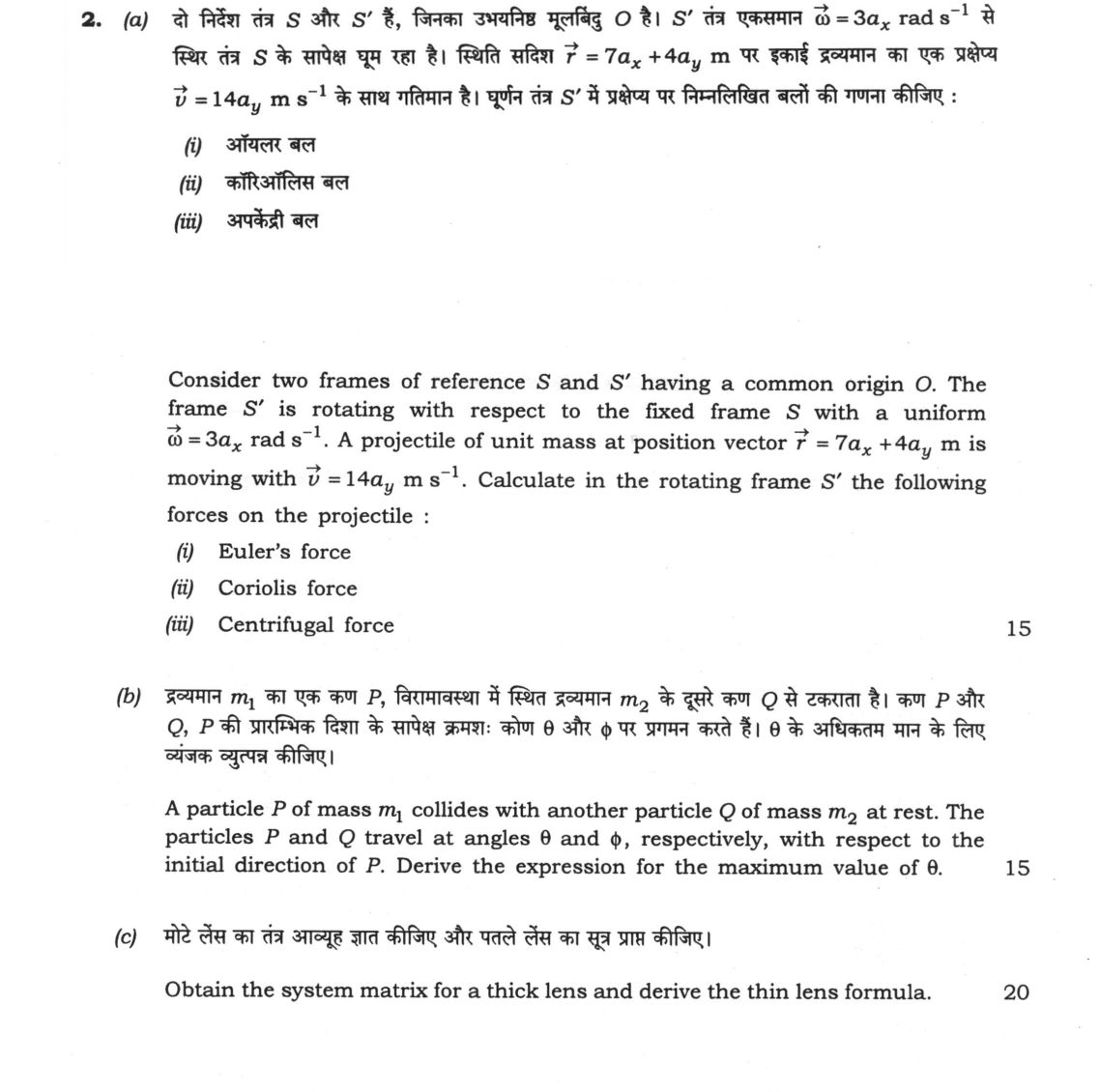
Consider two frames of reference S and S' having a common origin O. The frame S' is rotating with respect to the fixed frame S…
Consider two frames of reference S and S' having a common origin O. The frame S' is rotating with respect to the fixed frame S with a uniform ω⃗ = 3aₓ rad s⁻¹. A projectile of unit mass at position vector r⃗ = 7aₓ + 4aᵧ m is moving with v⃗ = 14aᵧ m s⁻¹. Calculate in the rotating frame S' the following forces on the projectile:
Euler's force
Coriolis force
Centrifugal force
15 marks
A particle P of mass m₁ collides with another particle Q of mass m₂ at rest. The particles P and Q travel at angles θ and φ, respectively, with respect to the initial direction of P. Derive the expression for the maximum value of θ. 15 marks
Obtain the system matrix for a thick lens and derive the thin lens formula. 20 marks
हिंदी में प्रश्न पढ़ें
दो निर्देश तंत्र S और S′ हैं, जिनका उभयनिष्ठ मूलबिंदु O है। S′ तंत्र एकसमान ω⃗ = 3aₓ rad s⁻¹ से स्थिर तंत्र S के सापेक्ष घूम रहा है। स्थिति सदिश r⃗ = 7aₓ + 4aᵧ m पर इकाई द्रव्यमान का एक प्रक्षेप्य v⃗ = 14aᵧ m s⁻¹ के साथ गतिमान है। घूर्णन तंत्र S′ में प्रक्षेप्य पर निम्नलिखित बलों की गणना कीजिए:
ऑयलर बल
कोरिऑलिस बल
अपकेन्द्री बल
15 अंक
द्रव्यमान m₁ का एक कण P, विरामावस्था में स्थित द्रव्यमान m₂ के दूसरे कण Q से टकराता है। कण P और Q, P की प्रारंभिक दिशा के सापेक्ष क्रमशः कोण θ और φ पर प्रगमन करते हैं। θ के अधिकतम मान के लिए व्यंजक व्युत्पन्न कीजिए। 15 अंक
मोटे लेंस का तंत्र आव्यूह ज्ञात कीजिए और पतले लेंस का सूत्र प्राप्त कीजिए। 20 अंक
Model answer
Written by UPSC Answer Check against this question's marking rubric, to the expected length. UPSC does not publish answers for Mains — this is one way to score well, not an official key.
(a) Rotating frame S′
Take m = 1 kg. The fictitious force in S′ is F = -m (dω⃗/dt × r⃗) - 2m (ω⃗ × v⃗′) - m [ω⃗ × (ω⃗ × r⃗)] where ω⃗ = 3aₓ rad s⁻¹, r⃗ = 7aₓ + 4aᵧ m. Taking v⃗′ = 14aᵧ m s⁻¹ as the velocity in S′:
(i) Euler force dω⃗/dt = 0 because ω⃗ is uniform. Hence F_E = 0 N.
(ii) Coriolis force F_C = -2m (ω⃗ × v⃗′) = -2(1)(3aₓ × 14aᵧ) = -84a_z N. F_C = -84a_z N.
(iii) Centrifugal force ω⃗ × r⃗ = 3aₓ × (7aₓ + 4aᵧ) = 12a_z m s⁻¹. ω⃗ × (ω⃗ × r⃗) = 3aₓ × 12a_z = -36aᵧ m s⁻². F_cf = -1(-36aᵧ) = 36aᵧ N. F_cf = 36aᵧ N.
If the given v⃗ = 14aᵧ m s⁻¹ is instead the fixed-frame velocity, then v⃗′ = v⃗ - ω⃗ × r⃗ = 14aᵧ - 12a_z m s⁻¹, and F_C = -84a_z - 72aᵧ N; F_E and F_cf are unchanged.
(b) Maximum angle θ in elastic collision
Assume a perfectly elastic collision. Let the initial speed of P be u along the x-axis, and Q be at rest.
Centre-of-mass velocity: V = m1 u/(m1+m2) along x.
Initial CM velocity of P: u′ = u - V = m2 u/(m1+m2) along x.
For an elastic collision, the CM speed of P is unchanged, so after collision its CM velocity has magnitude R = m2 u/(m1+m2).
The lab velocity of P is v1 = V + v_cm. Therefore the tip of v1 lies on a circle of radius R centred at V on the x-axis. The lab angle θ is the angle of the resultant from the origin.
Maximum θ occurs when the resultant is tangent to this circle. Then sin θ_max = R/V = (m2 u/(m1+m2))/(m1 u/(m1+m2)) = m2/m1.
This is valid when R ≤ V, i.e. m2 ≤ m1. Thus:
- If m1 ≥ m2, θ_max = sin⁻¹(m2/m1)
- If m1 < m2, the origin lies inside the circle, so θ can reach π: θ_max = π. At m1 = m2, both give θ_max = π/2.
(c) Thick lens system matrix and thin lens formula
Use ray vector [y, θ]^T. Light travels left to right; y is height, θ is small angle to axis. Radius R is positive if the centre of curvature is to the right of the surface. Let the lens refractive index be n, surrounding medium air (n=1), thickness t, surface radii R1 and R2.
Refraction matrix at a spherical surface separating n1 and n2: S = [ [1, 0], [-(n2 - n1)/(n2 R), n1/n2] ].
First surface: n1=1, n2=n, radius R1: S1 = [ [1, 0], [-(n-1)/(n R1), 1/n] ].
Propagation through thickness t in the lens: P = [ [1, t], [0, 1] ].
Second surface: n1=n, n2=1, radius R2: S2 = [ [1, 0], [(n-1)/R2, n] ].
The system matrix from just before the first surface to just after the second surface is M = S2 P S1. Multiplying: M = [ [1 - t(n-1)/(n R1), t/n], [-(n-1)(1/R1 - 1/R2) - t(n-1)²/(n R1 R2), 1 + t(n-1)/(n R2)] ].
Equivalently, writing M21 = -Φ, M = [ [1 - t(n-1)/(n R1), t/n], [-Φ, 1 + t(n-1)/(n R2)] ], where Φ = (n-1)(1/R1 - 1/R2) + t(n-1)²/(n R1 R2).
For a thin lens, t → 0. Then M_thin = [ [1, 0], [-(n-1)(1/R1 - 1/R2), 1] ] = [ [1, 0], [-1/f, 1] ], so the lens-maker formula is 1/f = (n-1)(1/R1 - 1/R2).
To derive the thin-lens equation, place an object at distance u to the left and image at distance v to the right. The total matrix from object to image is M_tot = [ [1, v], [0, 1] ] [ [1, 0], [-1/f, 1] ] [ [1, u], [0, 1] ].
Its off-diagonal element is u + v - uv/f. For a sharp image, all rays from the object point must meet at the same image point, so M_tot(1,2) = 0. Hence u + v - uv/f = 0 or 1/u + 1/v = 1/f. This is the thin lens formula. For a converging lens, f > 0; for a diverging lens, f < 0.
What "Calculate" is asking you to do
Apply the standard formula or schedule to data the question has already supplied — a table of readings, cost records, a balance sheet — and produce the number. The method is rarely in doubt; the marks sit in the named intermediate quantities, each of which has to appear as a labelled line.
Structure that answers it
Data as given → formula or standard treatment, named → substitution → each intermediate, labelled → result with units
Where marks are lost
Omitting an intermediate the marking scheme pays for separately, or rounding at an intermediate line so the final figure drifts. In commerce and accountancy, any figure in a statement that no numbered working note supports is treated as unearned.
How this answer will be evaluated
Approach
Framework: Principle > Setup and diagram > Derivation > Result and limiting case. (a) calculate: given > formula > substitution > result with units > interpretation | (b) derive: given > assumptions > stepwise derivation > result > check | (c) derive: given > assumptions > stepwise derivation > result > check Full marks: Complete derivations with correct units, clear diagrams, and physical interpretation
Key points expected
- State given vectors r, v, and omega with units
- Identify Euler force as zero due to uniform omega
- Calculate Coriolis force using -2m(omega x v)
- Calculate centrifugal force using -m(omega x (omega x r))
- Apply conservation of momentum in x and y directions
- Apply conservation of kinetic energy for elastic collision
- Eliminate final velocities to relate theta and phi
- Derive sin(theta_max) = m2/m1
Evaluation rubric
Each sub-part is marked on its own, against the marks and word limit printed on the paper.
- (a) Compute Euler, Coriolis, and centrifugal forces in the rotating frame S'. 15 marks
calculate— given → formula → substitution → result with units → interpretation
Must cover
- State given vectors r, v, and omega with units
- Identify Euler force as zero due to uniform omega
- Calculate Coriolis force using -2m(omega x v)
- Calculate centrifugal force using -m(omega x (omega x r))
Loses marks
- Missing units in final force values
- Incorrect cross-product sign convention
- Treating Euler force as non-zero
Earns more
- Correct vector cross-product evaluation
- Final answers in N with correct sign/direction
- Explicit statement of unit mass m=1 kg
Extra mark
- Physical interpretation of force directions
- (b) Derive the expression for the maximum scattering angle theta. 15 marks
derive— given → assumptions → stepwise derivation → result → check
Must cover
- Apply conservation of momentum in x and y directions
- Apply conservation of kinetic energy for elastic collision
- Eliminate final velocities to relate theta and phi
- Derive sin(theta_max) = m2/m1
Loses marks
- Skipping energy conservation step
- Incorrect vector decomposition of momenta
- No derivation, only final formula
Earns more
- Labelled diagram of collision geometry
- Explicit assumption of elastic collision
- Discussion of m1 < m2 case
Extra mark
- Physical interpretation of maximum angle limit
- (c) Obtain system matrix for thick lens and derive thin lens formula. 20 marks
derive— given → assumptions → stepwise derivation → result → check
Must cover
- Define ray vector and system matrix concept
- Write matrices for refraction and translation
- Multiply matrices to get thick lens system matrix
- Apply thin lens limit to derive 1/v - 1/u = 1/f
Loses marks
- Incorrect matrix element definitions
- Skipping matrix multiplication steps
- No derivation of thin lens formula
Earns more
- Correct matrix multiplication steps shown
- Clear definition of focal length from matrix
- Explicit statement of thin lens approximation
Extra mark
- Physical interpretation of matrix elements
Practice this exact question
Write your answer and it is marked point by point against the model answer above — what you covered, what you missed, what you got wrong.
Evaluate my answer →More from Physics 2022 Paper I
- Q1 An electron is moving under the influence of a point nucleus of atomic number Z. Show tha…
- Q2 Consider two frames of reference S and S' having a common origin O. The frame S' is rotat…
- Q3 (a) A homogeneous right triangular pyramid with the base side a and height 3a/2 is shown…
- Q4 (a) Consider the diagram below with a water flow rate Q. Derive the expression for Q in t…
- Q5 (a) Assume that the Earth's atmosphere is pure nitrogen in thermodynamic equilibrium at a…