Paper II — Q1
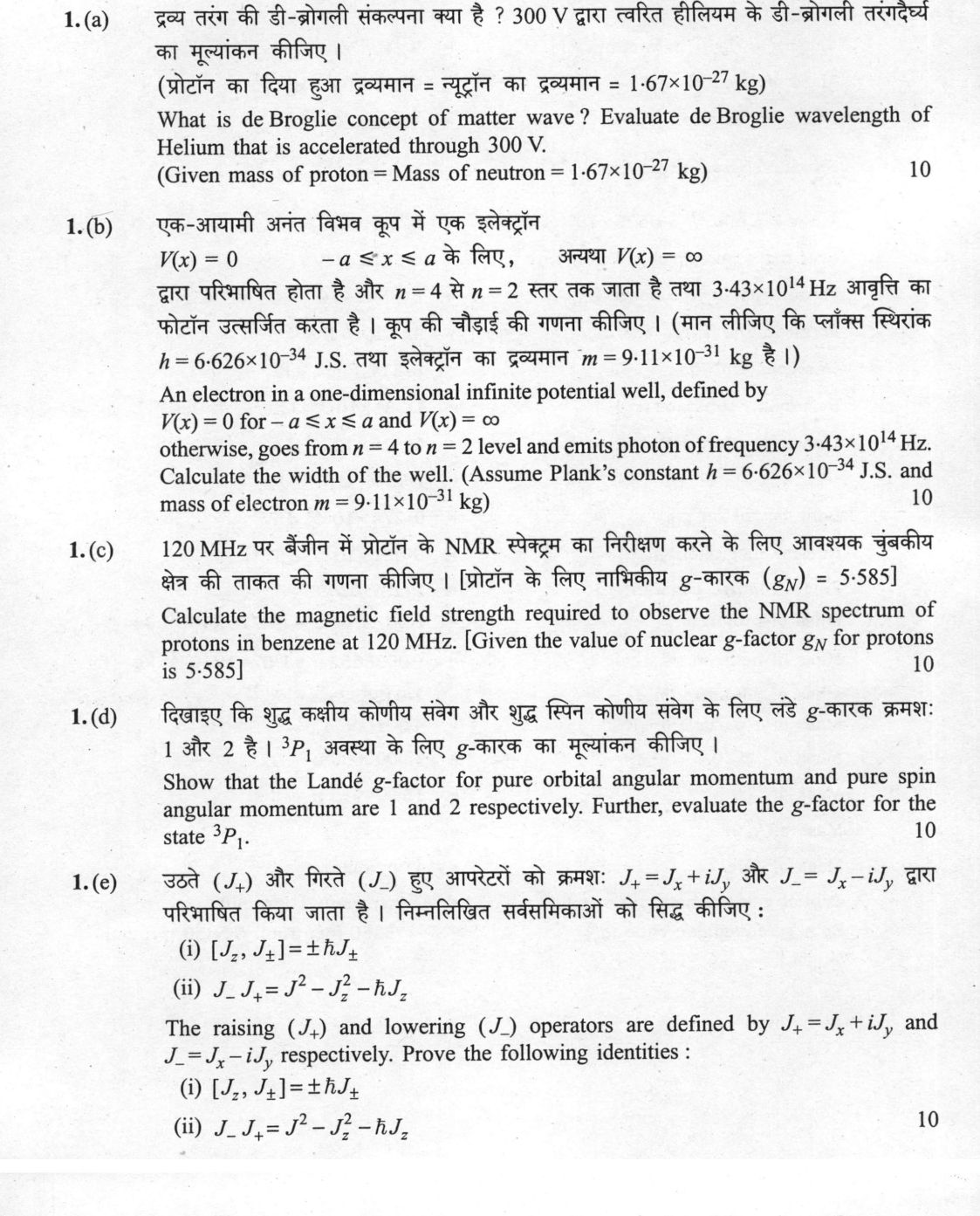
(a) What is de Broglie concept of matter wave ? Evaluate de Broglie wavelength of Helium that is accelerated through 300…
What is de Broglie concept of matter wave ? Evaluate de Broglie wavelength of Helium that is accelerated through 300 V. (Given mass of proton = Mass of neutron = 1·67×10⁻²⁷ kg) 10 marks
An electron in a one-dimensional infinite potential well, defined by V(x) = 0 for -a ≤ x ≤ a and V(x) = ∞ otherwise, goes from n = 4 to n = 2 level and emits photon of frequency 3·43×10¹⁴ Hz. Calculate the width of the well. (Assume Plank's constant h = 6·626×10⁻³⁴ J.S. and mass of electron m = 9·11×10⁻³¹ kg) 10 marks
Calculate the magnetic field strength required to observe the NMR spectrum of protons in benzene at 120 MHz. [Given the value of nuclear g-factor gₙ for protons is 5·585] 10 marks
Show that the Landé g-factor for pure orbital angular momentum and pure spin angular momentum are 1 and 2 respectively. Further, evaluate the g-factor for the state ³P₁. 10 marks
The raising (J₊) and lowering (J₋) operators are defined by J₊ = Jₓ + iJᵧ and J₋ = Jₓ - iJᵧ respectively. Prove the following identities : [Jᵤ, J₊] = ±ℏJ₊
J₋J₊ = J² - Jᵤ² - ℏJᵤ 10 marks
हिंदी में प्रश्न पढ़ें
द्रव्य तरंग की डी-ब्रोगली संकल्पना क्या है ? 300 V द्वारा त्वरित हीलियम के डी-ब्रोगली तरंगदैर्घ्य का मूल्यांकन कीजिए । (प्रोटॉन का दिया हुआ द्रव्यमान = न्यूट्रॉन का द्रव्यमान = 1·67×10⁻²⁷ kg) 10 अंक
एक-आयामी अनंत विभव कूप में एक इलेक्ट्रॉन V(x) = 0 -a ≤ x ≤ a के लिए, अन्यथा V(x) = ∞ द्वारा परिभाषित होता है और n = 4 से n = 2 स्तर तक जाता है तथा 3·43×10¹⁴ Hz आवृत्ति का फोटॉन उत्सर्जित करता है । कूप की चौड़ाई की गणना कीजिए । (मान लीजिए कि प्लांक स्थिरांक h = 6·626×10⁻³⁴ J.S. तथा इलेक्ट्रॉन का द्रव्यमान m = 9·11×10⁻³¹ kg है ।) 10 अंक
120 MHz पर बेंजीन में प्रोटॉन के NMR स्पेक्ट्रम का निरीक्षण करने के लिए आवश्यक चुंबकीय क्षेत्र की ताकत की गणना कीजिए । [प्रोटॉन के लिए नाभिकीय g-कारक (gₙ) = 5·585] 10 अंक
दिखाइए कि शुद्ध कक्षीय कोणीय संवेग और शुद्ध स्पिन कोणीय संवेग के लिए लैंडे g-कारक क्रमशः: 1 और 2 हैं । ³P₁ अवस्था के लिए g-कारक का मूल्यांकन कीजिए । 10 अंक
उत्तरे (J₊) और गिरते (J₋) हुए ऑपरेटरों को क्रमशः: J₊ = Jₓ + iJᵧ और J₋ = Jₓ - iJᵧ द्वारा परिभाषित किया जाता है । निम्नलिखित सर्वसमिकाओं को सिद्ध कीजिए : [Jᵤ, J₊] = ±ℏJ₊
J₋J₊ = J² - Jᵤ² - ℏJᵤ 10 अंक
Model answer
Written by UPSC Answer Check against this question's marking rubric, to the expected length. UPSC does not publish answers for Mains — this is one way to score well, not an official key.
(a) de Broglie’s matter-wave concept: every moving material particle has a wave associated with it. The wavelength is λ = h/p, where p is the particle momentum and h = 6.626×10⁻³⁴ J s is Planck’s constant. The wave is not a mechanical wave; its amplitude is related to the probability of finding the particle. The group velocity of the matter wave equals the particle velocity, while the phase velocity is c²/v.
For a charged particle accelerated electrostatically through potential V, kinetic energy is qV = p²/(2m), so p = √(2mqV). Thus λ = h/√(2mqV).
A neutral helium atom cannot be accelerated through V. Interpreting Helium as singly ionized helium He⁺, mass m≈4m_p and charge q=e. Given m_p=m_n=1.67×10⁻²⁷ kg, m = 4×1.67×10⁻²⁷ = 6.68×10⁻²⁷ kg, q = 1.602×10⁻¹⁹ C, V = 300 V.
Then 2mqV = 2×(6.68×10⁻²⁷ kg)×(1.602×10⁻¹⁹ C)×(300 V) = 6.4208×10⁻⁴³ kg² m² s⁻², so p = √(6.4208×10⁻⁴³) = 8.013×10⁻²² kg m s⁻¹.
Hence λ = (6.626×10⁻³⁴ J s)/(8.013×10⁻²² kg m s⁻¹) = 8.27×10⁻¹³ m = 0.827 pm.
If the bare helium nucleus He²⁺ (alpha particle) is intended, q=2e, so p is √2 times larger, and λ = 5.85×10⁻¹³ m = 0.585 pm. Kinetic energy is 300 eV or 600 eV, much smaller than the helium rest energy ≈3.73 GeV, so the non-relativistic formula is valid.
(b) For an infinite one-dimensional well, the particle is confined to -a≤x≤a. Therefore the full width is L=2a. The time-independent Schrödinger equation inside the well is -(ℏ²/2m)d²ψ/dx² = Eψ, with ψ(-a)=ψ(a)=0. The allowed wave numbers are k_n = nπ/L, n=1,2,3,... so the energy levels are E_n = ℏ²k_n²/(2m) = n²h²/(8mL²).
For the transition n=4→n=2, hν = E₄-E₂ = (16-4)h²/(8mL²) = 12h²/(8mL²) = 3h²/(2mL²). Therefore L² = 3h/(2mν).
Substitute h=6.626×10⁻³⁴ J s, m=9.11×10⁻³¹ kg, ν=3.43×10¹⁴ Hz: L² = [3×6.626×10⁻³⁴]/[2×9.11×10⁻³¹×3.43×10¹⁴] = 1.9878×10⁻³³ / 6.24946×10⁻¹⁶ = 3.18075×10⁻¹⁸ m². Thus L = √(3.18075×10⁻¹⁸) = 1.783×10⁻⁹ m.
So the width of the well is L=2a=1.78×10⁻⁹ m=1.78 nm. Equivalently, a=0.892 nm.
(c) For a proton in a magnetic field B, the nuclear magnetic moment is μ = gₙ μ_N I, where μ_N = eℏ/(2m_p) = 5.0508×10⁻²⁷ J/T is the nuclear magneton and gₙ=5.585. For proton spin I=1/2, the magnetic sublevels are m_I=±1/2. The energy separation is ΔE = gₙ μ_N B. The NMR photon frequency is ν = ΔE/h = gₙ μ_N B/h. Hence B = hν/(gₙ μ_N).
Given ν=120 MHz=1.20×10⁸ Hz, hν = (6.626×10⁻³⁴ J s)(1.20×10⁸ s⁻¹) = 7.9512×10⁻²⁶ J. Also, gₙ μ_N = 5.585×5.0508×10⁻²⁷ = 2.8209×10⁻²⁶ J/T. Therefore B = 7.9512×10⁻²⁶ / 2.8209×10⁻²⁶ = 2.82 T.
Thus the required magnetic field strength is 2.82 T (neglecting chemical shift).
(d) The Landé g-factor is obtained by projecting the total magnetic moment onto the total angular momentum J. For an electron, μ_L = -μ_B L/ℏ, μ_S = -2μ_B S/ℏ, with J=L+S. The effective g-factor is g_J = 3/2 + [S(S+1)-L(L+1)]/[2J(J+1)] or equivalently g_J = 1 + [J(J+1)+S(S+1)-L(L+1)]/[2J(J+1)].
Pure orbital angular momentum: S=0, J=L. Then g_J = 3/2 + [0-L(L+1)]/[2L(L+1)] = 3/2 - 1/2 = 1. So pure orbital motion gives g=1.
Pure spin angular momentum: L=0, J=S. Then g_J = 3/2 + [S(S+1)-0]/[2S(S+1)] = 3/2 + 1/2 = 2. So pure spin gives g=2.
For the state ³P₁: 2S+1=3 gives S=1, P gives L=1, and the subscript gives J=1. Thus g_J = 3/2 + [1(1+1)-1(1+1)]/[2×1(1+1)] = 3/2 + (2-2)/4 = 3/2.
Therefore the g-factor for ³P₁ is 3/2.
(e)(i) Use the angular-momentum commutation relations, writing Jᵤ for the component along the quantization axis: [J_x,J_y]=iℏJᵤ, [J_y,Jᵤ]=iℏJ_x, [Jᵤ,J_x]=iℏJ_y.
Given J₊ = J_x + iJ_y, J₋ = J_x - iJ_y. Then [Jᵤ,J₊] = [Jᵤ,J_x+iJ_y] = [Jᵤ,J_x] + i[Jᵤ,J_y]. Now [Jᵤ,J_x]=iℏJ_y and [Jᵤ,J_y]=-iℏJ_x. Hence [Jᵤ,J₊] = iℏJ_y + i(-iℏJ_x) = iℏJ_y + ℏJ_x = ℏ(J_x+iJ_y) = ℏJ₊.
Similarly, [Jᵤ,J₋] = [Jᵤ,J_x-iJ_y] = iℏJ_y - i(-iℏJ_x) = iℏJ_y - ℏJ_x = -ℏ(J_x-iJ_y) = -ℏJ₋. Thus [Jᵤ,J₊]=+ℏJ₊, [Jᵤ,J₋]=-ℏJ₋, or compactly [Jᵤ,J_±]=±ℏJ_±.
(e)(ii) Start from the product: J₋J₊ = (J_x-iJ_y)(J_x+iJ_y) = J_x² + iJ_xJ_y - iJ_yJ_x + J_y² = J_x² + J_y² + i[J_x,J_y]. Using [J_x,J_y]=iℏJᵤ, J₋J₊ = J_x² + J_y² + i(iℏJᵤ) = J_x² + J_y² - ℏJᵤ.
Since J² = J_x² + J_y² + Jᵤ², we have J_x² + J_y² = J² - Jᵤ². Therefore J₋J₊ = J² - Jᵤ² - ℏJᵤ.
Hence the identity is proved: J₋J₊ = J² - Jᵤ² - ℏJᵤ.
What "Solve" is asking you to do
Choose the method, then carry it through to a final answer. Identifying what kind of problem this is and why that method applies is the first thing marked; a correct figure arrived at invisibly earns almost nothing.
Structure that answers it
Given data and what is required → method chosen, with the reason it applies → set-up (equation, circuit, free body, trial balance) → working, step by step → answer with units and any condition of validity
Where marks are lost
Doing the middle steps mentally and writing only the result. In mathematics papers, a further loss comes from giving a decimal where the exact value in surds or fractions was wanted, or from skipping the justification a part explicitly asks for.
How this answer will be evaluated
Approach
(a) evaluate: criteria > evidence > balanced judgment | (b) calculate: given > formula > substitution > result with units > interpretation | (c) calculate: given > formula > substitution > result with units > interpretation | (d) evaluate: criteria > evidence > balanced judgment | (e) derive: given > assumptions > stepwise derivation > result > check Full marks: Complete derivations with correct units and physical interpretation
Key points expected
- State de Broglie relation λ = h/p
- Determine He mass from proton/neutron mass
- Relate kinetic energy to potential V
- Substitute values to find λ
- Write energy eigenvalues for well
- Relate ΔE to photon frequency
- Solve for width parameter a
- Substitute constants correctly
Evaluation rubric
Each sub-part is marked on its own, against the marks and word limit printed on the paper.
- (a) Define matter wave and calculate de Broglie wavelength for He atom. 10 marks
evaluate— criteria → evidence → balanced judgment
Must cover
- State de Broglie relation λ = h/p
- Determine He mass from proton/neutron mass
- Relate kinetic energy to potential V
- Substitute values to find λ
Loses marks
- Using electron mass for Helium
- Omitting derivation of p from V
Earns more
- Mention wave-particle duality
- Show unit conversion for mass
Extra mark
- Compare with electron wavelength
- (b) Determine width of infinite potential well from transition frequency. 10 marks
calculate— given → formula → substitution → result with units → interpretation
Must cover
- Write energy eigenvalues for well
- Relate ΔE to photon frequency
- Solve for width parameter a
- Substitute constants correctly
Loses marks
- Using wrong energy level formula
- Confusing width 2a with a
Earns more
- Explicitly state boundary conditions
- Check dimensional consistency
Extra mark
- Sketch potential well diagram
- (c) Find magnetic field strength for proton NMR at 120 MHz. 10 marks
calculate— given → formula → substitution → result with units → interpretation
Must cover
- State NMR resonance condition
- Use given g-factor for protons
- Rearrange for magnetic field B
- Substitute frequency and constants
Loses marks
- Using wrong g-factor value
- Ignoring nuclear magneton
Earns more
- Mention Larmor frequency
- Show unit consistency
Extra mark
- Note field strength in Tesla
- (d) Show g-factors for pure L and S, then find g for ³P₁. 10 marks
evaluate— criteria → evidence → balanced judgment
Must cover
- Derive g_L = 1 for orbital
- Derive g_S = 2 for spin
- Apply Landé formula for ³P₁
- Calculate final g-factor value
Loses marks
- Using wrong term symbol
- Arithmetic error in Landé formula
Earns more
- State total angular momentum J
- Show intermediate steps clearly
Extra mark
- Mention Hund's rules
- (e) Prove commutation relations for J₊ and J₋ operators. 10 marks
derive— given → assumptions → stepwise derivation → result → check
Must cover
- Use angular momentum commutators
- Expand J₊ and J₋ definitions
- Prove [J_z, J₊] = ±ℏJ₊
- Derive J₋J₊ = J² - J_z² - ℏJ_z
Loses marks
- Skipping intermediate steps
- Incorrect sign in commutator
Earns more
- Show step-by-step algebra
- State assumptions clearly
Extra mark
- Mention physical significance
Practice this exact question
Write your answer and it is marked point by point against the model answer above — what you covered, what you missed, what you got wrong.
Evaluate my answer →More from Physics 2022 Paper II
- Q1 (a) What is de Broglie concept of matter wave ? Evaluate de Broglie wavelength of Helium…
- Q2 (a) Set up the Schrodinger's wave equation for one dimensional potential barrier and obta…
- Q3 (a) What is the spin wave function (for s=1/2) if the spin component in the direction of…
- Q4 (a) (i) In a diatomic molecule when one constituent atom is replaced by one of its heavie…