Paper II — Q7
(a) Explain the drawbacks of Einstein's theory of specific heat and how it was overcome by Debye. 20 marks (b) A neutron and a…
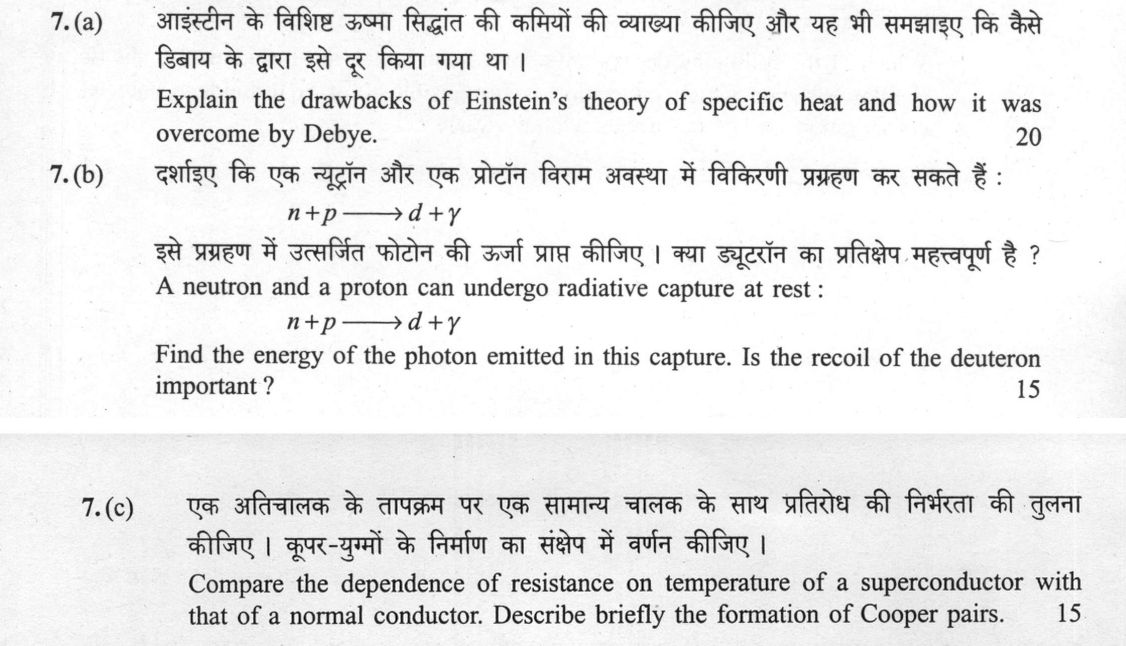
Explain the drawbacks of Einstein's theory of specific heat and how it was overcome by Debye. 20 marks
A neutron and a proton can undergo radiative capture at rest: n + p → d + γ Find the energy of the photon emitted in this capture. Is the recoil of the deuteron important? 15 marks
Compare the dependence of resistance on temperature of a superconductor with that of a normal conductor. Describe briefly the formation of Cooper pairs. 15 marks
हिंदी में प्रश्न पढ़ें
आइंस्टीन के विशिष्ट ऊष्मा सिद्धांत की कमियों की व्याख्या कीजिए और यह भी समझाइए कि कैसे डिबाय के द्वारा इसे दूर किया गया था। 20
दर्शाइए कि एक न्यूट्रॉन और एक प्रोटॉन विराम अवस्था में विकिरणी प्रग्रहण कर सकते हैं: n + p → d + γ इसे प्रग्रहण में उत्सर्जित फोटॉन की ऊर्जा प्राप्त कीजिए। क्या ड्यूटरॉन का प्रतिक्षेप महत्वपूर्ण है? 15 marks
एक अतिचालक के तापक्रम पर एक सामान्य चालक के साथ प्रतिरोध की निर्भरता की तुलना कीजिए। कूपर-युग्मों के निर्माण का संक्षेप में वर्णन कीजिए। 15
Model answer
Written by UPSC Answer Check against this question's marking rubric, to the expected length. UPSC does not publish answers for Mains — this is one way to score well, not an official key.
The failure of classical physics to explain the temperature dependence of specific heat, and its partial repair by Einstein, marks the entry of quantum ideas into condensed matter. Debye completed this repair, while the same quantum logic later explains radiative capture and superconductivity.
Einstein's theory and its drawbacks
Einstein treated each atom in a solid as an independent harmonic oscillator of the same frequency ν_E, with quantised energies nhν_E. Using Boltzmann statistics, the molar specific heat becomes
C_V = 3R (Θ_E/T)² e^(Θ_E/T) / (e^(Θ_E/T) − 1)²
This correctly gives C_V → 3R (Dulong–Petit) at high T, but at low T it falls exponentially, C_V ∝ e^(−Θ_E/T). Experimentally, C_V instead follows a T³ law. The drawback is the assumption of a single frequency and independent oscillators: in reality atomic vibrations are coupled, so a whole spectrum of collective modes exists, and low-frequency modes remain thermally excitable even at low T.
Debye's improvement
Debye treated the solid as a continuous elastic medium supporting collective vibrational modes (phonons) with a continuous frequency spectrum, cut off at ν_D to keep the total number of modes at 3N. The density of states is g(ν) ∝ ν², and the Debye temperature is Θ_D = hν_D/k_B. This yields
C_V = 9R (T/Θ_D)³ ∫₀^(Θ_D/T) x⁴eˣ/(eˣ−1)² dx
For T ≪ Θ_D, only low-frequency modes are excited, giving C_V ∝ T³, in agreement with experiment; for T ≫ Θ_D, the integral gives the Dulong–Petit value 3R. Debye's model thus removes the exponential fall-off, though it remains approximate at intermediate temperatures where the actual phonon spectrum is not strictly quadratic.
Photon energy in radiative capture
For n + p → d + γ at rest, conservation of energy–momentum gives the photon energy as the mass defect:
E_γ = [m_n + m_p − m_d]c² = B_d
Taking the deuteron binding energy B_d ≈ 2.224 MeV, the emitted photon has energy ≈ 2.224 MeV. The deuteron recoils to conserve momentum, with recoil energy
E_recoil = E_γ²/(2m_d c²) ≈ (2.224)²/(2 × 1875.6) MeV ≈ 1.3 keV
This is about 0.06% of E_γ, so the recoil is negligible and the photon energy is essentially the full binding energy.
Resistance versus temperature: normal conductor and superconductor
In a normal conductor, resistance rises with temperature because lattice vibrations (phonons) scatter electrons more strongly; ρ ∝ T for T > Θ_D and ρ ∝ T⁵ at low T. In a superconductor, resistance drops abruptly to zero below a critical temperature T_c, with a sharp transition rather than a gradual fall. Below T_c, electrons form Cooper pairs: an electron distorts the lattice, and a second electron of opposite momentum and spin is attracted via this phonon-mediated interaction, forming a bound state with an energy gap below the Fermi level. These pairs move without scattering, giving zero resistance, as described by BCS theory with a characteristic coherence length.
Thus, Einstein's quantised oscillators, Debye's collective phonon spectrum, nuclear mass-energy balance, and phonon-mediated Cooper pairing all illustrate how quantum effects govern condensed matter and nuclear phenomena alike.
What "Explain" is asking you to do
Make the working of something clear — what sets it off, what follows from what, and what it produces. Explain is the Commission's mechanism word: it dominates the technical papers and the “explain why” stems, where the marks sit in the causal chain and not in the label.
Structure that answers it
State what it is → the initiating condition → the chain of cause, step by step → an instance where it plays out → what the chain produces
Where marks are lost
Describing what something looks like instead of why it works that way. Naming the stages without linking them reads as description too.
How this answer will be evaluated
Approach
Framework: Principle > Setup and diagram > Derivation > Result and limiting case. (a) explain: definition/context > points in order > small example > short close | (b) calculate: given > formula > substitution > result with units > interpretation | (c) compare: paired headings or table > key differences > significance > conclusion Full marks: Complete derivations, correct units, physical interpretation, and clear diagrams.
Key points expected
- Einstein's assumption of independent oscillators
- Failure of Einstein model at low temperatures
- Debye's assumption of acoustic phonons
- Derivation of Debye T^3 law
- Conservation of energy and momentum
- Mass defect calculation (n+p-d)
- Recoil energy of deuteron
- Final photon energy with units
Evaluation rubric
Each sub-part is marked on its own, against the marks and word limit printed on the paper.
- (a) Drawbacks of Einstein's specific heat theory and Debye's solution. 20 marks
explain— definition/context → points in order → small example → short close
Must cover
- Einstein's assumption of independent oscillators
- Failure of Einstein model at low temperatures
- Debye's assumption of acoustic phonons
- Derivation of Debye T^3 law
Loses marks
- Formula substitution without derivation
- Ignoring the low-temperature limit
Earns more
- Comparison of Einstein and Debye curves
- Definition of Debye temperature
- Physical interpretation of phonon modes
Extra mark
- Graphical comparison of C_v vs T
- (b) Energy of photon in n+p capture and importance of recoil. 15 marks
calculate— given → formula → substitution → result with units → interpretation
Must cover
- Conservation of energy and momentum
- Mass defect calculation (n+p-d)
- Recoil energy of deuteron
- Final photon energy with units
Loses marks
- Ignoring momentum conservation
- Dropping units in final answer
Earns more
- Numerical value of binding energy
- Justification for neglecting recoil
- Dimensional check of energy terms
Extra mark
- Comparison of recoil energy to photon energy
- (c) Resistance vs temperature for superconductors vs normal conductors; Cooper pairs. 15 marks
compare— paired headings or table → key differences → significance → conclusion
Must cover
- Normal conductor R-T dependence
- Superconductor R-T dependence
- Critical temperature (Tc) concept
- Formation of Cooper pairs
Loses marks
- Confusing superconductor with perfect conductor
- Omitting the critical temperature
Earns more
- Bose-Einstein condensation analogy
- Energy gap in superconductors
- Role of phonon-mediated attraction
Extra mark
- BCS theory reference
Practice this exact question
Write your answer and it is marked point by point against the model answer above — what you covered, what you missed, what you got wrong.
Evaluate my answer →More from Physics 2022 Paper II
- Q4 (a) (i) In a diatomic molecule when one constituent atom is replaced by one of its heavie…
- Q5 (a) If the nuclear force is charge independent and a neutron and proton form a bound stat…
- Q6 (a) Show that for a specific value (n, l), there exists a large degeneracy relative to th…
- Q7 (a) Explain the drawbacks of Einstein's theory of specific heat and how it was overcome b…
- Q8 (a) Show that for an n-type semiconductor, the Fermi level lies midway between the donor…