Paper II — Q5
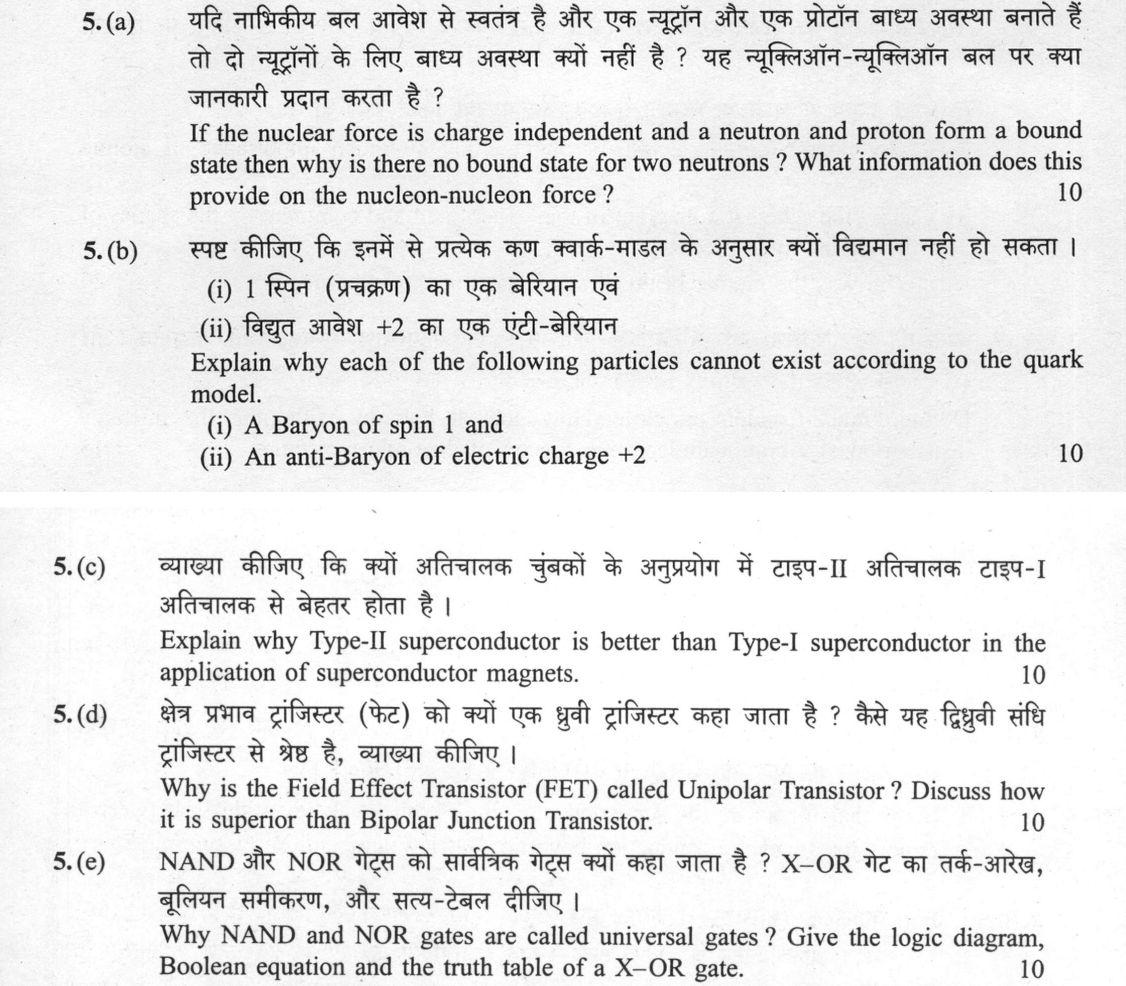
(a) If the nuclear force is charge independent and a neutron and proton form a bound state then why is there no bound state for…
If the nuclear force is charge independent and a neutron and proton form a bound state then why is there no bound state for two neutrons ? What information does this provide on the nucleon-nucleon force ? 10 marks
Explain why each of the following particles cannot exist according to the quark model. A Baryon of spin 1 and
An anti-Baryon of electric charge +2 10 marks
Explain why Type-II superconductor is better than Type-I superconductor in the application of superconductor magnets. 10 marks
Why is the Field Effect Transistor (FET) called Unipolar Transistor ? Discuss how it is superior than Bipolar Junction Transistor. 10 marks
Why NAND and NOR gates are called universal gates ? Give the logic diagram, Boolean equation and the truth table of a X-OR gate. 10 marks
हिंदी में प्रश्न पढ़ें
यदि नाभिकीय बल आवेश से स्वतंत्र है और एक न्यूट्रॉन और एक प्रोटॉन बाध्य अवस्था बनाते हैं तो दो न्यूट्रॉनों के लिए बाध्य अवस्था क्यों नहीं है ? यह न्यूक्लिऑन-न्यूक्लिऑन बल पर क्या जानकारी प्रदान करता है ? (10 अंक)
स्पष्ट कीजिए कि इनमें से प्रत्येक कण क्वार्क-मॉडल के अनुसार क्यों विद्यमान नहीं हो सकता । 1 स्पिन (प्रचक्रण) का एक बेरियन एवं
विद्युत आवेश +2 का एक एंटी-बेरियन (10 अंक)
व्याख्या कीजिए कि क्यों अतिचालक चुंबकों के अनुप्रयोग में टाइप-II अतिचालक टाइप-I अतिचालक से बेहतर होता है। (10 अंक)
क्षेत्र प्रभाव ट्रांजिस्टर (फेट) को क्यों एक ध्रुवी ट्रांजिस्टर कहा जाता है ? कैसे यह द्विध्रुवी संधि ट्रांजिस्टर से श्रेष्ठ है, व्याख्या कीजिए। (10 अंक)
NAND और NOR गेट्स को सार्वभौमिक गेट्स क्यों कहा जाता है ? X-OR गेट का तर्क-आरेख, बूलियन समीकरण, और सत्य-टेबल दीजिए। (10 अंक)
Model answer
Written by UPSC Answer Check against this question's marking rubric, to the expected length. UPSC does not publish answers for Mains — this is one way to score well, not an official key.
(a) Charge independence and the absence of a dineutron bound state
The nuclear force is charge independent, meaning the proton–proton, neutron–neutron and neutron–proton interactions are the same in the isotopic spin formalism. Yet the deuteron (np) is bound while the dineutron (nn) is not. The reason lies in the Pauli exclusion principle combined with the spin dependence of the nuclear force.
Two neutrons are identical fermions, so their total wavefunction must be antisymmetric under exchange. If they were in a spatially symmetric state (relative orbital angular momentum L = 0), their spin wavefunction must be antisymmetric, i.e. the spin-singlet state with total spin S = 0. But the deuteron is bound precisely in the spin-triplet (S = 1) state, where the tensor force provides the extra attraction. The nn system cannot access this triplet state in L = 0 because that would require a symmetric spin wavefunction, which is forbidden for identical fermions in a symmetric spatial state. The allowed nn state is therefore the spin-singlet, which is unbound. This tells us that the nucleon–nucleon force is spin-dependent and that the tensor component, which operates only in the triplet state, is essential for binding. It also confirms that charge independence alone does not guarantee identical binding for nn and np; the Pauli principle and spin–isospin structure of the force determine the outcome.
(b) Quark-model prohibitions
(i) A baryon of spin 1 cannot exist because a baryon is made of three spin-½ quarks. Coupling three spin-½ angular momenta yields total spin values of ½ or 3/2 only. Explicitly, combining two quarks gives either S = 0 or S = 1; adding the third spin-½ gives S = ½ or 3/2. There is no way to obtain S = 1. Hence a spin-1 baryon is forbidden by angular momentum coupling in the quark model.
(ii) An anti-baryon of charge +2 cannot exist. An anti-baryon consists of three antiquarks. Antiquark charges are −⅔ (anti-up) and +⅓ (anti-down). To achieve total charge +2, all three antiquarks would need charge +⅔, but the maximum antiquark charge is +⅔ only for anti-down? Actually, anti-up has charge −⅔ and anti-down has +⅓; the maximum positive charge from three antiquarks is +1 (three anti-downs). Even considering anti-strange (+⅓), the maximum is +1. Thus charge +2 is impossible. Moreover, the color-singlet requirement demands an antisymmetric color wavefunction, which forces a symmetric combination of flavor and spin; this further restricts allowed states and rules out such a configuration.
(c) Type-II versus Type-I superconductors in magnets
Type-I superconductors exhibit a complete Meissner effect up to a single critical field Hc, above which superconductivity is destroyed. They cannot carry large currents in high magnetic fields. Type-II superconductors have two critical fields, Hc1 and Hc2. Between Hc1 and Hc2, magnetic flux penetrates as Abrikosov vortices, each carrying a flux quantum. The material remains superconducting up to Hc2, which can be very high. This allows Type-II superconductors to sustain much larger currents and magnetic fields, making them ideal for superconducting magnets used in MRI, particle accelerators and maglev. Indian research institutions such as BARC and IITs have contributed to indigenous superconductor development, and ISRO has used such magnets in payload applications.
(d) FET as a unipolar transistor and its superiority
The Field Effect Transistor is called unipolar because its current is carried by only one type of charge carrier—either electrons in an n-channel or holes in a p-channel. In contrast, the Bipolar Junction Transistor (BJT) involves both electrons and holes, making it bipolar. The FET is superior because it has very high input impedance (gate current is negligible), it is voltage-controlled rather than current-controlled, it exhibits better thermal stability, it is smaller in size, and it offers faster switching speeds with lower power consumption. These advantages make FETs preferred in integrated circuits, memory devices and low-power electronics. Indian semiconductor initiatives, such as ISRO's indigenous fabrication of FETs for space applications, highlight their practical importance.
(e) Universality of NAND and NOR gates and XOR gate details
NAND and NOR gates are called universal gates because any logic function can be implemented using only NAND gates or only NOR gates. For example, a NOT gate is made by tying both inputs of a NAND gate together; an AND gate is a NAND followed by a NOT (another NAND); an OR gate is obtained by inverting the inputs before a NAND. Similarly, NOR gates can construct NOT, OR and AND. This universality simplifies circuit design and fabrication.
The XOR gate gives a high output when inputs differ. Its Boolean equation is Y = A⊕B = A'B + AB' = (A+B)(A'+B'). The logic diagram using NAND gates requires four NAND gates: first NAND gives (AB)', second NAND with inputs A and (AB)' gives A' + B, third NAND with inputs B and (AB)' gives A + B', and the final NAND combines these to yield A⊕B. The truth table is:
A B | Y 0 0 | 0 0 1 | 1 1 0 | 1 1 1 | 0
Thus the XOR gate is fundamental in arithmetic circuits and parity generation.
In conclusion, the charge independence of nuclear force is tempered by Pauli principle and spin dependence; quark model imposes strict constraints on baryon spin and charge; Type-II superconductors enable high-field magnets; FETs offer unipolar advantages over BJTs; and NAND/NOR universality underpins digital logic design.
What "Explain" is asking you to do
Make the working of something clear — what sets it off, what follows from what, and what it produces. Explain is the Commission's mechanism word: it dominates the technical papers and the “explain why” stems, where the marks sit in the causal chain and not in the label.
Structure that answers it
State what it is → the initiating condition → the chain of cause, step by step → an instance where it plays out → what the chain produces
Where marks are lost
Describing what something looks like instead of why it works that way. Naming the stages without linking them reads as description too.
How this answer will be evaluated
Approach
(a) explain: definition/context > points in order > small example > short close | (b) explain: definition/context > points in order > small example > short close | (c) explain: definition/context > points in order > small example > short close | (d) explain: definition/context > points in order > small example > short close | (e) explain: definition/context > points in order > small example > short close Full marks: All parts fully addressed with correct principles, derivations, and diagrams where required.
Key points expected
- Define charge independence of nuclear force
- Identify Pauli exclusion principle as the cause
- State spin-0 (singlet) nature of the two-neutron system
- Link Pauli principle to the lack of bound state
- State quark content of baryons (3 quarks)
- Explain spin 1 impossibility for 3-quark baryon
- State quark content of anti-baryons (3 antiquarks)
- Calculate max charge for anti-baryon (e.g., anti-Ω⁻ is -2)
Evaluation rubric
Each sub-part is marked on its own, against the marks and word limit printed on the paper.
- (a) Explain the absence of a bound state for two neutrons despite charge independence. 10 marks
explain— definition/context → points in order → small example → short close
Must cover
- Define charge independence of nuclear force
- Identify Pauli exclusion principle as the cause
- State spin-0 (singlet) nature of the two-neutron system
- Link Pauli principle to the lack of bound state
Loses marks
- Confusing charge independence with charge symmetry
- Failing to mention Pauli exclusion principle
- Incorrectly attributing instability to electromagnetic repulsion
Earns more
- Mention spin-1 (triplet) state of deuteron
- Note that nuclear force is spin-dependent
- Contrast deuteron stability with dineutron instability
Extra mark
- Reference to specific nucleon-nucleon potential models
- (b) Explain why the specified baryon and anti-baryon cannot exist in the quark model. 10 marks
explain— definition/context → points in order → small example → short close
Must cover
- State quark content of baryons (3 quarks)
- Explain spin 1 impossibility for 3-quark baryon
- State quark content of anti-baryons (3 antiquarks)
- Calculate max charge for anti-baryon (e.g., anti-Ω⁻ is -2)
Loses marks
- Incorrectly assigning integer spin to 3-quark system
- Confusing baryon with meson quark content
- Failing to calculate charge for anti-baryon
Earns more
- Show spin addition for 3 quarks (1/2 + 1/2 + 1/2)
- List charges of antiquarks (u-bar: -2/3, d-bar: +1/3)
- Mention that baryons are fermions (half-integer spin)
Extra mark
- Reference to specific baryon decuplet or octet
- (c) Explain why Type-II superconductors are superior for magnet applications. 10 marks
explain— definition/context → points in order → small example → short close
Must cover
- Define Type-I and Type-II superconductors
- Explain Meissner effect in Type-I (complete expulsion)
- Explain flux pinning in Type-II (mixed state)
- Link flux pinning to higher critical field (Hc2)
Loses marks
- Confusing Type-I and Type-II critical fields
- Failing to explain flux pinning mechanism
- Incorrectly stating Type-I has higher critical field
Earns more
- Mention lower critical field (Hc1) and upper (Hc2)
- Note that Type-II can sustain higher magnetic fields
- Reference to practical applications (MRI, particle accelerators)
Extra mark
- Mention specific Type-II materials (e.g., NbTi, YBCO)
- (d) Explain why FET is unipolar and how it is superior to BJT. 10 marks
explain— definition/context → points in order → small example → short close
Must cover
- Define unipolar (current by one carrier type)
- Contrast with BJT (bipolar, both carriers)
- List FET advantages (high input impedance, low noise)
- Mention thermal stability of FET
Loses marks
- Confusing unipolar with single junction
- Failing to contrast with BJT carrier types
- Incorrectly stating FET has lower input impedance
Earns more
- Explain voltage-controlled nature of FET
- Note lower power consumption in FET
- Mention easier integration in ICs
Extra mark
- Reference to specific FET types (JFET, MOSFET)
- (e) Explain universality of NAND/NOR and provide X-OR gate details. 10 marks
explain— definition/context → points in order → small example → short close
Must cover
- Define universal gate (can implement any logic function)
- Show NAND/NOR can make NOT, AND, OR
- Provide X-OR logic diagram
- Give X-OR Boolean equation (A⊕B = A'B + AB')
Loses marks
- Failing to demonstrate universality with examples
- Incorrect X-OR Boolean equation
- Missing or incorrect truth table
Earns more
- Provide complete X-OR truth table
- Show NAND implementation of X-OR
- Mention X-OR use in adders
Extra mark
- Reference to X-OR in parity checkers
Practice this exact question
Write your answer and it is marked point by point against the model answer above — what you covered, what you missed, what you got wrong.
Evaluate my answer →More from Physics 2022 Paper II
- Q2 (a) Set up the Schrodinger's wave equation for one dimensional potential barrier and obta…
- Q3 (a) What is the spin wave function (for s=1/2) if the spin component in the direction of…
- Q4 (a) (i) In a diatomic molecule when one constituent atom is replaced by one of its heavie…
- Q5 (a) If the nuclear force is charge independent and a neutron and proton form a bound stat…
- Q6 (a) Show that for a specific value (n, l), there exists a large degeneracy relative to th…
- Q7 (a) Explain the drawbacks of Einstein's theory of specific heat and how it was overcome b…
- Q8 (a) Show that for an n-type semiconductor, the Fermi level lies midway between the donor…