Paper II — Q2
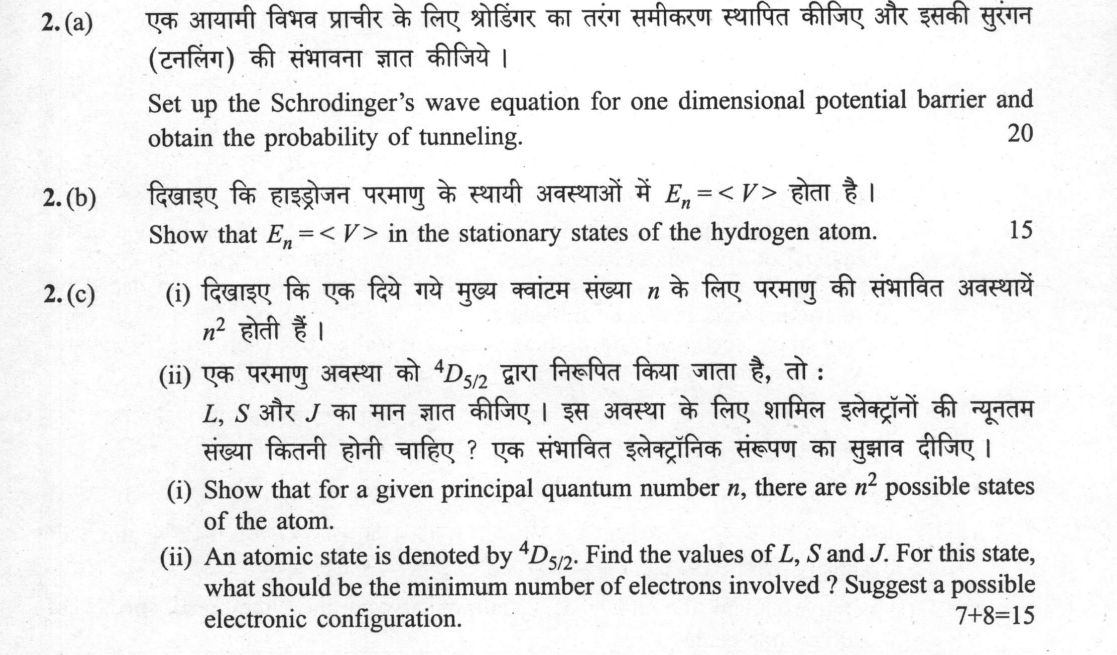
(a) Set up the Schrodinger's wave equation for one dimensional potential barrier and obtain the probability of tunneling. 20…
Set up the Schrodinger's wave equation for one dimensional potential barrier and obtain the probability of tunneling. 20 marks
Show that Eₙ = <V> in the stationary states of the hydrogen atom. 15 marks
Show that for a given principal quantum number n, there are n² possible states of the atom.
An atomic state is denoted by ^4D₅/2. Find the values of L, S and J. For this state, what should be the minimum number of electrons involved ? Suggest a possible electronic configuration. 7+8=15 marks
हिंदी में प्रश्न पढ़ें
एक आयामी विभव प्राचीर के लिए श्रोडिंगर का तरंग समीकरण स्थापित कीजिए और इसकी सुरंगन (टनलिंग) की संभावना ज्ञात कीजिये । 20 अंक
दिखाइए कि हाइड्रोजन परमाणु के स्थायी अवस्थाओं में Eₙ = <V> होता है । 15 अंक
दिखाइए कि एक दिये गये मुख्य क्वांटम संख्या n के लिए परमाणु की संभावित अवस्थायें n² होती हैं ।
एक परमाणु अवस्था को ^4D₅/2 द्वारा निर्दिष्ट किया जाता है, तो : L, S और J का मान ज्ञात कीजिए । इस अवस्था के लिए शामिल इलेक्ट्रॉनों की न्यूनतम संख्या कितनी होनी चाहिए ? एक संभावित इलेक्ट्रॉनिक संरचना का सुझाव दीजिए । 7+8=15 अंक
Model answer
Written by UPSC Answer Check against this question's marking rubric, to the expected length. UPSC does not publish answers for Mains — this is one way to score well, not an official key.
(a) Consider a rectangular one-dimensional barrier: V(x)=0 for x<0, V(x)=V₀ for 0<x<a, and V(x)=0 for x>a. The time-independent Schrödinger equation is -ħ²/(2m) d²ψ/dx² + V(x)ψ = Eψ.
For 0<E<V₀, define k = √(2mE)/ħ, κ = √(2m(V₀-E))/ħ.
The wavefunctions in the three regions are ψ₁ = A exp(ikx) + B exp(-ikx), ψ₂ = C exp(κx) + D exp(-κx), ψ₃ = F exp(ikx). Here F exp(ikx) is the transmitted wave; there is no left-moving wave in region 3.
Continuity of ψ and dψ/dx at x=0 and x=a gives A+B = C+D, ik(A-B)=κ(C-D), C exp(κa)+D exp(-κa)=F exp(ika), κ[C exp(κa)-D exp(-κa)] = ikF exp(ika).
Eliminating C and D leads to |F/A|² = 1/[cosh²(κa) + ((k²-κ²)²/(4k²κ²)) sinh²(κa)].
Since cosh²=1+sinh², T = |F/A|² = [1 + (1 + (k²-κ²)²/(4k²κ²)) sinh²(κa)]⁻¹ = [1 + ((k²+κ²)²/(4k²κ²)) sinh²(κa)]⁻¹.
Now k²+κ² = 2mV₀/ħ² and k²κ² = (2m/ħ²)² E(V₀-E). Hence ((k²+κ²)²/(4k²κ²)) = V₀²/[4E(V₀-E)].
Therefore the tunneling probability is T = [1 + V₀² sinh²(κa)/(4E(V₀-E))]⁻¹ = 4E(V₀-E)/[4E(V₀-E)+V₀² sinh²(κa)], valid for 0<E<V₀.
If E>V₀, replace κ by i k₂, k₂=√(2m(E-V₀))/ħ, so sinh²(κa) → -sin²(k₂a), giving T = [1 + V₀² sin²(k₂a)/(4E(E-V₀))]⁻¹.
(b) For the hydrogen atom, with the usual Coulomb potential V(r) = -e²/(4π ε₀ r), the expectation value is <V> = -e²/(4π ε₀) <1/r>.
For a stationary hydrogenic state with principal quantum number n, <1/r> = 1/(a₀ n²), where a₀ = 4π ε₀ ħ²/(m e²).
Thus <V> = -e²/(4π ε₀ a₀ n²) = - m e⁴/[(4π ε₀)² ħ² n²].
The Bohr energy is E_n = - m e⁴/[2(4π ε₀)² ħ² n²].
Hence <V> = 2E_n, equivalently E_n = <V>/2.
Equivalently, the Coulomb virial theorem gives 2<T> = -<V>, so E_n = <T> + <V> = <V>/2. Thus for the standard Coulomb potential the correct relation is E_n = <V>/2, not E_n = <V>; the latter would require V to denote the half-potential or total energy.
(c)(i) For a given principal quantum number n, the orbital angular momentum quantum number takes values l = 0,1,2,...,n-1.
For each l, the magnetic quantum number m_l takes 2l+1 values: m_l = -l,-l+1,...,+l.
Therefore the number of spatial states is Σ_(l=0)^(n-1) (2l+1) = 2Σ_(l=0)^(n-1) l + n = 2[(n-1)n/2] + n = n(n-1)+n = n².
Thus for a given n there are n² spatial states. If electron spin m_s=±1/2 is included, the total number of states becomes 2n².
(c)(ii) The term symbol is ⁴D₅/₂. Comparing with the general form ²ˢ⁺¹L_J: 2S+1 = 4 ⇒ S = 3/2. D ⇒ L = 2. Subscript ⇒ J = 5/2.
Since S=3/2 = 1/2+1/2+1/2, at least three electrons with parallel spins are needed. A possible configuration is ns¹ np¹ nd¹, for example 3s¹ 3p¹ 3d¹ (or the full configuration 1s² 2s² 2p⁶ 3s¹ 3p¹ 3d¹), with all three unpaired spins parallel. The np and nd electrons can couple to give L=2, and with S=3/2 the allowed J values are 1/2, 3/2, 5/2, 7/2. Hence J=5/2 is possible. Minimum number of electrons involved = 3; possible configuration: ns¹ np¹ nd¹.
What "Derive" is asking you to do
Reach the stated expression from a starting relation, justifying every step. The destination is printed in the question, so only the route earns marks, and the assumptions you work under are part of that route.
Structure that answers it
Assumptions and notation defined → starting relation or governing equation → each step with its justification → the required expression → limiting case or boundary check
Where marks are lost
Writing the standard result first and fitting three lines to it, which an examiner reads at a glance. Marks also go on assumptions left unstated — lossless medium, small amplitude, errors independent with zero mean — and on symbols used before they are defined, even when the question says usual notations.
How this answer will be evaluated
Approach
Framework: Principle > Setup and diagram > Derivation > Result and limiting case. (a) derive: given > assumptions > stepwise derivation > result > check | (b) justify: claim > 3-4 reasons > evidence > conclusion | (c(i)) justify: claim > 3-4 reasons > evidence > conclusion | (c(ii)) calculate: given > formula > substitution > result with units > interpretation Full marks: Complete derivations with all boundary conditions, Virial Theorem properly invoked, correct summation, and accurate term symbol interpretation.
Key points expected
- Labelled diagram of potential barrier (V0, width a)
- Time-independent Schrodinger equation for all three regions
- Wave functions for regions I, II, and III
- Derivation of transmission coefficient T
- Statement of Virial Theorem for Coulomb potential
- Relation <T> = -1/2 <V> for 1/r potential
- Total energy E = <T> + <V>
- Final result E = <V>
Evaluation rubric
Each sub-part is marked on its own, against the marks and word limit printed on the paper.
- (a) Set up 1D Schrodinger equation for potential barrier and derive tunneling probability. 20 marks
derive— given → assumptions → stepwise derivation → result → check
Must cover
- Labelled diagram of potential barrier (V0, width a)
- Time-independent Schrodinger equation for all three regions
- Wave functions for regions I, II, and III
- Derivation of transmission coefficient T
Loses marks
- Missing boundary conditions or continuity arguments
- No diagram or unlabelled regions
- Formula substitution without derivation steps
Earns more
- Application of boundary conditions (continuity of psi and dpsi/dx)
- Expression for T in terms of k, kappa, and a
- Limiting case for high barrier (exponential decay)
Extra mark
- Physical interpretation of tunneling as quantum leakage
- (b) Show that En = <V> in stationary states of hydrogen atom. 15 marks
justify— claim → 3-4 reasons → evidence → conclusion
Must cover
- Statement of Virial Theorem for Coulomb potential
- Relation <T> = -1/2 <V> for 1/r potential
- Total energy E = <T> + <V>
- Final result E = <V>
Loses marks
- Stating result without invoking Virial Theorem
- Confusing <V> with potential energy function V(r)
- Missing the factor of 1/2 in <T> relation
Earns more
- Derivation of Virial Theorem from commutators
- Explicit calculation of <V> for hydrogen ground state
Extra mark
- Mention of generalization to V(r) ~ r^n
- (c(i)) Show that for a given principal quantum number n, there are n² possible states. 7 marks
justify— claim → 3-4 reasons → evidence → conclusion
Must cover
- Summation over allowed l values (0 to n-1)
- Counting m_l values for each l (2l+1)
- Summation formula sum(2l+1) = n²
- Explicit calculation of the sum
Loses marks
- Missing the summation over l
- Incorrect range for l values
- No explicit summation shown
Earns more
- Mention of spin degeneracy (2n² if spin included)
- Example calculation for n=2 or n=3
Extra mark
- Connection to shell capacity in periodic table
- (c(ii)) Find L, S, J for ⁴D₅/₂; minimum electrons; suggest configuration. 8 marks
calculate— given → formula → substitution → result with units → interpretation
Must cover
- L=2 (D), S=3/2 (quartet), J=5/2
- Minimum electrons = 4 (from multiplicity 2S+1=4)
- Possible electronic configuration (e.g., 3d⁴ or 4s²3d²)
- Explanation of term symbol notation
Loses marks
- Incorrect S value from multiplicity
- Missing minimum electron count
- No valid electronic configuration suggested
Earns more
- Hund's rules application for ground state
- Specific example like Cr or Mn configuration
Extra mark
- Mention of LS coupling scheme
Practice this exact question
Write your answer and it is marked point by point against the model answer above — what you covered, what you missed, what you got wrong.
Evaluate my answer →More from Physics 2022 Paper II
- Q1 (a) What is de Broglie concept of matter wave ? Evaluate de Broglie wavelength of Helium…
- Q2 (a) Set up the Schrodinger's wave equation for one dimensional potential barrier and obta…
- Q3 (a) What is the spin wave function (for s=1/2) if the spin component in the direction of…
- Q4 (a) (i) In a diatomic molecule when one constituent atom is replaced by one of its heavie…
- Q5 (a) If the nuclear force is charge independent and a neutron and proton form a bound stat…