Paper II — Q3
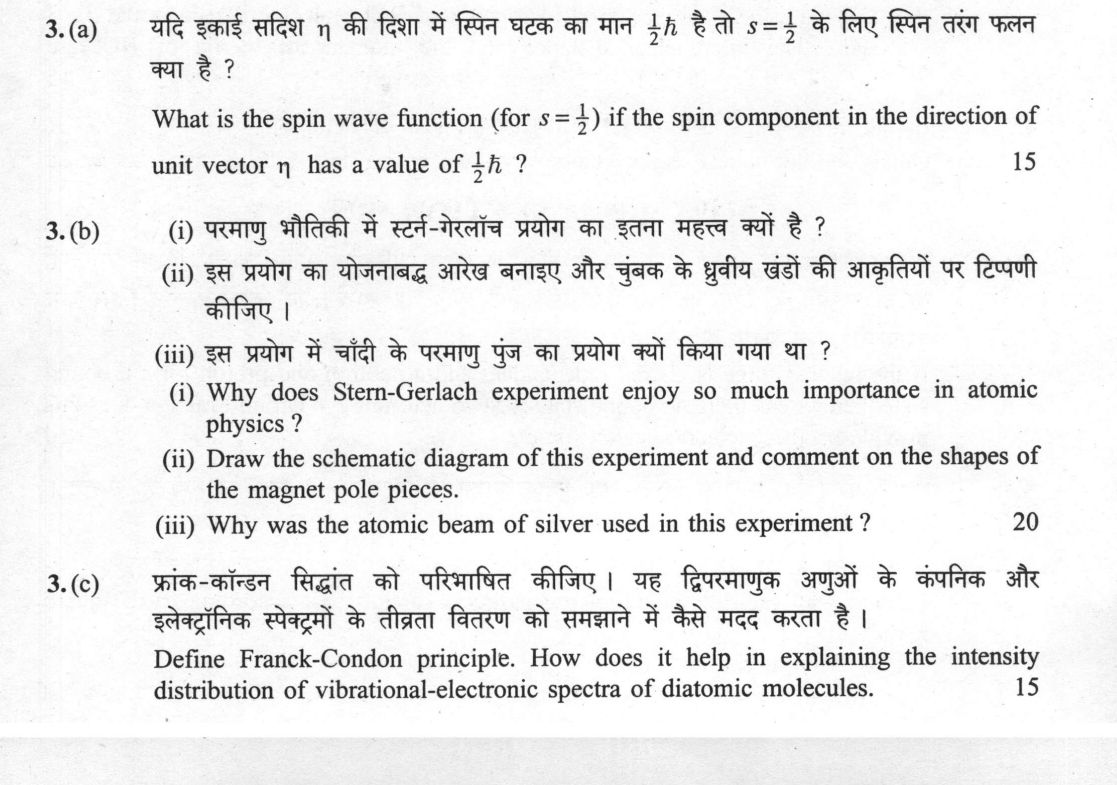
(a) What is the spin wave function (for s=1/2) if the spin component in the direction of unit vector η has a value of 1/2ℏ ? 15…
What is the spin wave function (for s=1/2) if the spin component in the direction of unit vector η has a value of 1/2ℏ ? 15 marks
Why does Stern-Gerlach experiment enjoy so much importance in atomic physics ?
Draw the schematic diagram of this experiment and comment on the shapes of the magnet pole pieces.
Why was the atomic beam of silver used in this experiment ? 20 marks
Define Franck-Condon principle. How does it help in explaining the intensity distribution of vibrational-electronic spectra of diatomic molecules. 15 marks
हिंदी में प्रश्न पढ़ें
यदि इकाई सदिश η की दिशा में स्पिन घटक का मान 1/2ℏ है तो s=1/2 के लिए स्पिन तरंग फलन क्या है ? 15 अंक
परमाणु भौतिकी में स्टर्न-गर्लाच प्रयोग का इतना महत्व क्यों है ?
इस प्रयोग का योजनाबद्ध आरेख बनाइए और चुंबक के ध्रुवीय खंडों की आकृतियों पर टिप्पणी कीजिए ।
इस प्रयोग में चांदी के परमाणु पुंज का प्रयोग क्यों किया गया था ? 20 अंक
फ्रांक-कॉन्डन सिद्धांत को परिभाषित कीजिए । यह द्विपरमाणुक अणुओं के कंपनिक और इलेक्ट्रॉनिक स्पेक्ट्रमों के तीव्रता वितरण को समझाने में कैसे मदद करता है । 15 अंक
Model answer
Written by UPSC Answer Check against this question's marking rubric, to the expected length. UPSC does not publish answers for Mains — this is one way to score well, not an official key.
(a) For a spin-1/2 particle, let η=(sinθ cosφ, sinθ sinφ, cosθ). The spin component along η is S·η=(ℏ/2)(σₓ sinθ cosφ+σ_y sinθ sinφ+σ_z cosθ). The required state is the normalized eigenstate satisfying S·ηχ=(+ℏ/2)χ. Writing χ=(a,b)^T and using σ·η = [[cosθ, sinθ e^-iφ],[sinθ eⁱφ, -cosθ]], the eigenvalue equations are (cosθ−1)a+sinθ e^-iφb=0 and sinθ eⁱφa−(cosθ+1)b=0. Choosing a=cos(θ/2) and b=eⁱφsin(θ/2) satisfies them because cosθ cos(θ/2)+sinθ sin(θ/2)=cos(θ/2) and sinθ cos(θ/2)−cosθ sin(θ/2)=sin(θ/2). Hence χ₊(η)=cos(θ/2)χ₊ + eⁱφsin(θ/2)χ₋. The phase eⁱφ fixes the azimuthal direction, while the overall phase is arbitrary; the state reduces to χ₊ for θ=0 and to eⁱφχ₋ for θ=π. This is the required spin wave function for the +1/2ℏ component along η.
(b)(i) The Stern–Gerlach experiment is important because it gave the first direct beam-splitting evidence for space quantization of angular momentum. In 1922 the silver beam split into discrete components, showing that a magnetic moment cannot orient continuously in a field. This turned an abstract quantum postulate into a visible spatial separation. After the 1925 spin hypothesis, the same two-line result became a standard demonstration of the two projections of electron spin, and it now underlies quantum measurement theory and qubit realizations in quantum information.
(b)(ii) Schematic: Ag oven → collimating slits S1 and S2 → inhomogeneous magnet → detection screen; the beam travels along z and two spots appear at ±Δz on the screen. The slits define a narrow beam and select atoms with similar velocities. In the magnet, B_z(z) is strong and varies with z; atoms with different μ_z receive forces F_z=μ_z∂B_z/∂z and are deflected by different amounts. The pole pieces are not flat parallel plates; one is shaped as a knife-edge or wedge and the other as a broad curved/cylindrical surface. This geometry makes ∂B_z/∂z large and nearly linear over the beam while keeping the field direction approximately along z, so the force separates the beam instead of merely precessing the spin. A uniform field would produce no net transverse force.
(b)(iii) Silver was used because its ground state is 5s¹, ^2S₁/2: L=0, S=1/2, J=1/2. With L=0 there is no orbital angular momentum contribution to the magnetic moment, and J=1/2 gives only two Zeeman components, m_J=±1/2, so the beam splits into two clean spots. Silver also forms an intense neutral atomic beam when heated and is chemically stable. Natural silver isotopes have I=1/2, so a small hyperfine structure exists; it is small compared with the spin Zeeman splitting and was not resolved in the original experiment, so it does not obscure the main two-line separation.
(c) The Franck–Condon principle states that an electronic transition is much faster than nuclear motion, so the internuclear distance remains essentially fixed during the transition; on a potential-energy diagram the transition is vertical. The vertical transition picture is the causal link between nuclear geometry and band intensity. For a diatomic molecule, if the electronic transition moment is slowly varying over vibrational levels, the intensity of a band from v'' in the lower state to v' in the upper state is governed by the Franck–Condon factor |⟨ψᵥ'|ψᵥ''⟩|², the overlap of the two vibrational wavefunctions at the same nuclear coordinate. When the upper and lower potential curves have different equilibrium positions, vertical transitions from a given v'' intersect the upper curve at different vibrational levels. The largest overlap, and hence the strongest band, occurs where the vertical line crosses a region of high vibrational probability. As v' changes, the overlap varies smoothly, giving a progression of bands whose intensities follow a Condon parabola; for a large shift of the upper curve the maximum moves to higher v'. Thus the principle explains why vibrational-electronic spectra show a sequence of bands with non-uniform intensities rather than a single line.
What "Explain" is asking you to do
Make the working of something clear — what sets it off, what follows from what, and what it produces. Explain is the Commission's mechanism word: it dominates the technical papers and the “explain why” stems, where the marks sit in the causal chain and not in the label.
Structure that answers it
State what it is → the initiating condition → the chain of cause, step by step → an instance where it plays out → what the chain produces
Where marks are lost
Describing what something looks like instead of why it works that way. Naming the stages without linking them reads as description too.
How this answer will be evaluated
Approach
Framework: Principle > Setup and diagram > Derivation > Result and limiting case. (a) derive: given > assumptions > stepwise derivation > result > check | (b(i)) justify: claim > 3-4 reasons > evidence > conclusion | (b(ii)) describe: define > structure or process in order > labelled diagram > significance | (b(iii)) justify: claim > 3-4 reasons > evidence > conclusion | (c) explain: definition/context > points in order > small example > short close Full marks: Derives the spinor from first principles, draws a correct labelled diagram with a clear explanation of the pole shape, and provides a rigorous definition of the Franck-Condon principle with a diagram.
Key points expected
- Define unit vector η in terms of polar angles θ, φ
- Apply spin operator S·η to the spinor
- Solve the eigenvalue equation for eigenvalue 1/2ℏ
- State the final spinor components explicitly
- State that it demonstrated space quantization
- Mention it provided evidence for electron spin
- Note it confirmed the quantization of angular momentum
- Draw a labelled diagram of the apparatus
Evaluation rubric
Each sub-part is marked on its own, against the marks and word limit printed on the paper.
- (a) Derive the spinor wave function for s=1/2 with spin projection 1/2ℏ along unit vector η. 15 marks
derive— given → assumptions → stepwise derivation → result → check
Must cover
- Define unit vector η in terms of polar angles θ, φ
- Apply spin operator S·η to the spinor
- Solve the eigenvalue equation for eigenvalue 1/2ℏ
- State the final spinor components explicitly
Loses marks
- Writing the spinor without derivation
- Confusing the spin operator with the Pauli matrix
- Failing to normalize the final state
Earns more
- Show the matrix form of S·η
- Verify the result is normalized
- Mention the arbitrary phase factor
Extra mark
- Relate the result to the Bloch sphere representation
- (b(i)) Justify the importance of the Stern-Gerlach experiment in atomic physics.
justify— claim → 3-4 reasons → evidence → conclusion
Must cover
- State that it demonstrated space quantization
- Mention it provided evidence for electron spin
- Note it confirmed the quantization of angular momentum
Loses marks
- Vague statements without specific physical evidence
- Confusing it with the Zeeman effect
Earns more
- Mention it was the first direct observation of quantum effects
- Link it to the development of quantum mechanics
Extra mark
- Mention its role in the discovery of the magnetic moment
- (b(ii)) Draw the schematic diagram of the Stern-Gerlach experiment and comment on the magnet pole shapes.
describe— define → structure or process in order → labelled diagram → significance
Must cover
- Draw a labelled diagram of the apparatus
- Show the inhomogeneous magnetic field region
- Comment on the shape of the pole pieces (one pointed, one flat)
- Explain why this shape creates an inhomogeneous field
Loses marks
- Drawing a uniform magnetic field
- Failing to label the key components
- Not explaining the reason for the pole shape
Earns more
- Label the source, collimator, magnet, and detector
- Show the splitting of the beam into two parts
Extra mark
- Mention the specific material used for the pole pieces
- (b(iii)) Justify why an atomic beam of silver was used in the experiment.
justify— claim → 3-4 reasons → evidence → conclusion
Must cover
- State that silver has a single unpaired electron in the 5s orbital
- Mention that this gives a net spin of 1/2
- Note that this leads to a clear two-beam splitting
Loses marks
- Saying silver was used because it is shiny
- Failing to mention the unpaired electron
Earns more
- Mention that silver is a volatile metal, easy to vaporize
- Note that the ground state is a doublet
Extra mark
- Mention the specific isotope used (Ag-107 or Ag-109)
- (c) Define the Franck-Condon principle and explain how it accounts for intensity distribution in spectra. 15 marks
explain— definition/context → points in order → small example → short close
Must cover
- Define the principle: electronic transitions are vertical on a potential energy diagram
- Explain that the transition occurs faster than nuclear motion
- Relate transition probability to the overlap integral of vibrational wavefunctions
- Explain how this leads to the observed intensity distribution
Loses marks
- Saying the transition is horizontal
- Failing to mention the overlap integral
- Confusing it with the Boltzmann distribution
Earns more
- Draw a potential energy diagram showing vertical transitions
- Mention the Franck-Condon factors
- Explain the concept of the 'Franck-Condon window'
Extra mark
- Mention the application to fluorescence and phosphorescence
Practice this exact question
Write your answer and it is marked point by point against the model answer above — what you covered, what you missed, what you got wrong.
Evaluate my answer →More from Physics 2022 Paper II
- Q1 (a) What is de Broglie concept of matter wave ? Evaluate de Broglie wavelength of Helium…
- Q2 (a) Set up the Schrodinger's wave equation for one dimensional potential barrier and obta…
- Q3 (a) What is the spin wave function (for s=1/2) if the spin component in the direction of…
- Q4 (a) (i) In a diatomic molecule when one constituent atom is replaced by one of its heavie…
- Q5 (a) If the nuclear force is charge independent and a neutron and proton form a bound stat…
- Q6 (a) Show that for a specific value (n, l), there exists a large degeneracy relative to th…