Paper II — Q8
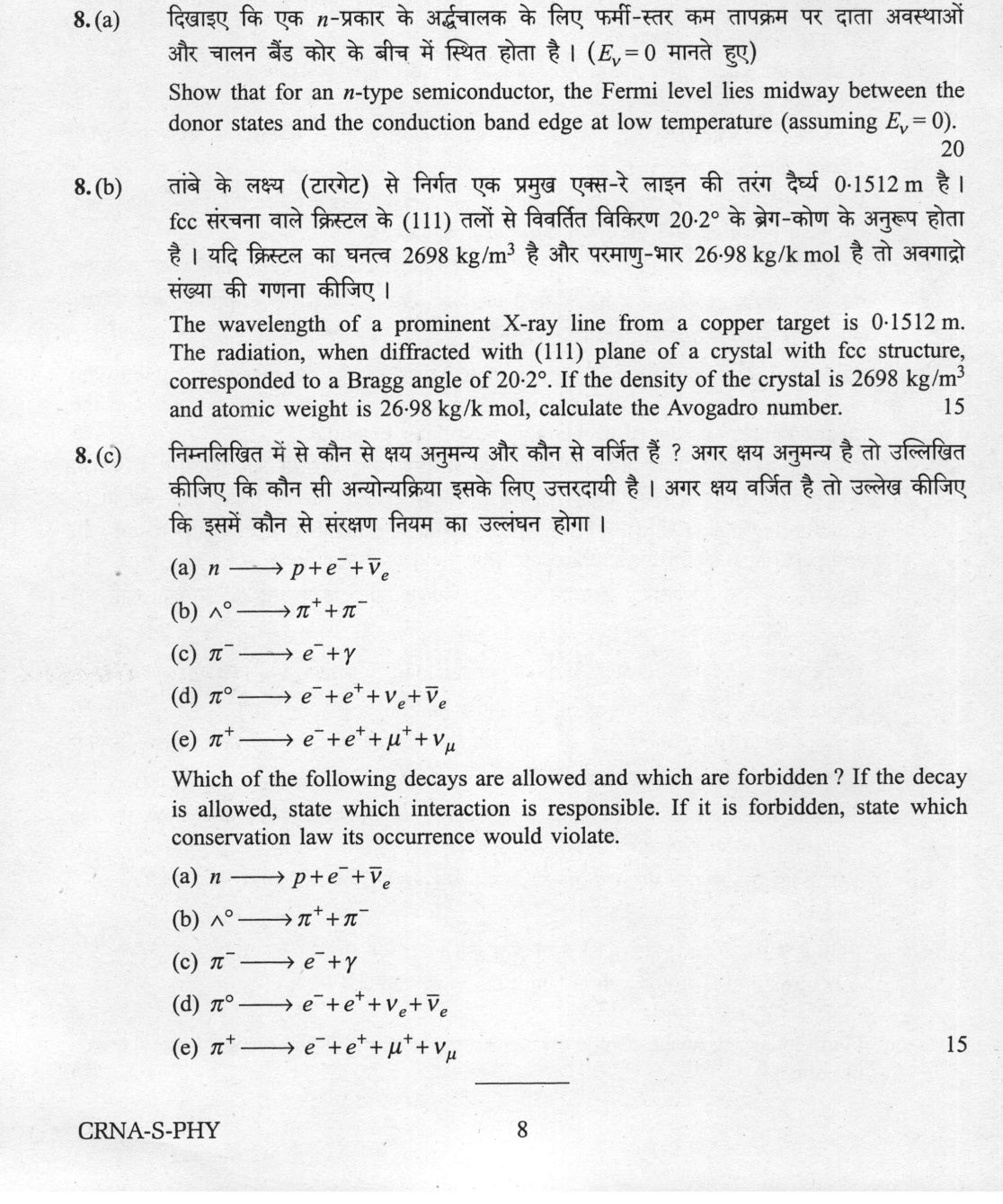
(a) Show that for an n-type semiconductor, the Fermi level lies midway between the donor states and the conduction band edge at…
Show that for an n-type semiconductor, the Fermi level lies midway between the donor states and the conduction band edge at low temperature (assuming Eᵥ = 0). 20 marks
The wavelength of a prominent X-ray line from a copper target is 0·1512 m. The radiation, when diffracted with (111) plane of a crystal with fcc structure, corresponded to a Bragg angle of 20·2°. If the density of the crystal is 2698 kg/m³ and atomic weight is 26·98 kg/k mol, calculate the Avogadro number. 15 marks
Which of the following decays are allowed and which are forbidden? If the decay is allowed, state which interaction is responsible. If it is forbidden, state which conservation law its occurrence would violate.
n → p + e⁻ + ν̄ₑ
Λ° → π⁺ + π⁻
π⁻ → e⁻ + γ
π° → e⁻ + e⁺ + νₑ + ν̄ₑ
π⁺ → e⁻ + e⁺ + μ⁺ + νᵤ 15 marks
हिंदी में प्रश्न पढ़ें
दिखाइए कि एक n-प्रकार के अर्ध्चालक के लिए फर्मी-स्तर कम तापक्रम पर दाता अवस्थाओं और चालन बैंड किनारे के बीच में स्थित होता है। (Eᵥ = 0 मानते हुए) 20 marks
तांबे के लक्ष्य (टारगेट) से निर्गत एक प्रमुख एक्स-रे लाइन की तरंग दैर्घ्य 0·1512 m है। fcc संरचना वाले क्रिस्टल के (111) तलों से विवर्तित विकिरण 20·2° के ब्रैग-कोण के अनुरूप होता है। यदि क्रिस्टल का घनत्व 2698 kg/m³ है और परमाणु-भार 26·98 kg/k mol है तो अवोगाद्रो संख्या की गणना कीजिए। 15
निम्नलिखित में से कौन से क्षय अनुमन्य और कौन से वर्जित हैं? अगर क्षय अनुमन्य है तो उल्लिखित कीजिए कि कौन सी अन्योन्यक्रिया इसके लिए उत्तरदायी है। अगर क्षय वर्जित है तो उल्लेख कीजिए कि इसमें कौन से संरक्षण नियम का उल्लंघन होगा।
n → p + e⁻ + ν̄ₑ
Λ° → π⁺ + π⁻
π⁻ → e⁻ + γ
π° → e⁻ + e⁺ + νₑ + ν̄ₑ
π⁺ → e⁻ + e⁺ + μ⁺ + νᵤ 15
What "Derive" is asking you to do
Reach the stated expression from a starting relation, justifying every step. The destination is printed in the question, so only the route earns marks, and the assumptions you work under are part of that route.
Structure that answers it
Assumptions and notation defined → starting relation or governing equation → each step with its justification → the required expression → limiting case or boundary check
Where marks are lost
Writing the standard result first and fitting three lines to it, which an examiner reads at a glance. Marks also go on assumptions left unstated — lossless medium, small amplitude, errors independent with zero mean — and on symbols used before they are defined, even when the question says usual notations.
How this answer will be evaluated
Approach
(a) derive: given > assumptions > stepwise derivation > result > check | (b) calculate: given > formula > substitution > result with units > interpretation | (c) examine: intro > how/why with reasoning > evidence > conclusion Full marks: Complete derivations with all conservation checks, correct units, and physical interpretation
Key points expected
- State charge neutrality condition for n-type semiconductor
- Apply Boltzmann approximation for carrier concentrations
- Assume low temperature and non-degenerate limit
- Show E_F lies midway between E_D and E_C
- Apply Bragg's law nλ = 2d sinθ
- Calculate interplanar spacing d_111 for fcc structure
- Relate unit cell volume to atomic density
- Substitute given values with correct units
Evaluation rubric
Each sub-part is marked on its own, against the marks and word limit printed on the paper.
- (a) Derive the position of the Fermi level in an n-type semiconductor at low temperature. 20 marks
derive— given → assumptions → stepwise derivation → result → check
Must cover
- State charge neutrality condition for n-type semiconductor
- Apply Boltzmann approximation for carrier concentrations
- Assume low temperature and non-degenerate limit
- Show E_F lies midway between E_D and E_C
Loses marks
- No derivation, only final result stated
- Missing charge neutrality condition
- Incorrect energy level positioning
Earns more
- Explicitly state assumption E_v = 0
- Show donor ionization fraction formula
- Discuss limiting case of complete ionization
- Include energy band diagram
Extra mark
- Mention temperature dependence of E_F
- Compare with intrinsic semiconductor case
- (b) Calculate Avogadro's number using X-ray diffraction data for fcc crystal. 15 marks
calculate— given → formula → substitution → result with units → interpretation
Must cover
- Apply Bragg's law nλ = 2d sinθ
- Calculate interplanar spacing d_111 for fcc structure
- Relate unit cell volume to atomic density
- Substitute given values with correct units
Loses marks
- Wrong Bragg angle or wavelength used
- Incorrect fcc atom count per unit cell
- Unit conversion errors in density or mass
Earns more
- Show fcc unit cell has 4 atoms
- Calculate lattice parameter a from d_111
- Use density formula ρ = (Z·M)/(N_A·a³)
- Verify dimensional consistency
Extra mark
- Compare result with accepted value 6.022×10²³
- Discuss experimental error sources
- (c) Determine if each decay is allowed or forbidden and identify responsible interaction or violated law. 15 marks
examine— intro → how/why with reasoning → evidence → conclusion
Must cover
- Check conservation of charge for each decay
- Check conservation of baryon number
- Check conservation of lepton number
- Identify interaction type for allowed decays
Loses marks
- Missing conservation law check
- Wrong interaction identified
- No justification for forbidden decays
Earns more
- Check energy/mass conservation
- Identify weak interaction for beta decays
- Note strangeness change for Λ decay
- Check angular momentum conservation
Extra mark
- Mention lifetime scales for different interactions
- Reference specific selection rules
Model answer coming soon
Every evaluation on this site is marked against a verified model answer. This question's answer is still being written; evaluation opens the moment it lands.
More from Physics 2022 Paper II
- Q5 (a) If the nuclear force is charge independent and a neutron and proton form a bound stat…
- Q6 (a) Show that for a specific value (n, l), there exists a large degeneracy relative to th…
- Q7 (a) Explain the drawbacks of Einstein's theory of specific heat and how it was overcome b…
- Q8 (a) Show that for an n-type semiconductor, the Fermi level lies midway between the donor…