Paper II — Q4
(a) (i) In a diatomic molecule when one constituent atom is replaced by one of its heavier isotopes, what change takes place in…
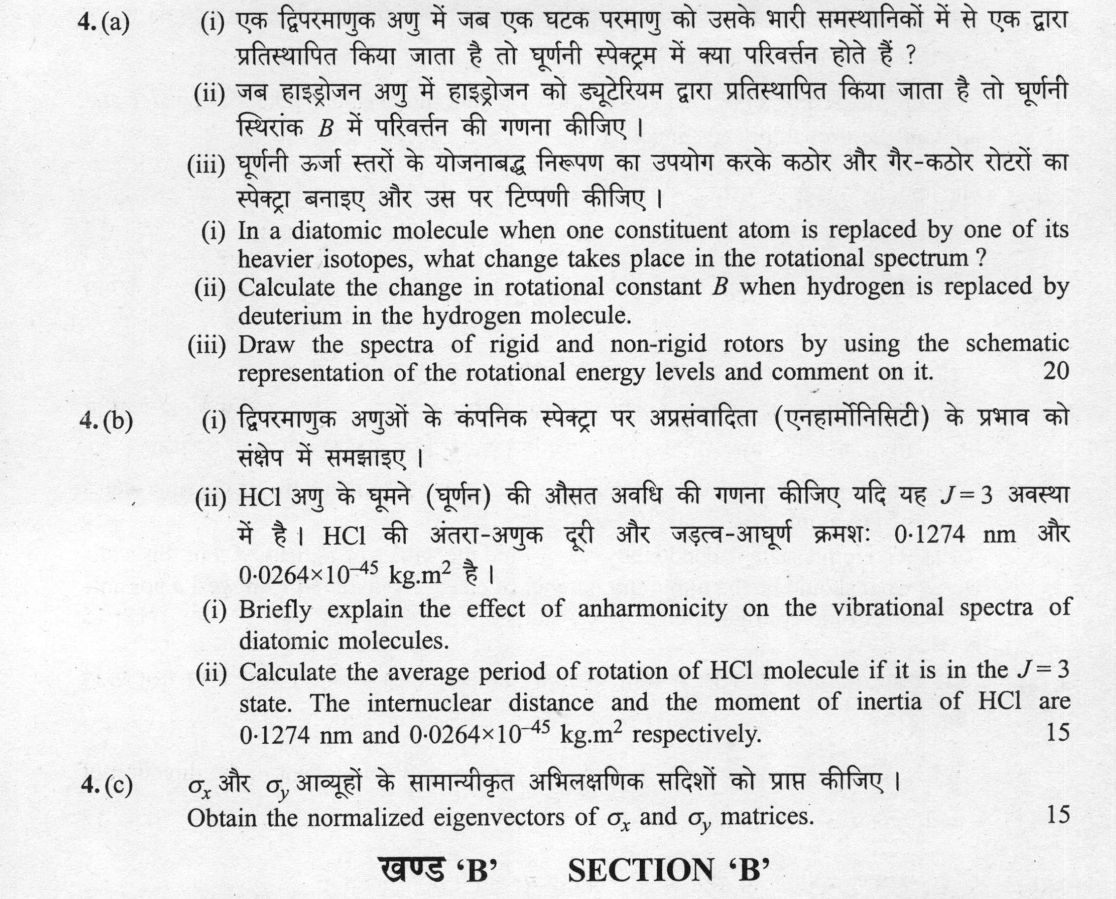
In a diatomic molecule when one constituent atom is replaced by one of its heavier isotopes, what change takes place in the rotational spectrum ?
Calculate the change in rotational constant B when hydrogen is replaced by deuterium in the hydrogen molecule.
Draw the spectra of rigid and non-rigid rotors by using the schematic representation of the rotational energy levels and comment on it. 20 marks
Briefly explain the effect of anharmonicity on the vibrational spectra of diatomic molecules.
Calculate the average period of rotation of HCl molecule if it is in the J = 3 state. The internuclear distance and the moment of inertia of HCl are 0·1274 nm and 0·0264×10⁻⁴⁵ kg.m² respectively. 15 marks
Obtain the normalized eigenvectors of σₓ and σᵧ matrices. 15 marks
हिंदी में प्रश्न पढ़ें
एक द्विपरमाणुक अणु में जब एक घटक परमाणु को उसके भारी समस्थानिकों में से एक द्वारा प्रतिस्थापित किया जाता है तो घूर्णी स्पेक्ट्रम में क्या परिवर्तन होते हैं ?
जब हाइड्रोजन अणु में हाइड्रोजन को ड्यूटेरियम द्वारा प्रतिस्थापित किया जाता है तो घूर्णी स्थिरांक B में परिवर्तन की गणना कीजिए ।
घूर्णी ऊर्जा स्तरों के योजनाबद्ध निरूपण का उपयोग करके कठोर और गैर-कठोर रोटरों का स्पेक्ट्रा बनाइए और उस पर टिप्पणी कीजिए । 20 अंक
द्विपरमाणुक अणुओं के कंपनिक स्पेक्ट्रा पर अप्रसंवादिता (एनहार्मोनिसिटी) के प्रभाव को संक्षेप में समझाइए ।
HCl अणु के घूमने (घूर्णन) की औसत अवधि की गणना कीजिए यदि यह J = 3 अवस्था में है । HCl की अंतरा-अणुक दूरी और जड़त्व-आघूर्ण क्रमशः: 0·1274 nm और 0·0264×10⁻⁴⁵ kg.m² है । 15 अंक
σₓ और σᵧ आव्यूहों के सामान्यीकृत अभिलक्षणिक सदिशों को प्राप्त कीजिए । 15 अंक
Model answer
Written by UPSC Answer Check against this question's marking rubric, to the expected length. UPSC does not publish answers for Mains — this is one way to score well, not an official key.
(a)(i) When one atom in a diatomic molecule is replaced by a heavier isotope, the reduced mass μ = m₁m₂/(m₁+m₂) increases. The bond length is almost unchanged, so the moment of inertia I = μr² increases. Since the rotational constant is B = h/(8π²Ic), B decreases. For a rigid rotor, rotational lines occur at 2B, 4B, 6B, … so the line spacing 2B decreases and the whole rotational spectrum shifts to lower frequency/wavenumber. If the original molecule is homonuclear and has no pure rotational dipole spectrum, isotopic substitution can break the symmetry and make a weak rotational spectrum appear.
(a)(ii) Taking the usual case of replacing one H atom by D in H₂ (i.e. H₂ → HD), let m_H = m and m_D ≈ 2m. Then μ(H₂) = m/2, μ(HD) = m(2m)/(m+2m) = 2m/3. Thus μ(HD)/μ(H₂) = (2m/3)/(m/2) = 4/3. Since B ∝ 1/μ, B(HD) = (3/4)B(H₂). Therefore ΔB = B(HD) − B(H₂) = −B(H₂)/4. Using B(H₂) ≈ 60.8 cm⁻¹, ΔB ≈ −15.2 cm⁻¹. If both H atoms are replaced (H₂ → D₂), then B(D₂) = B(H₂)/2 and ΔB ≈ −30.4 cm⁻¹.
(a)(iii) Rigid rotor: E_J = B J(J+1). Non-rigid rotor: E_J = B J(J+1) − D_c J²(J+1)², with D_c > 0 due to centrifugal stretching. Selection rule ΔJ = ±1.
Rigid levels: J=3 ───── 12B J=2 ───── 6B J=1 ───── 2B J=0 ───── 0
Rigid spectrum lines: |--2B--|--2B--|--2B--| … They are equally spaced.
Non-rigid levels: J=3 ───── 12B − 144D_c J=2 ───── 6B − 36D_c J=1 ───── 2B − 4D_c J=0 ───── 0
Non-rigid transition wavenumbers: ν = 2B(J+1) − 4D_c(J+1)³. So lines occur at 2B − 4D_c, 4B − 32D_c, 6B − 108D_c, … The spacing decreases as J increases; the lines crowd together at higher frequency. Thus the rigid-rotor spectrum is a series of equally spaced lines, while the non-rigid-rotor spectrum shows unequal spacing due to centrifugal distortion.
(b)(i) Anharmonicity is described by a Morse-type potential rather than a pure harmonic potential. In the harmonic oscillator, levels are equally spaced: E_v = (v+1/2)ħω, and the selection rule is Δv = ±1, giving only one fundamental band. With anharmonicity, E_v = ω_e(v+1/2) − ω_e x_e(v+1/2)² + … The level spacing decreases as v increases, and the levels converge near the dissociation limit. The selection rule relaxes so that weak overtones Δv = ±2, ±3, … also appear. The fundamental band shifts slightly, overtones occur at frequencies lower than exact multiples of the fundamental, and hot bands arise from thermally populated excited vibrational levels. Thus the vibrational spectrum is no longer a single equally spaced set of lines.
(b)(ii) For a rigid rotor, the angular momentum is L = √(J(J+1)) ħ = Iω. Hence ω = √(J(J+1)) ħ / I, and the average period is T = 2π/ω = 2πI/[ħ√(J(J+1))]. For J = 3, √(J(J+1)) = √12 = 2√3. Given I = 0.0264×10⁻⁴⁵ kg.m² = 2.64×10⁻⁴⁷ kg.m² and ħ = 1.0546×10⁻³⁴ J.s, T = 2π(2.64×10⁻⁴⁷)/[(1.0546×10⁻³⁴)(3.464)] T = 4.54×10⁻¹³ s. Thus the average rotational frequency is 1/T = 2.20×10¹² Hz. T ≈ 4.54×10⁻¹³ s.
(c) For σₓ = [[0, 1], [1, 0]], the eigenvalue equation is det(σₓ − λI) = 0: λ² − 1 = 0, so λ = ±1. For λ = +1: b = a, choose a = 1, b = 1. Normalized eigenvector: (1/√2)[[1], [1]]. For λ = −1: b = −a, choose a = 1, b = −1. Normalized eigenvector: (1/√2)[[1], [−1]].
For σᵧ = [[0, −i], [i, 0]], again det(σᵧ − λI) = 0 gives λ² − 1 = 0, so λ = ±1. For λ = +1: −i b = a and i a = b. Choose a = 1, b = i. Normalized eigenvector: (1/√2)[[1], [i]]. For λ = −1: −i b = −a and i a = −b. Choose a = 1, b = −i. Normalized eigenvector: (1/√2)[[1], [−i]]. These eigenvectors are mutually orthogonal and normalized up to an overall phase factor.
What "Calculate" is asking you to do
Apply the standard formula or schedule to data the question has already supplied — a table of readings, cost records, a balance sheet — and produce the number. The method is rarely in doubt; the marks sit in the named intermediate quantities, each of which has to appear as a labelled line.
Structure that answers it
Data as given → formula or standard treatment, named → substitution → each intermediate, labelled → result with units
Where marks are lost
Omitting an intermediate the marking scheme pays for separately, or rounding at an intermediate line so the final figure drifts. In commerce and accountancy, any figure in a statement that no numbered working note supports is treated as unearned.
How this answer will be evaluated
Approach
Framework: Principle > Setup and diagram > Derivation > Result and limiting case. (a(i)) explain: definition/context > points in order > small example > short close | (a(ii)) calculate: given > formula > substitution > result with units > interpretation | (a(iii)) describe: define > structure or process in order > labelled diagram > significance | (b(i)) explain: definition/context > points in order > small example > short close | (b(ii)) calculate: given > formula > substitution > result with units > interpretation | (c) derive: given > assumptions > stepwise derivation > result > check Full marks: Complete derivations with all steps, correct units, and physical interpretation
Key points expected
- State that heavier isotope increases reduced mass
- State that moment of inertia increases
- State that rotational constant B decreases
- State that spectral lines shift to lower frequency
- State formula B = h / (8π²I)
- Calculate reduced mass for H2 and D2
- Calculate ratio B_D2 / B_H2
- Provide final numerical value with units
Evaluation rubric
Each sub-part is marked on its own, against the marks and word limit printed on the paper.
- (a(i)) Explain the shift in rotational spectrum lines due to isotope substitution.
explain— definition/context → points in order → small example → short close
Must cover
- State that heavier isotope increases reduced mass
- State that moment of inertia increases
- State that rotational constant B decreases
- State that spectral lines shift to lower frequency
Loses marks
- Claiming B increases with mass
- Ignoring reduced mass concept
Earns more
- Mention line spacing decreases
- Mention isotope shift direction
Extra mark
- Mention specific isotope example
- (a(ii)) Calculate the change in rotational constant B for H2 to D2.
calculate— given → formula → substitution → result with units → interpretation
Must cover
- State formula B = h / (8π²I)
- Calculate reduced mass for H2 and D2
- Calculate ratio B_D2 / B_H2
- Provide final numerical value with units
Loses marks
- Using atomic mass instead of reduced mass
- Dropping units in final answer
Earns more
- Show step-by-step mass calculation
- Mention assumption of rigid rotor
Extra mark
- Mention physical implication of shift
- (a(iii)) Draw and compare spectra of rigid and non-rigid rotors.
describe— define → structure or process in order → labelled diagram → significance
Must cover
- Draw energy level diagram for rigid rotor
- Draw energy level diagram for non-rigid rotor
- Show convergence of lines in non-rigid case
- Comment on centrifugal distortion effect
Loses marks
- Drawing only one type of rotor
- Missing convergence in non-rigid diagram
Earns more
- Label energy levels J=0, 1, 2...
- Mention centrifugal distortion constant D
Extra mark
- Mention specific molecule example
- (b(i)) Explain the effect of anharmonicity on vibrational spectra.
explain— definition/context → points in order → small example → short close
Must cover
- Define anharmonicity in molecular vibrations
- Explain deviation from harmonic oscillator
- Mention appearance of overtones
- Explain decreasing spacing of energy levels
Loses marks
- Treating anharmonicity as negligible
- Confusing with rotational effects
Earns more
- Mention Morse potential
- Explain intensity of overtones
Extra mark
- Mention specific molecule example
- (b(ii)) Calculate average period of rotation for HCl in J=3 state.
calculate— given → formula → substitution → result with units → interpretation
Must cover
- State formula for rotational energy E_J
- Calculate energy for J=3 state
- Use E = h/τ to find period
- Provide final answer with units
Loses marks
- Using classical mechanics directly
- Dropping units in calculation
Earns more
- Show moment of inertia calculation
- Mention quantum mechanical nature
Extra mark
- Mention comparison with classical period
- (c) Obtain normalized eigenvectors of σx and σy matrices.
derive— given → assumptions → stepwise derivation → result → check
Must cover
- Write down σx and σy matrices
- Set up eigenvalue equation
- Solve for eigenvalues
- Find and normalize eigenvectors
Loses marks
- Skipping normalization step
- Incorrect matrix representation
Earns more
- Show characteristic equation
- Verify normalization condition
Extra mark
- Mention Pauli matrix properties
Practice this exact question
Write your answer and it is marked point by point against the model answer above — what you covered, what you missed, what you got wrong.
Evaluate my answer →More from Physics 2022 Paper II
- Q1 (a) What is de Broglie concept of matter wave ? Evaluate de Broglie wavelength of Helium…
- Q2 (a) Set up the Schrodinger's wave equation for one dimensional potential barrier and obta…
- Q3 (a) What is the spin wave function (for s=1/2) if the spin component in the direction of…
- Q4 (a) (i) In a diatomic molecule when one constituent atom is replaced by one of its heavie…
- Q5 (a) If the nuclear force is charge independent and a neutron and proton form a bound stat…
- Q6 (a) Show that for a specific value (n, l), there exists a large degeneracy relative to th…
- Q7 (a) Explain the drawbacks of Einstein's theory of specific heat and how it was overcome b…