Paper II — Q6
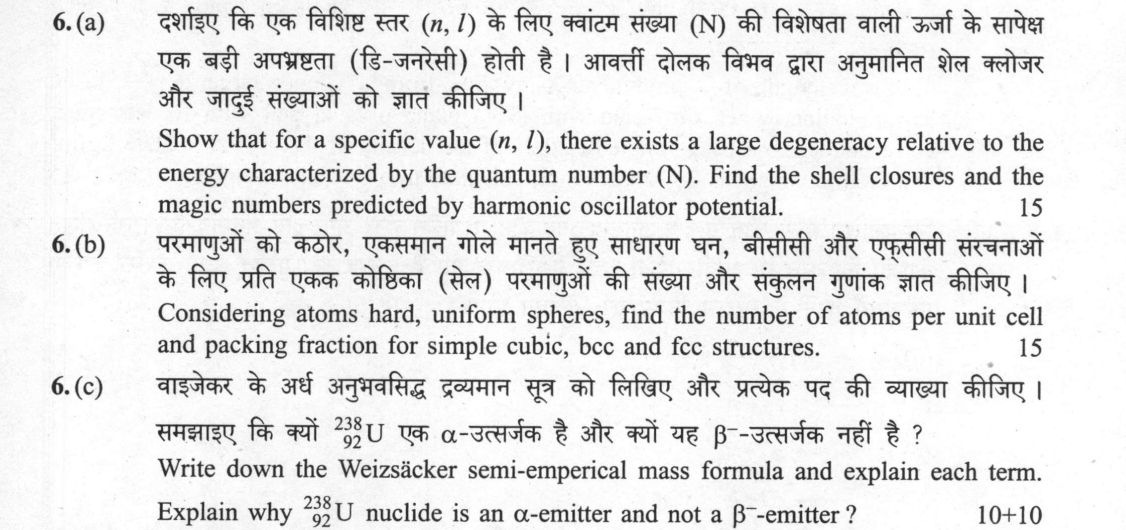
(a) Show that for a specific value (n, l), there exists a large degeneracy relative to the energy characterized by the quantum…
Show that for a specific value (n, l), there exists a large degeneracy relative to the energy characterized by the quantum number (N). Find the shell closures and the magic numbers predicted by harmonic oscillator potential. 15 marks
Considering atoms hard, uniform spheres, find the number of atoms per unit cell and packing fraction for simple cubic, bcc and fcc structures. 15 marks
Write down the Weizsäcker semi-empirical mass formula and explain each term. Explain why ₉₂²³⁸U nuclide is an α-emitter and not a β⁻-emitter ? (10+10 marks)
हिंदी में प्रश्न पढ़ें
दर्शाइए कि एक विशिष्ट स्तर (n, l) के लिए क्वांटम संख्या (N) की विशेषता वाली ऊर्जा के सापेक्ष एक बड़ी अपभ्रष्टता (डि-जनरेसी) होती है। आवर्ती दोलक विभव द्वारा अनुमानित शेल क्लोजर और जादुई संख्याओं को ज्ञात कीजिए। (15 अंक)
परमाणुओं को कठोर, एकसमान गोले मानते हुए साधारण घन, बीसीसी और एफसीसी संरचनाओं के लिए प्रति एकक कोष्ठिका (सेल) परमाणुओं की संख्या और संकुलन गुणांक ज्ञात कीजिए। (15 अंक)
वाइज़ैकर के अर्ध अनुभवसिद्ध द्रव्यमान सूत्र को लिखिए और प्रत्येक पद की व्याख्या कीजिए। समझाइए कि क्यों ₉₂²³⁸U एक α-उत्सर्जक है और क्यों यह β⁻-उत्सर्जक नहीं है ? (10+10 अंक)
Model answer
Written by UPSC Answer Check against this question's marking rubric, to the expected length. UPSC does not publish answers for Mains — this is one way to score well, not an official key.
(a) For a 3D isotropic harmonic oscillator, H = −(ħ²/2m)∇² + ½mω²r². In spherical coordinates the energy eigenvalues are E_n,l = (2n + l + 3/2) ħω, n = 0,1,2,...; l = 0,1,2,... Define N = 2n + l. Then E_N = (N + 3/2) ħω. Thus the energy depends only on N, not separately on n and l. For a fixed N, l can be N, N−2, N−4,... with the same parity as N, and n = (N−l)/2. Hence many (n,l) states are degenerate.
For a given l, the magnetic degeneracy is (2l+1). Therefore the orbital degeneracy of level N is ∑_l=N,N−2,... (2l+1) = (N+1)(N+2)/2. Including spin s = 1/2 multiplies by 2, so D_N = (N+1)(N+2). The cumulative occupancy up to level N is S_N = ∑_N'=0^N (N'+1)(N'+2) = (N+1)(N+2)(N+3)/3. Evaluating:
- N = 0: S = 2
- N = 1: S = 8
- N = 2: S = 20
- N = 3: S = 40
- N = 4: S = 70
- N = 5: S = 112
- N = 6: S = 168
Thus the pure harmonic-oscillator shell closures are 2, 8, 20, 40, 70, 112, 168. With the spin-orbit interaction included, the empirical magic numbers become 2, 8, 20, 28, 50, 82, 126.
(b) Let atomic radius be r and assume hard uniform spheres touch along nearest-neighbour directions.
Simple cubic: Atoms per unit cell = 8 corners × 1/8 = 1. Touching along cube edge: a = 2r. Packing fraction f = [1 × (4/3)πr³]/a³ = [(4/3)πr³]/(8r³) = π/6 ≈ 0.524.
BCC: Atoms per unit cell = 8 corners × 1/8 + 1 body centre = 2. Touching along body diagonal: √3 a = 4r, so a = 4r/√3. Packing fraction f = [2 × (4/3)πr³]/[64r³/(3√3)] = π√3/8 ≈ 0.680.
FCC: Atoms per unit cell = 8 corners × 1/8 + 6 face centres × 1/2 = 4. Touching along face diagonal: √2 a = 4r, so a = 2√2 r. Packing fraction f = [4 × (4/3)πr³]/[(2√2 r)³] = π/(3√2) = π√2/6 ≈ 0.740.
Thus numbers per unit cell are 1, 2, 4 and packing fractions are π/6, π√3/8, π√2/6 for SC, BCC, FCC respectively.
(c)(i) The Weizsäcker semi-empirical mass formula is B(A,Z) = a_V A − a_S A^(2/3) − a_C Z(Z−1)/A^(1/3) − a_A (A−2Z)²/A + δ(A,Z), where δ = +a_P A^(−3/4) for even-even, δ = 0 for odd-A, δ = −a_P A^(−3/4) for odd-odd. Typical coefficients are a_V ≈ 15.75 MeV, a_S ≈ 17.8 MeV, a_C ≈ 0.711 MeV, a_A ≈ 23.7 MeV, a_P ≈ 34 MeV.
- Volume term a_V A: short-range nuclear attraction saturates; binding is proportional to A.
- Surface term −a_S A^(2/3): surface nucleons are less bound; area ∝ A^(2/3).
- Coulomb term −a_C Z(Z−1)/A^(1/3): proton-proton repulsion in a sphere of radius ∝ A^(1/3).
- Asymmetry term −a_A (A−2Z)²/A: Pauli principle favours N ≈ Z; neutron excess costs energy.
- Pairing term δ: even-even nuclei are extra stable, odd-odd less stable, odd-A intermediate.
(c)(ii) For α-decay: ₉₂²³⁸U → ₉₀²³⁴Th + ₂⁴He. Qα = B(234,90) + B(4,2) − B(238,92). Using the above SEMF coefficients: B(238,92) ≈ 1814.6 MeV, B(234,90) ≈ 1790.6 MeV, B(4,2) = 28.3 MeV (helium binding energy). Hence Qα ≈ 1790.6 + 28.3 − 1814.6 = +4.3 MeV > 0.
For β⁻-decay: ₉₂²³⁸U → ₉₃²³⁸Np + e⁻ + anti-ν. Qβ⁻ = 0.782 MeV + B(238,93) − B(238,92). Using SEMF, B(238,93) ≈ 1813.4 MeV, so Qβ⁻ ≈ 0.782 + 1813.4 − 1814.6 = −0.4 MeV < 0.
Thus β⁻-decay is energetically forbidden. Alpha decay is allowed and favoured because Z = 92 is very large: reducing Z by 2 lowers Coulomb repulsion strongly, and the daughter ₉₀²³⁴Th is even-even, gaining pairing stability. β⁻-decay would increase Z to 93, increase Coulomb energy, and produce odd-odd ₉₃²³⁸Np, losing pairing stability. Therefore ₉₂²³⁸U is an α-emitter and not a β⁻-emitter.
What "Derive" is asking you to do
Reach the stated expression from a starting relation, justifying every step. The destination is printed in the question, so only the route earns marks, and the assumptions you work under are part of that route.
Structure that answers it
Assumptions and notation defined → starting relation or governing equation → each step with its justification → the required expression → limiting case or boundary check
Where marks are lost
Writing the standard result first and fitting three lines to it, which an examiner reads at a glance. Marks also go on assumptions left unstated — lossless medium, small amplitude, errors independent with zero mean — and on symbols used before they are defined, even when the question says usual notations.
How this answer will be evaluated
Approach
Framework: Quantum Mechanics (Harmonic Oscillator Model) & Solid State Physics (Crystal Structures) & Nuclear Physics (Semi-empirical Mass Formula). (a) derive: given > assumptions > stepwise derivation > result > check | (b) derive: given > assumptions > stepwise derivation > result > check | (c) explain: definition/context > points in order > small example > short close Full marks: Rigorous derivations with correct values and clear physical interpretation.
Key points expected
- Degeneracy g = (N+1)(N+2)/2
- Magic numbers 2, 8, 20, 40, 70
- Packing fractions 0.52, 0.68, 0.74
- Weizsäcker terms: Volume, Surface, Coulomb, Asymmetry, Pairing
- U-238 alpha decay due to Coulomb instability
Evaluation rubric
Each sub-part is marked on its own, against the marks and word limit printed on the paper.
- (a) Derive degeneracy for (n,l) and list magic numbers from harmonic oscillator potential. 15 marks
derive— given → assumptions → stepwise derivation → result → check
Must cover
- Define total quantum number N = 2n + l
- Derive degeneracy formula g = (N+1)(N+2)/2
- List shell closures for N=0, 1, 2, 3, 4
- List magic numbers: 2, 8, 20, 40, 70
Loses marks
- Listing numbers without derivation
- Confusing n and N
Earns more
- Mention spin degeneracy factor of 2
- Note failure to predict 50, 82, 126
Extra mark
- Comparison with actual magic numbers
- (b) Calculate atoms per unit cell and packing fraction for SC, BCC, and FCC. 15 marks
derive— given → assumptions → stepwise derivation → result → check
Must cover
- Derive atoms/cell: SC=1, BCC=2, FCC=4
- Derive lattice constant a in terms of radius R
- Calculate packing fraction for each structure
- State final values: 0.52, 0.68, 0.74
Loses marks
- Stating values without derivation
- Incorrect geometry for BCC/FCC
Earns more
- Labelled diagrams of unit cells
- Explicit volume calculations
Extra mark
- Mentioning 'hard sphere' assumption explicitly
- (c) Write Weizsäcker formula, explain terms, and justify U-238 alpha decay.
explain— definition/context → points in order → small example → short close
Must cover
- Write full semi-empirical mass formula
- Define volume, surface, Coulomb, asymmetry, pairing terms
- Explain alpha decay via Coulomb repulsion
- Explain why beta-minus is not favored
Loses marks
- Missing any term in the formula
- Vague explanation of decay mode
Earns more
- Mentioning Q-value for alpha decay
- Reference to neutron-proton ratio
Extra mark
- Mentioning tunneling probability
Practice this exact question
Write your answer and it is marked point by point against the model answer above — what you covered, what you missed, what you got wrong.
Evaluate my answer →More from Physics 2022 Paper II
- Q3 (a) What is the spin wave function (for s=1/2) if the spin component in the direction of…
- Q4 (a) (i) In a diatomic molecule when one constituent atom is replaced by one of its heavie…
- Q5 (a) If the nuclear force is charge independent and a neutron and proton form a bound stat…
- Q6 (a) Show that for a specific value (n, l), there exists a large degeneracy relative to th…
- Q7 (a) Explain the drawbacks of Einstein's theory of specific heat and how it was overcome b…
- Q8 (a) Show that for an n-type semiconductor, the Fermi level lies midway between the donor…