Paper I — Q1
Answer the following questions in about 150 words each: (a) How is descriptive type of research different from diagnostic…
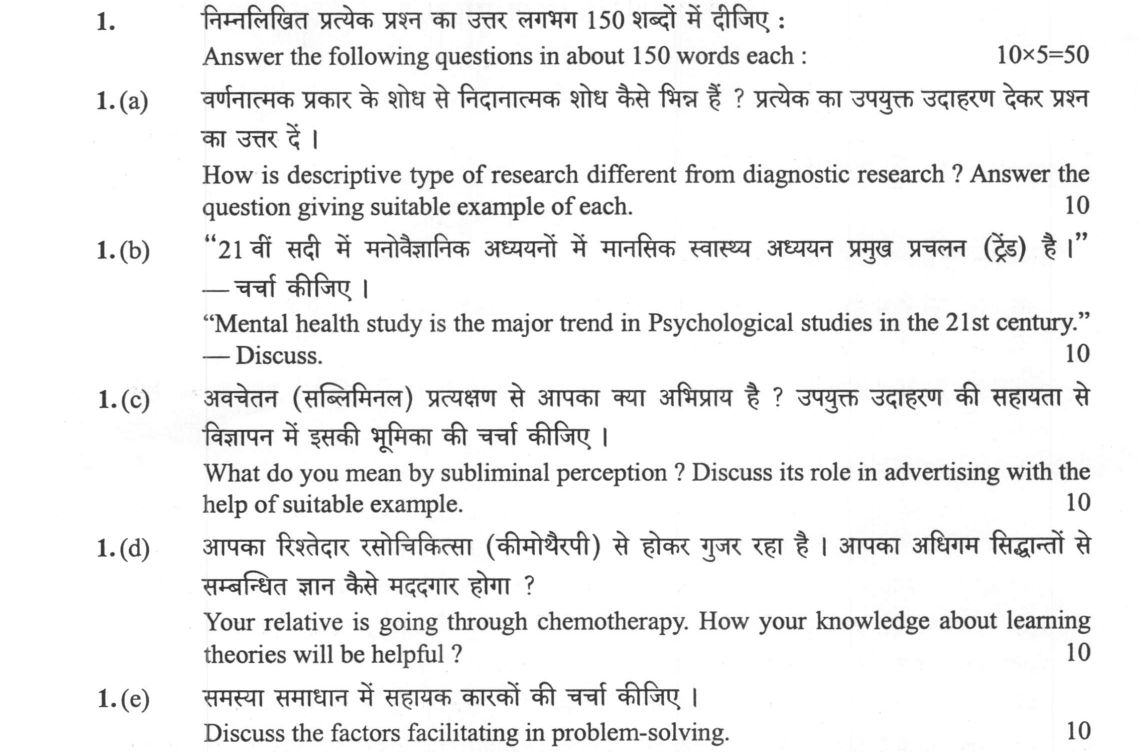
Answer the following questions in about 150 words each:
How is descriptive type of research different from diagnostic research? Answer the question giving suitable example of each. 10 marks
"Mental health study is the major trend in Psychological studies in the 21st century." — Discuss. 10 marks
What do you mean by subliminal perception? Discuss its role in advertising with the help of suitable example. 10 marks
Your relative is going through chemotherapy. How your knowledge about learning theories will be helpful? 10 marks
Discuss the factors facilitating in problem-solving. 10 marks
हिंदी में प्रश्न पढ़ें
निम्नलिखित प्रत्येक प्रश्न का उत्तर लगभग 150 शब्दों में दीजिए :
वर्णनात्मक प्रकार के शोध से निदानात्मक शोध कैसे भिन्न है ? प्रत्येक का उपयुक्त उदाहरण देकर प्रश्न का उत्तर दें । (10 अंक)
"21 वीं सदी में मनोवैज्ञानिक अध्ययनों में मानसिक स्वास्थ्य अध्ययन प्रमुख प्रचलन (ट्रेंड) है ।" — चर्चा कीजिए । (10 अंक)
अवचेतन (सब्लिमिनल) प्रत्यक्षण से आपका क्या अभिप्राय है ? उपयुक्त उदाहरण की सहायता से विज्ञापन में इसकी भूमिका की चर्चा कीजिए । (10 अंक)
आपका रिश्तेदार रसोचिकित्सा (कीमोथेरेपी) से होकर गुजर रहा है । आपका अधिगम सिद्धांतों से संबंधित ज्ञान कैसे मददगार होगा ? (10 अंक)
समस्या समाधान में सहायक कारकों की चर्चा कीजिए । (10 अंक)
Model answer
Written by UPSC Answer Check against this question's marking rubric, to the 150-word length. UPSC does not publish answers for Mains — this is one way to score well, not an official key.
(a) Descriptive and diagnostic research differ mainly in purpose, method and outcome. Descriptive research asks “what is happening?” It records behaviour, attitudes or prevalence without manipulating variables, using surveys, observation, census or case series. It may be quantitative or qualitative, but it does not establish causes. Its outcome is a frequency or pattern description. For example, Census 2011 described literacy, age structure and migration in India. Diagnostic research asks “why is it happening?” It seeks causes, correlates and mechanisms through case studies, interviews, psychological tests, clinical observation and sometimes experimental or quasi-experimental methods. It often uses differential diagnosis to separate possible causes. Its outcome is causal or explanatory. For example, a NIMHANS diagnostic study on dementia may use neuropsychological tests, medical history and interviews to identify aetiological factors such as vascular risk, depression or neurodegeneration. Thus descriptive research maps the phenomenon; diagnostic research explains it.
(b) Mental health as a 21st-century trend is defensible but needs qualification. The trend is visible in policy and public need: WHO’s Mental Health Action Plan 2013-2030 placed mental health at the centre of health systems; India’s National Mental Health Programme and Tele-MANAS expanded awareness and tele-mental health access, especially after the pandemic. Post-COVID studies in India report higher anxiety, depression and stress, making prevention, counselling and digital interventions urgent. Research also benefits from neuroplasticity studies, which connect brain, body and social context. However, it would be wrong to say mental health has displaced other areas. Cognitive neuroscience and AI-driven behavioural analysis remain dominant in laboratories and publications. The more accurate claim is that mental health has become a cross-cutting priority: it links clinical, community, educational and policy psychology, and it demands Indian data on stigma, rural access and affordability. It also needs affordable local services.
(c) Subliminal perception means processing a stimulus below the threshold of conscious awareness, so the person does not knowingly attend to it. In advertising, its claimed role is to influence preferences or purchases without the viewer’s awareness. The famous 1957 Vicary “Eat Popcorn/Drink Coca-Cola” cinema study became the standard example, but it was later admitted to be fabricated or hoaxed, and subsequent evidence for strong subliminal persuasion is weak and often inconsistent. Therefore, subliminal advertising should not be presented as a proven sales technique. In India, allegations that IPL broadcasts or digital ads contain hidden brand flashes are mostly unverified; many effects attributed to “subliminal” cues are better explained by repeated supraliminal exposure, mere exposure, or conscious priming. The real relevance is ethical and methodological: advertisers may use rapid cues, but if they are consciously visible they are not subliminal, and claims of hidden influence require strict experimental controls.
(d) Learning theories can guide care for a relative undergoing chemotherapy in practical, humane ways. Classical conditioning explains why chemotherapy can become a conditioned nausea trigger: the hospital smell, food eaten before treatment, or the sight of medicine may pair with the unconditioned nausea of drugs, producing anticipatory vomiting or food aversion. Knowledge helps prevent this by changing the context: offering bland, preferred foods away from the hospital, using distraction, and, where appropriate, counterconditioning with pleasant cues. Operant conditioning supports adherence: small positive reinforcement, such as praise, rest breaks, or preferred activities after completing anti-emetics or attending appointments, can strengthen cooperative behaviour without coercion. Observational learning matters because the relative can model coping from family members, nurses or peer cancer-care groups in India, seeing calm breathing, asking questions, and seeking help. In India’s cancer-care context, family and nurses can provide such support. Together, these theories reduce distress and improve daily functioning.
(e) Problem-solving is facilitated by several cognitive, emotional and social factors. Expertise helps because experts store rich schemas and retrieve relevant strategies, although mental sets can also narrow thinking. Incubation allows unconscious processing after an impasse, often producing a fresh perspective. Analogical reasoning enables transfer from a known problem to a new one, as when an Indian public-health officer uses a previous outbreak model to plan vaccination logistics. Working-memory capacity is crucial for holding constraints, comparing alternatives and monitoring progress; it can be supported by notes or diagrams. Emotional regulation matters because anxiety narrows attention, while calm persistence allows systematic search. Cultural tools and social support also facilitate solving: Vygotsky’s zone of proximal development shows that hints, collaboration, language and scaffolding from teachers or peers can carry a person beyond unaided ability. In Indian settings, mentoring and local examples make this concrete. A way forward is to combine accurate diagnosis, mental-health priority, rigorous advertising tests, compassionate learning-based care, and social-emotional support.
What "Discuss" is asking you to do
Lay the issue out from more than one side — how it arose, what is claimed for it, what is held against it, and where it now stands. UPSC attaches discuss to broad topics with several live dimensions, so coverage of the dimensions earns more than the strength of your opinion.
Structure that answers it
Set the issue up → the case as it is made → the case against → the dimension both sides leave out → where the balance now lies
Where marks are lost
Listing facts with no thread between them, or arguing one side throughout and calling it a discussion.
How this answer will be evaluated
Approach
Framework: Define > Theory or model > Evidence > Application. (a) compare: paired headings or table > key differences > significance > conclusion | (b) discuss: intro > 3-4 dimensions > example > balanced close | (c) explain: definition/context > points in order > small example > short close | (d) explain: definition/context > points in order > small example > short close | (e) discuss: intro > 3-4 dimensions > example > balanced close Full marks: Precise definitions, named theories/studies, clear application, and balanced discussion.
Key points expected
- Define descriptive research (what/who/where)
- Define diagnostic research (why/how)
- Provide suitable example of descriptive research
- Provide suitable example of diagnostic research
- Contextualize the shift from pathology to well-being
- Identify 3-4 key drivers (e.g., stress, urbanization, digital age)
- Mention specific areas (e.g., clinical, organizational, positive psych)
- Conclude with the significance of this trend
Evaluation rubric
Each sub-part is marked on its own, against the marks and word limit printed on the paper.
- (a) Distinguish descriptive from diagnostic research with examples. 10 marks · 150 words
compare— paired headings or table → key differences → significance → conclusion
Must cover
- Define descriptive research (what/who/where)
- Define diagnostic research (why/how)
- Provide suitable example of descriptive research
- Provide suitable example of diagnostic research
Loses marks
- Confusing descriptive with experimental research
- Providing only definitions without examples
Earns more
- Mention specific research designs (e.g., survey vs case study)
- Highlight the 'status quo' vs 'problem analysis' distinction
Extra mark
- Reference to specific methodological tools (e.g., Likert scale vs interview)
- (b) Analyze the rise of mental health as a major trend in 21st-century psychology. 10 marks · 150 words
discuss— intro → 3-4 dimensions → example → balanced close
Must cover
- Contextualize the shift from pathology to well-being
- Identify 3-4 key drivers (e.g., stress, urbanization, digital age)
- Mention specific areas (e.g., clinical, organizational, positive psych)
- Conclude with the significance of this trend
Loses marks
- Generalizing without specific psychological context
- Ignoring the '21st century' temporal constraint
Earns more
- Reference to WHO reports or global statistics
- Mention of 'Positive Psychology' movement (Seligman)
Extra mark
- Citing specific recent studies or global mental health initiatives
- (c) Define subliminal perception and its application in advertising. 10 marks · 150 words
explain— definition/context → points in order → small example → short close
Must cover
- Define subliminal perception (below threshold of awareness)
- Explain the mechanism of influence in advertising
- Provide a suitable example of subliminal advertising
- Briefly mention ethical or scientific debate (optional but good)
Loses marks
- Confusing subliminal with supraliminal perception
- Failing to link the concept to advertising specifically
Earns more
- Mentioning 'flash frames' or 'hidden messages'
- Referencing specific studies (e.g., Vicary's 1957 claim)
Extra mark
- Citing specific legal regulations on subliminal advertising
- (d) Apply learning theories to support a relative undergoing chemotherapy. 10 marks · 150 words
explain— definition/context → points in order → small example → short close
Must cover
- Identify relevant learning theories (e.g., Operant, Classical, Social)
- Apply theory to a specific chemotherapy challenge (e.g., nausea, pain)
- Suggest a practical intervention based on the theory
- Explain the expected outcome of the intervention
Loses marks
- Giving generic medical advice instead of psychological application
- Failing to name specific learning theories
Earns more
- Mentioning 'Systematic Desensitization' or 'Cognitive Behavioral Therapy'
- Referencing 'Classical Conditioning' for nausea (e.g., Pavlovian)
Extra mark
- Citing specific therapeutic protocols used in oncology
- (e) Identify and discuss factors that facilitate problem-solving. 10 marks · 150 words
discuss— intro → 3-4 dimensions → example → balanced close
Must cover
- Define problem-solving in psychological context
- List 3-4 facilitating factors (e.g., insight, incubation, prior knowledge)
- Explain how each factor aids the process
- Provide a brief example for at least one factor
Loses marks
- Listing factors without explaining their facilitative role
- Confusing problem-solving with decision-making
Earns more
- Mentioning 'Gestalt' principles (e.g., functional fixedness)
- Referencing 'Duncker's Candle Problem' or similar classic studies
Extra mark
- Citing specific cognitive models of problem-solving (e.g., Newell & Simon)
Practice this exact question
Write your answer and it is marked point by point against the model answer above — what you covered, what you missed, what you got wrong.
Evaluate my answer →More from Psychology 2023 Paper I
- Q1 Answer the following questions in about 150 words each: (a) How is descriptive type of re…
- Q2 (a) Explain in detail the use of computer technology in psychological studies. Give your…
- Q3 (a) Describe the factors influencing perceptual organization with reference to past exper…
- Q4 (a) Compare and contrast between programmed and probability learning and also highlight t…