Paper I — Q2
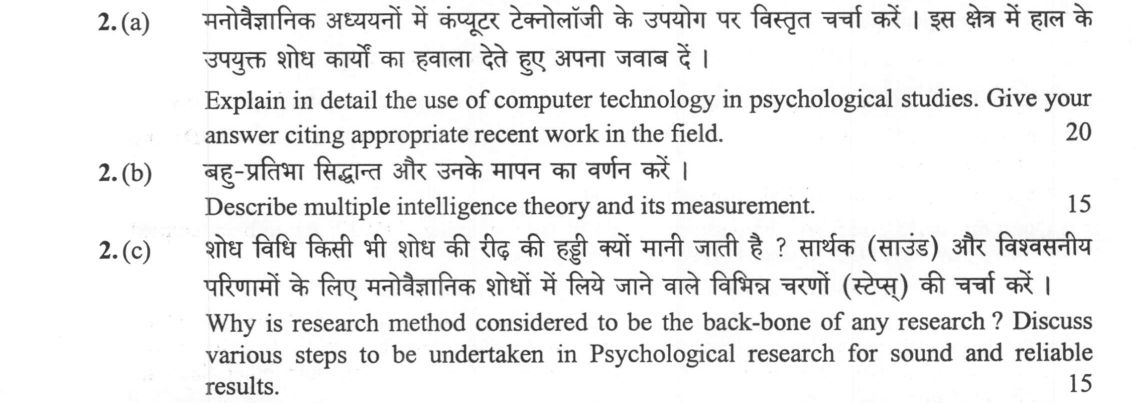
(a) Explain in detail the use of computer technology in psychological studies. Give your answer citing appropriate recent work in…
Explain in detail the use of computer technology in psychological studies. Give your answer citing appropriate recent work in the field. 20 marks
Describe multiple intelligence theory and its measurement. 15 marks
Why is research method considered to be the back-bone of any research? Discuss various steps to be undertaken in Psychological research for sound and reliable results. 15 marks
हिंदी में प्रश्न पढ़ें
मनोवैज्ञानिक अध्ययनों में कम्प्यूटर टेक्नोलॉजी के उपयोग पर विस्तृत चर्चा करें । इस क्षेत्र में हाल के उपयुक्त शोध कार्यों का हवाला देते हुए अपना जवाब दें । (20 अंक)
बहु-प्रतिभा सिद्धांत और उनके मापन का वर्णन करें । (15 अंक)
शोध विधि किसी भी शोध की रीढ़ की हड्डी क्यों मानी जाती है ? सार्थक (साउंड) और विश्वसनीय परिणामों के लिए मनोवैज्ञानिक शोधों में लिये जाने वाले विभिन्न चरणों (स्टेप्स) की चर्चा करें । (15 अंक)
Model answer
Written by UPSC Answer Check against this question's marking rubric, to the expected length. UPSC does not publish answers for Mains — this is one way to score well, not an official key.
Psychological research depends on technology because it turns mental processes into measurable events. Computers now support capture, simulation, modelling, and analysis, so they shape the causal chain from stimulus to inference.
Computer technology in psychological studies In neuroimaging, fMRI records BOLD changes with temporal resolution on the order of seconds, while EEG/MEG capture neural activity with millisecond precision. Kroenke et al. (2021) show computational psychiatry uses models to test mechanisms of psychiatric symptoms, moving beyond mere correlations. Machine learning extends this by predicting behaviour or diagnosis from large datasets; Bzdok et al. (2018) show precision psychiatry can stratify risk, though they caution about data quality and bias. Virtual reality creates controlled, immersive environments; Carl et al. (2019) found VR exposure therapy effective and safe for PTSD, because graded exposure can be repeated with precise control over threat cues. Online platforms such as Amazon Mechanical Turk have made large-scale behavioural data collection feasible; Buhrmester et al. (2019) show online samples can replicate paper-based findings when screening is careful. Smartphone-based ecological momentary assessment reduces retrospective recall bias by sampling experience in real time, as reviewed by Kording et al. (2020). In India, NIMHANS has advanced digital neuropsychology and tele-neuropsychology, using computerised cognitive batteries and remote assessment to reach underserved populations (NIMHANS, 2023). Big data analytics and digital ethics are now central: Borenstein et al. (2021) argue digital mental health research must address consent, privacy, data ownership, and algorithmic fairness.
Multiple intelligence theory and measurement Gardner’s multiple intelligence theory proposes that intelligence is not a single general factor but a set of relatively independent capacities: linguistic, logical-mathematical, spatial, musical, bodily-kinesthetic, interpersonal, intrapersonal, and naturalist. Each has a plausible neurobiological basis: language involves left temporal-frontal networks; mathematical reasoning involves parietal regions; spatial ability involves parietal-temporal areas; music involves auditory and temporal regions; bodily-kinesthetic skill involves motor, cerebellar, and somatosensory circuits; interpersonal and intrapersonal abilities involve social-cognitive and self-monitoring networks; naturalist intelligence involves pattern recognition in biological categories. Measurement therefore cannot rely only on paper-and-pencil IQ tests. Gardner emphasised performance-based assessment, portfolios, and real-world tasks that show how a person uses intelligences in context. In practice, tools such as the Multiple Intelligences Inventory or profile questionnaires ask respondents to rate strengths, while classroom and clinical assessment uses portfolios, project work, demonstrations, and structured interviews. The main critique is that many MI measures lack strong standardisation, test-retest reliability, and norming, and in the Indian context they may carry cultural bias if tasks assume particular schooling, language, or urban experiences.
Research method as the backbone Research method is the backbone because it determines whether an observed effect can be attributed to the variable of interest. Method refers to specific procedures; methodology refers to the logic that justifies those procedures. A sound method controls or reduces extraneous variance, protects objectivity, internal validity, and replicability, and supports external generalisability without guaranteeing it. The steps are causal: identifying a problem focuses the study; literature review locates gaps and prior evidence; hypothesis formulation states expected relations; design chooses experimental, correlational, or mixed methods; sampling determines who can be generalised to; data collection standardises measurement; analysis tests the hypothesis; interpretation links results to theory; report writing allows replication. APA ethics run through all stages, requiring informed consent, confidentiality, minimal harm, and transparent reporting.
Conclusion Computer technology strengthens psychological research by making measurement faster, richer, and more ecologically valid, while methodological rigour keeps those tools interpretable. The same digital tools that enable VR exposure, machine-learning prediction, and tele-neuropsychology also create new assessment modes for multiple intelligences, but only when embedded in ethical, replicable, and culturally sensitive methods.
What "Explain" is asking you to do
Make the working of something clear — what sets it off, what follows from what, and what it produces. Explain is the Commission's mechanism word: it dominates the technical papers and the “explain why” stems, where the marks sit in the causal chain and not in the label.
Structure that answers it
State what it is → the initiating condition → the chain of cause, step by step → an instance where it plays out → what the chain produces
Where marks are lost
Describing what something looks like instead of why it works that way. Naming the stages without linking them reads as description too.
How this answer will be evaluated
Approach
Framework: Define > Theory or model > Evidence > Application. (a) explain: definition/context > points in order > small example > short close | (b) describe: define > structure or process in order > labelled diagram > significance | (c) discuss: intro > 3-4 dimensions > example > balanced close Full marks: Comprehensive, well-structured, with specific examples and recent citations.
Key points expected
- Define the role of computer technology in psych research
- Explain specific applications (e.g., EEG, fMRI, AI, VR)
- Cite appropriate recent work in the field
- Provide a short example of a study using tech
- Define Multiple Intelligence Theory (MI)
- List the 8 intelligences (Gardner)
- Explain how MI is measured (assessment methods)
- Mention the significance of MI in education
Evaluation rubric
Each sub-part is marked on its own, against the marks and word limit printed on the paper.
- (a) Detail the use of computer technology in psychological studies with recent citations. 20 marks
explain— definition/context → points in order → small example → short close
Must cover
- Define the role of computer technology in psych research
- Explain specific applications (e.g., EEG, fMRI, AI, VR)
- Cite appropriate recent work in the field
- Provide a short example of a study using tech
Loses marks
- General talk on computers without psych context
- No recent citations (pre-2010 only)
- Theory without evidence of application
Earns more
- Mention specific software (SPSS, R, MATLAB)
- Discuss online data collection methods
- Reference specific recent studies (post-2015)
- Mention neuroimaging techniques
Extra mark
- Name a specific recent AI-based diagnostic tool
- Cite a specific 2020+ paper on VR in therapy
- (b) Describe multiple intelligence theory and its measurement. 15 marks
describe— define → structure or process in order → labelled diagram → significance
Must cover
- Define Multiple Intelligence Theory (MI)
- List the 8 intelligences (Gardner)
- Explain how MI is measured (assessment methods)
- Mention the significance of MI in education
Loses marks
- Confusing MI with general intelligence
- Listing intelligences without explaining measurement
- No mention of Gardner
Earns more
- Contrast MI with traditional IQ testing
- Mention specific MI assessment tools
- Discuss the limitations of MI measurement
- Reference Howard Gardner's original work
Extra mark
- Name a specific MI inventory (e.g., MI Profile)
- Mention a specific study validating MI
- (c) Discuss why research method is the back-bone and the steps for reliable results. 15 marks
discuss— intro → 3-4 dimensions → example → balanced close
Must cover
- Explain why research method is the back-bone
- List the steps in psychological research
- Discuss validity and reliability in research
- Provide a balanced conclusion on method importance
Loses marks
- Listing steps without explaining their importance
- No discussion of validity/reliability
- General talk on research without psych context
Earns more
- Mention specific research designs (experimental, survey)
- Discuss ethical considerations in research
- Reference specific statistical methods
- Mention the role of hypothesis testing
Extra mark
- Name a specific research method (e.g., ANOVA)
- Cite a specific study on research methodology
Practice this exact question
Write your answer and it is marked point by point against the model answer above — what you covered, what you missed, what you got wrong.
Evaluate my answer →More from Psychology 2023 Paper I
- Q1 Answer the following questions in about 150 words each: (a) How is descriptive type of re…
- Q2 (a) Explain in detail the use of computer technology in psychological studies. Give your…
- Q3 (a) Describe the factors influencing perceptual organization with reference to past exper…
- Q4 (a) Compare and contrast between programmed and probability learning and also highlight t…
- Q5 Answer the following questions in about 150 words each: (a) Should the researcher always…