Paper I — Q8
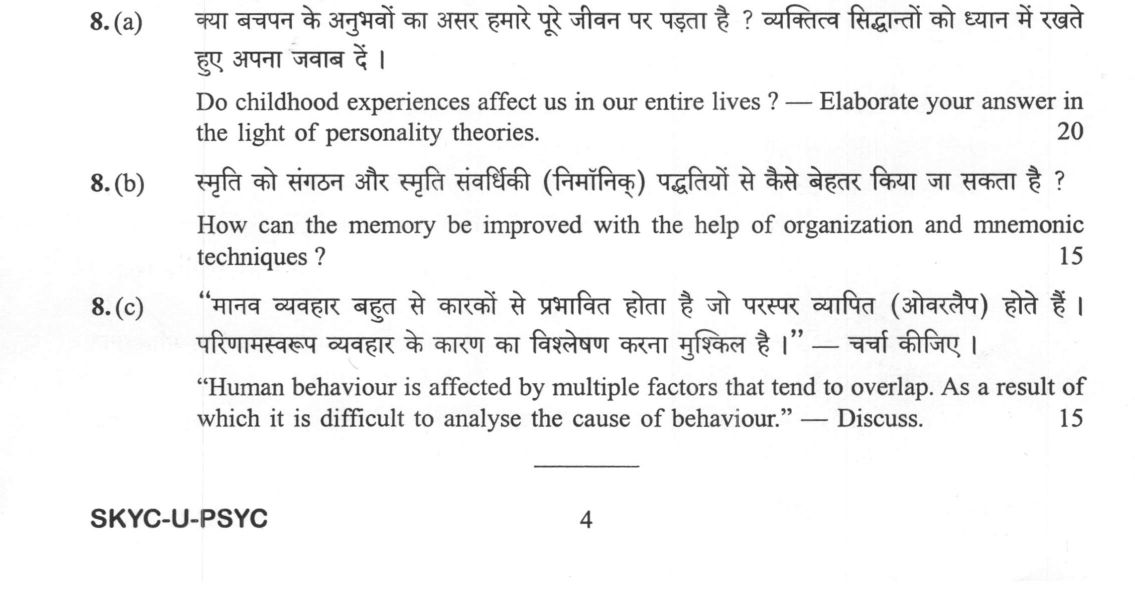
(a) Do childhood experiences affect us in our entire lives? — Elaborate your answer in the light of personality theories. (20…
Do childhood experiences affect us in our entire lives? — Elaborate your answer in the light of personality theories. 20 marks
How can the memory be improved with the help of organization and mnemonic techniques? 15 marks
"Human behaviour is affected by multiple factors that tend to overlap. As a result of which it is difficult to analyse the cause of behaviour." — Discuss. 15 marks
हिंदी में प्रश्न पढ़ें
क्या बचपन के अनुभवों का असर हमारे पूरे जीवन पर पड़ता है ? व्यक्तित्व सिद्धांतों को ध्यान में रखते हुए अपना जवाब दें । (20 अंक)
स्मृति को संगठन और स्मृति संबंधी (निमोनिक) पद्धतियों से कैसे बेहतर किया जा सकता है ? (15 अंक)
"मानव व्यवहार बहुत से कारकों से प्रभावित होता है जो परस्पर व्यापित (ओवरलैप) होते हैं । परिणामस्वरूप व्यवहार के कारण का विश्लेषण करना मुश्किल है ।" — चर्चा कीजिए । (15 अंक)
Model answer
Written by UPSC Answer Check against this question's marking rubric, to the expected length. UPSC does not publish answers for Mains — this is one way to score well, not an official key.
Childhood Experiences and Lifelong Personality
Childhood experiences significantly shape lifelong personality trajectories, though theoretical perspectives differ on whether this influence represents rigid determinism or evolving vulnerability. Sigmund Freud’s psychosexual theory posits that early parent-child interactions during the oral, anal, and phallic stages result in permanent character fixations if conflicts are unresolved, crystallizing adult personality by age five. Conversely, Erik Erikson extended this developmental arc across the entire lifespan through eight psychosocial crises, establishing that early resolutions—such as acquiring basic trust versus mistrust in infancy—provide the foundational ego strength for subsequent stages.
John Bowlby and Mary Ainsworth’s attachment theory further demonstrates that early caregiver responsiveness creates internal working models of the self and others, predicting adult intimacy patterns, affect regulation, and relational stability. Neo-Freudians refined this developmental focus: Alfred Adler emphasized that childhood feelings of organ inferiority drive a lifelong striving for superiority and style of life, while Karen Horney argued that parental indifference generates basic anxiety, compelling individuals toward rigid neurotic coping orientations (moving toward, against, or away from people). Carl Rogers’ humanistic framework highlighted how parental "conditions of worth" internalize an incongruence between the real and ideal self, persisting as adult psychological distress. In the Indian context, Sudhir Kakar’s psychoanalytic studies illustrate how maternal indulgence and joint family dynamics uniquely configure adult Indian identity and relational boundaries. However, contemporary neuroplasticity and behavioural epigenetics show that while early adverse experiences alter gene expression via the HPA axis, later corrective environments can modify these trajectories, refuting absolute childhood determinism.
Enhancing Memory: Organization and Mnemonics
Memory retention depends heavily on how information is structured during encoding, consistent with Craik and Lockhart’s levels-of-processing framework, which demonstrates that deep semantic processing yields superior recall compared to shallow structural encoding. Organization optimizes the structural limits of working memory. George Miller’s chunking technique groups discrete units of information into meaningful clusters, effectively expanding short-term capacity beyond the classic 7±2 limit. Similarly, hierarchical organization, as shown by Gordon Bower, utilizes categorical tree structures that mirror existing cognitive schemas, facilitating systematic retrieval pathways.
Mnemonic devices leverage organizational and imagery principles to enhance retention. The Method of Loci pairs items to be remembered with familiar mental spatial locations, activating hippocampal spatial mapping. The Peg-word system links new concepts to pre-memorized rhyming anchors using vivid visual imagery. Verbal systems like acronyms and acrostics impose artificial structure on unrelated stimuli, providing efficient retrieval cues that mitigate proactive and retroactive interference.
Multicausality and Analytical Complexity in Human Behaviour
The difficulty in isolating singular causes of human behaviour stems from the continuous, overlapping interactions conceptualized in George Engel’s biopsychosocial model. Behaviour is simultaneously driven by biological substrates (polygenic inheritance, neurochemistry), psychological processes (cognitive schemas, emotional appraisal), and social systems (socioeconomic status, family structures, cultural norms).
This interconnectedness was highlighted by the person-situation debate initiated by Walter Mischel, which demonstrated that behavioural variance is rarely attributable solely to stable internal traits or external environments in isolation. Albert Bandura formalised this interdependence in his model of reciprocal determinism, wherein personal cognitive factors, environmental stimuli, and overt behaviour operate as interacting determinants that mutually influence one another.
Methodologically, this confounding overlap introduces severe analytical challenges:
- Multicollinearity: Social class, educational access, and chronic stress frequently co-vary, making it difficult to isolate individual variable effects.
- Bidirectional causality: Depressive cognitions alter social support networks, which in turn exacerbate neurochemical imbalances.
- Third-variable problems: Unmeasured genetic or contextual confounders often obscure true underlying causal pathways.
Ultimately, human behaviour cannot be understood through linear, monocausal models. Advancing psychological analysis requires multivariate, longitudinal, and interactionist methodologies that evaluate the dynamic equilibrium among biological, cognitive, and systemic influences.
What "Elaborate" is asking you to do
Give the full detailed account the question has compressed into a line — every dimension of it, with specifics. Elaborate rewards completeness and detail rather than clarification or argument: the examiner is checking whether you can fill out a topic without being told what its parts are.
Structure that answers it
State the proposition → first dimension in detail → second dimension in detail → the part the statement leaves implicit → the consolidated picture
Where marks are lost
Repeating the statement at greater length instead of adding substance. Elaborate also punishes narrowness: omitting a whole dimension costs more here than anywhere else in this family.
How this answer will be evaluated
Approach
Framework: null. (a) explain: definition/context > points in order > small example > short close | (b) explain: definition/context > points in order > small example > short close | (c) discuss: intro > 3-4 dimensions > example > balanced close Full marks: Comprehensive theoretical application with named studies and clear examples.
Key points expected
- Freud's psychosexual stages and fixation
- Erikson's psychosocial stages (trust vs mistrust)
- Bandura's social learning theory (modeling)
- Link specific childhood events to adult traits
- Define organization (chunking, hierarchy)
- Define mnemonic techniques (acronyms, pegs)
- Explain the mechanism of encoding
- Provide a specific example of a technique
Evaluation rubric
Each sub-part is marked on its own, against the marks and word limit printed on the paper.
- (a) Elaborate the impact of childhood experiences on adult life using personality theories. 20 marks
explain— definition/context → points in order → small example → short close
Must cover
- Freud's psychosexual stages and fixation
- Erikson's psychosocial stages (trust vs mistrust)
- Bandura's social learning theory (modeling)
- Link specific childhood events to adult traits
Loses marks
- General advice without theoretical basis
- Ignoring the 'entire life' aspect
- Listing theories without application
Earns more
- Mention Bowlby's attachment theory
- Reference 'Blue Book' or longitudinal studies
- Contrast nature vs nurture perspectives
Extra mark
- Cite specific study (e.g., Minnesota Twin Study)
- Mention specific psychometric tool (e.g., Rorschach)
- (b) Explain how organization and mnemonic techniques improve memory. 15 marks
explain— definition/context → points in order → small example → short close
Must cover
- Define organization (chunking, hierarchy)
- Define mnemonic techniques (acronyms, pegs)
- Explain the mechanism of encoding
- Provide a specific example of a technique
Loses marks
- Confusing organization with mere repetition
- Lack of specific examples
- Ignoring the 'how' (mechanism)
Earns more
- Mention 'Method of Loci' (Memory Palace)
- Reference Ebbinghaus's forgetting curve
- Discuss long-term vs short-term memory
Extra mark
- Cite specific study on memory improvement
- Mention specific psychometric tool
- (c) Discuss the difficulty of analyzing behavior due to overlapping factors. 15 marks
discuss— intro → 3-4 dimensions → example → balanced close
Must cover
- Identify multiple factors (bio, psych, social)
- Explain the concept of 'overlap' or interaction
- Discuss the challenge of isolating variables
- Mention the 'multi-causal' nature of behavior
Loses marks
- Treating factors as independent
- Ignoring the 'difficulty' aspect
- Vague generalizations
Earns more
- Reference 'Diathesis-Stress Model'
- Mention 'Reciprocal Determinism' (Bandura)
- Discuss 'Ecological Systems Theory' (Bronfenbrenner)
Extra mark
- Cite specific study on multi-causality
- Mention specific psychometric tool
Practice this exact question
Write your answer and it is marked point by point against the model answer above — what you covered, what you missed, what you got wrong.
Evaluate my answer →More from Psychology 2023 Paper I
- Q5 Answer the following questions in about 150 words each: (a) Should the researcher always…
- Q6 (a) In view of Piaget, "Intellectual development takes place through stages which occur i…
- Q7 (a) How do intelligence and aptitude differ? Explain the two in the light of 'g' and 's'…
- Q8 (a) Do childhood experiences affect us in our entire lives? — Elaborate your answer in th…