Paper I — Q7
(a) How do intelligence and aptitude differ? Explain the two in the light of 'g' and 's' factors of intelligence giving suitable…
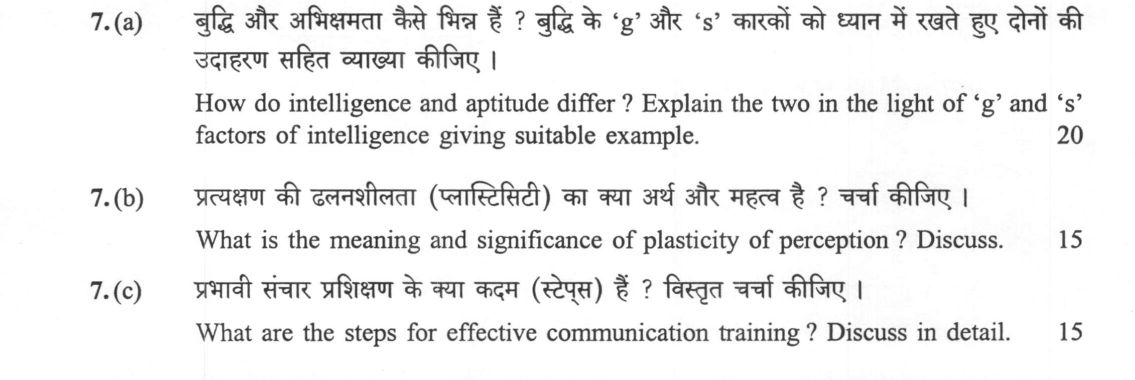
How do intelligence and aptitude differ? Explain the two in the light of 'g' and 's' factors of intelligence giving suitable example. 20 marks
What is the meaning and significance of plasticity of perception? Discuss. 15 marks
What are the steps for effective communication training? Discuss in detail. 15 marks
हिंदी में प्रश्न पढ़ें
बुद्धि और अभिक्षमता कैसे भिन्न हैं ? बुद्धि के 'g' और 's' कारकों को ध्यान में रखते हुए दोनों की उदाहरण सहित व्याख्या कीजिए । (20 अंक)
प्रत्यक्षण की ढलनशीलता (प्लास्टिसिटी) का क्या अर्थ और महत्व है ? चर्चा कीजिए । (15 अंक)
प्रभावी संचार प्रशिक्षण के क्या कदम (स्टेप्स) हैं ? विस्तृत चर्चा कीजिए । (15 अंक)
Model answer
Written by UPSC Answer Check against this question's marking rubric, to the expected length. UPSC does not publish answers for Mains — this is one way to score well, not an official key.
Intelligence and aptitude Intelligence and aptitude are related but distinct. Intelligence is the general cognitive capacity to reason, solve novel problems, learn from experience, and adapt to changing demands. Aptitude is a more specific potential for acquiring a particular skill or performing in a defined domain after training. In Spearman’s two-factor theory, every mental task draws on a common general factor, g, and task-specific factors, s. The general factor g is shared cognitive power that helps performance across diverse tasks, such as grasping a new rule, holding information, and transferring principles. The specific factors s are domain-bound capacities that make performance easier in particular activities. Performance on any task reflects g and a task-specific s; across a battery, g contributes to every task, while each s contributes only to its own task. Thus intelligence tests load heavily on g, whereas aptitude tests load more on domain-specific s factors, though g still contributes. A student with high g may learn quickly in school, but musical aptitude depends on auditory discrimination and rhythm, spatial aptitude on mental rotation, and mechanical aptitude on understanding forces. A person may have average intelligence yet high spatial aptitude, suiting architecture, or high musical aptitude despite modest verbal scores. This distinction matters for counselling and career guidance, because a low score on one aptitude does not imply low general intelligence.
Plasticity of perception Plasticity of perception means the brain’s capacity to reorganize sensory processing in response to experience, deprivation, or training. It is significant because perception is not fixed; it is shaped by neural development and use. Neural mechanisms include synaptic pruning, where frequently used connections are strengthened and unused ones reduced, and cortical remapping, where areas can take over functions when another area is damaged or underused. Critical and sensitive periods matter: early visual experience organises the visual cortex, so deprivation can have lasting effects, though some recovery remains possible. Rehabilitation shows practical value. In India, children born with congenital cataracts who are operated on early may regain useful vision, while delayed surgery can leave amblyopia because visual pathways lacked adequate stimulation. Braille reading in blind individuals illustrates cross-modal plasticity: visual cortex regions can become involved in tactile and linguistic processing, enabling skilled reading. Such plasticity also supports perceptual learning in musicians, athletes, or radiologists, where repeated experience refines discrimination.
Communication training Effective communication training should be systematic. First, needs assessment identifies gaps in listening, speaking, writing, non-verbal cues, and audience awareness through observation, feedback, or workplace incidents. Second, objective setting converts needs into measurable goals, such as reducing interruptions or improving clarity in public speaking. Third, content design selects relevant skills, language norms, and contexts, including formal, informal, and digital communication. Fourth, skill demonstration uses modelling, grounded in social learning theory, so trainees observe competent behaviour, including eye contact, structure, and respectful disagreement. Fifth, practice with feedback is central; deliberate practice involves repeated role-plays, speeches, or written exercises with specific corrective feedback, not mere repetition. The Johari window can expand self-awareness by revealing blind spots in tone, assumptions, and body language. Sixth, transfer to real contexts requires applying skills in meetings, counselling, teaching, or community work, with gradual complexity. Finally, evaluation checks whether objectives were met through pre-post assessments, peer review, and performance outcomes, feeding back into further training.
Conclusion Together, these topics show cognition is both structured and malleable. Intelligence and aptitude reveal stable capacities and trainable potentials; perceptual plasticity shows sensory systems can be reshaped by experience; communication training shows social cognition can be improved through deliberate practice. A way forward is to design education and rehabilitation that respect individual aptitudes, exploit sensitive periods, and provide structured, feedback-rich communication experiences.
What "Discuss" is asking you to do
Lay the issue out from more than one side — how it arose, what is claimed for it, what is held against it, and where it now stands. UPSC attaches discuss to broad topics with several live dimensions, so coverage of the dimensions earns more than the strength of your opinion.
Structure that answers it
Set the issue up → the case as it is made → the case against → the dimension both sides leave out → where the balance now lies
Where marks are lost
Listing facts with no thread between them, or arguing one side throughout and calling it a discussion.
How this answer will be evaluated
Approach
Framework: Spearman's Two-Factor Theory of Intelligence. (a) compare: paired headings or table > key differences > significance > conclusion | (b) discuss: intro > 3-4 dimensions > example > balanced close | (c) describe: define > structure or process in order > labelled diagram > significance Full marks: Comprehensive coverage with named theories, specific examples, and clear structure
Key points expected
- Define intelligence as general ability (g factor)
- Define aptitude as specific potential (s factor)
- Explain g factor as general mental ability
- Explain s factor as specific task ability
- Define plasticity of perception
- Explain perceptual flexibility/adaptability
- Discuss significance in learning
- Provide example of perceptual change
Evaluation rubric
Each sub-part is marked on its own, against the marks and word limit printed on the paper.
- (a) Differentiate intelligence and aptitude using Spearman's g and s factors with examples. 20 marks
compare— paired headings or table → key differences → significance → conclusion
Must cover
- Define intelligence as general ability (g factor)
- Define aptitude as specific potential (s factor)
- Explain g factor as general mental ability
- Explain s factor as specific task ability
Loses marks
- Confusing g and s factors
- No concrete examples provided
- Treating intelligence and aptitude as identical
Earns more
- Mention Spearman's Two-Factor Theory
- Provide concrete example of g vs s
- Discuss relationship between g and s
- Reference psychometric tests for g/s
Extra mark
- Name specific psychometric tool (e.g., WAIS)
- Cite Spearman's original study
- (b) Explain meaning and significance of plasticity of perception. 15 marks
discuss— intro → 3-4 dimensions → example → balanced close
Must cover
- Define plasticity of perception
- Explain perceptual flexibility/adaptability
- Discuss significance in learning
- Provide example of perceptual change
Loses marks
- Confusing with motor plasticity
- No examples of perceptual change
- Ignoring significance in learning
Earns more
- Reference Gestalt principles
- Discuss role in problem-solving
- Mention developmental aspects
- Link to cognitive flexibility
Extra mark
- Name specific experiment on perceptual plasticity
- Reference specific researcher (e.g., Wertheimer)
- (c) Outline steps for effective communication training in detail. 15 marks
describe— define → structure or process in order → labelled diagram → significance
Must cover
- Identify communication needs assessment
- Describe training content development
- Explain delivery methods (workshops, role-plays)
- Include evaluation and feedback mechanisms
Loses marks
- Listing steps without explanation
- Ignoring evaluation component
- No practical application examples
Earns more
- Mention specific training techniques
- Discuss adult learning principles
- Include practical exercises
- Reference communication models
Extra mark
- Name specific training program
- Cite research on training effectiveness
Practice this exact question
Write your answer and it is marked point by point against the model answer above — what you covered, what you missed, what you got wrong.
Evaluate my answer →More from Psychology 2023 Paper I
- Q4 (a) Compare and contrast between programmed and probability learning and also highlight t…
- Q5 Answer the following questions in about 150 words each: (a) Should the researcher always…
- Q6 (a) In view of Piaget, "Intellectual development takes place through stages which occur i…
- Q7 (a) How do intelligence and aptitude differ? Explain the two in the light of 'g' and 's'…
- Q8 (a) Do childhood experiences affect us in our entire lives? — Elaborate your answer in th…