Paper I — Q3
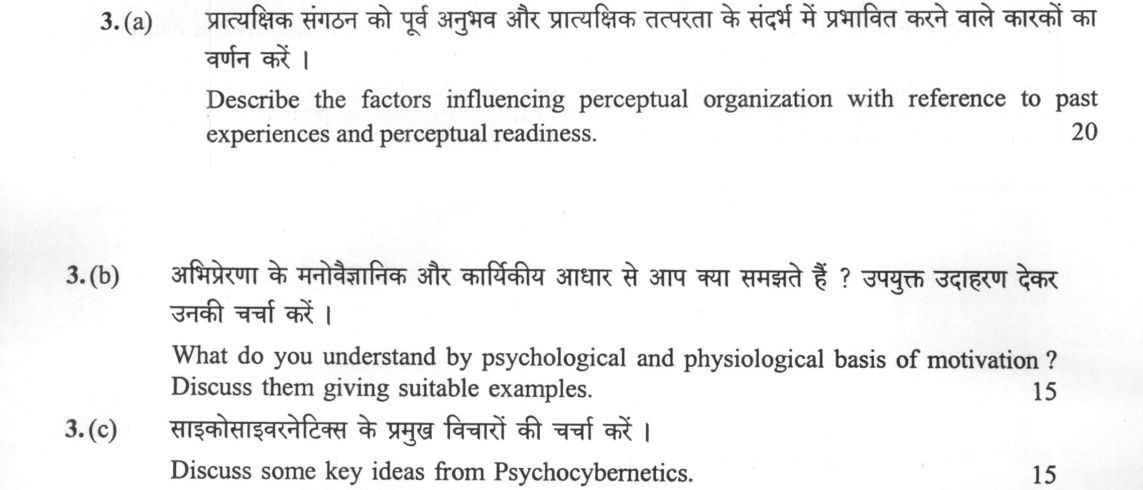
(a) Describe the factors influencing perceptual organization with reference to past experiences and perceptual readiness. (20…
Describe the factors influencing perceptual organization with reference to past experiences and perceptual readiness. 20 marks
What do you understand by psychological and physiological basis of motivation? Discuss them giving suitable examples. 15 marks
Discuss some key ideas from Psychocybernetics. 15 marks
हिंदी में प्रश्न पढ़ें
प्रत्यक्षिक संगठन को पूर्व अनुभव और प्रत्यक्षिक तत्परता के संदर्भ में प्रभावित करने वाले कारकों का वर्णन करें । (20 अंक)
अभिप्रेरणा के मनोवैज्ञानिक और कार्यिकीय आधार से आप क्या समझते हैं ? उपयुक्त उदाहरण देकर उनकी चर्चा करें । (15 अंक)
साइकोसाइबरनेटिक्स के प्रमुख विचारों की चर्चा करें । (15 अंक)
Model answer
Written by UPSC Answer Check against this question's marking rubric, to the expected length. UPSC does not publish answers for Mains — this is one way to score well, not an official key.
Perceptual Organization: Past Experience and Perceptual Readiness
Perceptual organization refers to the process through which sensory inputs are structured into meaningful, coherent wholes. The Gestalt school identified fundamental principles governing this process, including figure-ground segregation, proximity, similarity, continuity, and closure. However, perception is not solely bottom-up; top-down influences such as past experience and perceptual readiness fundamentally structure perceptual input.
Past experience establishes a perceptual set—a predisposition to perceive stimuli in a particular manner. Bruner and Minturn demonstrated this through the ambiguous stimulus "13," which was perceived as the letter "B" when preceded by letters, but as the number "13" when preceded by numbers. Similarly, past perceptual learning governs spatial context in illusions like the Ebbinghaus (Titchener) circles, where identical central circles appear unequal due to surrounding size contexts. Past experience also operates through perceptual defence, where emotionally threatening stimuli require higher recognition thresholds, and perceptual vigilance, where motivationally significant stimuli are detected more rapidly.
Perceptual readiness, formulated by Jerome Bruner, denotes the ease with which a cognitive category is accessed to interpret sensory data. An individual’s needs, values, and expectations dictate category accessibility. In Bruner and Goodman’s classic study, children from economically disadvantaged backgrounds overestimated the physical size of coins significantly more than affluent children, showing that subjective value directly alters perceptual organization.
Psychological and Physiological Basis of Motivation
Motivation involves forces that initiate, direct, and sustain goal-oriented behavior, resting on interdependent physiological and psychological foundations.
Physiological bases are rooted in biological homeostasis, neural structures, and endocrine regulation. The hypothalamus acts as a central control hub; its lateral nucleus (LH) triggers feeding behavior, while the ventromedial nucleus (VMH) signals satiety. These neural centres interact with hormonal regulators such as ghrelin (hunger stimulating) and leptin (satiety signaling), alongside cortisol in stress responses. The limbic system processes emotional salience and reward, while the Reticular Activating System (RAS) modulates cortical arousal. An example is the physiological drive for fluid regulation in arid zones like the Thar desert, where hyperosmolality triggers thirst via osmoreceptors, driving behavioral water conservation.
Psychological bases encompass cognitive, social, and personality dimensions. Maslow’s hierarchy posits needs progressing from physiological survival to self-actualization. McClelland’s acquired needs theory highlights needs for achievement (nAch), affiliation (nAff), and power (nPow), visible in the high achievement motivation among Punjab’s Green Revolution farmers. Furthermore, Bandura’s concept of self-efficacy and cognitive incentive theories illustrate that behavior is guided by anticipated outcomes and beliefs in personal competence, rather than mere biological deficits.
Key Ideas from Psychocybernetics
Introduced by plastic surgeon Maxwell Maltz, Psychocybernetics applies cybernetic principles to human psychology, viewing the brain and nervous system as an internal goal-striving servo-mechanism.
The core construct is the self-image, which acts as a psychological thermostat determining the boundaries of individual achievement. If an individual holds an inadequate self-image, the servo-mechanism automatically guides behavior toward failure. Maltz contrasted the Automatic Success Mechanism—characterized by confidence, goal-direction, and error-correction—with the Failure Mechanism, characterized by resentment, insecurity, and frustration.
A central premise is the role of mental rehearsal. Because the nervous system cannot strictly distinguish between a vividly imagined experience and a real one, systematic visualization allows individuals to reprogram their internal self-image. Maltz emphasized physical relaxation to reduce psychic resistance and suggested a minimum duration of 21 days for neural habit pattern consolidation.
While lacking rigorous experimental validation compared to contemporary cognitive-behavioral paradigms, Psychocybernetics laid foundational concepts for modern sports psychology, visualization protocols used by institutions like the Sports Authority of India (SAI), and performance coaching.
In summary, perceptual organization, motivational mechanisms, and self-image systems form an interconnected cognitive architecture: perceptual readiness shapes subjective reality, physiological and psychological drives supply behavioral impetus, and the self-image sets the cybernetic boundary within which human potential is realized.
What "Describe" is asking you to do
Give a full, ordered account of the thing named — its parts, stages or mechanism — in the sequence in which it actually exists or occurs. Most describe questions come from the science optionals, where the marks sit in correct technical detail and, where the stem says so, a labelled diagram.
Structure that answers it
One-line identification of the subject → the parts or stages in their real order, each with its defining detail → labelled diagram where the subject is structural → closing line on function or significance
Where marks are lost
Loose general prose where the examiner is ticking named parts, correct terminology and their sequence; and in the General Studies papers, turning to evaluation before the description is finished.
How this answer will be evaluated
Approach
Framework: Gestalt Principles & Psychocybernetics. (a) describe: define > structure or process in order > labelled diagram > significance | (b) discuss: intro > 3-4 dimensions > example > balanced close | (c) discuss: intro > 3-4 dimensions > example > balanced close Full marks: Precise definitions, clear distinction between concepts, named theories (Gestalt, Maslow, Beer), and relevant examples.
Key points expected
- Define perceptual organization (Gestalt context)
- Explain 'Past Experiences' (perceptual set, learning)
- Explain 'Perceptual Readiness' (expectancy, motivation)
- Link factors to specific organizational principles
- Define 'Physiological Basis' (homeostasis, drives)
- Define 'Psychological Basis' (needs, goals, incentives)
- Provide suitable example for physiological basis
- Provide suitable example for psychological basis
Evaluation rubric
Each sub-part is marked on its own, against the marks and word limit printed on the paper.
- (a) Define perceptual organization and detail factors of past experience and readiness. 20 marks
describe— define → structure or process in order → labelled diagram → significance
Must cover
- Define perceptual organization (Gestalt context)
- Explain 'Past Experiences' (perceptual set, learning)
- Explain 'Perceptual Readiness' (expectancy, motivation)
- Link factors to specific organizational principles
Loses marks
- Confusing 'readiness' with general 'motivation'
- Listing Gestalt laws without linking to experience
- Ignoring the 'past experience' component
Earns more
- Reference to Wertheimer/Koffka/Kohler
- Distinction between top-down and bottom-up processing
- Mention of 'Perceptual Set' explicitly
- Reference to 'Schematic' processing
Extra mark
- Diagram of 'Perceptual Set' mechanism
- Reference to specific experiment (e.g., Bruner)
- (b) Define and discuss psychological and physiological bases of motivation with examples. 15 marks
discuss— intro → 3-4 dimensions → example → balanced close
Must cover
- Define 'Physiological Basis' (homeostasis, drives)
- Define 'Psychological Basis' (needs, goals, incentives)
- Provide suitable example for physiological basis
- Provide suitable example for psychological basis
Loses marks
- Treating physiological and psychological as identical
- Lack of specific examples for either basis
- Vague definitions without theoretical grounding
Earns more
- Reference to Maslow's Hierarchy of Needs
- Reference to Hull's Drive Theory
- Mention of 'Incentive' vs 'Drive' distinction
- Reference to 'Arousal' theory
Extra mark
- Diagram of 'Drive-Reduction' cycle
- Reference to specific study (e.g., Cannon)
- (c) Discuss key ideas from Psychocybernetics. 15 marks
discuss— intro → 3-4 dimensions → example → balanced close
Must cover
- Define Psychocybernetics (Beer's concept)
- Explain 'Self-Regulating System' (feedback loops)
- Explain 'Set Point' or 'Goal' mechanism
- Explain 'Error Reduction' or 'Deviation Counting'
Loses marks
- Confusing 'Cybernetics' with 'Cybersecurity'
- Ignoring the 'Psychological' application of the theory
- Failing to explain the 'Feedback' mechanism
Earns more
- Reference to Ross Ashby (Law of Requisite Variety)
- Reference to Norbert Wiener (Cybernetics)
- Mention of 'Open' vs 'Closed' systems
- Application to human behavior/learning
Extra mark
- Diagram of 'Cybernetic Loop' (Input-Process-Output-Feedback)
- Reference to specific model (e.g., Ashby's Statcon)
Practice this exact question
Write your answer and it is marked point by point against the model answer above — what you covered, what you missed, what you got wrong.
Evaluate my answer →More from Psychology 2023 Paper I
- Q1 Answer the following questions in about 150 words each: (a) How is descriptive type of re…
- Q2 (a) Explain in detail the use of computer technology in psychological studies. Give your…
- Q3 (a) Describe the factors influencing perceptual organization with reference to past exper…
- Q4 (a) Compare and contrast between programmed and probability learning and also highlight t…
- Q5 Answer the following questions in about 150 words each: (a) Should the researcher always…
- Q6 (a) In view of Piaget, "Intellectual development takes place through stages which occur i…