Paper I — Q4
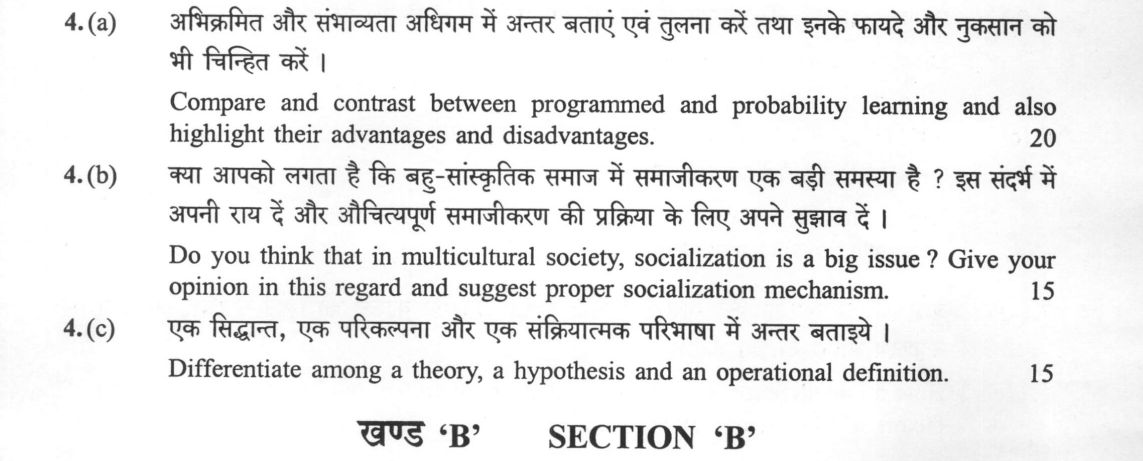
(a) Compare and contrast between programmed and probability learning and also highlight their advantages and disadvantages. (20…
Compare and contrast between programmed and probability learning and also highlight their advantages and disadvantages. 20 marks
Do you think that in multicultural society, socialization is a big issue? Give your opinion in this regard and suggest proper socialization mechanism. 15 marks
Differentiate among a theory, a hypothesis and an operational definition. 15 marks
हिंदी में प्रश्न पढ़ें
अभिक्रमित और संभाव्यता अधिगम में अंतर बताएं एवं तुलना करें तथा इनके फायदे और नुकसान को भी चिन्हित करें । (20 अंक)
क्या आपको लगता है कि बहु-सांस्कृतिक समाज में समाजीकरण एक बड़ी समस्या है ? इस संदर्भ में अपनी राय दें और औचित्यपूर्ण समाजीकरण की प्रक्रिया के लिए अपने सुझाव दें । (15 अंक)
एक सिद्धांत, एक परिकल्पना और एक संकियात्मक परिभाषा में अंतर बताइये । (15 अंक)
Model answer
Written by UPSC Answer Check against this question's marking rubric, to the expected length. UPSC does not publish answers for Mains — this is one way to score well, not an official key.
Learning, social adaptation, and scientific methodology form the foundational pillars of psychological inquiry, spanning behavioural acquisition, developmental enculturation, and epistemological rigor.
Programmed versus Probability Learning
Programmed learning, developed through B.F. Skinner’s operant conditioning (linear frames) and Norman Crowder’s branching techniques, is a deterministic instructional method characterized by small progressive steps, active responding, immediate reinforcement, and errorless learning. In contrast, probability learning, rooted in W.K. Estes’ statistical learning theory, investigates how organisms adapt to stochastic environments where reinforcement occurs on partial, probabilistic schedules, requiring probabilistic prediction and strategy optimization.
While programmed learning relies on continuous reinforcement to build predictable stimulus-response chains, probability learning uses uncertain reinforcement, leading organisms to exhibit probability matching or maximizing behaviours. Programmed learning targets uniform mastery of closed curricula, whereas probability learning develops heuristic decision-making under ambiguity.
Programmed learning offers high individualization through self-paced learning, immediate error-correction, and rapid mastery of structured material. Its disadvantages include mechanical rigidity, suppression of spontaneous creativity, and limited transfer to unstructured domains. Conversely, probability learning boasts high ecological validity and prepares learners for real-world uncertainty. Its drawbacks include slower rates of acquisition, heightened cognitive load, and emotional frustration arising from inevitable probabilistic errors.
Multicultural Socialization and Intervention Mechanisms
Socialization in a multicultural society is a major challenge. Diverse cultural milieus often generate value conflicts, fragmented identity formation, and acculturative stress. In the Indian context, socializing individuals across multilingual divisions, varied religious traditions, and distinct tribal identities requires balancing primary cultural heritage with national integration without imposing assimilationist homogenization.
To address these challenges, systematic socialization mechanisms must be instituted: First, educational institutions must adopt multilingual education and inclusive curricula, as envisioned in the National Education Policy (NEP) 2020, allowing mother-tongue instruction alongside multicultural histories. Second, intergroup contact must be structured using Gordon Allport's contact conditions—ensuring equal group status, common goals, intergroup cooperation, and explicit institutional support in schools and youth forums. Third, civic and mass media platforms must counter stereotyping by promoting pluralistic role models. Finally, community-based family support systems should encourage bicultural socialization strategies, helping children cultivate dual cultural competence and adaptive resilience.
Theory, Hypothesis, and Operational Definition
Scientific inquiry in psychology progresses through an interconnected, hierarchical continuum from abstract conceptual frameworks to empirical measurements:
A theory is an organized, coherent set of concepts and principles that explains and predicts a wide array of observed phenomena (for example, Jean Piaget’s Theory of Cognitive Development).
A hypothesis is a specific, testable, and falsifiable prediction derived deductively from a theory, stating an expected relationship between distinct variables (e.g., "Children in the concrete operational stage will perform significantly better on volume conservation tasks than children in the preoperational stage").
An operational definition translates abstract theoretical variables into concrete, observable, and quantifiable procedures (e.g., defining "conservation of liquid volume" as the child's verbal judgment and correct reasoning when identical quantities of water are poured into containers of differing heights and diameters).
These three constructs operate dynamically: operational definitions provide the empirical bridge to test specific hypotheses, and the continuous accumulation, validation, or refutation of these operationalized hypotheses progressively refines, expands, or falsifies broader psychological theories.
Progress in psychological science relies on reconciling structured learning with real-world uncertainty, implementing inclusive socialization in diverse societies, and maintaining strict empirical alignment from operationalization to theoretical formulation.
What "Compare and contrast" is asking you to do
Both halves, visibly separated, usually because the two are routinely conflated: similarities across the stated dimensions, then differences across those same dimensions. The longer form is an instruction that the differences must not be folded into the similarities.
Structure that answers it
Dimensions fixed → similarities across them → differences across them → why the pair gets confused and what in fact separates it
Where marks are lost
One half done in a page and the other in three lines. Marks are allotted to each half separately, so the weaker half is lost however strong the other is.
How this answer will be evaluated
Approach
Framework: null. (a) compare: paired headings or table > key differences > significance > conclusion | (b) suggest: the problem in one line > implementable measures > who acts > conclusion | (c) define: precise definition > the distinguishing feature > one example Full marks: Precise definitions, clear tabulation in (a), specific mechanisms in (b), and a unified example in (c).
Key points expected
- Define programmed learning (e.g., Skinner/PLT)
- Define probability learning (e.g., Thorndike/gradual)
- Contrast reinforcement schedules (continuous vs partial)
- List specific advantages and disadvantages of both
- State opinion on socialization as a 'big issue'
- Identify specific multicultural challenges (e.g., conflict)
- Suggest implementable socialization mechanisms
- Link mechanisms to specific stakeholders (school/family)
Evaluation rubric
Each sub-part is marked on its own, against the marks and word limit printed on the paper.
- (a) Tabulate differences between programmed and probability learning with pros/cons. 20 marks
compare— paired headings or table → key differences → significance → conclusion
Must cover
- Define programmed learning (e.g., Skinner/PLT)
- Define probability learning (e.g., Thorndike/gradual)
- Contrast reinforcement schedules (continuous vs partial)
- List specific advantages and disadvantages of both
Loses marks
- Confusing programmed learning with computer programming
- Treating probability learning as random guessing
- Missing the 'advantages/disadvantages' requirement
Earns more
- Mention 'Law of Effect' for probability learning
- Reference 'Programmed Instruction' for programmed learning
- Table format for comparison
- Mention 'extinction' or 'spontaneous recovery' context
Extra mark
- Cite Skinner's 'Teaching Machines' (1968)
- Reference Thorndike's 'Puzzle Box' experiment
- (b) Opinion on socialization in multicultural society and specific mechanisms. 15 marks
suggest— the problem in one line → implementable measures → who acts → conclusion
Must cover
- State opinion on socialization as a 'big issue'
- Identify specific multicultural challenges (e.g., conflict)
- Suggest implementable socialization mechanisms
- Link mechanisms to specific stakeholders (school/family)
Loses marks
- Vague advice without specific mechanisms
- Ignoring the 'multicultural' context
- Failing to give a clear opinion
Earns more
- Mention 'Cultural Relativism' or 'Ethnocentrism'
- Reference 'Cooperative Learning' in schools
- Mention 'Media' as a socialization agent
- Reference 'Social Identity Theory'
Extra mark
- Cite specific Indian policy (e.g., NEP 2020)
- Reference specific study on cultural conflict
- (c) Differentiate theory, hypothesis, and operational definition. 15 marks
define— precise definition → the distinguishing feature → one example
Must cover
- Define 'Theory' (systematic explanation)
- Define 'Hypothesis' (testable prediction)
- Define 'Operational Definition' (measurement procedure)
- Show the logical link between the three
Loses marks
- Confusing hypothesis with theory
- Defining operational definition as just a dictionary definition
- Failing to show the relationship between them
Earns more
- Use a single example (e.g., 'Intelligence') for all three
- Mention 'Falsifiability' for hypothesis
- Mention 'Variables' in operational definition
- Mention 'Paradigm' for theory
Extra mark
- Reference 'Popper' for falsifiability
- Reference 'Stevens' for levels of measurement
Practice this exact question
Write your answer and it is marked point by point against the model answer above — what you covered, what you missed, what you got wrong.
Evaluate my answer →More from Psychology 2023 Paper I
- Q1 Answer the following questions in about 150 words each: (a) How is descriptive type of re…
- Q2 (a) Explain in detail the use of computer technology in psychological studies. Give your…
- Q3 (a) Describe the factors influencing perceptual organization with reference to past exper…
- Q4 (a) Compare and contrast between programmed and probability learning and also highlight t…
- Q5 Answer the following questions in about 150 words each: (a) Should the researcher always…
- Q6 (a) In view of Piaget, "Intellectual development takes place through stages which occur i…
- Q7 (a) How do intelligence and aptitude differ? Explain the two in the light of 'g' and 's'…