Paper I — Q6
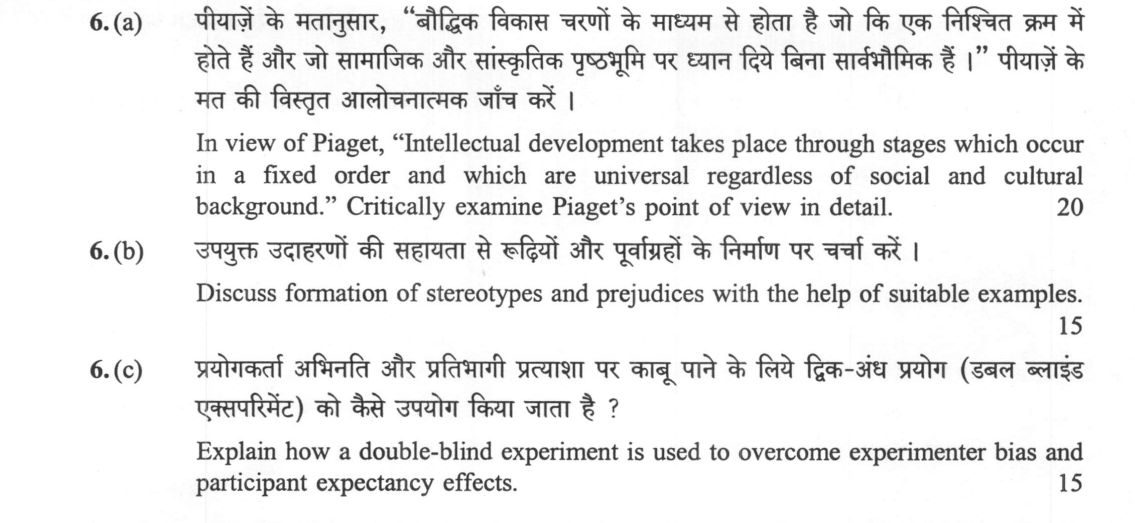
(a) In view of Piaget, "Intellectual development takes place through stages which occur in a fixed order and which are universal…
In view of Piaget, "Intellectual development takes place through stages which occur in a fixed order and which are universal regardless of social and cultural background." Critically examine Piaget's point of view in detail. 20 marks
Discuss formation of stereotypes and prejudices with the help of suitable examples. 15 marks
Explain how a double-blind experiment is used to overcome experimenter bias and participant expectancy effects. 15 marks
हिंदी में प्रश्न पढ़ें
पियाजे के मतानुसार, "बौद्धिक विकास चरणों के माध्यम से होता है जो कि एक निश्चित क्रम में होते हैं और जो सामाजिक और सांस्कृतिक पृष्ठभूमि पर ध्यान दिये बिना सार्वभौमिक हैं।" पियाजे के मत की विस्तृत आलोचनात्मक जाँच करें । (20 अंक)
उपयुक्त उदाहरणों की सहायता से रूढ़ियों और पूर्वाग्रहों के निर्माण पर चर्चा करें । (15 अंक)
प्रयोगकर्ता अभिनति और प्रतिभागी प्रत्याशा पर काबू पाने के लिए द्वि-अंध प्रयोग (डबल ब्लाइंड एक्सपेरिमेंट) को कैसे उपयोग किया जाता है ? (15 अंक)
Model answer
Written by UPSC Answer Check against this question's marking rubric, to the expected length. UPSC does not publish answers for Mains — this is one way to score well, not an official key.
Jean Piaget proposed that cognitive development proceeds through an invariant, universal sequence of four qualitative stages: the Sensorimotor stage (0–2 years), marked by sensory exploration, motor coordination, and the acquisition of object permanence; the Preoperational stage (2–7 years), characterized by symbolic thought, intuitive reasoning, egocentrism, and centration; the Concrete Operational stage (7–11 years), where children acquire conservation, reversibility, and logical operations on tangible objects; and the Formal Operational stage (11+ years), defined by abstract reasoning, hypothetical-deductive logic, and metacognition. Piaget asserted that this structural progression reflects intrinsic biological maturation and equilibration, unfolding identically across all sociocultural environments.
Critical Examination of Piaget's Universality Claim
Piaget's assertion of strict universality and fixed stage progression has faced substantial theoretical and empirical refutation. Lev Vygotsky’s sociocultural theory demonstrated that cognitive development is not an isolated, biologically driven unfolding, but is fundamentally mediated by culture, social interaction, and language through the Zone of Proximal Development.
Cross-cultural investigations have revealed significant variations in cognitive trajectories. Pierre Dasen’s cross-cultural research demonstrated that while Inuit children in hunting-gathering societies develop spatial reasoning and conservation of distance earlier than European norms, Baoulé children in agricultural Côte d'Ivoire develop quantitative and conservation skills later, reflecting distinct ecological adaptations rather than developmental deficits. Furthermore, Neo-Piagetian theorists such as Robbie Case (emphasizing working memory capacity) and Kurt Fischer (dynamic skill theory) demonstrate that cognitive growth is domain-specific and uneven (décalage), rather than domain-general. Formal operational thought is far from universal; it is heavily dependent on formal Western schooling and specialized training. Thus, while the broad sequential transition from concrete to abstract thought remains a robust heuristic, development is contextually contingent rather than biologically fixed or universally uniform.
Formation of Stereotypes and Prejudices
A stereotype is the cognitive component of intergroup bias—a generalized, oversimplified belief about members of a social group. Prejudice represents the affective and evaluative component, involving irrational negative attitudes and feelings toward that group. Their formation operates through three major psychological mechanisms:
Social Categorization: As posited by Henri Tajfel’s Social Identity Theory, individuals automatically classify people into "in-groups" and "out-groups" to simplify the social world. This categorization fosters in-group favoritism and out-group derogation, visibly manifesting in regional stereotypes (e.g., North-South cultural generalizations in India).
Social Learning: Albert Bandura's observational learning theory shows that biases are acquired early through parental reinforcement, media portrayals, and cultural socialization. In Indian educational settings, entrenched caste-based stereotypes often lead to implicit teacher bias and marginalized students internalizing feelings of academic inadequacy.
Realistic Group Conflict Theory: Muzafer Sherif established that intergroup competition over scarce socio-economic and political resources generates mutual hostility, providing the psychological foundation for communal and religious prejudices.
Double-Blind Experiments in Controlling Experimental Artifacts
A double-blind experiment is a methodological design in which neither the participants nor the experimenters interacting with them are aware of which condition (experimental or control/placebo) the participants are assigned to.
This procedure neutralizes two major threats to internal validity:
Experimenter Bias (Rosenthal Effect): Unconscious verbal and non-verbal cues from researchers can steer participants toward hypothesized outcomes. Rosenthal and Fode illustrated this expectancy effect in their classic "maze-bright vs. maze-dull" rat studies. Double-blinding ensures experimenter behavior remains identical across conditions.
Participant Expectancy Effects: Participants' beliefs and demand characteristics frequently drive subjective improvements (placebo effect) or distress (nocebo effect). Keeping participants blind prevents anticipatory psychological shifts.
However, double-blind designs face distinct limitations in psychological research. They are readily implemented in psychopharmacological and computer-delivered cognitive tasks, but are often unfeasible in psychotherapy, social-skills training, or naturalistic field interventions where the therapist or experimenter cannot remain unaware of the intervention delivered.
Rigorous psychological inquiry requires balancing structured theoretical models with contextual and methodological safeguards. Just as cross-cultural evidence qualifies Piaget’s universalism, rigorous experimental protocols such as double-blind designs ensure that developmental and social phenomena are analyzed free from researcher and participant bias.
What "Critically examine" is asking you to do
Test the proposition the question puts to you and return a finding on how far it holds. Examine stems carry a claim, or ask whether something has happened, and expect evidence weighed both ways before the extent is stated — often with remedial measures attached. “Critically” is not a section added at the end: name the yardstick you are judging by — the evidence, the stated objective, a constitutional principle, a rival explanation — and let a verdict close each part of the body. Where the question quotes a claim, that verdict must land on the claim itself, accepted, qualified or rejected, and not on the theme in general.
Structure that answers it
Restate the claim as the question frames it → evidence that supports it → evidence that undercuts it → the conditions under which it holds → verdict on how far it stands
Where marks are lost
Merits in one paragraph, demerits in the next, and a conclusion calling for a balanced and holistic approach. That is a survey with the judgement left out and it holds the answer in the middle band. The opposite error is reading “critically” as permission to attack — and with the odd pairings, critically describe or critically explain, the exposition still carries most of the marks, the judgement being a layer on it rather than a substitute for it.
How this answer will be evaluated
Approach
Framework: null. (a) critique: the claim > its strengths > its weaknesses > your judgment | (b) discuss: intro > 3-4 dimensions > example > balanced close | (c) explain: definition/context > points in order > small example > short close Full marks: Comprehensive, critical, and well-supported with specific examples and theories.
Key points expected
- Define the four stages (Sensorimotor to Formal Operational)
- Explain the 'fixed order' and 'universality' claims
- Critique universality using cross-cultural evidence (e.g., Das Gupta)
- Critique fixed order using evidence of individual variation
- Define stereotypes and distinguish from prejudice
- Explain cognitive mechanisms (categorization, in-group bias)
- Explain social mechanisms (social learning, media)
- Provide suitable examples of formation
Evaluation rubric
Each sub-part is marked on its own, against the marks and word limit printed on the paper.
- (a) Critical examination of Piaget's stage theory of intellectual development. 20 marks
critique— the claim → its strengths → its weaknesses → your judgment
Must cover
- Define the four stages (Sensorimotor to Formal Operational)
- Explain the 'fixed order' and 'universality' claims
- Critique universality using cross-cultural evidence (e.g., Das Gupta)
- Critique fixed order using evidence of individual variation
Loses marks
- Describing stages without critical analysis
- Ignoring the 'universality' aspect of the prompt
- Confusing Piaget with Vygotsky
Earns more
- Mention Vygotsky's sociocultural critique
- Reference information processing perspective
- Discuss the concept of 'schemata' and 'equilibration'
- Mention limitations of Piaget's experimental methods
Extra mark
- Reference specific studies (e.g., Das Gupta 1977)
- Mention 'domain-specific' vs 'domain-general' debate
- (b) Discussion of the formation of stereotypes and prejudices with examples. 15 marks
discuss— intro → 3-4 dimensions → example → balanced close
Must cover
- Define stereotypes and distinguish from prejudice
- Explain cognitive mechanisms (categorization, in-group bias)
- Explain social mechanisms (social learning, media)
- Provide suitable examples of formation
Loses marks
- Defining terms without discussing formation
- Lack of suitable examples
- Conflating prejudice with discrimination
Earns more
- Mention Tajfel's Social Identity Theory
- Reference 'contact hypothesis' as a counter
- Discuss the role of 'out-group homogeneity'
- Mention specific social examples (e.g., caste, gender)
Extra mark
- Reference specific studies (e.g., Allport's work)
- Mention 'stereotype threat' concept
- (c) Explanation of how double-blind experiments overcome bias and expectancy. 15 marks
explain— definition/context → points in order → small example → short close
Must cover
- Define double-blind experiment
- Explain how it controls experimenter bias
- Explain how it controls participant expectancy
- Mention the role of placebo/control groups
Loses marks
- Confusing single-blind with double-blind
- Failing to link blinding to specific biases
- Vague explanation of the mechanism
Earns more
- Mention 'Hawthorne effect' or 'demand characteristics'
- Explain the mechanism of blinding (e.g., identical pills)
- Reference 'double-dummy' designs
- Mention limitations of double-blind designs
Extra mark
- Reference specific famous double-blind studies
- Mention 'triple-blind' designs
Practice this exact question
Write your answer and it is marked point by point against the model answer above — what you covered, what you missed, what you got wrong.
Evaluate my answer →More from Psychology 2023 Paper I
- Q3 (a) Describe the factors influencing perceptual organization with reference to past exper…
- Q4 (a) Compare and contrast between programmed and probability learning and also highlight t…
- Q5 Answer the following questions in about 150 words each: (a) Should the researcher always…
- Q6 (a) In view of Piaget, "Intellectual development takes place through stages which occur i…
- Q7 (a) How do intelligence and aptitude differ? Explain the two in the light of 'g' and 's'…
- Q8 (a) Do childhood experiences affect us in our entire lives? — Elaborate your answer in th…