Paper I — Q5
Answer the following questions in about 150 words each: (a) Should the researcher always formulate a hypothesis before…
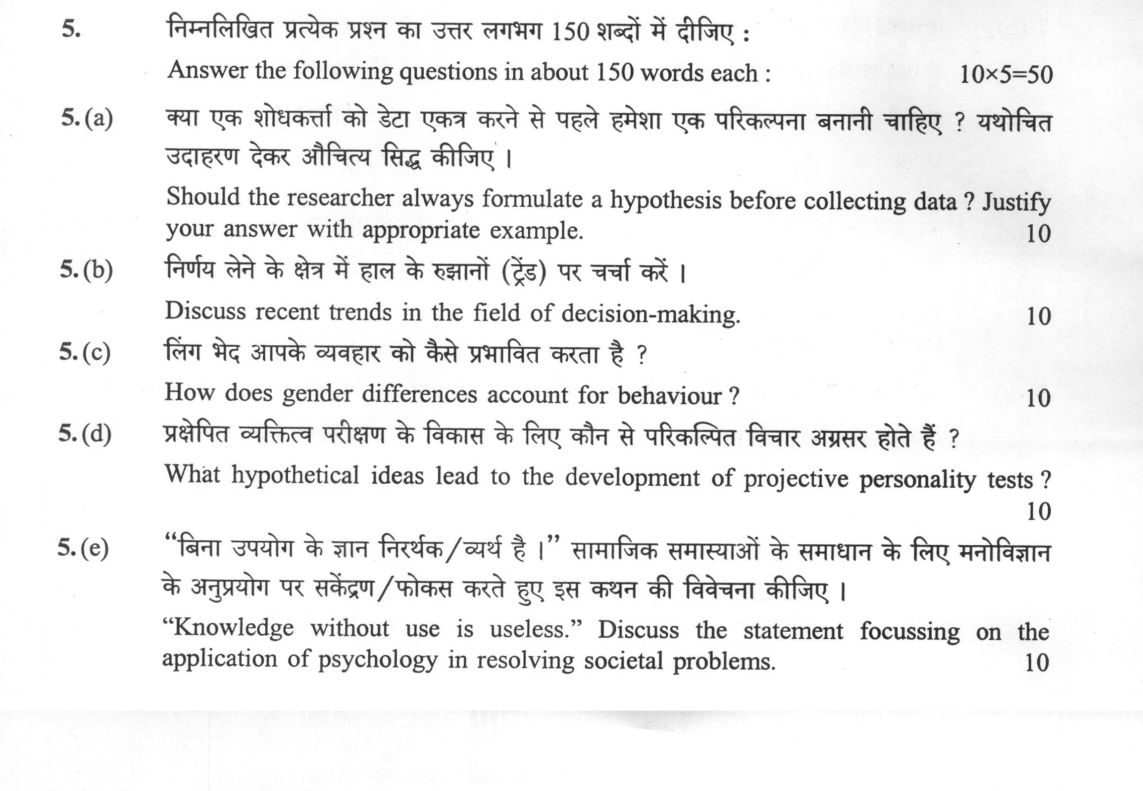
Answer the following questions in about 150 words each:
Should the researcher always formulate a hypothesis before collecting data? Justify your answer with appropriate example. 10 marks
Discuss recent trends in the field of decision-making. 10 marks
How does gender differences account for behaviour? 10 marks
What hypothetical ideas lead to the development of projective personality tests? 10 marks
"Knowledge without use is useless." Discuss the statement focussing on the application of psychology in resolving societal problems. 10 marks
हिंदी में प्रश्न पढ़ें
निम्नलिखित प्रत्येक प्रश्न का उत्तर लगभग 150 शब्दों में दीजिए :
क्या एक शोधकर्ता को डेटा एकत्र करने से पहले हमेशा एक परिकल्पना बनानी चाहिए ? यथोचित उदाहरण देकर औचित्य सिद्ध कीजिए । (10 अंक)
निर्णय लेने के क्षेत्र में हाल के रुझानों (ट्रेंड) पर चर्चा करें । (10 अंक)
लिंग भेद आपके व्यवहार को कैसे प्रभावित करता है ? (10 अंक)
प्रक्षेपित व्यक्तित्व परीक्षण के विकास के लिए कौन से परिकल्पित विचार अग्रसर होते हैं ? (10 अंक)
"बिना उपयोग के ज्ञान निरर्थक/व्यर्थ है ।" सामाजिक समस्याओं के समाधान के लिए मनोविज्ञान के अनुप्रयोग पर संकेंद्रण/फोकस करते हुए इस कथन की विवेचना कीजिए । (10 अंक)
Model answer
Written by UPSC Answer Check against this question's marking rubric, to the 150-word length. UPSC does not publish answers for Mains — this is one way to score well, not an official key.
(a) The formulation of a hypothesis prior to data collection depends on the epistemological paradigm guiding the inquiry. In deductive, quantitative research rooted in positivism, pre-formulating a hypothesis is essential to operationalise variables, prevent confirmation bias, and test theoretical propositions systematically. Conversely, in inductive and qualitative paradigms, insisting on an a priori hypothesis can constrain inquiry and blind researchers to emergent patterns. For example, in Grounded Theory (Glaser and Strauss) and ethnographic traditions—such as M.N. Srinivas’s field study of Rampura village in *The Remembered Village*—suspending prior hypotheses allowed complex socio-cultural realities like dominant caste dynamics to emerge directly from field observations. Similarly, exploratory studies, phenomenological research, and big-data discovery rely on hypothesis-generating rather than hypothesis-testing approaches. Thus, rather than being an absolute prerequisite, hypothesis formulation is a methodological choice dictated by whether the research seeks confirmatory validation or exploratory discovery.
(b) The study of decision-making has shifted significantly from classical normative frameworks, such as Expected Utility Theory which presupposed fully rational agents, toward empirical, multi-disciplinary paradigms. A prominent trend is Behavioural Economics, spearheaded by Kahneman and Tversky’s Prospect Theory, which establishes that human decisions systematically deviate from rationality due to heuristics, loss aversion, and framing effects. This foundation led to Richard Thaler’s Nudge Theory, widely utilized to design choice architectures in public governance (such as behavioural nudges in the Swachh Bharat Mission). Another major advance is Neuroeconomics, which utilizes functional neuroimaging (fMRI) to map neural correlates of choice, demonstrating how value computation in the ventromedial prefrontal cortex interacts with emotional responses in the amygdala during risk evaluation. Furthermore, contemporary research increasingly explores Human-Artificial Intelligence decision integration, evaluating algorithmic bias, cognitive offloading, and automated decision-support systems. Modern decision science thus views choice as boundedly rational, neurobiologically grounded, and socio-technologically embedded.
(c) Gender-differentiated behaviour emerges from a continuous interplay among biological predispositions, psychological processes, and sociocultural structures. Biologically, evolutionary pressures and endocrinological factors—such as prenatal and circulating levels of testosterone and oxytocin—along with subtle neuroanatomical variations, influence behavioural domains like physical aggression and socio-emotional orientation. However, these biological foundations are heavily mediated by psychological learning mechanisms; as Albert Bandura’s Social Cognitive Theory explains, individuals internalize gender schemas through differential reinforcement, imitation, and self-regulatory standards. Socioculturally, as Judith Butler emphasizes, gender operates as a performative construct—a sequence of repeated behaviours dictated by normative cultural expectations rather than innate essence. In the Indian context, deeply entrenched patriarchal structures institutionalize distinct behavioural repertoires through gendered division of labour, son-preference, and socialisation into obedience versus agency. Therefore, gender differences in behaviour cannot be explained by biological determinism or extreme social constructionism alone, but through an integrated biosocial perspective where culture continually shapes and reinforces psychological expression.
(d) Projective personality tests were developed on the theoretical foundation of the "projective hypothesis," derived primarily from Sigmund Freud’s psychoanalytic conceptualization of defense mechanisms. Freud argued that individuals cope with unacceptable impulses, repressed anxieties, and latent conflicts by unconsciously projecting them onto external objects. Test developers hypothesized that when presented with ambiguous, unstructured, or semi-structured stimuli, an individual cannot rely on conventional psychological defenses, conscious filtering, or socially desirable responses. Instead, to make sense of the ambiguity, the individual must impose their own personal structure, inadvertently revealing unconscious motives, core conflicts, and personality dynamics. Furthermore, Henry Murray’s Personology and Need-Press Theory expanded this idea by positing that internal psychogenic needs (such as the need for achievement or affiliation) project onto environmental stimuli (presses) to create fantasies. These theoretical propositions directly culminated in clinical tools such as Hermann Rorschach’s Inkblot Test and Murray’s Thematic Apperception Test (TAT) to bypass conscious defensiveness.
(e) Pure psychological theory gains social relevance only when translated into applied interventions capable of solving pressing societal problems. In India, psychological science has made tangible contributions across critical public spheres. In disaster management, psychosocial support and mental health interventions designed by NIMHANS during the 2004 Indian Ocean Tsunami and the Kerala floods provided community-level psychological first aid and mitigated post-traumatic stress. In education, interventions drawing on Carol Dweck’s growth-mindset theory and socio-emotional learning frameworks are applied in schools to reduce examination anxiety, bridge learning gaps, and foster academic resilience. In public health, decentralized community mental health models, such as the Bellary Model that formed the blueprint for the District Mental Health Programme (DMHP), democratize access to psychiatric care in rural areas. Additionally, forensic psychology assists the criminal justice system through non-coercive investigative interviewing, risk assessment, and offender rehabilitation. Psychological knowledge must continue bridging the laboratory-to-society gap, leveraging evidence-based insights to inform inclusive public policy and social reform.
What "Discuss" is asking you to do
Lay the issue out from more than one side — how it arose, what is claimed for it, what is held against it, and where it now stands. UPSC attaches discuss to broad topics with several live dimensions, so coverage of the dimensions earns more than the strength of your opinion.
Structure that answers it
Set the issue up → the case as it is made → the case against → the dimension both sides leave out → where the balance now lies
Where marks are lost
Listing facts with no thread between them, or arguing one side throughout and calling it a discussion.
How this answer will be evaluated
Approach
Framework: Define > Theory or model > Evidence > Application. (a) justify: claim > 3-4 reasons > evidence > conclusion | (b) discuss: intro > 3-4 dimensions > example > balanced close | (c) account for: state the phenomenon > the causes in order of weight > conclusion | (d) explain: definition/context > points in order > small example > short close | (e) discuss: intro > 3-4 dimensions > example > balanced close Full marks: Clear structure, named theories/studies, specific examples, balanced analysis.
Key points expected
- Claim: hypothesis not always required
- Reason: Exploratory research (e.g., qualitative)
- Reason: Inductive approach (e.g., grounded theory)
- Reason: Pilot studies for data collection
- Trend: AI and Machine Learning in decisions
- Trend: Behavioral economics (nudging)
- Trend: Data-driven decision making
- Trend: Collaborative/Participatory decision making
Evaluation rubric
Each sub-part is marked on its own, against the marks and word limit printed on the paper.
- (a) Claim on hypothesis necessity with 3-4 reasons and evidence. 10 marks · 150 words
justify— claim → 3-4 reasons → evidence → conclusion
Must cover
- Claim: hypothesis not always required
- Reason: Exploratory research (e.g., qualitative)
- Reason: Inductive approach (e.g., grounded theory)
- Reason: Pilot studies for data collection
Loses marks
- Claiming hypothesis is always mandatory
- No distinction between exploratory and confirmatory research
- Theory without specific examples
Earns more
- Example: Exploratory study on new social phenomenon
- Contrast: Hypothesis-driven vs. data-driven research
- Mention: Qualitative vs. Quantitative paradigms
Extra mark
- Named study: Grounded Theory (Glaser & Strauss)
- Specific example: Exploratory study on social media use
- (b) Intro, 3-4 recent trends in decision-making, example, balanced close. 10 marks · 150 words
discuss— intro → 3-4 dimensions → example → balanced close
Must cover
- Trend: AI and Machine Learning in decisions
- Trend: Behavioral economics (nudging)
- Trend: Data-driven decision making
- Trend: Collaborative/Participatory decision making
Loses marks
- Only listing trends without discussion
- Ignoring ethical implications of AI
- No examples or applications
Earns more
- Example: Algorithmic bias in hiring
- Mention: Bounded rationality (Simon)
- Link to organizational behavior
Extra mark
- Named model: Prospect Theory (Kahneman & Tversky)
- Specific application: Nudge in public policy
- (c) State phenomenon, causes in order of weight, conclusion. 10 marks · 150 words
account for— state the phenomenon → the causes in order of weight → conclusion
Must cover
- Biological factors: Hormones (testosterone, estrogen)
- Socialization: Gender roles and expectations
- Cognitive differences: Spatial vs. verbal abilities
- Personality traits: Big Five differences
Loses marks
- Overstating biological determinism
- Ignoring social/cultural factors
- Stereotyping without nuance
Earns more
- Example: Aggression differences (hormonal)
- Mention: Social learning theory (Bandura)
- Nuance: Overlap between genders
Extra mark
- Named study: Meta-analysis on gender differences
- Specific example: Leadership style differences
- (d) Definition/context, points in order, small example, short close. 10 marks · 150 words
explain— definition/context → points in order → small example → short close
Must cover
- Psychodynamic theory: Unconscious projection
- Ambiguous stimuli: Rorschach, TAT
- Assumption: Response reflects inner self
- Limitation: Subjective interpretation
Loses marks
- Confusing projective with objective tests
- No mention of psychodynamic basis
- Ignoring reliability/validity issues
Earns more
- Example: Rorschach inkblot test
- Mention: Freud's psychoanalytic principles
- Contrast with objective tests
Extra mark
- Named test: Thematic Apperception Test (Murray)
- Specific example: Interpreting a Rorschach response
- (e) Intro, 3-4 applications of psychology, example, balanced close. 10 marks · 150 words
discuss— intro → 3-4 dimensions → example → balanced close
Must cover
- Application: Mental health services (counseling)
- Application: Education (learning difficulties)
- Application: Workplace (stress management)
- Application: Social issues (prejudice, conflict)
Loses marks
- Only theoretical discussion
- No specific societal applications
- Ignoring practical implementation
Earns more
- Example: CBT for depression
- Mention: Applied psychology fields
- Link to societal well-being
Extra mark
- Named program: School counseling initiatives
- Specific example: Workplace wellness programs
Practice this exact question
Write your answer and it is marked point by point against the model answer above — what you covered, what you missed, what you got wrong.
Evaluate my answer →More from Psychology 2023 Paper I
- Q2 (a) Explain in detail the use of computer technology in psychological studies. Give your…
- Q3 (a) Describe the factors influencing perceptual organization with reference to past exper…
- Q4 (a) Compare and contrast between programmed and probability learning and also highlight t…
- Q5 Answer the following questions in about 150 words each: (a) Should the researcher always…
- Q6 (a) In view of Piaget, "Intellectual development takes place through stages which occur i…
- Q7 (a) How do intelligence and aptitude differ? Explain the two in the light of 'g' and 's'…
- Q8 (a) Do childhood experiences affect us in our entire lives? — Elaborate your answer in th…