Paper II — Q1
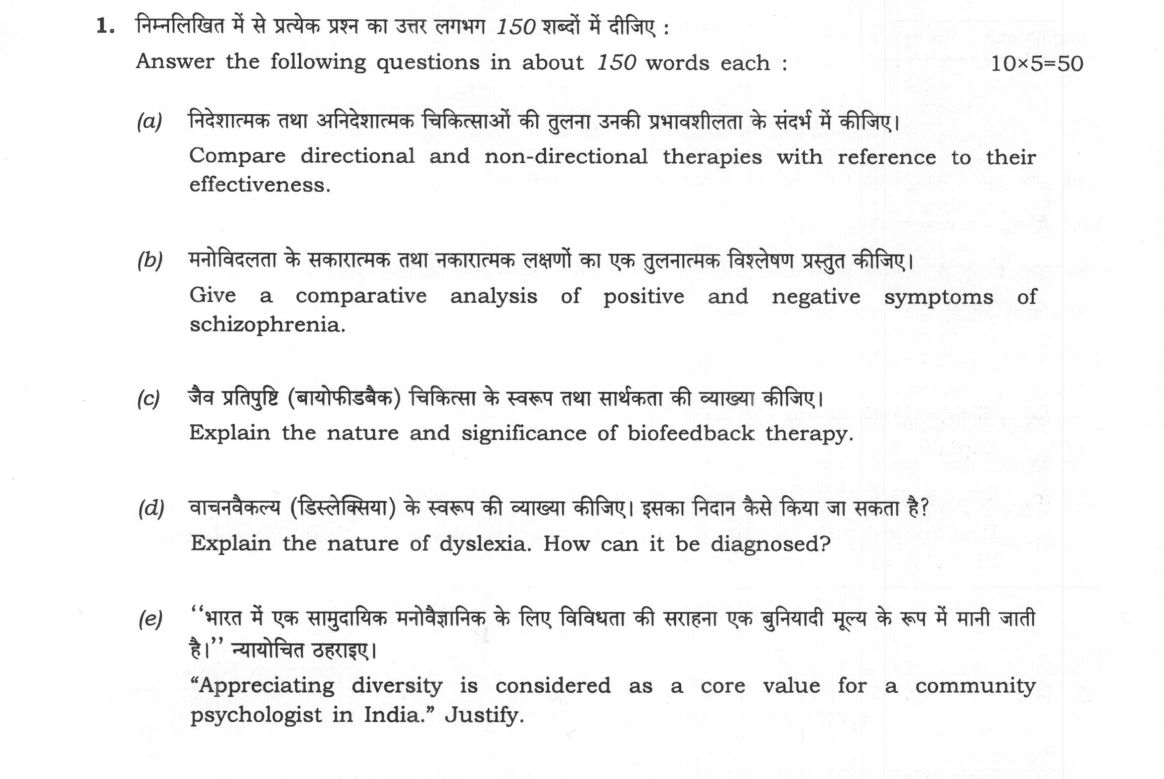
Answer the following questions in about 150 words each: (a) Compare directional and non-directional therapies with reference to…
Answer the following questions in about 150 words each:
Compare directional and non-directional therapies with reference to their effectiveness. 10 marks
Give a comparative analysis of positive and negative symptoms of schizophrenia. 10 marks
Explain the nature and significance of biofeedback therapy. 10 marks
Explain the nature of dyslexia. How can it be diagnosed? 10 marks
"Appreciating diversity is considered as a core value for a community psychologist in India." Justify. 10 marks
हिंदी में प्रश्न पढ़ें
निम्नलिखित में से प्रत्येक प्रश्न का उत्तर लगभग 150 शब्दों में दीजिए :
निदेशात्मक तथा अनिदेशात्मक चिकित्साओं की तुलना उनकी प्रभावशीलता के संदर्भ में कीजिए। (10 अंक)
मनोविदलता के सकारात्मक तथा नकारात्मक लक्षणों का एक तुलनात्मक विश्लेषण प्रस्तुत कीजिए। (10 अंक)
जैव प्रतिपुष्टि (बायोफीडबैक) चिकित्सा के स्वरूप तथा सार्थकता की व्याख्या कीजिए। (10 अंक)
वाचनवैकल्य (डिस्लेक्सिया) के स्वरूप की व्याख्या कीजिए। इसका निदान कैसे किया जा सकता है? (10 अंक)
"भारत में एक सामुदायिक मनोवैज्ञानिक के लिए विविधता की सराहना एक बुनियादी मूल्य के रूप में मानी जाती है।" न्यायोचित ठहराइए। (10 अंक)
Model answer
Written by UPSC Answer Check against this question's marking rubric, to the 150-word length. UPSC does not publish answers for Mains — this is one way to score well, not an official key.
(a) Directional therapies are therapist-led, structured interventions in which the clinician sets goals, selects techniques, and guides the client, as in cognitive-behavioural therapy, exposure therapy, or problem-solving therapy. Non-directional therapies, especially Rogerian client-centred therapy, leave the agenda largely to the client; the therapist provides empathy, unconditional positive regard and congruence, helping the person explore feelings and self-understanding. The key difference is control: directional work is problem-focused and skill-building, while non-directional work is process-focused and self-actualization-oriented. Their effectiveness differs by outcome. For circumscribed symptoms such as phobia, panic, depression or behavioural problems, directional therapies often show faster symptom reduction and measurable behavioural change. For identity confusion, low self-esteem, relational distress or personal growth, non-directional approaches may be more effective because they strengthen autonomy, insight and self-acceptance. In practice, many Indian clinical settings use a blended stance: directive for acute symptoms, non-directive for long-term adjustment.
(b) Positive and negative symptoms of schizophrenia differ in kind, not merely degree. Positive symptoms are excesses or distortions of normal experience: hallucinations, delusions, disorganized speech, and disorganized or catatonic behaviour. They reflect added, often bizarre, mental activity and are usually more responsive to antipsychotic medication. Negative symptoms are deficits or reductions in normal functioning: alogia, avolition, anhedonia, flat affect, and social withdrawal. They reflect loss of motivation, expression and engagement, and are often more persistent and harder to treat. Neurobiologically, positive symptoms are commonly linked with dopamine hyperactivity in mesolimbic pathways, while negative symptoms are associated with hypofrontality and dopaminergic deficits in prefrontal circuits. Clinically, positive symptoms dominate acute episodes and may bring the patient to hospital, whereas negative symptoms shape chronic disability, poor social adjustment and long-term prognosis. A comparative view therefore shows that positive symptoms are overt, measurable and often treatable, while negative symptoms are subtle, enduring and central to functional recovery.
(c) Biofeedback is a learning-based therapy in which a person receives continuous information about normally unconscious autonomic responses, such as muscle tension, heart rate, skin temperature or respiration. Through operant conditioning, the client learns to voluntarily modify these responses: relaxation lowers tension, controlled breathing reduces arousal, and thermal feedback may help vascular regulation. Its nature is therefore self-regulation of physiological states, not direct medical treatment. Its significance lies in expanding the client’s sense of agency over stress-related symptoms. It is used as an adjunct in anxiety, migraine, and stress-related hypertension, though evidence for essential hypertension is mixed and it is not a first-line treatment. In India, biofeedback has value in yoga-integrated interventions, where breath awareness, meditation and physiological monitoring can support stress management in schools, workplaces and mental-health clinics. It is especially useful where medication is limited, side-effects are a concern, or the client needs a practical skill for self-management.
(d) Dyslexia is a specific learning disorder with a neurodevelopmental basis, marked by persistent difficulty in accurate or fluent word reading, poor spelling and weak decoding, despite adequate instruction and opportunity. Its core nature is often a phonological processing deficit: the person has difficulty identifying, storing and manipulating speech sounds, which affects reading, spelling and sometimes written expression. It is not caused by low vision, low motivation or general intellectual disability. Diagnosis requires comprehensive clinical and psychoeducational assessment, not a single test. In India, screening may use tools such as the Dyslexia Screening Test-Junior (DST-J), but screening must be followed by diagnostic evaluation. Standardized diagnostic assessment may include the NIMHANS SLD battery, reading, spelling, phonological awareness, memory, attention and language measures. DSM-5 and ICD-11 do not require an IQ–achievement discrepancy; diagnosis rests on persistent reading difficulties despite intervention and assessment of developmental history, educational impact and response to support.
(e) Appreciating diversity is a core value for a community psychologist in India because the community is not a uniform unit but a mosaic of caste, tribal, linguistic, religious, gender, regional and socio-economic differences. A community psychologist must understand that mental health, help-seeking, stigma and resilience are shaped by these identities. In a caste-based society, for example, a Dalit client may face discrimination that affects self-worth, while a tribal community may have its own healing practices and collective decision-making. Linguistic diversity means that psychological assessment and counselling must be culturally and idiomatically appropriate, not merely translated. Schemes such as the District Mental Health Programme (DMHP) and community mental health services require psychologists to work with primary health teams, schools, panchayats and NGOs, where cultural competence is essential. Even behaviour-change campaigns like Swachh Bharat Abhiyan succeed only when they respect local beliefs, rituals and social hierarchies. Thus, diversity appreciation is not a soft value; it is the basis of ethical, effective and inclusive community practice.
What "Compare" is asking you to do
Set the items against each other on named dimensions. In UPSC practice compare already carries both halves — likeness and difference — and where the stem names the dimensions, as in region, nature and climatic impact, those are the headings the examiner expects to see.
Structure that answers it
Dimensions named → both items on dimension 1 → dimension 2 → dimension 3 → where they converge and where they part
Where marks are lost
Two self-contained descriptive blocks with the comparison left for the reader to make. Marks here sit on the dimensions, so an answer that names none of them gives the examiner nothing to award.
How this answer will be evaluated
Approach
Framework: UPSC Psychology Paper II (Clinical & Applied). (a) compare: paired headings or table > key differences > significance > conclusion | (b) compare: paired headings or table > key differences > significance > conclusion | (c) explain: definition/context > points in order > small example > short close | (d) explain: definition/context > points in order > small example > short close | (e) justify: claim > 3-4 reasons > evidence > conclusion Full marks: Precise definitions, clear comparative structure, specific examples, and strong application to Indian context where relevant.
Key points expected
- Define directional (directive) therapy
- Define non-directional (non-directive) therapy
- Compare effectiveness for specific disorders
- Mention specific therapy types (e.g., CBT vs Person-Centred)
- Define positive symptoms (e.g., hallucinations)
- Define negative symptoms (e.g., flat affect)
- Contrast the nature of the two
- Mention treatment response differences
Evaluation rubric
Each sub-part is marked on its own, against the marks and word limit printed on the paper.
- (a) Contrast directional vs non-directional therapies based on effectiveness. · 150 words
compare— paired headings or table → key differences → significance → conclusion
Must cover
- Define directional (directive) therapy
- Define non-directional (non-directive) therapy
- Compare effectiveness for specific disorders
- Mention specific therapy types (e.g., CBT vs Person-Centred)
Loses marks
- Confusing 'directional' with 'direct' instruction
- Ignoring the 'effectiveness' criterion
Earns more
- Reference to Carl Rogers for non-directive
- Reference to Beck for directional
- Mention of client autonomy in non-directive
Extra mark
- Cite specific meta-analysis on therapy effectiveness
- (b) Comparative analysis of positive and negative symptoms of schizophrenia. · 150 words
compare— paired headings or table → key differences → significance → conclusion
Must cover
- Define positive symptoms (e.g., hallucinations)
- Define negative symptoms (e.g., flat affect)
- Contrast the nature of the two
- Mention treatment response differences
Loses marks
- Listing symptoms without comparative analysis
- Confusing negative symptoms with depression
Earns more
- Reference to 'disorganization' symptoms
- Mention of 'cognitive' symptoms as a third category
- Link to dopamine hypothesis
Extra mark
- Reference to specific rating scales (e.g., PANSS)
- (c) Explain the nature and significance of biofeedback therapy. · 150 words
explain— definition/context → points in order → small example → short close
Must cover
- Define biofeedback (operant conditioning of physiological responses)
- Explain the mechanism (sensor -> feedback -> control)
- State significance (self-regulation, non-invasive)
- Give one application (e.g., tension headache, anxiety)
Loses marks
- Confusing biofeedback with simple relaxation
- Failing to explain the 'feedback' loop
Earns more
- Mention specific physiological parameters (EMG, GSR, EEG)
- Reference to Wolpe or Schwartz
- Mention of 'operant conditioning' principle
Extra mark
- Mention of specific study on biofeedback efficacy
- (d) Explain nature of dyslexia and its diagnosis. · 150 words
explain— definition/context → points in order → small example → short close
Must cover
- Define dyslexia (specific reading disability)
- Describe nature (phonological processing deficit)
- Explain diagnosis (discrepancy between IQ and reading age)
- Mention diagnostic tools (e.g., WISC, reading tests)
Loses marks
- Confusing dyslexia with general learning disability
- Failing to mention the diagnostic criteria
Earns more
- Mention of 'phonological awareness' deficit
- Reference to 'double deficit' hypothesis
- Mention of 'exclusion' of other causes
Extra mark
- Name a specific Indian diagnostic tool or study
- (e) Justify why appreciating diversity is a core value for community psychologists in India. · 150 words
justify— claim → 3-4 reasons → evidence → conclusion
Must cover
- Define 'diversity' in Indian context (language, caste, religion)
- Link to community psychology principles (cultural sensitivity)
- Provide 3-4 reasons (e.g., access, trust, effectiveness)
- Conclude with the necessity for Indian context
Loses marks
- Generic answer not specific to India
- Failing to link diversity to 'core value'
Earns more
- Mention of 'cultural competence'
- Reference to 'social justice' in community psych
- Mention of specific Indian diversity (e.g., tribal, linguistic)
Extra mark
- Reference to a specific Indian community psychology study
Practice this exact question
Write your answer and it is marked point by point against the model answer above — what you covered, what you missed, what you got wrong.
Evaluate my answer →More from Psychology 2023 Paper II
- Q1 Answer the following questions in about 150 words each: (a) Compare directional and non-d…
- Q2 (a) Discuss the biopsychosocial model of health. Suggest relevant actions to prevent illn…
- Q3 (a) Explain Maslow's need hierarchy theory. Critically evaluate the same. (15 marks) (b)…
- Q4 (a) Discuss the importance and applications of ecological theory for programme implementa…