Paper II — Q8
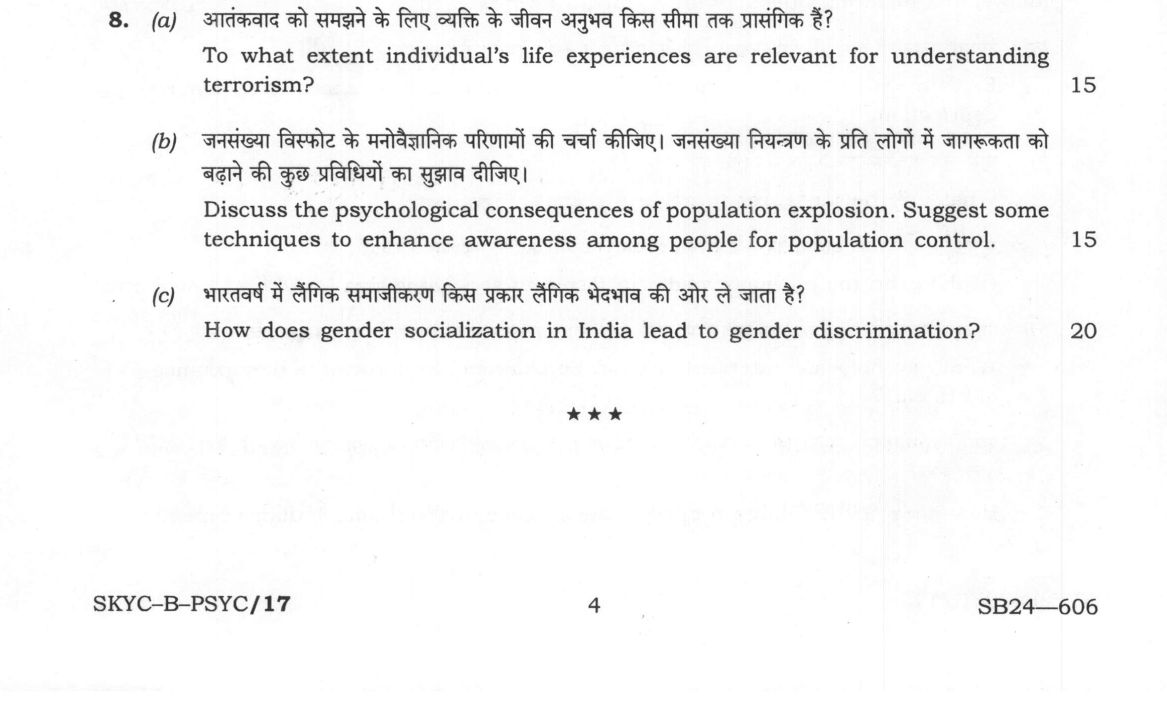
(a) To what extent individual's life experiences are relevant for understanding terrorism? (15 marks) (b) Discuss the…
To what extent individual's life experiences are relevant for understanding terrorism? 15 marks
Discuss the psychological consequences of population explosion. Suggest some techniques to enhance awareness among people for population control. 15 marks
How does gender socialization in India lead to gender discrimination? 20 marks
हिंदी में प्रश्न पढ़ें
आतंकवाद को समझने के लिए व्यक्ति के जीवन अनुभव किस सीमा तक प्रासंगिक हैं? (15 अंक)
जनसंख्या विस्फोट के मनोवैज्ञानिक परिणामों की चर्चा कीजिए। जनसंख्या नियंत्रण के प्रति लोगों में जागरूकता को बढ़ाने की कुछ प्रविधियों का सुझाव दीजिए। (15 अंक)
भारतवर्ष में लैंगिक समाजीकरण किस प्रकार लैंगिक भेदभाव की ओर ले जाता है? (20 अंक)
Model answer
Written by UPSC Answer Check against this question's marking rubric, to the expected length. UPSC does not publish answers for Mains — this is one way to score well, not an official key.
Understanding complex socio-behavioural challenges—ranging from political violence and demographic pressures to systemic gender inequality—requires examining how individual psychological processes intersect with macro-level socio-structural forces.
Life Experiences and Terrorism
An individual’s life experiences provide critical insights into vulnerability to radicalization. Personal trauma, early marginalization, identity crises, and perceived relative deprivation frequently act as psychological catalysts. Under Moghaddam’s Staircase to Terrorism model, individuals experiencing alienation and perceived injustice ascend through cognitive stages, seeking out extremist groups to restore personal significance. However, while adverse life experiences may be necessary predispositions for some individuals, they are rarely sufficient conditions. Millions face trauma and systemic deprivation without resorting to violent extremism.
A complete understanding requires integrating individual vulnerabilities with group dynamics and structural variables. Social Identity Theory demonstrates how out-group derogation and in-group glorification foster collective narcissism, transforming individual distress into organized hostility. Terrorist recruitment leverages shared ideological narratives, charismatic leadership, and geopolitical grievances, showing that individual biography functions only within an enabling socio-political matrix.
Psychological Consequences of Population Explosion and Awareness Techniques
Population explosion imposes severe psychological costs rooted in environmental and cognitive strain. High spatial density translates into crowding stress and sensory overload, which elevate chronic cortisol levels, interpersonal aggression, and withdrawal. Resource scarcity intensifies competition, generating chronic survival anxiety, intergenerational distress over employment and space, and a measurable decline in subjective well-being and quality of life.
Mitigating these impacts requires targeted psycho-social interventions:
First, applying the Health Belief Model, awareness campaigns must elevate the perceived susceptibility to and severity of overpopulation-induced hardships, while emphasizing the benefits of family planning.
Second, drawing from the Theory of Planned Behavior, community-based interventions via frontline workers (such as ASHA under Mission Parivar Vikas) must reshape subjective norms and enhance perceived behavioural control regarding modern contraceptives.
Third, culturally resonant entertainment-education media campaigns (like Main Kuch Bhi Kar Sakti Hoon) and age-appropriate reproductive health education in schools can dispel myths, normalize small family norms, and foster proactive reproductive choices.
Gender Socialization and Discrimination in India
In India, gender socialization systematically manufactures and legitimizes gender discrimination through pervasive primary and secondary agents.
According to Bandura’s Social Learning Theory, children observe and imitate gendered divisions of labour within the family, where caregiving is assigned to females and authority to males. This is reinforced by differential reinforcement—rewarding compliance in girls and assertiveness in boys. Concurrently, as children attain gender constancy (Kohlberg), they actively categorize behaviours into rigid schemas.
These schemas are reinforced across institutions: Schools subtlely direct girls toward domesticity and boys toward STEM disciplines. Media representations perpetuate patriarchal tropes and objectification. Religious and cultural practices (such as patrilocal marriage, kanyadaan, and rituals prioritizing male lineage for ancestral rites) institutionalize son preference and the dowry system, portraying female children as economic liabilities. Peer groups further police deviations from normative gender roles.
This socialization translates directly into structural discrimination. Internalized gender roles suppress female self-efficacy and agency, fostering stereotype threat in competitive spheres and solidifying the glass ceiling in professional domains. Culturally sanctioned son preference fuels sex-selective practices and skewed child sex ratios. Furthermore, gender discrimination intersects with caste and class hierarchies; for instance, Dalit women experience compounded, multidimensional subjugation.
Way Forward
Addressing these interconnected challenges necessitates moving beyond purely structural or individual-level interventions. Sustainable solutions require cognitive restructuring through value-based education, the deconstruction of rigid patriarchal schemas, and the integration of community-driven psychological insights into public policy, thereby aligning individual attitudes with progressive institutional reforms.
What "Discuss" is asking you to do
Lay the issue out from more than one side — how it arose, what is claimed for it, what is held against it, and where it now stands. UPSC attaches discuss to broad topics with several live dimensions, so coverage of the dimensions earns more than the strength of your opinion.
Structure that answers it
Set the issue up → the case as it is made → the case against → the dimension both sides leave out → where the balance now lies
Where marks are lost
Listing facts with no thread between them, or arguing one side throughout and calling it a discussion.
How this answer will be evaluated
Approach
Framework: Psychology Paper II: Social & Applied Psychology. (a) examine: intro > how/why with reasoning > evidence > conclusion | (b) discuss: intro > 3-4 dimensions > example > balanced close | (c) explain: definition/context > points in order > small example > short close Full marks: Comprehensive, evidence-based, specific to Indian context, clear structure
Key points expected
- Define terrorism in a psychological context
- Identify specific life experiences (trauma, humiliation, loss)
- Explain the mechanism of radicalization or grievance
- Provide a named study or case example
- Define population explosion in a social context
- List 3-4 psychological consequences (stress, alienation)
- Suggest 3-4 specific awareness techniques
- Link consequences to social behavior
Evaluation rubric
Each sub-part is marked on its own, against the marks and word limit printed on the paper.
- (a) Link individual life experiences to the psychological roots of terrorism. 15 marks
examine— intro → how/why with reasoning → evidence → conclusion
Must cover
- Define terrorism in a psychological context
- Identify specific life experiences (trauma, humiliation, loss)
- Explain the mechanism of radicalization or grievance
- Provide a named study or case example
Loses marks
- Focusing only on political causes
- Generalizing without psychological evidence
- Ignoring the 'individual' aspect of the prompt
Earns more
- Reference to social identity theory
- Mention of cognitive dissonance
- Distinction between state and non-state terrorism
- Reference to specific psychological profiles
Extra mark
- Citing a specific longitudinal study on radicalization
- Mentioning a specific psychometric tool for assessment
- (b) Analyze psychological impacts of population explosion and suggest awareness techniques. 15 marks
discuss— intro → 3-4 dimensions → example → balanced close
Must cover
- Define population explosion in a social context
- List 3-4 psychological consequences (stress, alienation)
- Suggest 3-4 specific awareness techniques
- Link consequences to social behavior
Loses marks
- Listing consequences without psychological depth
- Suggesting vague or unimplementable techniques
- Ignoring the 'awareness' part of the question
Earns more
- Mentioning 'crowding' vs 'density' distinction
- Reference to Maslow's hierarchy of needs
- Specific examples of awareness campaigns
- Discussion of resource scarcity effects
Extra mark
- Citing a specific government awareness campaign
- Mentioning a specific psychological scale for stress
- (c) Trace the process of gender socialization in India leading to discrimination. 20 marks
explain— definition/context → points in order → small example → short close
Must cover
- Define gender socialization
- Identify agents of socialization (family, school, media)
- Explain the mechanism of internalization
- Link socialization to specific discriminatory outcomes
Loses marks
- Focusing only on legal aspects
- Ignoring the 'socialization' process
- Generalizing without specific Indian context
Earns more
- Reference to social learning theory
- Mentioning specific Indian cultural practices
- Discussion of gender role rigidity
- Reference to specific studies on Indian gender roles
Extra mark
- Citing a specific Supreme Court judgment on gender
- Mentioning a specific psychometric tool for gender bias
Practice this exact question
Write your answer and it is marked point by point against the model answer above — what you covered, what you missed, what you got wrong.
Evaluate my answer →More from Psychology 2023 Paper II
- Q5 Answer the following questions in about 150 words each: (a) Explain with suitable example…
- Q6 (a) Discuss the steps to be taken to reduce the incidence of school dropouts among depriv…
- Q7 (a) Discuss the psychological and social effects of pornography addiction. (15 marks) (b)…
- Q8 (a) To what extent individual's life experiences are relevant for understanding terrorism…