Paper II — Q2
(a) Discuss the biopsychosocial model of health. Suggest relevant actions to prevent illness. (15 marks) (b) Explain the…
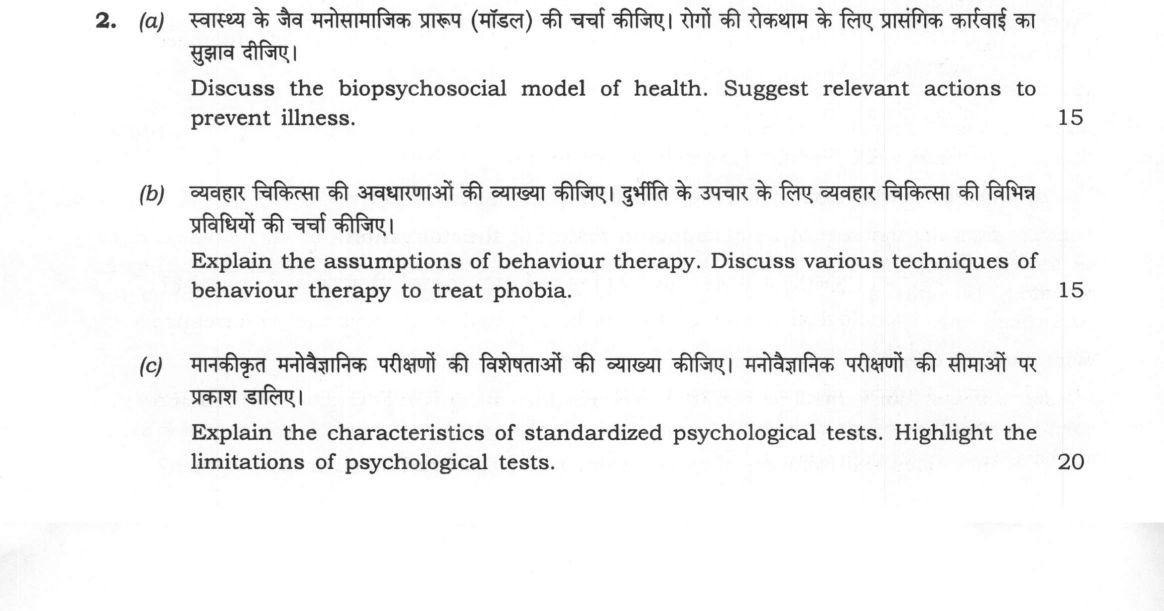
Discuss the biopsychosocial model of health. Suggest relevant actions to prevent illness. 15 marks
Explain the assumptions of behaviour therapy. Discuss various techniques of behaviour therapy to treat phobia. 15 marks
Explain the characteristics of standardized psychological tests. Highlight the limitations of psychological tests. 20 marks
हिंदी में प्रश्न पढ़ें
स्वास्थ्य के जैव मनोसामाजिक प्रारूप (मॉडल) की चर्चा कीजिए। रोगों की रोकथाम के लिए प्रासंगिक कार्रवाई का सुझाव दीजिए। (15 अंक)
व्यवहार चिकित्सा की अवधारणाओं की व्याख्या कीजिए। डरभीति के उपचार के लिए व्यवहार चिकित्सा की विभिन्न प्रविधियों की चर्चा कीजिए। (15 अंक)
मानकीकृत मनोवैज्ञानिक परीक्षणों की विशेषताओं की व्याख्या कीजिए। मनोवैज्ञानिक परीक्षणों की सीमाओं पर प्रकाश डालिए। (20 अंक)
Model answer
Written by UPSC Answer Check against this question's marking rubric, to the expected length. UPSC does not publish answers for Mains — this is one way to score well, not an official key.
Biopsychosocial Model of Health and Illness Prevention
George Engel’s Biopsychosocial Model posits that health and illness result from dynamic, reciprocal interactions among biological factors (genetic vulnerability, neurochemistry, immune response), psychological factors (health beliefs, emotional distress, coping styles), and social factors (socioeconomic status, family support, environmental sanitation). Disease manifests not merely through biological pathogens, but when systemic stressors overwhelm an individual’s biopsychosocial resilience.
Preventive actions operate at three interconnected tiers: Primary prevention targets risk reduction before pathology emerges through lifestyle modification, stress management, and public health initiatives such as the Swachh Bharat Abhiyan, which addresses social determinants to prevent vector-borne and enteric infections. Secondary prevention emphasizes early detection and prompt intervention via screening and psychophysiological assessments, as implemented through Ayushman Bharat Health and Wellness Centres to manage asymptomatic hypertension and prediabetes. Tertiary prevention minimizes disability and prevents relapse through chronic disease management, lifestyle pacing, and family-inclusive psychosocial rehabilitation. While Western health frameworks often emphasize individual agency, applying this model in India requires integrating collectivistic family structures and indigenous health systems like Ayush.
Behaviour Therapy: Assumptions and Phobia Interventions
Behaviour therapy assumes that maladaptive behaviours, including phobias, are acquired and maintained through classical conditioning, operant reinforcement, and observational learning. It focuses strictly on observable behaviour, operates in a present-centred and time-limited framework, and relies on empirically testable causal mechanisms.
To treat phobias, behaviour therapy alters learned stimulus-response contingencies: Systematic Desensitization, developed by Joseph Wolpe, utilizes the principle of reciprocal inhibition. The client is trained in progressive muscle relaxation and gradually exposed to items along a graded anxiety hierarchy, pairing the feared stimulus with a physiologically incompatible relaxed state until counter-conditioning occurs. Flooding achieves extinction through continuous in vivo or imaginal exposure to the maximum-intensity feared stimulus while preventing avoidance or escape responses, allowing conditioned sympathetic arousal to naturally dissipate. Participant Modelling utilizes Bandura’s social learning theory, wherein the client observes a model successfully interact with the phobic object, gradually imitating the behaviour to extinguish avoidance and bolster self-efficacy. Virtual Reality Exposure Therapy (VRET) serves as an advanced digital therapeutic delivering immersive, precisely calibrated computer-generated phobic environments, offering safe and controlled exposure.
Standardized Psychological Tests: Characteristics and Limitations
Standardized psychological tests provide objective, quantified indices of psychological constructs, directly informing clinical case formulation in health psychology and functional behavioural analysis in behaviour therapy.
A standardized test possesses five core psychometric characteristics: standard administration (uniform physical settings, instructions, and time limits), objective scoring (independent of evaluator bias), reliability (consistency across time via test-retest or items via internal consistency), validity (the degree to which the test measures its intended construct, established through construct and criterion validation), and normative data (standardized scores derived from a representative reference sample to enable meaningful comparative interpretation).
However, psychological testing faces notable limitations. Cultural bias remains significant when Western instruments are applied in non-Western contexts; linguistic and conceptual discrepancies frequently distort diagnostic validity, as seen in the need for indigenous adaptations like the Malin’s Intelligence Scale for Indian Children (MISIC) or Indian adaptations of the MMPI. Test results are vulnerable to response sets, including social desirability and faking good, as well as coaching effects that artificially inflate scores. Ethical challenges regarding data privacy, stigmatizing diagnostic labelling, and mechanized computer-based testing—which lacks contextual clinical nuances and qualitative behavioural observation—further limit utility.
Conclusion
A comprehensive psychological approach requires integrating rigorous standardized psychometric assessment with biopsychosocial formulation and empirical behavioural interventions. The way forward lies in developing culturally grounded, indigenously normed assessment tools alongside blended digital-telehealth interventions, ensuring equitable, context-sensitive healthcare delivery across diverse socioeconomic strata.
What "Explain" is asking you to do
Make the working of something clear — what sets it off, what follows from what, and what it produces. Explain is the Commission's mechanism word: it dominates the technical papers and the “explain why” stems, where the marks sit in the causal chain and not in the label.
Structure that answers it
State what it is → the initiating condition → the chain of cause, step by step → an instance where it plays out → what the chain produces
Where marks are lost
Describing what something looks like instead of why it works that way. Naming the stages without linking them reads as description too.
How this answer will be evaluated
Approach
Framework: Biopsychosocial Model of Health. (a) discuss: intro > 3-4 dimensions > example > balanced close | (b) explain: definition/context > points in order > small example > short close | (c) explain: definition/context > points in order > small example > short close Full marks: Comprehensive coverage of all parts with specific examples and named studies
Key points expected
- Define biopsychosocial model (Engel)
- Explain biological, psychological, social components
- Suggest specific actions for illness prevention
- Link actions to the model's components
- State assumptions of behaviour therapy
- Explain classical conditioning in phobia
- Describe systematic desensitization
- Describe exposure therapy
Evaluation rubric
Each sub-part is marked on its own, against the marks and word limit printed on the paper.
- (a) Explain the biopsychosocial model and suggest actions to prevent illness. 15 marks
discuss— intro → 3-4 dimensions → example → balanced close
Must cover
- Define biopsychosocial model (Engel)
- Explain biological, psychological, social components
- Suggest specific actions for illness prevention
- Link actions to the model's components
Loses marks
- Only listing components without explanation
- Generic advice not linked to the model
- Ignoring the social component
Earns more
- Mention Engel (1977)
- Provide examples of social determinants
- Discuss lifestyle modifications
- Mention stress management techniques
Extra mark
- Reference specific public health initiatives
- Cite a study on biopsychosocial interventions
- (b) Explain assumptions of behaviour therapy and techniques for phobia. 15 marks
explain— definition/context → points in order → small example → short close
Must cover
- State assumptions of behaviour therapy
- Explain classical conditioning in phobia
- Describe systematic desensitization
- Describe exposure therapy
Loses marks
- Confusing behaviour therapy with CBT
- Listing techniques without explaining them
- Ignoring the assumptions part
Earns more
- Mention Wolpe's reciprocal inhibition
- Explain counter-conditioning
- Mention flooding technique
- Reference specific phobia examples
Extra mark
- Cite a specific phobia treatment study
- Mention virtual reality exposure therapy
- (c) Explain characteristics of standardized tests and their limitations. 20 marks
explain— definition/context → points in order → small example → short close
Must cover
- Define standardized psychological tests
- Explain reliability and validity
- Discuss norming and standardization
- Highlight limitations of psychological tests
Loses marks
- Confusing reliability with validity
- Listing limitations without explanation
- Ignoring the standardization aspect
Earns more
- Mention test-retest reliability
- Explain content and criterion validity
- Discuss cultural bias
- Mention specific tests like WAIS or MMPI
Extra mark
- Reference specific psychometric properties
- Mention ethical considerations in testing
Practice this exact question
Write your answer and it is marked point by point against the model answer above — what you covered, what you missed, what you got wrong.
Evaluate my answer →More from Psychology 2023 Paper II
- Q1 Answer the following questions in about 150 words each: (a) Compare directional and non-d…
- Q2 (a) Discuss the biopsychosocial model of health. Suggest relevant actions to prevent illn…
- Q3 (a) Explain Maslow's need hierarchy theory. Critically evaluate the same. (15 marks) (b)…
- Q4 (a) Discuss the importance and applications of ecological theory for programme implementa…
- Q5 Answer the following questions in about 150 words each: (a) Explain with suitable example…