Paper II — Q5
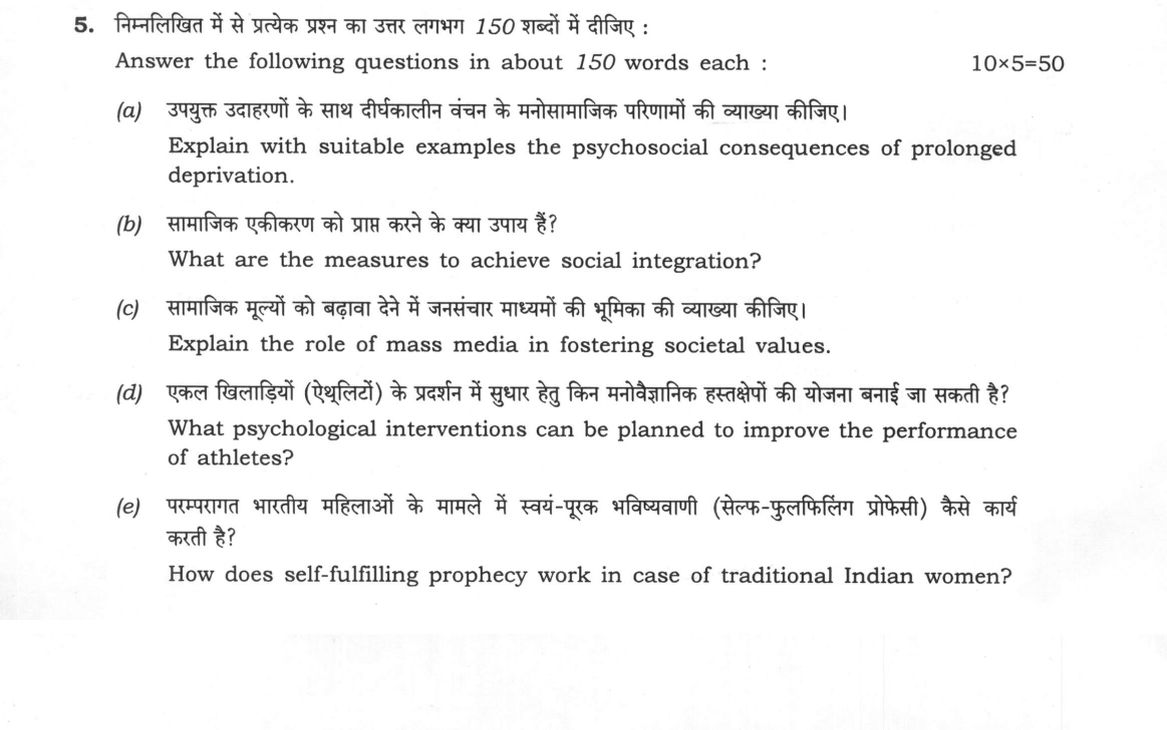
Answer the following questions in about 150 words each: (a) Explain with suitable examples the psychosocial consequences of…
Answer the following questions in about 150 words each:
Explain with suitable examples the psychosocial consequences of prolonged deprivation. 10 marks
What are the measures to achieve social integration? 10 marks
Explain the role of mass media in fostering societal values. 10 marks
What psychological interventions can be planned to improve the performance of athletes? 10 marks
How does self-fulfilling prophecy work in case of traditional Indian women? 10 marks
हिंदी में प्रश्न पढ़ें
निम्नलिखित में से प्रत्येक प्रश्न का उत्तर लगभग 150 शब्दों में दीजिए :
उपयुक्त उदाहरणों के साथ दीर्घकालीन वंचन के मनोसामाजिक परिणामों की व्याख्या कीजिए। (10 अंक)
सामाजिक एकीकरण को प्राप्त करने के क्या उपाय हैं? (10 अंक)
सामाजिक मूल्यों को बढ़ावा देने में जनसंचार माध्यमों की भूमिका की व्याख्या कीजिए। (10 अंक)
एकल खिलाड़ियों (एथलीटों) के प्रदर्शन में सुधार हेतु किन मनोवैज्ञानिक हस्तक्षेपों की योजना बनाई जा सकती है? (10 अंक)
परंपरागत भारतीय महिलाओं के मामले में स्वयं-पूर्ण भविष्यवाणी (सेल्फ-फुलफिलिंग प्रोफेसी) कैसे कार्य करती है? (10 अंक)
Model answer
Written by UPSC Answer Check against this question's marking rubric, to the 150-word length. UPSC does not publish answers for Mains — this is one way to score well, not an official key.
(a) Psychosocial Consequences of Prolonged Deprivation
Prolonged deprivation involves sustained deficits in environmental, socio-economic, and emotional stimulation, triggering severe psychological and developmental impairments. Cognitively, the absence of enriched sensory inputs and chronic neurobiological stress disrupt neurocognitive maturation, resulting in sub-optimal intelligence quotient (IQ) scores, executive dysfunction, and chronic attention deficits. Emotionally, prolonged inability to control environmental stressors fosters learned helplessness, yielding pervasive anxiety, depressive symptoms, and diminished self-efficacy. Socially, deprivation impairs interpersonal functioning, leading to emotional detachment, heightened aggression, or withdrawal due to disrupted attachment patterns. Indian empirical studies, notably by T. S. Saraswathi on rural child development and research by Girishwar Misra on urban slum populations, demonstrate that prolonged environmental impoverishment severely stymies perceptual-motor competencies and language acquisition. Deprivation thus institutionalizes a cycle of compromised psychological capability and diminished socio-economic mobility.
(b) Measures to Achieve Social Integration
Social integration requires structured interventions to reduce intergroup distance and build an overarching collective identity. Gordon Allport’s Intergroup Contact Hypothesis provides the operational mechanism: prejudice decreases when diverse groups engage under conditions of equal status, common goals, institutional backing, and non-competitive interaction. Incorporating Muzafer Sherif’s superordinate goals further dissolves out-group antagonism by compelling collaborative problem-solving. Structural interventions include inclusive education systems that dismantle socio-economic segregation in classrooms, and cooperative economic ventures that foster mutual interdependence. In India, initiatives such as the Ek Bharat Shreshtha Bharat programme operationalize intergroup contact through institutionalized cultural and linguistic exchanges, while the National Foundation for Communal Harmony utilizes collaborative rehabilitation projects. These measures systematically re-categorize disparate group identities into an inclusive common in-group identity, minimizing social friction and fostering enduring cohesion.
(c) Role of Mass Media in Fostering Societal Values
Mass media functions as a powerful socialization vehicle through established cognitive and behavioural mechanisms. Under Albert Bandura’s Social Learning Theory, media models prosocial behaviour, enabling audience members to internalize constructive values via observational learning and vicarious reinforcement. Concurrently, George Gerbner’s Cultivation Theory shows that sustained exposure to positive narratives reshapes public perceptions of normative reality, while McCombs and Shaw’s Agenda-Setting Theory elevates crucial ethical issues to public consciousness. In India, public broadcasting by Doordarshan (through programmes like Hum Log and Kalyani) historically fostered community hygiene, family planning, and gender equity. Modern campaigns, such as the multimedia Swachh Bharat Mission, successfully transformed sanitation into a shared civic norm using celebrity modelling and behavioural nudges. Responsible depictions on streaming platforms continue to normalize mental healthcare and social inclusivity, catalyzing progressive value change across society.
(d) Psychological Interventions to Improve Athletic Performance
Athletic performance can be optimized through systematic psychological skills training that regulates arousal, attention, and cognition. Imagery and visualization techniques enable athletes to mentally rehearse motor executions, activating neuromuscular pathways and reinforcing muscle memory without physiological fatigue. SMART (Specific, Measurable, Achievable, Relevant, Time-bound) goal-setting strategies direct attentional focus and sustain motivation across preparation cycles. Cognitive restructuring identifies self-defeating self-talk, replacing it with task-oriented self-instruction to manage competitive anxiety. Biofeedback and progressive relaxation techniques assist athletes in monitoring autonomic arousal, maintaining an optimal zone of physiological functioning. Team-building exercises enhance task and social cohesion, vital for collective efficacy in team events. In India, the Netaji Subhas National Institute of Sports (NSNIS) and sports psychology divisions under the Target Olympic Podium Scheme (TOPS) institutionalize these interventions, directly translating psychological resilience into podium performance.
(e) Self-Fulfilling Prophecy in Traditional Indian Women
A self-fulfilling prophecy, rooted in Robert Merton’s framework and the Rosenthal effect, occurs when an initial false definition of a situation evokes behaviour that makes the original conception come true. In traditional Indian patriarchal contexts, pervasive societal biases designate women as inherently domestic, intellectually subordinate, and suited primarily for caregiving roles. Parents and institutions transmit these expectations through differential resource allocation, restricted autonomy, and low academic demands. When exposed to these expectations, women experience stereotype threat (as articulated by Claude Steele and Joshua Aronson), leading to performance debilitation and internalized low self-efficacy. Consequently, women scale down their educational ambitions, avoid competitive career paths, and prioritize domesticity to align with perceived social norms. This behavioral concession is subsequently cited by traditional society as empirical proof of women's "natural" domestic inclination, completing the self-fulfilling cycle and perpetuating systemic gender disparity.
What "Explain" is asking you to do
Make the working of something clear — what sets it off, what follows from what, and what it produces. Explain is the Commission's mechanism word: it dominates the technical papers and the “explain why” stems, where the marks sit in the causal chain and not in the label.
Structure that answers it
State what it is → the initiating condition → the chain of cause, step by step → an instance where it plays out → what the chain produces
Where marks are lost
Describing what something looks like instead of why it works that way. Naming the stages without linking them reads as description too.
How this answer will be evaluated
Approach
Framework: Psychosocial Development & Social Psychology. (a) explain: definition/context > points in order > small example > short close | (b) suggest: the problem in one line > implementable measures > who acts > conclusion | (c) explain: definition/context > points in order > small example > short close | (d) suggest: the problem in one line > implementable measures > who acts > conclusion | (e) explain: definition/context > points in order > small example > short close Full marks: Precise definitions, specific examples, and clear application to the context.
Key points expected
- Define prolonged deprivation (sensory/social)
- List specific psychosocial consequences
- Provide suitable examples (e.g., orphanage studies)
- Link deprivation to developmental outcomes
- Identify the problem (social fragmentation)
- List implementable measures
- Specify who acts (government/community)
- Conclude with expected outcome
Evaluation rubric
Each sub-part is marked on its own, against the marks and word limit printed on the paper.
- (a) Definition of deprivation, psychosocial consequences, and suitable examples. · 150 words
explain— definition/context → points in order → small example → short close
Must cover
- Define prolonged deprivation (sensory/social)
- List specific psychosocial consequences
- Provide suitable examples (e.g., orphanage studies)
- Link deprivation to developmental outcomes
Loses marks
- Vague examples without specific context
- Confusing deprivation with neglect
- Lack of psychosocial focus (only physical)
Earns more
- Reference to Harlow's monkey studies
- Mention of 'institutional care' effects
- Distinction between sensory and social deprivation
- Reference to critical periods
Extra mark
- Specific study name (e.g., Rutter's Institute Study)
- Diagram of developmental trajectory
- (b) Implementable measures to achieve social integration. · 150 words
suggest— the problem in one line → implementable measures → who acts → conclusion
Must cover
- Identify the problem (social fragmentation)
- List implementable measures
- Specify who acts (government/community)
- Conclude with expected outcome
Loses marks
- General advice without implementation
- Ignoring the 'who acts' component
- Theoretical only without practical measures
Earns more
- Mention of inter-group contact hypothesis
- Specific policy examples (e.g., reservation)
- Role of education in integration
- Media's role in reducing prejudice
Extra mark
- Reference to Allport's Contact Hypothesis
- Specific Indian policy name
- (c) Role of mass media in fostering societal values. · 150 words
explain— definition/context → points in order → small example → short close
Must cover
- Define mass media's role in socialization
- List specific societal values fostered
- Provide small example of media influence
- Short close on media's power
Loses marks
- Ignoring negative impacts of media
- Vague examples without specific values
- Treating media as passive tool
Earns more
- Mention of 'cultivation theory'
- Specific values (e.g., gender equality)
- Example of a specific campaign
- Distinction between traditional and digital media
Extra mark
- Reference to Gerbner's Cultivation Theory
- Specific Indian media campaign
- (d) Psychological interventions to improve athlete performance. · 150 words
suggest— the problem in one line → implementable measures → who acts → conclusion
Must cover
- Identify the problem (performance anxiety)
- List specific psychological interventions
- Specify who acts (sports psychologist)
- Conclude with performance improvement
Loses marks
- General advice without specific interventions
- Ignoring the psychological aspect
- Focusing only on physical training
Earns more
- Mention of 'cognitive-behavioral therapy'
- Specific techniques (e.g., visualization)
- Role of goal-setting
- Stress management techniques
Extra mark
- Reference to specific sports psychology study
- Specific athlete example
- (e) How self-fulfilling prophecy works for traditional Indian women. · 150 words
explain— definition/context → points in order → small example → short close
Must cover
- Define self-fulfilling prophecy
- Explain the mechanism in this context
- Provide small example of traditional roles
- Short close on the cycle
Loses marks
- Ignoring the 'traditional' context
- Vague examples without specific roles
- Treating it as a one-way process
Earns more
- Mention of 'Pygmalion effect'
- Specific traditional roles (e.g., homemaker)
- Example of expectation vs. reality
- Link to gender socialization
Extra mark
- Reference to Rosenthal's Pygmalion study
- Specific Indian cultural reference
Practice this exact question
Write your answer and it is marked point by point against the model answer above — what you covered, what you missed, what you got wrong.
Evaluate my answer →More from Psychology 2023 Paper II
- Q2 (a) Discuss the biopsychosocial model of health. Suggest relevant actions to prevent illn…
- Q3 (a) Explain Maslow's need hierarchy theory. Critically evaluate the same. (15 marks) (b)…
- Q4 (a) Discuss the importance and applications of ecological theory for programme implementa…
- Q5 Answer the following questions in about 150 words each: (a) Explain with suitable example…
- Q6 (a) Discuss the steps to be taken to reduce the incidence of school dropouts among depriv…
- Q7 (a) Discuss the psychological and social effects of pornography addiction. (15 marks) (b)…
- Q8 (a) To what extent individual's life experiences are relevant for understanding terrorism…