Paper II — Q6
(a) Discuss the steps to be taken to reduce the incidence of school dropouts among deprived groups. (15 marks) (b) Discuss the…
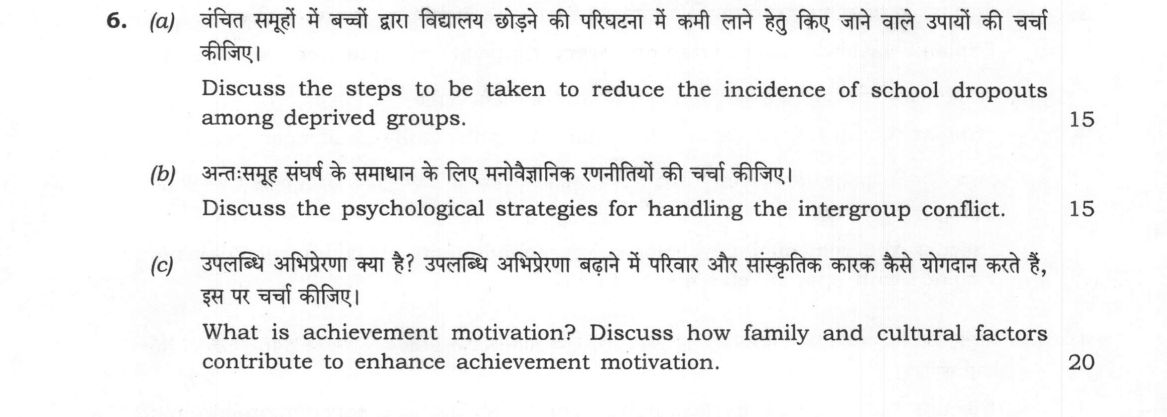
Discuss the steps to be taken to reduce the incidence of school dropouts among deprived groups. 15 marks
Discuss the psychological strategies for handling the intergroup conflict. 15 marks
What is achievement motivation? Discuss how family and cultural factors contribute to enhance achievement motivation. 20 marks
हिंदी में प्रश्न पढ़ें
वंचित समूहों में बच्चों द्वारा विद्यालय छोड़ने की परिघटना में कमी लाने हेतु किए जाने वाले उपायों की चर्चा कीजिए। (15 अंक)
अंतःसमूह संघर्ष के समाधान के लिए मनोवैज्ञानिक रणनीतियों की चर्चा कीजिए। (15 अंक)
उपलब्धि अभिप्रेरणा क्या है? उपलब्धि अभिप्रेरणा बढ़ाने में परिवार और सांस्कृतिक कारक कैसे योगदान करते हैं, इस पर चर्चा कीजिए। (20 अंक)
Model answer
Written by UPSC Answer Check against this question's marking rubric, to the expected length. UPSC does not publish answers for Mains — this is one way to score well, not an official key.
Reducing School Dropouts Among Deprived Groups
School dropout among marginalized communities (SC, ST, minorities, and rural girls) arises from an interplay of structural deprivations and psychological vulnerabilities. Drawing upon Bronfenbrenner’s ecological systems theory, multi-level interventions are necessary at the microsystem (family, school) and macrosystem (policy) levels.
At the structural level, strengthening the Right to Education (RTE) Act (2009) and Samagra Shiksha Abhiyan through targeted conditional cash transfers, midday meals (PM-POSHAN), and safe transport addresses immediate economic pushes. Mitigating caste- and gender-based discrimination through inclusive curricula and sensitizing teachers dismantles institutional biases. Concurrently, community mobilization through Village Education Committees and parental counseling fosters parental involvement and alters the perceived cost-benefit ratio of schooling.
Psychologically, deprived children often exhibit learned helplessness, a constrained future time orientation, and stereotype threat arising from internalized social stigmas. Targeted psychological interventions must include: (i) Growth mindset training (Carol Dweck) to decouple academic struggles from innate ability; (ii) Mentoring and peer-buddy programs to build self-efficacy and resilience; and (iii) Culturally responsive remedial teaching to validate marginalized identities and enhance academic engagement.
Psychological Strategies for Handling Intergroup Conflict
Intergroup conflict, rooted in social categorization, realistic resource competition, and outgroup derogation, requires psychologically grounded desegregation and mediation strategies:
Allport’s Contact Hypothesis provides the foundation: structured intergroup contact reduces prejudice when groups enjoy equal status, common goals, institutional support, and opportunities for meaningful acquaintance. Building on this, Muzafer Sherif’s Robbers Cave experiment demonstrated that introducing superordinate goals—objectives requiring interdependent cooperation—effectively neutralizes hostility.
Furthermore, the Common In-group Identity Model (Gaertner and Dovidio) utilizes recategorization, shifting cognitive boundaries from "Us vs. Them" to an overarching, inclusive "We". Facilitated dialogue-based approaches (e.g., problem-solving workshops) alleviate perceptual distortions, de-escalate emotional reactivity, and rebuild empathy.
In the Indian context, these principles manifest in the Gandhian Constructive Programme, emphasizing communal unity through collaborative manual labor. Institutionalizing intergroup contact through community policing, peace committees (Mohalla committees) in riot-prone zones, and civic initiatives that highlight shared syncretic cultural heritage (Ganga-Jamuni tehzeeb) operationalizes superordinate identities to foster long-term social cohesion.
Achievement Motivation: Family and Cultural Determinants
Achievement motivation (nAch), conceptualized by David McClelland, refers to a learned predisposition to strive for excellence, take calculated risks, and derive intrinsic satisfaction from mastering challenging tasks. John Atkinson refined this through his risk-taking model, positing that the tendency to achieve (Tₛ) is a multiplicative function of the motive to succeed (Mₛ), the perceived probability of success (Pₛ), and the incentive value of success (Iₛ), distinguishing high nAch individuals by their preference for moderate, realistic challenges. While intrinsic motivation reflects engagement purely for inherent enjoyment, nAch specifically involves competing against an internalized standard of excellence.
Family factors heavily shape the early emergence of nAch:
- Parenting Styles: Diana Baumrind’s authoritative parenting—combining high warmth with high expectations and autonomy granting—fosters high competence and intrinsic mastery orientation.
- Home Environment and Modeling: Stimulating home learning environments coupled with high parental expectations and vicarious learning (Albert Bandura’s observational modeling) internalize achievement values. Early independence training and praise for effort rather than innate talent build self-efficacy.
Cultural factors provide the macro-level scaffolding:
- Ideological Foundations: Max Weber and McClelland linked the "Protestant Ethic" to achievement, showing that cultures emphasizing individualism, delayed gratification, and hard work nurture higher baseline nAch.
- Sociocultural Valuation: Collectivist middle-class cultures (e.g., Indian and East Asian) channel achievement motivation socially, tying personal success to family honor and upward caste-class mobility aspirations.
- Intervention Evidence: McClelland’s landmark Kakinada Experiment in Andhra Pradesh proved that nAch is malleable; structured entrepreneurial training among local businessmen significantly accelerated business growth, confirming that cultural and psychological environments can be intentionally redesigned.
A cohesive social development policy must integrate structural equity with psychological empowerment—mitigating learned helplessness in classrooms, fostering superordinate identities in conflicted communities, and actively cultivating achievement drives across social strata.
What "Discuss" is asking you to do
Lay the issue out from more than one side — how it arose, what is claimed for it, what is held against it, and where it now stands. UPSC attaches discuss to broad topics with several live dimensions, so coverage of the dimensions earns more than the strength of your opinion.
Structure that answers it
Set the issue up → the case as it is made → the case against → the dimension both sides leave out → where the balance now lies
Where marks are lost
Listing facts with no thread between them, or arguing one side throughout and calling it a discussion.
How this answer will be evaluated
Approach
Framework: UPSC Psychology Paper II (Educational & Social Psychology). (a) discuss: intro > 3-4 dimensions > example > balanced close | (b) discuss: intro > 3-4 dimensions > example > balanced close | (c) discuss: intro > 3-4 dimensions > example > balanced close Full marks: Precise definitions, named theories (Atkinson, Allport), Indian context, balanced analysis.
Key points expected
- Define 'deprived groups' (SC/ST, rural, girl child).
- Identify causes: economic, social, pedagogical.
- Link to Indian schemes (RTE, Mid-day Meal, PM-SY).
- Balanced conclusion on holistic approach.
- Define intergroup conflict (in-group/out-group).
- Explain 'Contact Hypothesis' (Allport).
- Explain 'Superordinate Goals' (Sherif).
- Mention 'Decategorization' or 'Recategorization'.
Evaluation rubric
Each sub-part is marked on its own, against the marks and word limit printed on the paper.
- (a) Steps to reduce school dropouts among deprived groups. 15 marks
discuss— intro → 3-4 dimensions → example → balanced close
Must cover
- Define 'deprived groups' (SC/ST, rural, girl child).
- Identify causes: economic, social, pedagogical.
- Link to Indian schemes (RTE, Mid-day Meal, PM-SY).
- Balanced conclusion on holistic approach.
Loses marks
- Generic advice without policy context.
- Ignoring the 'deprived' aspect (treating as general).
- No link to Indian educational context.
Earns more
- Reference to 'Education for All' (EFA) goals.
- Mention of 'Sarva Shiksha Abhiyan' (SSA).
- Distinction between primary and secondary dropouts.
- Role of community participation.
Extra mark
- Specific statistic on dropout rates (e.g., ASER data).
- Reference to a specific state-level initiative.
- (b) Psychological strategies for handling intergroup conflict. 15 marks
discuss— intro → 3-4 dimensions → example → balanced close
Must cover
- Define intergroup conflict (in-group/out-group).
- Explain 'Contact Hypothesis' (Allport).
- Explain 'Superordinate Goals' (Sherif).
- Mention 'Decategorization' or 'Recategorization'.
Loses marks
- Confusing intergroup with interpersonal conflict.
- Lack of named theories or experiments.
- Vague suggestions without psychological basis.
Earns more
- Reference to 'Robbers Cave' experiment.
- Discussion of 'Social Identity Theory' (Tajfel).
- Role of empathy and perspective-taking.
- Application to Indian social context (communal harmony).
Extra mark
- Mention of 'Intergroup Contact' guidelines (equal status).
- Reference to 'Common Ingroup Identity' model.
- (c) Definition of achievement motivation and role of family/culture. 20 marks
discuss— intro → 3-4 dimensions → example → balanced close
Must cover
- Define Achievement Motivation (Atkinson/McClelland).
- Explain 'Need for Achievement' (nAch).
- Role of family: parenting styles, expectations.
- Role of culture: individualism vs. collectivism.
Loses marks
- Defining motivation generally, not 'achievement' specifically.
- Ignoring the 'family' or 'cultural' component.
- No theoretical framework (e.g., Atkinson's model).
Earns more
- Mention of 'Locus of Control' (Rotter).
- Reference to 'Self-Efficacy' (Bandura).
- Discussion of 'Stereotype Threat'.
- Link to 'Growth Mindset' (Dweck).
Extra mark
- Reference to 'Hofstede's Cultural Dimensions'.
- Specific example of cultural influence on career choice.
Practice this exact question
Write your answer and it is marked point by point against the model answer above — what you covered, what you missed, what you got wrong.
Evaluate my answer →More from Psychology 2023 Paper II
- Q3 (a) Explain Maslow's need hierarchy theory. Critically evaluate the same. (15 marks) (b)…
- Q4 (a) Discuss the importance and applications of ecological theory for programme implementa…
- Q5 Answer the following questions in about 150 words each: (a) Explain with suitable example…
- Q6 (a) Discuss the steps to be taken to reduce the incidence of school dropouts among depriv…
- Q7 (a) Discuss the psychological and social effects of pornography addiction. (15 marks) (b)…
- Q8 (a) To what extent individual's life experiences are relevant for understanding terrorism…