Paper II — Q7
(a) Discuss the psychological and social effects of pornography addiction. (15 marks) (b) Discuss the strategies for promoting…
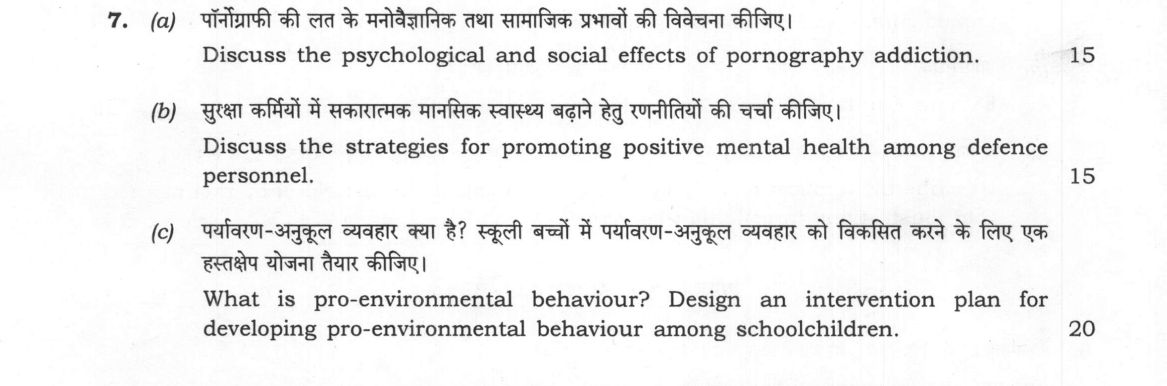
Discuss the psychological and social effects of pornography addiction. 15 marks
Discuss the strategies for promoting positive mental health among defence personnel. 15 marks
What is pro-environmental behaviour? Design an intervention plan for developing pro-environmental behaviour among schoolchildren. 20 marks
हिंदी में प्रश्न पढ़ें
पॉर्नोग्राफी की लत के मनोवैज्ञानिक तथा सामाजिक प्रभावों की विवेचना कीजिए। (15 अंक)
सुरक्षा कर्मियों में सकारात्मक मानसिक स्वास्थ्य बढ़ाने हेतु रणनीतियों की चर्चा कीजिए। (15 अंक)
पर्यावरण-अनुकूल व्यवहार क्या है? स्कूली बच्चों में पर्यावरण-अनुकूल व्यवहार को विकसित करने के लिए एक हस्तक्षेप योजना तैयार कीजिए। (20 अंक)
Model answer
Written by UPSC Answer Check against this question's marking rubric, to the expected length. UPSC does not publish answers for Mains — this is one way to score well, not an official key.
(a) Pornography addiction is not a formal DSM-5 diagnosis; it is better termed problematic pornography use, or compulsive sexual behaviour disorder in ICD-11 when it becomes persistent, repetitive, and impairing. Mechanism: repeated use sensitises mesolimbic dopamine pathways, creating cue reactivity, craving, tolerance, withdrawal-like distress, and weakened prefrontal inhibitory control. Psychological effects include mood dysregulation, anxiety, depression, shame, guilt, low self-esteem, body-image dissatisfaction, loneliness, sleep disturbance, and academic or occupational decline. Users may develop unrealistic sexual scripts, objectification of others, attentional bias to sexual cues, and sexual dysfunction such as delayed ejaculation or erectile difficulty. Moral incongruence—conflict between use and personal values—can amplify distress. Social effects include relationship dissatisfaction, reduced intimacy and trust, marital conflict, divorce risk, secrecy, isolation, financial or legal problems, and, in severe cases, exploitation or coercive behaviour. Evidence on aggression is mixed and moderated by pre-existing traits, alcohol, and content type. Effects are not universal; frequency alone does not equal addiction. Diagnosis requires impairment, loss of control, and persistence despite harm. Comorbidities include depression, anxiety, ADHD, impulsivity, and substance use. Prevention needs digital literacy, sex education, parental guidance, and accessible counselling.
(b) Promoting positive mental health among defence personnel requires a continuum of care: promotion, prevention, early intervention, and rehabilitation. Unique stressors include combat exposure, operational stress, separation from family, hierarchy, frequent postings, sleep deprivation, stigma, and reintegration problems. Primary promotion: mental health literacy campaigns, anti-stigma leadership, resilience training based on Reivich-Shatte or Penn Resiliency Program, stress inoculation training, mindfulness, relaxation, sleep hygiene, physical fitness, unit cohesion, buddy support, and PERMA-based positive psychology—positive emotions, engagement, relationships, meaning, accomplishment. Secondary prevention: periodic screening for PTSD, depression, anxiety, alcohol misuse, and suicidality; confidential counselling by unit psychologists and chaplains; tele-MANAS; peer support networks; early stress reaction management; decompression after deployment. Tertiary: trauma-focused CBT, EMDR, medication, family therapy, rehabilitation, vocational reintegration, financial and legal counselling, and disability support. Organizational strategies: humane rostering, leave, recreational facilities, grievance redressal, zero tolerance for harassment, command commitment, and confidentiality. Family support reduces separation stress. Training in emotional regulation, hardiness, cognitive reframing, biofeedback, yoga, adventure activities, sports, art therapy, and spiritual care builds protective factors. Postvention after suicide or trauma prevents contagion. Evaluation through mental health indicators, retention, and stigma surveys ensures accountability.
(c)(i) Pro-environmental behaviour is behaviour that consciously seeks to minimise negative environmental impact or benefit the environment. Examples: energy and water conservation, recycling, sustainable transport, plastic reduction, tree planting, biodiversity protection, environmental activism, and policy support. Determinants include knowledge, biospheric and altruistic values, attitudes, personal and social norms, perceived behavioural control, self-efficacy, habits, emotions, identity, and situational facilities. The attitude-behaviour gap means knowledge alone is insufficient; norms, cues, and reinforcement matter.
(c)(ii) Intervention plan for schoolchildren:
- Theory: Social Cognitive Theory for modelling, reinforcement, and self-efficacy; Theory of Planned Behaviour for attitudes, subjective norms, and perceived control; Norm Activation Model for awareness of consequences, responsibility, and personal norms; nudge theory for cues.
- Needs assessment: baseline survey of knowledge, attitudes, and behaviours; ecological audit of school waste, energy, and water.
- Objectives: increase eco-knowledge, favourable attitudes, personal norms, and self-efficacy; achieve measurable pro-environmental behaviours over six months.
- Target: classes VI–X; train teachers and eco-club coordinators.
- Components:
- Classroom: age-appropriate curriculum, stories, experiments, debates, climate films.
- Experiential: kitchen garden, composting, waste segregation, paper recycling, energy monitors, field trips, clean-up drives.
- Behavioural: goal setting, implementation intentions, self-monitoring diaries, weekly pledges.
- Social: eco-clubs, competitions, badges, certificates, teacher and parent modelling, public display of norms.
- Community: parent workshops, local NGO partnership, community clean-up.
- Implementation: integrate into timetable, monthly themes, assign responsibility, provide bins and signage.
- Evaluation: quasi-experimental pre-post with control school; measures: knowledge-attitude scale, behaviour checklist, observed behaviour, waste and energy audit, ecological footprint; follow-up at 3 and 6 months; process evaluation of fidelity and attendance.
- Ethics: voluntary, age-appropriate, non-shaming, inclusive.
What "Design" is asking you to do
Produce a specification that meets the given brief and demonstrate that it does. In civil and electrical papers the design is incomplete until it is expressed in buildable numbers — diameter, spacing, section, component value — and checked back against every limit stated.
Structure that answers it
Requirements and permissible values listed → code clause or design basis adopted → proportioning calculations → the specification in final dimensions → check against each requirement → sketch
Where marks are lost
Stopping at a required area or a required value without converting it into the bar size, spacing or component actually provided. The provided-against-required comparison and the serviceability or stability check are separately marked and routinely left out.
How this answer will be evaluated
Approach
Framework: Define > Theory or model > Evidence > Application. (a) discuss: intro > 3-4 dimensions > example > balanced close | (b) discuss: intro > 3-4 dimensions > example > balanced close | (c) derive: given > assumptions > stepwise derivation > result > check Full marks: Precise definitions, named theories (TPB, Dopamine), specific Indian context, structured plan with evaluation.
Key points expected
- Define pornography addiction (compulsive use)
- Psychological effects: desensitization, anxiety, depression
- Social effects: relationship dysfunction, isolation
- Balanced close on treatment or recovery
- Context: unique stressors of defence (deployment, isolation)
- Strategy 1: Peer support / Buddy systems
- Strategy 2: Professional counseling / EAP
- Strategy 3: Resilience training / Stress inoculation
Evaluation rubric
Each sub-part is marked on its own, against the marks and word limit printed on the paper.
- (a) Intro > 3-4 dimensions > example > balanced close 15 marks
discuss— intro → 3-4 dimensions → example → balanced close
Must cover
- Define pornography addiction (compulsive use)
- Psychological effects: desensitization, anxiety, depression
- Social effects: relationship dysfunction, isolation
- Balanced close on treatment or recovery
Loses marks
- Moralizing tone without psychological basis
- Confusing general use with clinical addiction
- Ignoring social/relational impact
Earns more
- Mention of 'dopamine reward pathway'
- Reference to 'compulsive sexual behavior disorder'
- Impact on self-esteem or body image
- Distinction between use and addiction
Extra mark
- Named study on desensitization (e.g., Prause)
- Reference to ICD-11 classification
- (b) Intro > 3-4 dimensions > example > balanced close 15 marks
discuss— intro → 3-4 dimensions → example → balanced close
Must cover
- Context: unique stressors of defence (deployment, isolation)
- Strategy 1: Peer support / Buddy systems
- Strategy 2: Professional counseling / EAP
- Strategy 3: Resilience training / Stress inoculation
Loses marks
- Generic advice applicable to any office job
- Ignoring the 'defence' specific context
- Focusing only on treatment, not promotion
Earns more
- Mention of 'PTSD' or 'combat stress'
- Role of family support systems
- De-stigmatization of mental health help
- Physical fitness as a coping mechanism
Extra mark
- Reference to specific Indian Army mental health initiatives
- Mention of 'resilience' as a specific construct
- (c) Definition > Intervention Plan (Objectives, Methods, Evaluation) 20 marks
derive— given → assumptions → stepwise derivation → result → check
Must cover
- Define pro-environmental behaviour (PEB)
- Plan: Specific objectives for schoolchildren
- Plan: Methods (e.g., gamification, field trips, curriculum)
- Plan: Evaluation metrics (pre/post test, observation)
Loses marks
- Vague plan without specific activities
- Ignoring the 'schoolchildren' target group
- No evaluation component in the plan
Earns more
- Use of 'Theory of Planned Behaviour' or 'TPB'
- Involving parents/community in the plan
- Specific age-appropriate activities (e.g., composting)
- Long-term vs short-term goals
Extra mark
- Reference to 'Sustainability Development Goals' (SDGs)
- Specific psychometric tool for measuring attitude
Practice this exact question
Write your answer and it is marked point by point against the model answer above — what you covered, what you missed, what you got wrong.
Evaluate my answer →More from Psychology 2023 Paper II
- Q4 (a) Discuss the importance and applications of ecological theory for programme implementa…
- Q5 Answer the following questions in about 150 words each: (a) Explain with suitable example…
- Q6 (a) Discuss the steps to be taken to reduce the incidence of school dropouts among depriv…
- Q7 (a) Discuss the psychological and social effects of pornography addiction. (15 marks) (b)…
- Q8 (a) To what extent individual's life experiences are relevant for understanding terrorism…