Paper II — Q3
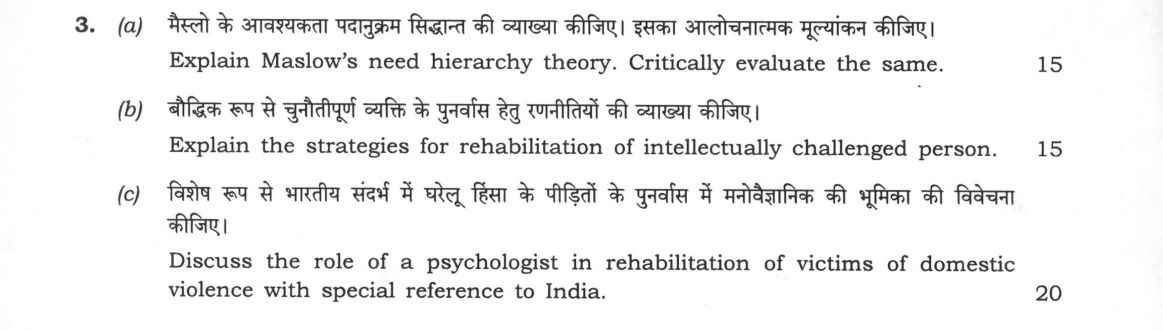
(a) Explain Maslow's need hierarchy theory. Critically evaluate the same. (15 marks) (b) Explain the strategies for…
Explain Maslow's need hierarchy theory. Critically evaluate the same. 15 marks
Explain the strategies for rehabilitation of intellectually challenged person. 15 marks
Discuss the role of a psychologist in rehabilitation of victims of domestic violence with special reference to India. 20 marks
हिंदी में प्रश्न पढ़ें
मैस्लो के आवश्यकता पदानुक्रम सिद्धांत की व्याख्या कीजिए। इसका आलोचनात्मक मूल्यांकन कीजिए। (15 अंक)
बौद्धिक रूप से चुनौतीपूर्ण व्यक्ति के पुनर्वास हेतु रणनीतियों की व्याख्या कीजिए। (15 अंक)
विशेष रूप से भारतीय संदर्भ में घरेलू हिंसा के पीड़ितों के पुनर्वास में मनोवैज्ञानिक की भूमिका की विवेचना कीजिए। (20 अंक)
Model answer
Written by UPSC Answer Check against this question's marking rubric, to the expected length. UPSC does not publish answers for Mains — this is one way to score well, not an official key.
Rehabilitation in Indian psychology is less about curing a deficit than about restoring safety, competence and participation. This is visible in how need theory, disability rehabilitation and domestic-violence care intersect.
Maslow's hierarchy and its critique. Maslow proposed that human motivation is organised in a hierarchy: physiological needs (food, water, sleep), safety needs (security, health, predictability), love/belonging (family, friendship, intimacy), esteem (respect, confidence, achievement), and self-actualization (realizing potential). The first four—physiological, safety, love/belonging and esteem—are deficiency needs (D-needs); self-actualization is a growth need (B-need). Lower needs are prepotent and must be reasonably satisfied before higher needs become dominant. The model is useful because it links basic survival to psychological flourishing. However, it has been criticised. Wahba and Bridwell's narrative review of empirical studies found limited support for a rigid, universal sequence; people often pursue several needs at once. Cross-cultural validity is also questioned: in collectivist Indian settings, belonging and family duty may precede individual esteem, and safety may be collective rather than personal. Alderfer's ERG theory challenges the strict hierarchy by allowing existence, relatedness and growth needs to operate simultaneously and by introducing frustration-regression.
Rehabilitation of intellectual disability. For an intellectually challenged person, rehabilitation must be educational, vocational, social and community-based. Educational strategies include special schools, resource rooms, individualized education programmes, and inclusive classrooms supported by Sarva Shiksha Abhiyan and disability-rights legislation. Vocational rehabilitation moves from sheltered workshops to supported employment, job coaching, and skill training matched to ability. Social rehabilitation teaches independent living, communication, money management and social skills, while family training reduces overprotection and builds realistic expectations. Community integration is central: accessible public spaces, community-based rehabilitation, and anti-discrimination norms such as those reflected in the Americans with Disabilities Act and India's disability rights framework help shift the person from segregation to participation. NIMHANS disability research underscores that family support and community inclusion improve outcomes more than institutional isolation alone.
Psychologist in domestic-violence rehabilitation. In India, the psychologist's role is multidimensional. Crisis intervention comes first: risk assessment, safety planning, emergency shelter, and coordination with one-stop centres, police, and legal aid under the Protection of Women from Domestic Violence Act, 2005 and the Dowry Prohibition Act, 1961. Therapy must be trauma-informed, using approaches such as TF-CBT and EMDR where appropriate, to address PTSD, depression, shame and disrupted attachment. Shelter-based counseling provides a safe space, while legal advocacy coordination helps victims obtain protection orders, maintenance and custody support. The psychologist must also address patriarchal barriers to reporting—stigma, economic dependence, caste pressure, and fear of retaliation—while avoiding victim-blaming or forced family reconciliation.
The evidence base matters. NFHS-5 reports that about one-third of ever-married women in India have experienced physical, sexual or emotional violence by a current or former partner, and ICSSR studies have documented high prevalence with low reporting. These data show that rehabilitation cannot be only clinical; it must be legal, economic and social. Intersectionality is crucial: a Dalit, poor, disabled or migrant woman faces compounded barriers, so services must be caste-sensitive, accessible and gender-responsive.
A critical comparison of institutional and community-based models is necessary. Institutions can provide immediate safety but may create dependency; community-based rehabilitation promotes autonomy but requires strong safeguards, housing and livelihood support. Maslow's deficiency needs explain why safety and belonging must precede esteem and self-actualization in both disability and domestic-violence rehabilitation. The way forward is a rights-based, multidisciplinary model in which psychologists combine trauma care, legal coordination, family work and community integration, ensuring that rehabilitation restores dignity rather than merely managing symptoms.
What "Discuss" is asking you to do
Lay the issue out from more than one side — how it arose, what is claimed for it, what is held against it, and where it now stands. UPSC attaches discuss to broad topics with several live dimensions, so coverage of the dimensions earns more than the strength of your opinion.
Structure that answers it
Set the issue up → the case as it is made → the case against → the dimension both sides leave out → where the balance now lies
Where marks are lost
Listing facts with no thread between them, or arguing one side throughout and calling it a discussion.
How this answer will be evaluated
Approach
Framework: UPSC Psychology Paper 2. (a) critically evaluate: positives > negatives/limits > conditions/safeguards > conclusion | (b) explain: definition/context > points in order > small example > short close | (c) discuss: intro > 3-4 dimensions > example > balanced close Full marks: Comprehensive, evidence-based, with specific Indian context and named theories.
Key points expected
- List 5 levels: physiological, safety, love, esteem, self-actualization
- Explain prepotency and the 'satisfaction-progression' principle
- Critique: cultural bias (individualism) and rigidity of hierarchy
- Mention 'self-transcendence' as a later addition by Maslow
- Define Intellectual Disability (IQ < 70 + adaptive deficit)
- Explain 'Least Restrictive Environment' (LRE) and inclusion
- Describe 'Life Skills Training' (daily living, social skills)
- Mention 'Vocational Rehabilitation' and supported employment
Evaluation rubric
Each sub-part is marked on its own, against the marks and word limit printed on the paper.
- (a) Explain Maslow's hierarchy and evaluate its strengths and limitations. 15 marks
critically evaluate— positives → negatives/limits → conditions/safeguards → conclusion
Must cover
- List 5 levels: physiological, safety, love, esteem, self-actualization
- Explain prepotency and the 'satisfaction-progression' principle
- Critique: cultural bias (individualism) and rigidity of hierarchy
- Mention 'self-transcendence' as a later addition by Maslow
Loses marks
- Listing levels without explaining the mechanism
- Treating the hierarchy as a strict, unchangeable law
- Ignoring the 'critical evaluation' aspect of the prompt
Earns more
- Reference to 'peak experiences' or 'B-values'
- Comparison with Alderfer's ERG theory
- Application to workplace motivation or education
Extra mark
- Diagram of the pyramid with labels
- Citation of specific studies (e.g., Deci & Ryan)
- (b) Detail strategies for rehabilitating intellectually challenged persons. 15 marks
explain— definition/context → points in order → small example → short close
Must cover
- Define Intellectual Disability (IQ < 70 + adaptive deficit)
- Explain 'Least Restrictive Environment' (LRE) and inclusion
- Describe 'Life Skills Training' (daily living, social skills)
- Mention 'Vocational Rehabilitation' and supported employment
Loses marks
- Confusing intellectual disability with mental illness
- Focusing only on medical treatment (medication)
- Ignoring the social/adaptive component of rehabilitation
Earns more
- Reference to 'Individualized Education Program' (IEP)
- Role of family counseling and support groups
- Use of assistive technology or AAC devices
Extra mark
- Mention of specific Indian schemes (e.g., SAKSHAM)
- Reference to specific psychometric tools (e.g., WISC)
- (c) Discuss the psychologist's role in rehabilitating domestic violence victims in India. 20 marks
discuss— intro → 3-4 dimensions → example → balanced close
Must cover
- Identify psychological trauma (PTSD, anxiety, low self-esteem)
- Explain 'Cognitive Behavioral Therapy' (CBT) for trauma
- Reference 'Protection of Women from Domestic Violence Act, 2005'
- Discuss 'Safe House' or shelter home interventions
Loses marks
- Ignoring the specific Indian legal/social context
- Focusing only on the perpetrator's rehabilitation
- Treating the victim as passive rather than empowering
Earns more
- Mention of 'One Stop Centre' (OSC) in India
- Role in legal aid and court testimony preparation
- Addressing 'Battered Woman Syndrome' or learned helplessness
Extra mark
- Reference to specific NGOs (e.g., Akshaya Patra, CRY)
- Mention of 'National Commission for Women' guidelines
Practice this exact question
Write your answer and it is marked point by point against the model answer above — what you covered, what you missed, what you got wrong.
Evaluate my answer →More from Psychology 2023 Paper II
- Q1 Answer the following questions in about 150 words each: (a) Compare directional and non-d…
- Q2 (a) Discuss the biopsychosocial model of health. Suggest relevant actions to prevent illn…
- Q3 (a) Explain Maslow's need hierarchy theory. Critically evaluate the same. (15 marks) (b)…
- Q4 (a) Discuss the importance and applications of ecological theory for programme implementa…
- Q5 Answer the following questions in about 150 words each: (a) Explain with suitable example…
- Q6 (a) Discuss the steps to be taken to reduce the incidence of school dropouts among depriv…