Paper II — Q4
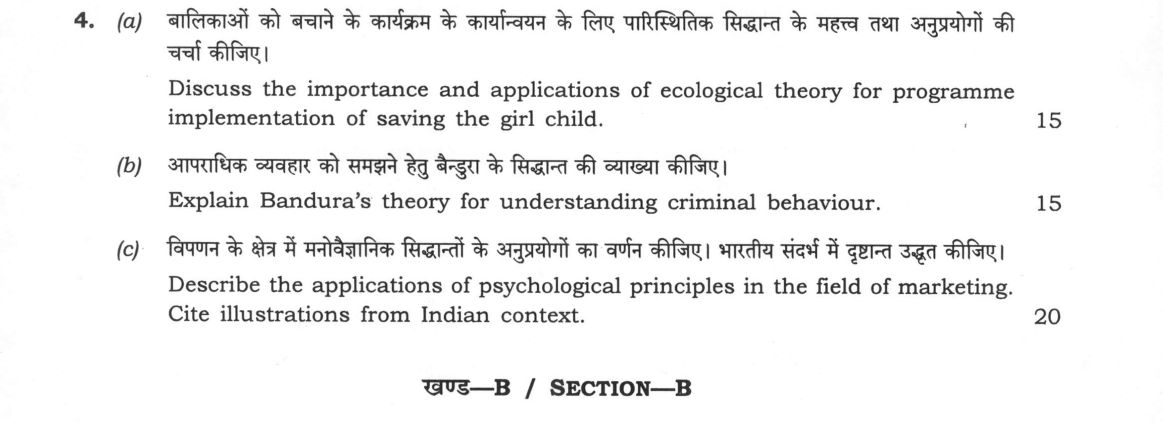
(a) Discuss the importance and applications of ecological theory for programme implementation of saving the girl child. (15…
Discuss the importance and applications of ecological theory for programme implementation of saving the girl child. 15 marks
Explain Bandura's theory for understanding criminal behaviour. 15 marks
Describe the applications of psychological principles in the field of marketing. Cite illustrations from Indian context. 20 marks
हिंदी में प्रश्न पढ़ें
बालिकाओं को बचाने के कार्यक्रम के कार्यान्वयन के लिए पारिस्थितिक सिद्धांत के महत्व तथा अनुप्रयोगों की चर्चा कीजिए। (15 अंक)
अपराधिक व्यवहार को समझने हेतु बैंडूरा के सिद्धांत की व्याख्या कीजिए। (15 अंक)
विपणन के क्षेत्र में मनोवैज्ञानिक सिद्धांतों के अनुप्रयोगों का वर्णन कीजिए। भारतीय संदर्भ में दृष्टांत उद्धृत कीजिए। (20 अंक)
Model answer
Written by UPSC Answer Check against this question's marking rubric, to the expected length. UPSC does not publish answers for Mains — this is one way to score well, not an official key.
Applied psychology bridges theoretical paradigms with real-world interventions, offering analytical tools for social development, criminology, and consumer behavior.
Ecological Theory and Girl Child Protection
Urie Bronfenbrenner’s Ecological Systems Theory conceptualizes human development within nested socio-environmental systems, providing a structural blueprint for multi-level interventions like the Beti Bachao Beti Padhao (BBBP) scheme.
At the microsystem level, direct interactions within the family and school are addressed by sensitizing parents against son preference and incentivizing girl child nutrition and schooling. The mesosystem strengthens linkages between these immediate settings, such as parent-teacher associations and Anganwadi-family interactions promoting institutional deliveries. The exosystem encompasses settings that indirectly affect the child, including local Gram Panchayats, community vigil groups, and media campaigns that alter community norms. The macrosystem tackles overarching cultural ideologies, patriarchy, and legal enforcement through acts like the PC-PNDT Act, 1994. Finally, the chronosystem tracks socio-historical changes, capturing longitudinal improvements in child sex ratios over time.
While ecological theory offers comprehensive systemic mapping, its practical limitation lies in the immense operational complexity of coordinating multi-sectoral agencies across health, education, and law enforcement.
Bandura’s Theory of Criminal Behaviour
Albert Bandura’s Social Cognitive Theory explains criminal conduct as a learned behavior acquired through observational learning, vicarious reinforcement, and cognitive mediation.
Individuals acquire antisocial patterns by observing aggressive or delinquent models within families, deviant peer networks, or violent media. When observed criminal acts yield material rewards or social status without punishment, vicarious reinforcement increases the likelihood of imitation. Central to this is Bandura’s reciprocal determinism, which posits that criminal actions result from the continuous, bidirectional interaction between personal cognitions (such as moral disengagement and perceived self-efficacy in executing illicit acts), environmental pressures (deviant peer subcultures), and the behavior itself. Mechanisms of moral disengagement—including diffusion of responsibility, moral justification, and dehumanization of victims—allow offenders to bypass self-censure.
However, a critical limitation of Bandura’s framework is its relative neglect of biological, neurochemical, and genetic predispositions toward impulsivity and aggression.
Psychological Principles in Marketing: Indian Applications
Marketing extensively applies core psychological concepts to shape consumer perception, motivation, attitudes, and decision-making:
Perception and Sensory Marketing: Marketers use sensory branding to create distinctive perceptual schemas. Amul successfully deploys consistent visual cues, top-of-mind brand personality, and emotive nostalgia through its topical Amul Girl campaign to capture consumer attention.
Motivation and Identity: Maslow’s hierarchy and McClelland’s acquired needs theory are leveraged to tap into consumer aspirations. Patanjali operationalized cultural identity and nationalistic pride (Swadeshi), using trust heuristics to satisfy consumers' intrinsic needs for safety, authenticity, and cultural affiliation.
Attitudes and Persuasion: Using Petty and Cacioppo’s Elaboration Likelihood Model (ELM) and Heider’s Balance Theory, brands induce central and peripheral attitude change. Tata Tea’s Jaago Re campaign connects product purchase with civic awakenings and anti-corruption awareness, fostering positive brand attitudes through cause-related social messaging.
Learning and Behavioral Economics: Classical and operant conditioning, alongside Kahneman and Tversky’s Prospect Theory, drive consumer action. Reliance Jio utilized operant reinforcement through initial free data trials to build consumption habits, followed by behavioral nudges and default framing that leveraged loss aversion during subscription rollouts.
Despite its commercial efficacy, applying consumer psychology raises serious ethical concerns regarding subconscious manipulation, behavioral dependency, and the exploitation of vulnerable demographics.
Applied psychology provides the necessary mechanisms for social change—guiding systemic ecosystems to protect the girl child, informing cognitive-behavioral rehabilitation in criminal justice, and demanding ethical frameworks in consumer-facing markets.
What "Describe" is asking you to do
Give a full, ordered account of the thing named — its parts, stages or mechanism — in the sequence in which it actually exists or occurs. Most describe questions come from the science optionals, where the marks sit in correct technical detail and, where the stem says so, a labelled diagram.
Structure that answers it
One-line identification of the subject → the parts or stages in their real order, each with its defining detail → labelled diagram where the subject is structural → closing line on function or significance
Where marks are lost
Loose general prose where the examiner is ticking named parts, correct terminology and their sequence; and in the General Studies papers, turning to evaluation before the description is finished.
How this answer will be evaluated
Approach
Framework: UPSC Psychology Paper II. (a) discuss: intro > 3-4 dimensions > example > balanced close | (b) explain: definition/context > points in order > small example > short close | (c) describe: define > structure or process in order > labelled diagram > significance Full marks: Precise theory application with specific Indian examples and named studies
Key points expected
- Define ecological theory (Bronfenbrenner/Urie Bronfenbrenner)
- Identify microsystem, mesosystem, exosystem, macrosystem
- Apply each level to girl child issues (e.g., school, policy)
- Link theory to specific programme implementation strategies
- Define Social Learning Theory (Bandura)
- Explain observational learning and modeling
- Explain reinforcement and self-regulation in crime
- Apply theory to understanding criminal behaviour
Evaluation rubric
Each sub-part is marked on its own, against the marks and word limit printed on the paper.
- (a) Link ecological theory levels to 'Save the Girl Child' programme implementation. 15 marks
discuss— intro → 3-4 dimensions → example → balanced close
Must cover
- Define ecological theory (Bronfenbrenner/Urie Bronfenbrenner)
- Identify microsystem, mesosystem, exosystem, macrosystem
- Apply each level to girl child issues (e.g., school, policy)
- Link theory to specific programme implementation strategies
Loses marks
- Generic discussion of girl child without theory
- Theory defined but not applied to the specific programme
- Confusing ecological theory with other developmental theories
Earns more
- Mention specific Indian schemes (e.g., Beti Bachao Beti Padhao)
- Discuss cultural factors in macrosystem
- Reference specific ecological studies on gender
Extra mark
- Diagram of ecological systems
- Cite specific policy document or committee report
- (b) Explain Bandura's Social Learning Theory as applied to criminal behaviour. 15 marks
explain— definition/context → points in order → small example → short close
Must cover
- Define Social Learning Theory (Bandura)
- Explain observational learning and modeling
- Explain reinforcement and self-regulation in crime
- Apply theory to understanding criminal behaviour
Loses marks
- Confusing Bandura with Skinner or other behaviorists
- Theory explained but not linked to criminal behaviour
- Vague description of 'learning' without specific mechanisms
Earns more
- Mention Bobo doll experiment
- Discuss reciprocal determinism
- Reference specific studies on criminal modeling
Extra mark
- Diagram of reciprocal determinism
- Cite specific criminological study using Bandura's framework
- (c) Describe psychological principles in marketing with Indian examples. 20 marks
describe— define → structure or process in order → labelled diagram → significance
Must cover
- Identify specific psychological principles (e.g., perception, motivation)
- Explain how each principle is applied in marketing
- Provide specific Indian context illustrations
- Link principles to consumer behaviour
Loses marks
- Generic marketing principles without psychological basis
- Indian examples that are not clearly linked to psychological principles
- Confusing marketing tactics with psychological theory
Earns more
- Mention specific Indian brands or campaigns
- Discuss cultural factors in Indian marketing
- Reference specific psychological studies on Indian consumers
Extra mark
- Diagram of consumer decision process
- Cite specific market research data from India
Practice this exact question
Write your answer and it is marked point by point against the model answer above — what you covered, what you missed, what you got wrong.
Evaluate my answer →More from Psychology 2023 Paper II
- Q1 Answer the following questions in about 150 words each: (a) Compare directional and non-d…
- Q2 (a) Discuss the biopsychosocial model of health. Suggest relevant actions to prevent illn…
- Q3 (a) Explain Maslow's need hierarchy theory. Critically evaluate the same. (15 marks) (b)…
- Q4 (a) Discuss the importance and applications of ecological theory for programme implementa…
- Q5 Answer the following questions in about 150 words each: (a) Explain with suitable example…
- Q6 (a) Discuss the steps to be taken to reduce the incidence of school dropouts among depriv…
- Q7 (a) Discuss the psychological and social effects of pornography addiction. (15 marks) (b)…