Paper I — Q1
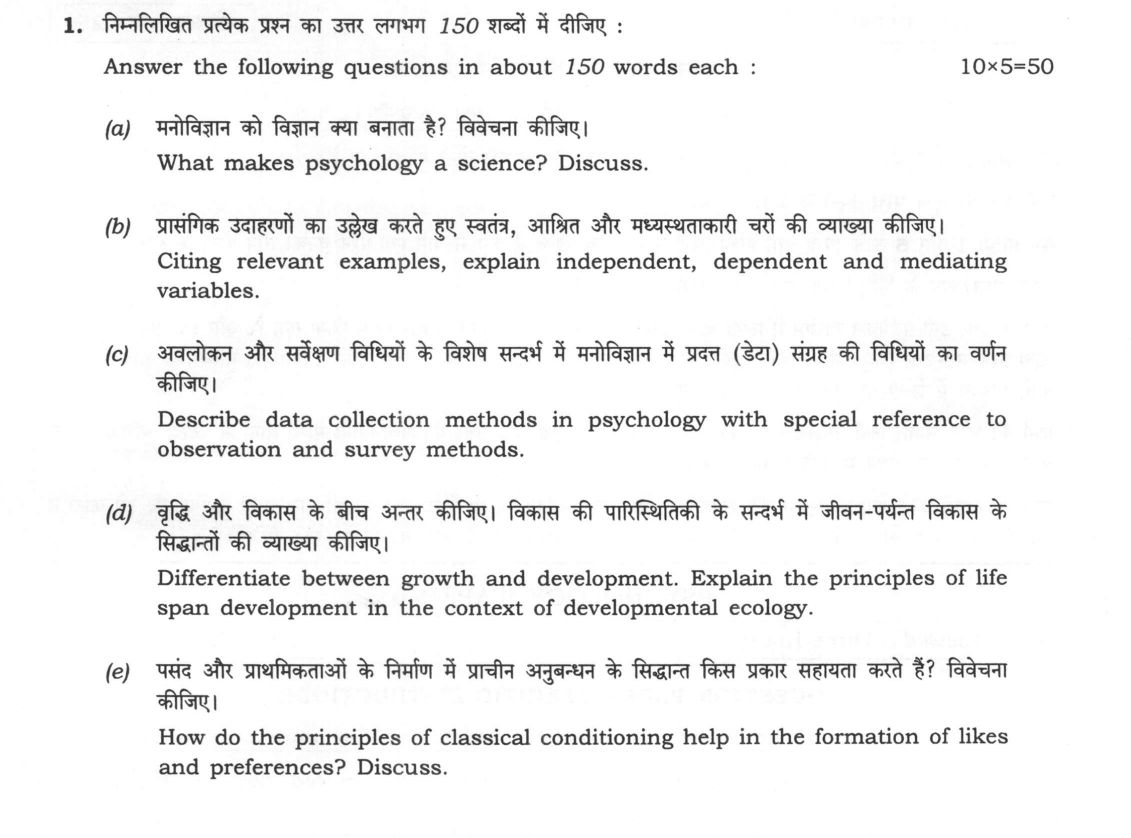
Answer the following questions in about 150 words each: (a) What makes psychology a science? Discuss. (10 marks) (b) Citing…
Answer the following questions in about 150 words each: What makes psychology a science? Discuss. 10 marks
Citing relevant examples, explain independent, dependent and mediating variables. 10 marks
Describe data collection methods in psychology with special reference to observation and survey methods. 10 marks
Differentiate between growth and development. Explain the principles of life span development in the context of developmental ecology. 10 marks
How do the principles of classical conditioning help in the formation of likes and preferences? Discuss. 10 marks
हिंदी में प्रश्न पढ़ें
निम्नलिखित प्रत्येक प्रश्न का उत्तर लगभग 150 शब्दों में दीजिए : मनोविज्ञान को विज्ञान क्या बनाता है? विवेचना कीजिए। (10 अंक)
प्रासंगिक उदाहरणों का उल्लेख करते हुए स्वतंत्र, आश्रित और मध्यस्थताकारी चरों की व्याख्या कीजिए। (10 अंक)
अवलोकन और सर्वेक्षण विधियों के विशेष संदर्भ में मनोविज्ञान में प्रदत्त (डेटा) संग्रह की विधियों का वर्णन कीजिए। (10 अंक)
वृद्धि और विकास के बीच अंतर कीजिए। विकास की पारिस्थितिकी के संदर्भ में जीवन-पर्यंत विकास के सिद्धांतों की व्याख्या कीजिए। (10 अंक)
पसंद और प्राथमिकताओं के निर्माण में प्राचीन अनुबंधन के सिद्धांत किस प्रकार सहायता करते हैं? विवेचना कीजिए। (10 अंक)
Model answer
Written by UPSC Answer Check against this question's marking rubric, to the 150-word length. UPSC does not publish answers for Mains — this is one way to score well, not an official key.
(a) Psychology as a science Psychology is a science because it studies behaviour and mental processes through systematic empiricism: observations are planned, recorded, and subjected to controlled or comparative analysis. It formulates concepts, constructs theories, and derives hypotheses that can be tested, revised, or rejected; falsifiability, in Popper’s sense, is an important criterion, though not every qualitative or clinical formulation is strictly falsifiable. Replicability, measurement, and cumulative theory-building distinguish it from pseudoscience, which relies on vague claims and immune-to-failure authority. Its methodological pluralism—quantitative experiments, qualitative interviews, neuroimaging, and field studies—allows it to address both general laws and individual meaning. For example, an Indian study on exam stress can operationalise stress, measure cortisol or self-report, and test whether an intervention reduces anxiety, making the claim empirically accountable.
(b) Variables In research, the independent variable is the cause or condition manipulated or selected by the researcher; the dependent variable is the outcome measured; the mediating variable is the intervening mechanism that explains how the independent variable affects the dependent variable. For instance, in an Indian classroom experiment, the independent variable may be exam pressure created by a timed, high-stakes test; the dependent variable may be academic performance measured by marks or working-memory task scores. A mediator could be threat appraisal: pressure increases the perception of threat, which raises test anxiety and narrows attention, thereby lowering performance. This differs from moderation, where a third variable changes the strength of the relation. Operational clarity is essential: if pressure is manipulated, anxiety is measured, and performance is scored, the causal chain can be tested.
(c) Data collection Psychology uses several data-collection methods. Experiments establish causality by manipulating an independent variable and controlling extraneous factors; case studies give in-depth description of rare or complex cases; psychological tests assess abilities, traits, or disorders; archival research uses existing records such as school registers or hospital data. Observation is especially important: structured observation uses predefined categories and time or event sampling, such as counting aggressive acts in a Delhi schoolyard; unstructured observation records open-ended behaviour, useful in exploratory studies. Participant observation involves joining the setting, while non-participant observation maintains distance. Survey methods collect self-report data through questionnaires, interviews, and standardised scales. They are economical and can reach large Indian populations, but are limited by social desirability, recall bias, and language validity. Ethical care—consent, anonymity, and cultural sensitivity—is required in all methods.
(d) Growth and development Growth refers mainly to quantitative biological changes—height, weight, brain size—whereas development is broader, including quantitative and qualitative changes in cognition, emotion, language, and social competence. Growth is thus a subset of development, not its opposite; it is more specific and biological, while development is holistic and person-level. Baltes’ life-span principles include multidimensionality (physical, cognitive, socio-emotional), multidirectionality (gains and losses across life), plasticity (change remains possible), contextualism (shaped by environment), multiple causality, and interdisciplinary explanation. Bronfenbrenner’s ecological systems clarify this: the microsystem includes family and school; the mesosystem links home and school; the exosystem includes parents’ workplaces and policies; the macrosystem includes caste, gender, religion, and national culture; the chronosystem includes historical change. In India, a child’s development is affected by joint-family support, school quality, urban migration, and digital access.
(e) Classical conditioning Classical conditioning helps form likes and preferences through repeated association. A neutral stimulus (NS), such as a particular brand jingle, is paired with an unconditioned stimulus (US), such as a pleasant taste or social approval, that naturally produces liking. After acquisition, the NS becomes a conditioned stimulus (CS) and can elicit a conditioned response of preference. Generalisation extends liking to similar stimuli, such as other products with similar colours or music. Higher-order conditioning allows a new stimulus, such as a celebrity image, to acquire liking because it is paired with an already liked CS. Extinction weakens the preference if the CS is repeatedly presented without the US. In Indian consumer life, repeated pairing of a food with festive family gatherings can create lasting taste preferences, while advertising uses these principles to shape aesthetic and brand tastes. The same logic can create dislikes, as a child bitten by a dog may generalise fear to all furry animals.
Thus, psychology’s scientific character lies in testable, replicable inquiry; its methods and variable logic make behaviour analytically accessible; life-span development shows that persons are shaped by nested contexts; and conditioning shows that preferences are learned. A way forward is to combine rigorous measurement, ethical practice, and Indian social contexts so that psychological knowledge remains both scientific and socially relevant.
What "Discuss" is asking you to do
Lay the issue out from more than one side — how it arose, what is claimed for it, what is held against it, and where it now stands. UPSC attaches discuss to broad topics with several live dimensions, so coverage of the dimensions earns more than the strength of your opinion.
Structure that answers it
Set the issue up → the case as it is made → the case against → the dimension both sides leave out → where the balance now lies
Where marks are lost
Listing facts with no thread between them, or arguing one side throughout and calling it a discussion.
How this answer will be evaluated
Approach
Framework: Psychology Paper 1: Define > Theory/Model > Evidence > Application. (a) discuss: intro > 3-4 dimensions > example > balanced close | (b) explain: definition/context > points in order > small example > short close | (c) describe: define > structure or process in order > labelled diagram > significance | (d) compare: paired headings or table > key differences > significance > conclusion | (e) discuss: intro > 3-4 dimensions > example > balanced close Full marks: Precise definitions, named theories/studies, clear examples, balanced discussion, and correct application of command words.
Key points expected
- Mention empirical method and scientific attitude
- Reference objective measurement and quantification
- Discuss hypothesis testing and falsifiability
- Mention systematic observation and experimentation
- Define independent variable (manipulated)
- Define dependent variable (measured)
- Define mediating variable (mechanism)
- Provide a coherent example linking all three
Evaluation rubric
Each sub-part is marked on its own, against the marks and word limit printed on the paper.
- (a) Justify psychology's status as a science through methodological and theoretical criteria. · 150 words
discuss— intro → 3-4 dimensions → example → balanced close
Must cover
- Mention empirical method and scientific attitude
- Reference objective measurement and quantification
- Discuss hypothesis testing and falsifiability
- Mention systematic observation and experimentation
Loses marks
- Treating psychology as purely philosophical
- Ignoring the role of empirical evidence
- Confusing science with common sense
Earns more
- Reference to Wundt or structuralism
- Mention of operational definitions
- Reference to peer review process
- Mention of replicability
Extra mark
- Reference to specific psychometric tools
- Mention of specific scientific journals
- (b) Define and distinguish independent, dependent, and mediating variables with examples. · 150 words
explain— definition/context → points in order → small example → short close
Must cover
- Define independent variable (manipulated)
- Define dependent variable (measured)
- Define mediating variable (mechanism)
- Provide a coherent example linking all three
Loses marks
- Confusing independent and dependent variables
- Failing to explain the mechanism of mediation
- Providing vague or unrelated examples
Earns more
- Mention of control variables
- Reference to a specific study
- Clear distinction between mediator and moderator
- Use of a diagram or flow
Extra mark
- Reference to a specific named experiment
- Mention of statistical mediation analysis
- (c) Outline data collection methods, focusing on observation and survey techniques. · 150 words
describe— define → structure or process in order → labelled diagram → significance
Must cover
- Define observation method (naturalistic/participant)
- Define survey method (questionnaire/interview)
- Mention strengths of observation (ecological validity)
- Mention strengths of survey (large samples)
Loses marks
- Confusing observation with experiment
- Ignoring the specific focus on observation and survey
- Failing to mention limitations
Earns more
- Mention of limitations (observer bias, social desirability)
- Reference to specific scales (e.g., Likert)
- Mention of reliability and validity
- Reference to specific studies
Extra mark
- Reference to specific psychometric tools
- Mention of specific observation protocols
- (d) Distinguish growth from development and explain life span principles in developmental ecology. · 150 words
compare— paired headings or table → key differences → significance → conclusion
Must cover
- Define growth (quantitative/physical)
- Define development (qualitative/functional)
- Mention life span perspective (continuous)
- Reference to developmental ecology (Bronfenbrenner)
Loses marks
- Treating growth and development as identical
- Ignoring the life span perspective
- Failing to mention developmental ecology
Earns more
- Mention of microsystem and macrosystem
- Reference to specific developmental stages
- Mention of nature vs nurture
- Reference to specific theories
Extra mark
- Reference to specific named studies
- Mention of specific ecological models
- (e) Explain how classical conditioning principles contribute to the formation of likes and preferences. · 150 words
discuss— intro → 3-4 dimensions → example → balanced close
Must cover
- Define classical conditioning (Pavlov)
- Explain acquisition of conditioned response
- Apply to taste preferences (e.g., food)
- Mention of emotional conditioning (fear/liking)
Loses marks
- Confusing classical and operant conditioning
- Failing to apply principles to likes/preferences
- Ignoring the role of emotional response
Earns more
- Reference to specific studies (e.g., Garcia effect)
- Mention of advertising and marketing
- Reference to specific examples (e.g., music)
- Mention of extinction and spontaneous recovery
Extra mark
- Reference to specific named experiments
- Mention of specific psychometric tools
Practice this exact question
Write your answer and it is marked point by point against the model answer above — what you covered, what you missed, what you got wrong.
Evaluate my answer →More from Psychology 2024 Paper I
- Q1 Answer the following questions in about 150 words each: (a) What makes psychology a scien…
- Q2 (a) Describe the diversity in the disciplinary thoughts with special reference to structu…
- Q3 (a) Discuss the signal detection theory (SDT) with reference to perceptual vigilance task…
- Q4 (a) Differentiate between classical and operant conditioning. Discuss their applications…