Paper I — Q8
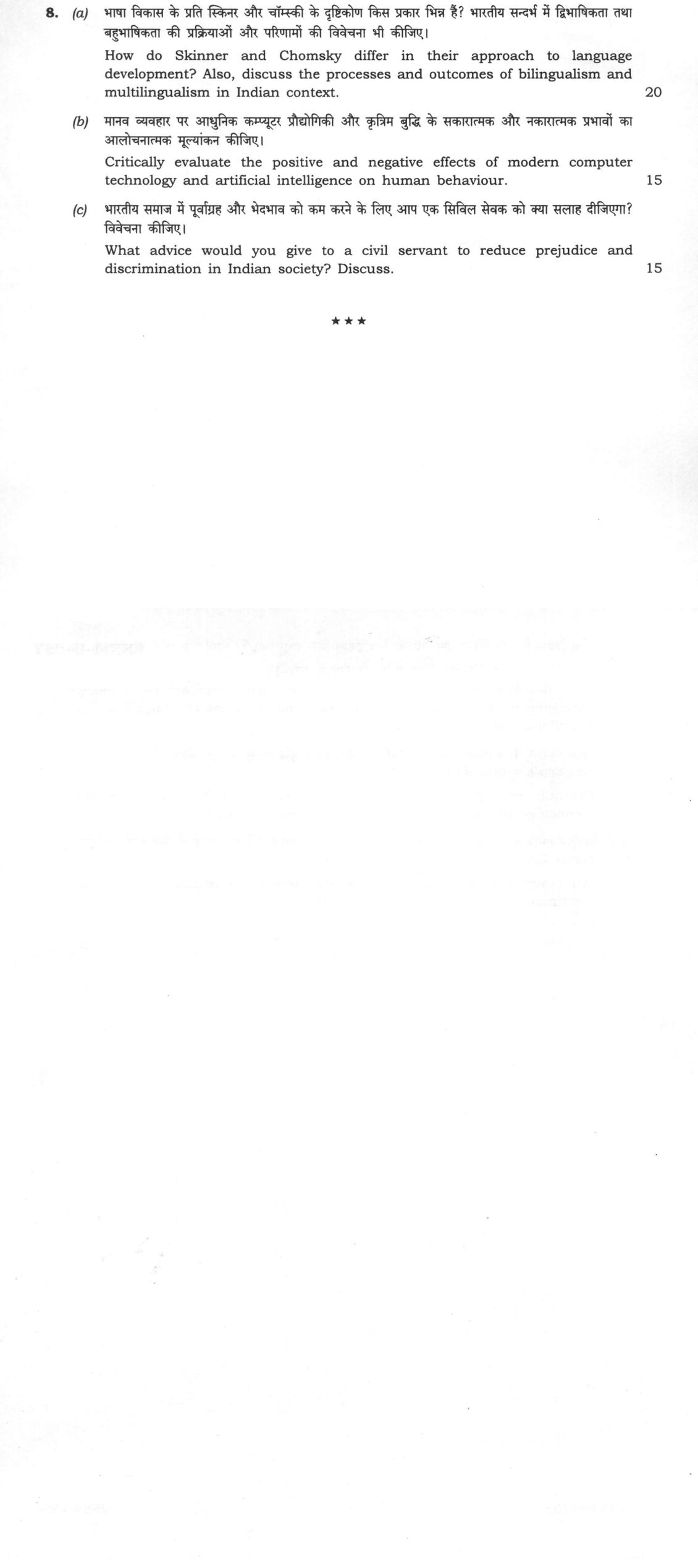
(a) How do Skinner and Chomsky differ in their approach to language development? Also, discuss the processes and outcomes of…
How do Skinner and Chomsky differ in their approach to language development? Also, discuss the processes and outcomes of bilingualism and multilingualism in Indian context. 20 marks
Critically evaluate the positive and negative effects of modern computer technology and artificial intelligence on human behaviour. 15 marks
What advice would you give to a civil servant to reduce prejudice and discrimination in Indian society? Discuss. 15 marks
हिंदी में प्रश्न पढ़ें
भाषा विकास के प्रति स्किनर और चॉम्स्की के दृष्टिकोण किस प्रकार भिन्न हैं? भारतीय संदर्भ में द्विभाषिकता तथा बहुभाषिकता की प्रक्रियाओं और परिणामों की विवेचना भी कीजिए। (20 अंक)
मानव व्यवहार पर आधुनिक कम्प्यूटर प्रौद्योगिकी और कृत्रिम बुद्धि के सकारात्मक और नकारात्मक प्रभावों का आलोचनात्मक मूल्यांकन कीजिए। (15 अंक)
भारतीय समाज में पूर्वाग्रह और भेदभाव को कम करने के लिए आप एक सिविल सेवक को क्या सलाह दीजिएगा? विवेचना कीजिए। (15 अंक)
Model answer
Written by UPSC Answer Check against this question's marking rubric, to the expected length. UPSC does not publish answers for Mains — this is one way to score well, not an official key.
Skinner vs. Chomsky and Indian Multilingualism
B.F. Skinner conceptualized language acquisition through an empiricist framework of operant conditioning, arguing that verbal behavior is acquired via environmental imitation, stimulus-response associations, and selective reinforcement. In contrast, Noam Chomsky proposed a rationalist, nativist paradigm centered on an innate Language Acquisition Device (LAD) and Universal Grammar (UG). Chomsky’s "poverty of the stimulus" argument demonstrated that environmental input alone is too degenerate and finite to account for a child’s rapid, generative capacity to construct infinite novel, grammatically accurate sentences.
In India's linguistically plural society, language acquisition occurs through both simultaneous acquisition (in multilingual households) and sequential acquisition (formal schooling). This involves widespread code-switching and code-mixing as functional communicative strategies. Cognitively, negotiating multiple active linguistic systems enhances executive control functions—specifically inhibitory control, task-switching, and working memory. In the Indian context, these cognitive advantages contribute to a greater "cognitive reserve," significantly delaying the clinical onset of dementia symptoms in multilingual aging populations. Applied institutional frameworks like the Three-Language Formula and natural grassroots tribal multilingualism illustrate that acquiring multiple tongues does not cause cognitive overload; rather, it fosters divergent thinking, metalinguistic awareness, and cross-cultural adaptability.
Technology, AI, and Human Behaviour
The integration of artificial intelligence and digital technology has reconfigured human cognition and social dynamics. Positively, modern computing facilitates cognitive offloading, validating Clark and Chalmers’ "extended mind thesis" by freeing working memory for complex problem-solving. Adaptive educational technology personalizes learning, while assistive AI enhances accessibility for neurodiverse and disabled populations, fostering social inclusion.
Conversely, pervasive technology induces cognitive and behavioral vulnerabilities. Hyper-connectivity causes attention fragmentation and "digital amnesia" (reliance on search engines over long-term memory encoding). As Nicholas Carr argues in his Shallows thesis, neuroplastic adaptation to rapid digital browsing erodes capacities for sustained contemplation and deep reading. Socially, Sherry Turkle’s Alone Together framework highlights how networked communication displaces genuine interpersonal vulnerability, fostering social displacement and shallow connectedness. Furthermore, automated algorithms introduce behavioral deskilling and perpetuate algorithmic biases. In India, deploying AI in governance—such as automated facial recognition and biometric welfare delivery—risks amplifying systemic exclusion across the digital divide while fostering surveillance-induced behavioral conformity.
Reducing Prejudice in Public Administration
To eliminate systemic prejudice—encompassing caste discrimination, communalism, and regionalism—a civil servant must translate constitutional mandates (Articles 15, 16, and 29) into evidence-based psychological interventions:
Implementing the Contact Hypothesis: Drawing on Gordon Allport’s contact hypothesis, the administrator should design shared civic spaces, non-segregated public housing, and integrated schooling programs. Ensuring equal status, institutional support, and cooperative interactions across caste and religious groups directly disconfirms outgroup stereotypes.
Mobilizing Superordinate Goals: Emphasizing overarching, cooperative tasks reduces intergroup hostility. Civil servants can deliberately create mixed-caste and cross-community teams for disaster response (e.g., Aapda Mitra volunteers), local watershed management, and village development committees, aligning with B.R. Ambedkar’s vision of breaking down social endogamy through collective civic engagement.
Institutional and Behavioral Reforms: Administrators must institutionalize blind evaluation mechanisms in recruitment and discretionary welfare delivery to eliminate direct discrimination. Introducing mandatory implicit bias and perspective-taking training for police and block-level officers, alongside behavioral nudges in public service counters, systematically overrides heuristic-driven prejudice.
A nuanced understanding of human development—from innate language faculties to socio-technological interactions—equips public administrators to harmonize pluralism, regulate technological disruptions, and engineer an egalitarian social order.
What "Discuss" is asking you to do
Lay the issue out from more than one side — how it arose, what is claimed for it, what is held against it, and where it now stands. UPSC attaches discuss to broad topics with several live dimensions, so coverage of the dimensions earns more than the strength of your opinion.
Structure that answers it
Set the issue up → the case as it is made → the case against → the dimension both sides leave out → where the balance now lies
Where marks are lost
Listing facts with no thread between them, or arguing one side throughout and calling it a discussion.
How this answer will be evaluated
Approach
Framework: UPSC Psychology Paper 1. (a) discuss: intro > 3-4 dimensions > example > balanced close | (b) critically evaluate: positives > negatives/limits > conditions/safeguards > conclusion | (c) suggest: the problem in one line > implementable measures > who acts > conclusion Full marks: Comprehensive, well-structured, with specific examples and critical analysis.
Key points expected
- Contrast Skinner's behaviorism with Chomsky's nativism
- Explain processes of bilingualism and multilingualism
- Discuss outcomes in the Indian context
- Provide balanced evaluation of both theories
- Identify positive effects on human behavior
- Identify negative effects on human behavior
- Provide critical analysis of these effects
- Discuss specific examples of computer tech and AI
Evaluation rubric
Each sub-part is marked on its own, against the marks and word limit printed on the paper.
- (a) Compare Skinner/Chomsky language theories and analyze Indian bilingualism/multilingualism. 20 marks
discuss— intro → 3-4 dimensions → example → balanced close
Must cover
- Contrast Skinner's behaviorism with Chomsky's nativism
- Explain processes of bilingualism and multilingualism
- Discuss outcomes in the Indian context
- Provide balanced evaluation of both theories
Loses marks
- Confusing Skinner's and Chomsky's core arguments
- Generic discussion of bilingualism without Indian context
- Lack of critical evaluation of the theories
Earns more
- Reference to specific language acquisition experiments
- Mention of Indian language policy or census data
- Discussion of code-switching or language interference
- Reference to specific psycholinguistic models
Extra mark
- Citation of specific named studies (e.g., Chomsky's Poverty of the Stimulus)
- Reference to specific Indian linguistic surveys or reports
- (b) Assess positive and negative impacts of computer tech and AI on human behavior. 15 marks
critically evaluate— positives → negatives/limits → conditions/safeguards → conclusion
Must cover
- Identify positive effects on human behavior
- Identify negative effects on human behavior
- Provide critical analysis of these effects
- Discuss specific examples of computer tech and AI
Loses marks
- Listing effects without critical evaluation
- Ignoring the 'human behavior' aspect
- Overly optimistic or pessimistic view without nuance
Earns more
- Reference to specific psychological studies on technology use
- Discussion of cognitive or social impacts
- Mention of specific AI applications and their behavioral consequences
- Balanced view of technological determinism vs. human agency
Extra mark
- Citation of specific named research on AI and human interaction
- Reference to specific ethical frameworks for AI development
- (c) Provide actionable advice for civil servants to reduce prejudice and discrimination. 15 marks
suggest— the problem in one line → implementable measures → who acts → conclusion
Must cover
- Identify specific forms of prejudice/discrimination in India
- Propose implementable measures for civil servants
- Link advice to the role of a civil servant
- Discuss the societal impact of these measures
Loses marks
- Generic advice not specific to civil servants
- Ignoring the Indian societal context
- Lack of practical implementation details
Earns more
- Reference to specific government policies or initiatives
- Discussion of training programs for civil servants
- Mention of legal frameworks (e.g., SC/ST Act, RTI)
- Examples of successful interventions by civil servants
Extra mark
- Citation of specific named government schemes or reports
- Reference to specific case studies of civil servant intervention
Practice this exact question
Write your answer and it is marked point by point against the model answer above — what you covered, what you missed, what you got wrong.
Evaluate my answer →More from Psychology 2024 Paper I
- Q5 Answer the following questions in about 150 words each: (a) Citing research evidence, exp…
- Q6 (a) How do heuristic and algorithm differ as problem-solving strategies? Illustrate the r…
- Q7 (a) Distinguish between psychoanalytic and humanistic approaches to personality. Discuss…
- Q8 (a) How do Skinner and Chomsky differ in their approach to language development? Also, di…